August 31, 2026
14 min read
Scaling Content Production Without Losing Your Voice
A practical guide to scaling content production with AI, automation, and clear workflows. Learn how growing teams publish more without quality drift.

A team can publish more content and still become less visible. One 2026 industry estimate projects that AI-assisted content will account for 38% of business web content, with 312 million AI-assisted web pages published each month. The same estimate puts the average cost of a 2,000-word article at $268, down from $480 in 2024, a 44% decline. The implication is uncomfortable but useful: scaling content production is no longer mainly a hiring problem. It's a governance, discoverability, and operating-system problem. (Presence AI's 2026 AI content research)
More output only matters when audiences can find, understand, trust, and reuse what you publish. The teams that scale well don't add writers or prompts. They design review thresholds, metadata standards, modular briefs, distribution handoffs, and measurement loops before volume exposes every weakness.
Table of Contents
- Why Most Scaling Efforts Stall
- Setting Goals and KPIs That Actually Predict Scale
- Team Roles and Workflows for a Scaled Operation
- Automation, Repurposing, and AI in the Pipeline
- Building the Right Tech Stack Without Tool Sprawl
- Quality Control and Governance as the Binding Constraint
- Measuring, Iterating, and Rolling Out in 90 Days
Why Most Scaling Efforts Stall
A mid-stage SaaS team once increased its publishing cadence from 12 articles a month to 36 over nine months. The production dashboard looked excellent. Organic sessions barely moved, and branded search queries declined. The team hadn't failed at writing. It had increased the number of assets without increasing the system's ability to make those assets distinctive, connected, discoverable, and worth revisiting.
The pattern is widespread. A 2026 B2B content production report found that 35% of B2B marketers said they already had a scalable production model, while two in three produced content without a fixed process. Separately, 82% of teams increased content output in the past year, which means demand for production is growing faster than process maturity. (Customer Impact's content production statistics)
The four failure modes
Hiring writers without redesigning the workflow creates more contributors, not more capacity. Writers still wait for unclear briefs, subject-matter reviews, SEO input, approvals, and promotion instructions. The queue grows because each handoff remains dependent on individual memory.
Layering AI onto undefined briefs creates polished ambiguity. A model can draft quickly, but it can't decide which customer problem deserves priority, what the brand refuses to claim, or which internal source is authoritative unless the team supplies those rules.
Optimizing for publish count also hides reuse failure. A standalone article that never becomes a newsletter section, sales enablement asset, social sequence, or internal link hub may consume the same review energy as a high-value pillar piece while creating less long-term utility.
The most damaging mistake is treating governance as a final checkpoint. If metadata, source tagging, voice requirements, and risk classification appear only at approval, reviewers become the system's repair crew.
Practical rule: Design the review requirement before you increase the production target. If reviewers can't explain what makes an asset publishable, more output will magnify inconsistency.
Define scale as proportional growth across pipeline capacity, review bandwidth, distribution, reuse, and brand consistency. The weakest layer sets the ceiling. A four-person team with explicit gates can outperform a larger team that shares a vague process because everyone knows what “ready” means and who has authority to decide.
Setting Goals and KPIs That Actually Predict Scale
Scaling goals fail when teams combine production activity with business outcomes in one undifferentiated dashboard. “More articles” measures capacity. “More qualified pipeline” measures impact. Both matter, but they answer different management questions and need different cadences.
Start with one outcome that represents why the operation exists. For an organic content program, that might be qualified pipeline influenced by non-branded discovery. For a product education program, it might be assisted conversions or expansion engagement. Don't choose every desirable outcome as a north star. A crowded dashboard gives stakeholders more numbers and less agreement.
Separate capacity from outcomes
Use leading indicators that can change before the final outcome becomes visible. For example, a team focused on non-branded acquisition might pair its north-star outcome with:
- Indexed URL growth: Are completed assets becoming discoverable rather than remaining in draft or excluded states?
- Internal link coverage: Are new pages connected to relevant hubs, product pages, and supporting resources?
- Topic progression: Are briefs advancing from isolated keywords toward coherent coverage of a customer problem?
- Revision rounds: Are briefs and drafts becoming clearer, or is the review queue absorbing the same avoidable errors?
Then add one or two capacity measures. Pieces shipped, repurposed derivatives, and cycle time show whether throughput is real. A publish count without distribution or reuse can inflate activity while leaving the audience experience unchanged.
A useful KPI structure looks like this:
| Goal Tier | Metric Type | Example Metric | Cadence |
|---|---|---|---|
| Business outcome | North-star result | Qualified pipeline influenced by content | Monthly |
| Discoverability | Leading indicator | Non-branded sessions and indexed URL growth | Monthly |
| Content architecture | Leading indicator | Internal link coverage across priority topics | Monthly |
| Production capacity | Throughput measure | Pieces shipped and derivatives created | Weekly |
| Operational health | Efficiency measure | Cycle time and revision rounds | Weekly |
The time horizon matters. Choose leading indicators that can signal movement within the team's operating cycle, then review the north-star outcome less frequently. If every metric is inspected daily, the team will optimize for whatever moved most recently, not for durable performance.
KPI inflation is another form of process failure. Stakeholders often add a metric to every meeting until no single measure carries enough authority to guide a decision. Keep the list short enough that a writer, reviewer, and executive would identify the same problem from the same dashboard.
Team Roles and Workflows for a Scaled Operation
Scaling content changes the cost of unclear ownership. A writer may finish a draft, yet nobody decides whether the claim is supported, the page fits the brand, or the asset deserves distribution. Assign owners for those decisions before adding production capacity.
The strategist sets topic priorities, audience intent, evidence requirements, and connections between pieces. The operations lead manages dependencies and queue health. A brand reviewer checks voice, claims, terminology, and prohibited language. The distribution owner adapts approved work for other channels. The analytics partner turns performance findings into sharper briefs and updates.
Replace handoffs with decision gates
A workflow should record decisions, not just movement between people:
- Brief approval: Confirm the audience, intent, primary sources, internal links, metadata needs, reuse opportunities, and review threshold.
- Draft review: Check the draft against the approved brief. Writers should not have to interpret an open-ended prompt while production is already underway.
- Brand and fact check: Verify voice, claims, citations, terminology, and restricted language. Escalate unsupported or high-risk claims instead of passing them downstream.
- Publish preparation: The SEO or publishing owner checks metadata, headings, links, accessibility, canonical intent, and search intent alignment.
- Distribution: Adapt the approved source for each channel and record which derivative came from which source.
- Performance feedback: Analytics flags content to update, expand, consolidate, or remove, then feeds those findings into future briefs.
Use a responsibility matrix when ownership crosses team boundaries. Keep strategy, operations, and analytics close to the business when they depend on product context, calendars, integrations, or accumulated learning. Outsourced writers work well for repeatable formats with strong briefs. External editors can support brand review after internal standards are documented, while agencies can absorb distribution peaks and format adaptation.
The status system must expose what has cleared review. “Editor approved” leaves too much unresolved. Record factual review, source tags, metadata readiness, reuse plans, and risk tier separately, with an owner and exit condition for each gate.
A smaller team with explicit decision rights can ship faster than a larger team where everyone edits and nobody owns publication. The trade-off is deliberate specialization: fewer people make each decision, while the record makes exceptions visible and gives discovery, brand, and SEO checks a place in the workflow.
Automation, Repurposing, and AI in the Pipeline
AI shortens production time, but faster drafting does not automatically create a better operation. A benchmark survey reported a median publish time of 4.2 hours for an AI-augmented blog post, compared with 18.5 hours for fully human production. Teams using generative AI also reported a 3x to 5x increase in published asset volume per quarter against their 2023 baseline. (AI content workflow benchmarks)
The operating question is where automation can follow rules and where judgment must remain visible. Start with approved inputs. AI can organize interview findings, classify questions by intent, suggest internal sources, draft metadata fields, and flag missing brief components. A strategist still decides whether the topic supports the business priority and whether the available evidence supports the claim.
Repurposing needs its own discovery record. A pillar article can become social posts, email sections, quote cards, or video scripts, but every derivative should retain its source URL, target audience, search intent, owner, and status. Without that metadata, teams produce repetitive assets, conflicting claims, or several pages competing for the same intent. The PostPulse repurposing guide 2026 provides a practical framework for mapping one source to channel-specific derivatives.
Distribution handoffs are safer automation targets than factual rewriting. Automate task creation, format conversion, scheduling, and channel checklists. Keep claims, positioning, customer promises, and sensitive recommendations behind a human gate.
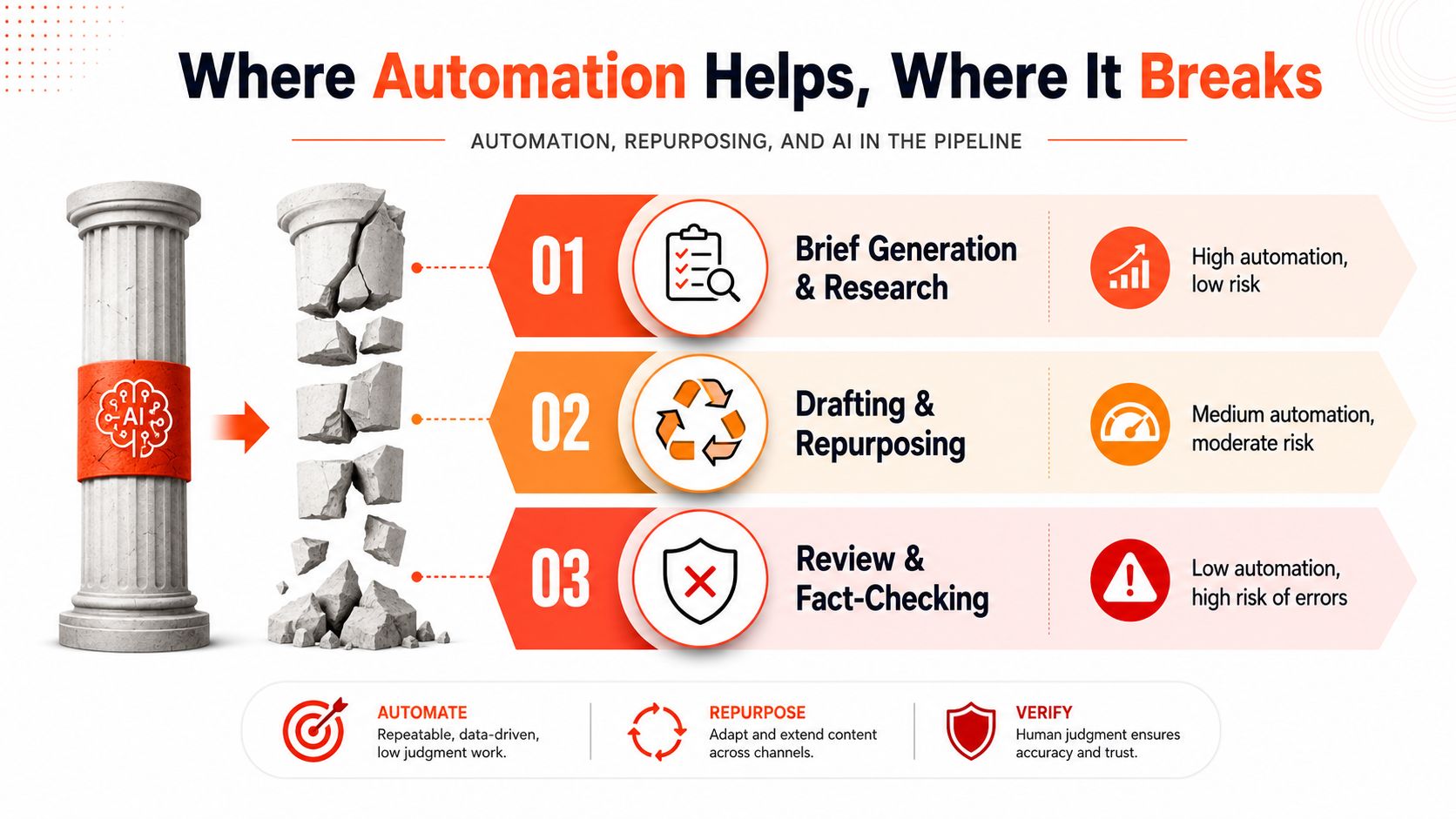
Review thresholds should change with risk. A low-risk derivative may need source matching, metadata completion, and a voice check. A new claim, product promise, or regulated recommendation needs factual review and an accountable approver before scheduling. The benchmark found that 63% of B2B marketers using AI reported at least one brand-voice or factual-accuracy incident requiring republishing or retraction during the prior 12 months. Smooth prose is not a sufficient release condition.
Use a staged rollout:
- First week: Automate brief fields, metadata suggestions, task routing, and derivative checklists.
- First month: Pilot AI-assisted drafting on low-risk formats using a fixed source library and voice rubric.
- By month three: Expand repurposing across a validated pillar, monitor cannibalization, and compare revision patterns by workflow type.
For broader use cases, teams can review AI for content marketing workflows and test one repeatable task before automating the full pipeline.
Building the Right Tech Stack Without Tool Sprawl
A scalable content stack should centralize shared truth while leaving personal work flexible. Keep the calendar, approved brief templates, brand-voice rules, source library, metadata taxonomy, and approval status in systems the whole team can access. Writers can keep scratchpads, brainstorming apps, and temporary research workspaces separate.
Evaluate every tool against a defined operating constraint. It should shorten a handoff, improve discovery, strengthen review control, or make distribution traceable. Impressive features alone do not justify another system.
Use four layers
Planning contains the editorial calendar, priorities, dependencies, and ownership. Creation supports drafting, asset development, and approved source access. Review and governance manage comments, versions, claims, brand checks, metadata, and publishing permissions. Distribution handles adaptation, scheduling, channel delivery, and performance feedback.
| Layer | Centralize (Shared) | Keep Lightweight | Evaluation Trigger |
|---|---|---|---|
| Planning | Calendar, briefs, priorities, ownership | Individual idea capture | Clearer prioritization and fewer stalled assignments |
| Creation | Source library, approved templates, reusable modules | Writer workspaces and exploratory tools | Shorter cycle time without weaker briefs |
| Review and governance | Voice rules, claims checks, metadata, approval status | Temporary annotation and drafting aids | Higher review pass rate and fewer late revisions |
| Distribution | Channel requirements, publishing status, derivative relationships | One-off experiments | Wider reach with traceable source content |
Pilot one workflow before adopting a platform. Measure cycle time, review pass rate, or distribution reach during a two-week test. If the tool produces no meaningful lift, remove it rather than expanding its footprint.
Tool sprawl creates an integration tax. Each system requires training, maintenance, attention, and reconciliation with existing records. A small stack with one trusted source of truth is easier to govern than a larger stack that makes people copy status updates across disconnected tools.
The review layer should also determine what can move automatically. Low-risk derivatives can pass through metadata and source-link checks, while new claims, product promises, and sensitive recommendations need an accountable human approver. Metadata is part of discovery, not clerical cleanup. Missing taxonomy, source relationships, or approval status can make sound content difficult to find, reuse, or audit.
Distribution connects approved content with audience contact. WaveGen.ai's content distribution system can adapt a source article, newsletter, podcast script, or YouTube transcript into channel-specific social assets. Judge the workflow by whether each derivative stays linked to its source and passes the applicable brand-voice gate, not by generation speed alone.
Quality Control and Governance as the Binding Constraint
Scaling content production depends on how many qualified decisions reviewers can make without lowering standards. The review queue becomes the operating limit when every asset receives the same level of scrutiny, regardless of its risk or source material.
Survey data shows where content teams spend their time: 65% say research and ideation take the most time, 40% cite outlining and first drafts, 37% say editing and approvals are resource-heavy, and 33% struggle with promotion and performance tracking. Another study found that 86% of enterprises use AI, but only 29% report moderate or fast progress scaling it. Adoption is moving faster than operating maturity. (AirOps' state of content teams report)
Set review thresholds before production expands
A tiered model keeps senior reviewers focused on decisions that require judgment:
- Tier 1, automated checks: Validate required fields, metadata completeness, links, formatting, source tags, and prohibited terms. Passing assets can proceed without manual inspection of every mechanical detail.
- Tier 2, single reviewer: Use for derivatives built from approved briefs and source material. The reviewer checks meaning, voice, intent match, and channel suitability.
- Tier 3, full editorial review: Apply to cornerstone content, new subject areas, material with significant AI drafting, and claims requiring careful evidence review.
- Tier 4, multi-stakeholder approval: Reserve for regulated, legally sensitive, financial, medical, security, or otherwise high-stakes content.
Every gate needs a minimum metadata package. Record the intended audience, search or business intent, source status for factual claims, content type, parent or pillar relationship, canonical purpose, internal-link targets, owner, reviewer, and update condition. Add a tone assessment, originality check, fact-source tagging, and intent match to the review record.
Governance isn't bureaucracy added after creativity. It's the mechanism that tells the team where speed is safe.
A concrete routing change can remove a severe bottleneck. Suppose a team stalls at 40 pieces a month because one senior editor reviews everything. Classify the queue, move metadata and format checks into Tier 1, send validated derivatives to Tier 2, and reserve the senior editor's time for Tier 3 and Tier 4 work. If the redesigned system reaches 120 pieces without quality drift, the gain comes from routing and risk allocation. Identical scrutiny for every asset would only preserve the queue.
Discovery also belongs inside governance. Weak structure, missing relationships, unclear authorship, or inconsistent terminology can leave published pages difficult for search engines, internal teams, and AI-enabled discovery systems to interpret. This brand voice guidelines template can help formalize language rules. Connect those rules to approval fields, reviewer ownership, and exception handling so brand voice remains a tested gate rather than a document people consult inconsistently.
Measuring, Iterating, and Rolling Out in 90 Days
A scaled operation earns the right to grow when its review data, discovery signals, and business outcomes improve together. Weekly reporting should expose operational health, monthly reporting should show business movement, and quarterly analysis should test whether the portfolio still deserves its current shape.
Track weekly inputs such as pieces shipped, cycle time, revision rounds, review-tier distribution, derivative completion, metadata defects, and brand-voice exceptions. Review monthly outcomes such as organic sessions, qualified pipeline contribution, assisted conversions, and branded search movement. At portfolio level, inspect topic gaps, cannibalization, reuse relationships, findability, and return by content type.
A practical 30-60-90 rollout
Days 1 to 30 are for baseline and instrumentation. Document the workflow from idea through distribution. Record where briefs wait, where reviewers intervene, which metadata fields are missing, how often published pieces receive updates, and which brand-voice rules create exceptions. Establish approval tiers and connect analytics to each content record before changing production targets.
Days 31 to 60 are for a controlled pilot. Choose one content pillar and run the complete system against it. Use approved source material, structured briefs, AI-assisted repurposing where risk is low, and the full review model. Compare throughput with revision quality, metadata accuracy, discoverability, and reviewer workload. A faster queue that creates more rework is not a successful pilot.
Days 61 to 90 are for expansion and lock-in. Extend the workflow to three pillars, audit a sample of 50 pieces, and document recurring failure patterns. Lock the calendar cadence only after the review team can sustain it and distribution owners can trace derivatives back to their source. Keep the exceptions visible, because hidden exceptions become the next bottleneck.
Run a 45-minute weekly standup around a throughput-quality scatterplot. Each point should represent a content batch or asset group, with production speed on one axis and quality or revision burden on the other. Hold a monthly KPI review for outcome movement, then conduct a quarterly architecture reset to retire weak formats, repair taxonomy, and reallocate review capacity.
The decision rule is simple. Increase output when qualified pipeline, discoverability, metadata quality, and review performance move together. Hold the target when output rises but the review queue, revision rounds, brand-voice exceptions, or metadata defects rise faster. Pull back when production grows without meaningful business or audience movement. Scaling is proven when the system produces more useful, findable, trusted content without exhausting the people responsible for its quality.
WaveGen.ai helps teams turn approved long-form content into on-brand social assets, including carousels, captions, short videos, and platform-specific formats, while keeping distribution connected to the source idea. Visit WaveGen.ai to see how you can add a governed repurposing layer to your content production workflow.
scaling content production
content operations
content workflow
AI content
content team
Turn this kind of writing into a week of social content.
Paste a blog post, newsletter, or rough draft — WaveGen turns it into publish-ready carousels, captions, and slideshows for every channel.
No credit card · First posts in 2min