September 8, 2026
14 min read
Marketing for Dummies: A Practical Beginner Guide
Marketing for Dummies made simple — learn core concepts, channels, KPIs, and a 30-day plan beginners can run this week to grow any business.
The most popular beginner marketing advice starts in the wrong place. It tells you to learn algorithms, copy viral hooks, open several social accounts, and build an ad campaign before you can explain who you're helping, what problem you solve, or how you'll know whether the effort worked.
Marketing isn't a bag of channels and posting tricks. It's a disciplined process of putting the right offer in front of the right person at the right time, then measuring what happens. The channel matters, but it comes after the audience, promise, and outcome.
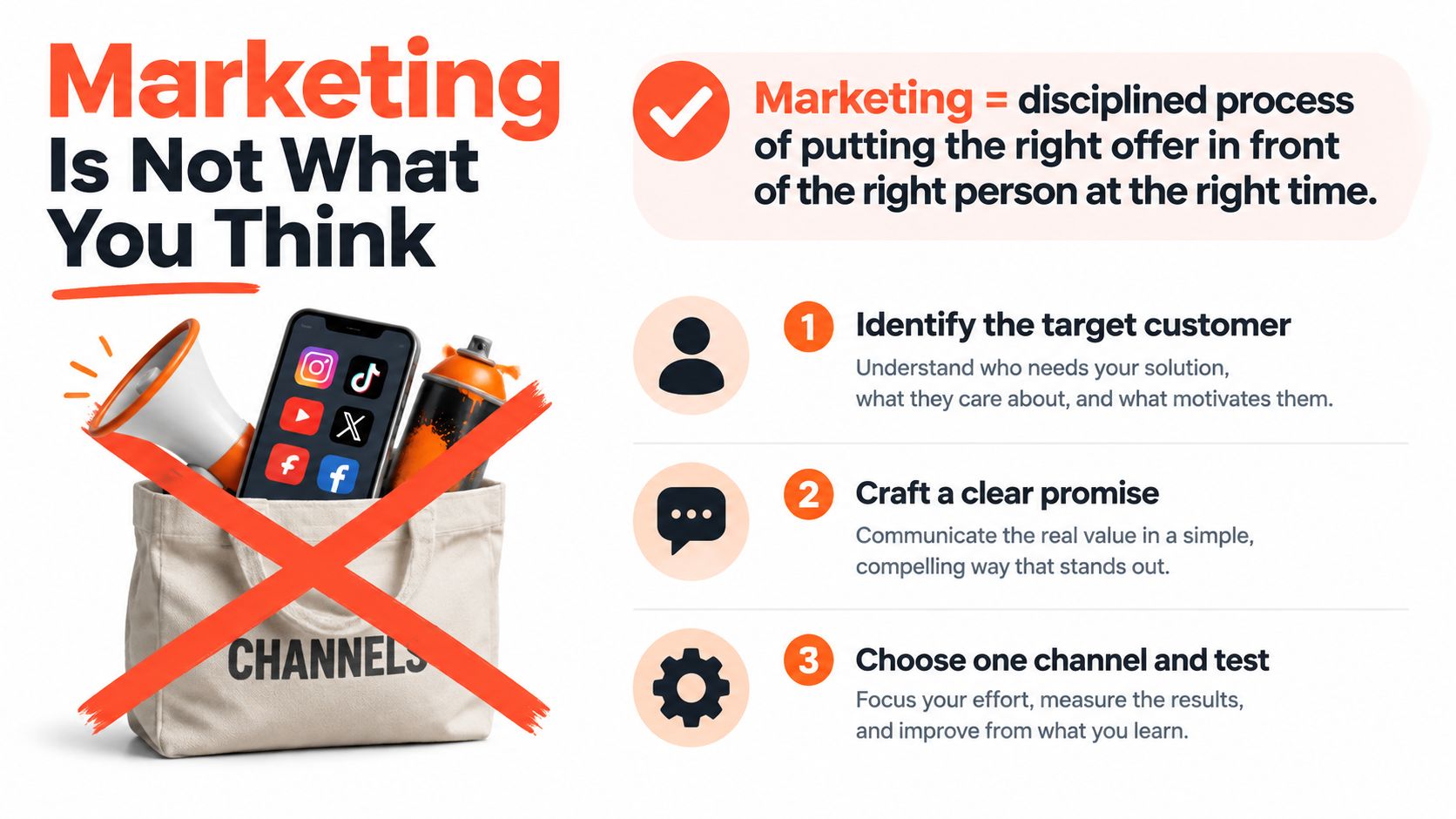
Table of Contents
- What Marketing Actually Is and Why Beginners Get It Wrong
- The Core Concepts Every Beginner Needs First
- Choosing the Right Channels for Your First Push
- Mapping the Buyer Journey Without Overcomplicating It
- The Five KPIs Beginners Should Track on Day One
- How Repurposing and Distribution Turn Content Into Reach
- Your 30-Day Starter Marketing Plan
- Closing Habits That Turn a Beginner Into a Marketer
What Marketing Actually Is and Why Beginners Get It Wrong
Marketing became a formal business discipline only recently. Histories commonly place the transition from simple trade and mass production to organized marketing in the late 19th and early 20th centuries, after the Industrial Revolution created the scale that made modern promotion and distribution necessary. The field then moved through recognizable production, sales, and marketing eras before digital channels expanded measurable search and display activity. This history of marketing helps explain why segmentation, positioning, consistency, and channel choice remain foundational.
Beginners often confuse marketing activity with business progress. They see a competitor posting every day and assume the posting schedule caused the sales. They copy the visible tactic without seeing the offer, audience research, pricing, sales process, or economics underneath it.
Three mistakes appear repeatedly:
- Tactics before positioning: You choose Instagram, SEO, or paid ads before deciding what you want to be known for.
- Competitor imitation without context: You copy a playbook without knowing whether it suits your margins, sales cycle, audience, or resources.
- Activity mistaken for outcome: You celebrate posts published, impressions earned, or followers gained without checking inquiries, qualified leads, purchases, or profit.
Practical rule: Before choosing a platform, write one sentence that names your audience, their problem, and the useful result you provide.
A beginner usually needs only three decisions at the start. Define one clear audience, express one focused message, and select one outcome to track. That outcome might be a qualified inquiry, a completed purchase, a booked consultation, or an email signup, depending on the business.
The historical shift toward customer-centered marketing matters because reach alone has never been the whole job. Distribution gets attention, but positioning gives attention a reason to become action. This guide follows that order, so you'll learn measurement and strategy before spending time on channel mechanics.
The Core Concepts Every Beginner Needs First
A shopkeeper can teach you most of the vocabulary in a beginner marketing guide. Product is what sits on the shelf. Price is the tag. Place is the aisle, street, or storefront where shoppers find it. Promotion is the sign in the window, the conversation with the customer, and the flyer that brings people inside.
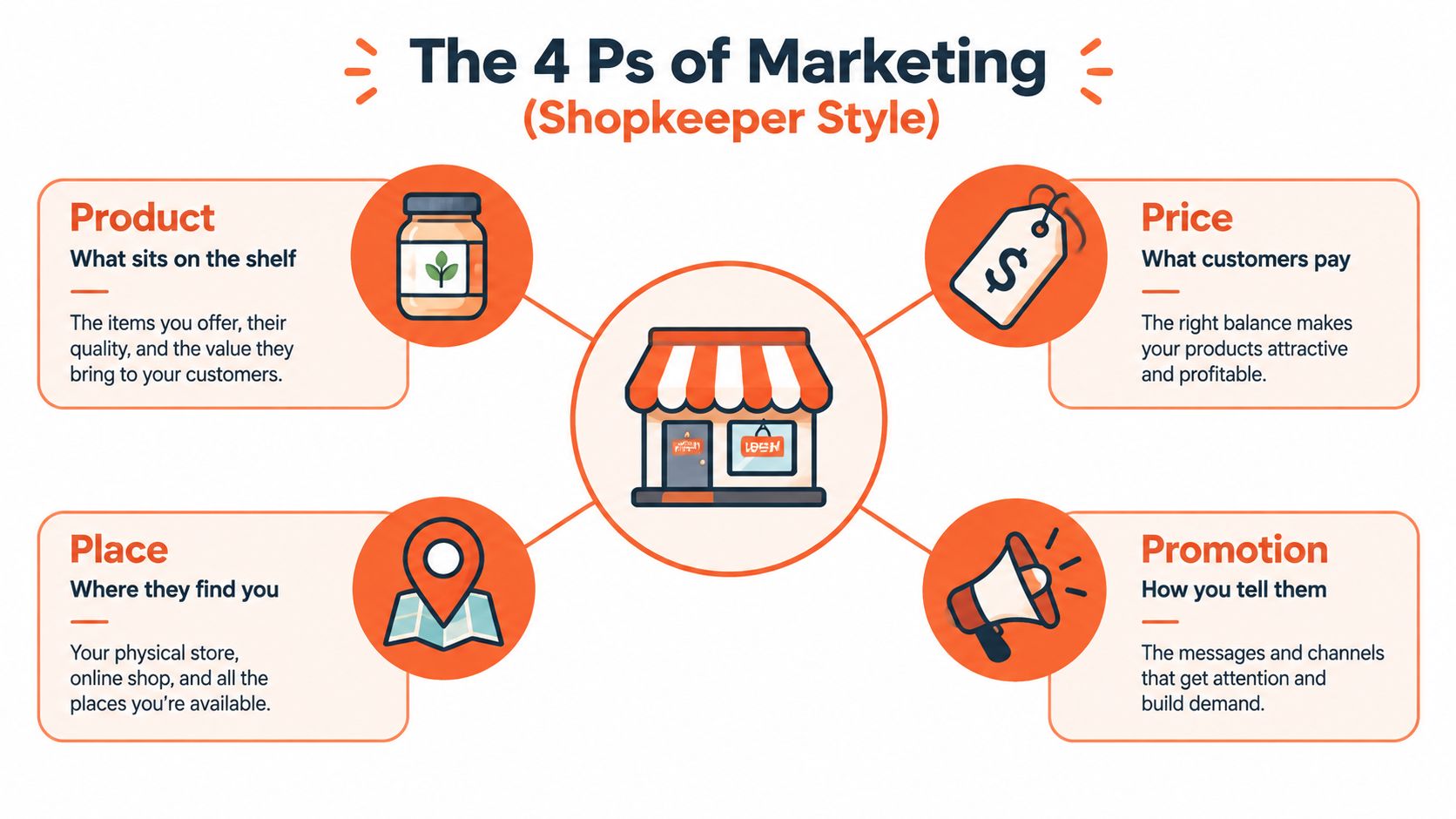
The four Ps work as a system, not as four unrelated boxes. A strong product can struggle if customers can't find it. A visible offer can fail if the price doesn't make sense. A well-priced service can still attract the wrong people if the message is vague.
The customer decisions behind the vocabulary
Segmentation means deciding which shoppers you're inviting into the store. You might serve new parents, independent consultants, or finance teams at growing companies. The narrower choice gives your message something specific to say.
Positioning is the sentence a customer could repeat to a friend. It answers, “What is this, who is it for, and why should I consider it?” Differentiation supplies the reason to choose your shelf over the one next door. That reason could involve specialization, convenience, proof, service, design, or a distinct method.
The buyer journey adds time to the picture. A person who has never heard of you needs a different message from someone comparing your offer with alternatives. Someone ready to buy needs a clear next step, not another broad educational essay.
B2B and B2C don't use identical logic
In B2C marketing, one person may discover, evaluate, and purchase an offer. Emotion, convenience, identity, and immediate usefulness often influence the decision.
In B2B marketing, several people may shape the purchase. A user cares about usability, a manager cares about results and risk, and a finance stakeholder cares about the commercial case. The same offer needs evidence that works for each role.
Targeting, personas, and an ideal customer profile, or ICP, are three lenses on the same choice. Targeting selects the market, a persona describes a representative buyer, and an ICP defines the type of organization or customer most likely to benefit and buy.
Before choosing a channel, ask yourself: Which specific person has the problem, what promise would make sense to them, and what action should they take next?
Choosing the Right Channels for Your First Push
Every channel solves a different beginner problem. SEO helps people discover answers through search, but it compounds slowly and requires useful content. Organic social can create conversation and reach, but it demands a sustainable publishing rhythm. Email builds a direct relationship after you have permission and a list.
Paid ads provide fast feedback on an offer and audience, but weak positioning can turn that speed into wasted spend. Content marketing supplies the raw material for search, email, social, and sales conversations. If you're exploring visual storytelling, a curated resource on motion graphics companies can help you understand the production environment before commissioning creative work.
| Channel | Cost to Start | Time to First Result | Best Beginner Goal | Main Risk |
|---|---|---|---|---|
| SEO | Time and content effort | Usually gradual | Build discoverability | Expecting immediate traffic |
| Organic social | Time and creative effort | Can be relatively quick | Test messages and start conversations | Posting without a system |
| List-building and platform effort | Depends on list quality | Nurture interest and repeat contact | Sending without permission or value | |
| Paid ads | Budget plus creative effort | Fast signal | Test demand and offers | Paying to amplify a weak offer |
| Content marketing | Time and subject expertise | Gradual but reusable | Answer buyer questions | Creating without distribution |
A useful first choice depends on your constraint. If you have expertise but little budget, start with content and one organic channel. If you already have a permission-based list, email may be the clearest first test. If your offer is proven and you can absorb the learning cost, paid media can provide faster feedback.
Avoid broad paid campaigns before you have a clear offer and conversion path. Also avoid opening every platform at once. A beginner usually needs one primary channel and one supporting channel, not a complicated stack that produces inconsistent work everywhere.
Channel fit beats channel fashion. A consultant may use search content to capture a defined question and email to continue the relationship. A visual studio may use social content to demonstrate its work and a landing page to collect inquiries. Choose the route that matches how your audience discovers, evaluates, and buys.
Mapping the Buyer Journey Without Overcomplicating It
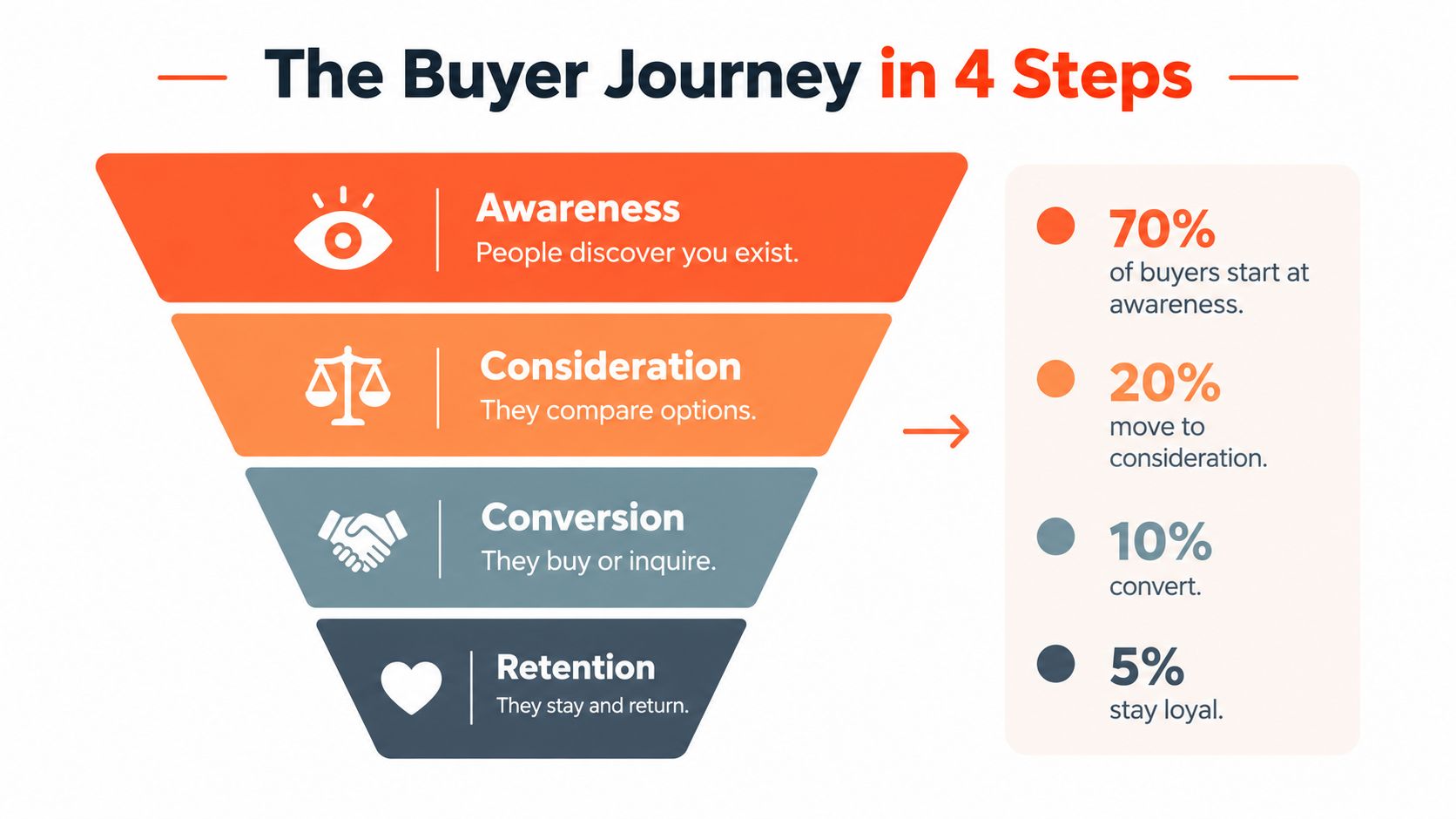
Funnels become confusing when marketers fill every stage with too many tactics. You can make the model useful by assigning one action and one metric to each stage.
Awareness
At awareness, people discover that your business exists. Publish one helpful search-focused article or educational social post that answers a real question, then track search impressions or the equivalent discovery signal available on your platform.
Don't judge this stage by sales alone. A person can't inquire about an offer they haven't encountered, so the first job is to make the problem and your relevance visible.
Consideration
At consideration, the buyer compares options. Give them something that reduces uncertainty, such as a comparison guide, practical checklist, sample process, or detailed explanation of what your service includes.
Track email opt-ins if the resource leads to a permission-based list. An opt-in shows stronger interest than a passive view because the person has agreed to hear from you again.
Conversion
Conversion is the moment when the buyer buys or makes an inquiry. Add one clear call to action to the relevant page, email, or post, then track form completions or sales.
Your call to action should name the next step. “Book a consultation,” “Request a sample,” and “Start an evaluation” are clearer than a vague “Learn more.”
Retention
Retention begins after the first transaction or inquiry. Send a useful follow-up sequence, provide onboarding guidance, or ask for feedback at an appropriate moment. Track repeat purchases or referrals.
A simple funnel is more useful than a complete funnel you never review.
You don't need six deliverables at each stage. One awareness asset, one consideration resource, one conversion path, and one retention follow-up create a workable starting system. The important discipline is to connect each action to the stage it serves, rather than treating every view or click as evidence of purchase intent.
The Five KPIs Beginners Should Track on Day One
Start with five numbers, not a dashboard full of distractions. HubSpot's 2026 marketing statistics page identifies lead quality or MQLs, lead-to-customer conversion rate, ROI, CAC, and lead volume among the metrics marketers prioritize, with reported figures of 39%, 34%, 31%, 30%, and 29% respectively. HubSpot's marketing statistics provide the context for putting measurement choices ahead of channel collecting.
The five-number baseline
| KPI | What It Measures | Formula | Beginner Mistake It Fixes |
|---|---|---|---|
| Lead quality | Whether prospects match your buyer profile | Qualified leads ÷ total leads | Chasing every inquiry |
| Conversion rate | How often prospects take the desired action | Conversions ÷ relevant prospects | Confusing interest with action |
| Marketing ROI | Return attributed to marketing investment | Attributed revenue ÷ marketing spend | Treating spend as success |
| CAC | Acquisition cost for each new customer | Acquisition spend ÷ new customers | Ignoring efficiency |
| Lead volume | New leads entering the pipeline | Count qualified new leads | Assuming visibility equals demand |
Lead quality comes first because ten poor-fit inquiries can create more work than one relevant opportunity. A lead should match the audience you selected, have a problem you can solve, and show a plausible path to buying.
Use a simple spreadsheet. Record the date, source, lead quality, conversion status, spend, and resulting revenue when available. During the first week, your job is to establish a baseline, not to optimize every cell.
Followers, page views, and open rates can help diagnose distribution later. They don't tell you whether the business is improving unless you connect them to a meaningful action. For a broader framework on how to map KPIs to campaign objectives, keep the campaign goal visible beside the metric.
If conversion mechanics need attention, use this conversion rate improvement guide as a separate reference. The essential question remains simple: Are the same efforts producing better-qualified demand or more customers over time?
How Repurposing and Distribution Turn Content Into Reach
A single article shouldn't have a single life. Treat one substantial piece as a source document that can answer several audience questions across the places where your buyers already pay attention.
A practical workflow looks like this:
- Create the pillar: Write a detailed article, record a webinar, publish a newsletter, or produce a podcast episode.
- Extract the teaching points: Pull out the strongest lessons, examples, objections, and practical steps.
- Adapt the formats: Turn those points into short social posts, a thread, a carousel, an email teaser, a short video script, a quote graphic, and a podcast talking point.
- Match the platform: Keep the idea consistent, but adjust length, opening, visual treatment, and call to action for each audience.
- Schedule and review: Publish at a controlled cadence, then record which assets create qualified responses.
Format matters more than raw output. Cross-platform benchmark data reported by Socialinsider's social media posting frequency analysis shows native LinkedIn documents averaging 6.90% engagement, compared with 5.00% for images, while Instagram carousels can outperform Reels even when Reels appear more frequently. The lesson is strategic, not mechanical. Choose the format that gives the idea room to be understood and acted upon.
One large dataset of more than 25,000 social profiles found engagement rates peak around one to two posts per week, while another analysis reported reach per post increases of about 12% at three to five posts per week, 18% at six to nine, and 24% at ten or more, compared with one to two posts weekly. The frequency analysis from ZoomSphere supports a controlled cadence rather than unlimited publishing.
A business coach might turn one webinar into a teaching article, several LinkedIn lessons, a carousel, a short video script, and an email invitation. A financial advisor might turn one client letter into an educational email sequence and a set of social cards. Neither needs a new idea every morning. They need a checklist that extracts and adapts the useful parts.
Tools can reduce the manual work between source content and distribution. WaveGen.ai turns an article, newsletter, blog post, podcast script, or YouTube transcript into platform-ready social posts, captions, carousels, quote cards, and short video scripts, with brand settings for consistent formatting. For additional planning ideas, see this guide to growing your channel with repurposing and this overview of content distribution channels.
Your 30-Day Starter Marketing Plan
A beginner plan should fit around existing work. Give each week one deliverable, one review point, and a time limit that prevents marketing from becoming an endless research project.
Week 1 focuses on positioning
Choose one audience, one problem, and one promise. Put them in a short messaging document with a plain-language description of the buyer, the situation they face, the result you provide, and the next action you want them to take.
Review point: read the promise aloud and remove any phrase a customer wouldn't use. Deliverable: one usable message. Keep the work under five hours.
Week 2 creates one pillar
Select the audience's most important question and answer it fully in one article, video, or podcast episode. Include examples, objections, and a clear next step rather than trying to cover your entire industry.
Review point: ask whether the piece would help someone make a decision. Deliverable: one published source asset.
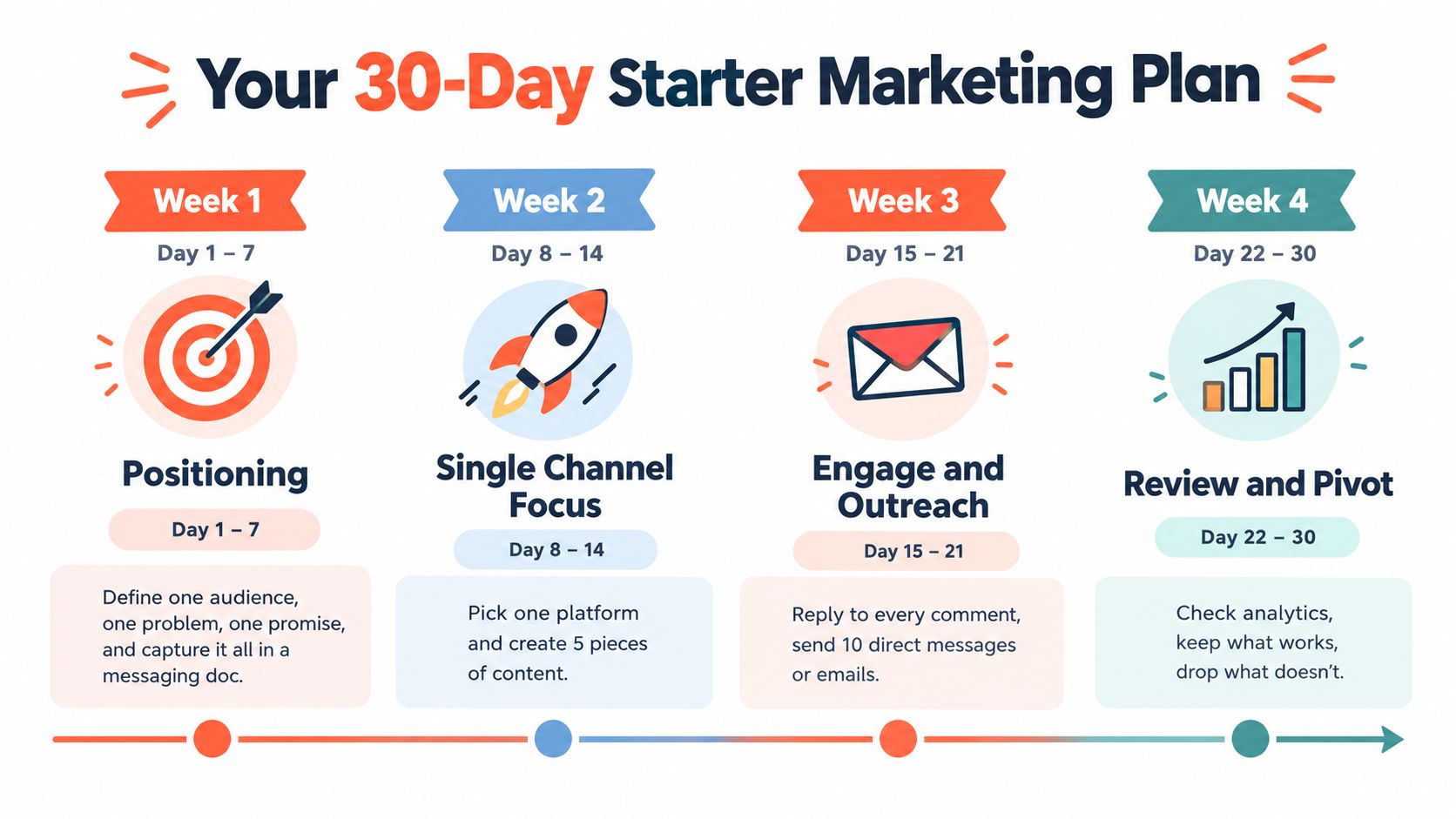
Week 3 distributes the idea
Turn the pillar into a LinkedIn carousel, three short-form video scripts, an email newsletter, and a community post. Use a scheduling workflow, such as the one described in this guide to what is a content calendar, so publishing doesn't depend on remembering each task manually.
Review point: check whether every derivative preserves the original promise while fitting its platform. Deliverable: one week of scheduled distribution.
Week 4 closes the loop
Track lead quality and cost per lead in a simple spreadsheet. Note the source, whether the lead fits your profile, and the effort or spend required to generate it.
Review point: decide whether to repeat, refine, or pivot. Deliverable: one written decision based on observed evidence. Keep the review focused. A small, reliable record will teach you more than a large analytics setup you don't trust.
Closing Habits That Turn a Beginner Into a Marketer
Three habits separate temporary activity from durable practice.
Measure consistently. Set aside a short Friday review and inspect the same core numbers each time. Look for changes in lead quality, conversion, acquisition cost, or volume before you make a new tactical decision. Without a baseline, you can't tell whether a new channel helped or merely created more work.
Use a controlled cadence. Publish one substantial source piece and derive useful assets from it instead of creating disconnected posts in sporadic bursts. The frequency evidence discussed earlier points to a nonlinear relationship between posting and engagement, so more output isn't automatically better. A schedule you can maintain protects both quality and audience attention.
Build an owned audience with privacy in mind. Social platforms rent you access to attention, and their rules can change. An email list built with clear permission, useful subscriber choices, and responsible first-party data practices gives you a more dependable relationship. Clutch reports that 87% of marketers prioritized first-party data in 2025, while 58% still relied on third-party data, and 40% ranked marketing mix modeling as a top investment priority in its industry reporting. Clutch's state of digital marketing research describes the broader move toward owned data and privacy-aware measurement.
Don't wait for perfect tracking. Record what you can verify, explain your assumptions, and improve the quality of the evidence over time.
Tomorrow morning, write down the one number you'll check every Friday for the next twelve weeks and the one audience you'll serve first. That small commitment turns marketing for dummies from a reading topic into a repeatable operating habit.
WaveGen.ai turns one article, newsletter, podcast script, or transcript into on-brand social posts, carousels, quote cards, captions, and short video scripts, helping you maintain a measured distribution cadence without creating every asset from scratch. Visit WaveGen.ai to see how your first pillar piece can become a practical week of marketing output.
marketing for dummies
marketing basics
marketing strategy
beginner marketing
marketing plan
Turn this kind of writing into a week of social content.
Paste a blog post, newsletter, or rough draft — WaveGen turns it into publish-ready carousels, captions, and slideshows for every channel.
No credit card · First posts in 2min