July 2, 2026
14 min read
Content Distribution Platform: A 2026 Guide for Marketers
Discover what a content distribution platform is and how to choose one. This guide explains workflows, benefits, and metrics for marketers and agencies in 2026.
You already have content.
A blog post went out last week. The newsletter was thoughtful. The podcast episode was solid. Maybe you even clipped one quote for LinkedIn, posted it once, and moved on. Then everything disappeared into the same quiet archive where good work gets buried after a single publish.
That's the core problem for most consultants, coaches, small marketing teams, and agencies. Content creation usually isn't the bottleneck anymore. Distribution is. Not because people don't know they should promote their work, but because turning one strong article or video into a steady stream of native social content takes time, judgment, design work, scheduling, and consistency.
A modern content distribution platform exists to solve that gap. Not in the abstract enterprise sense. In the practical, day-to-day sense of taking the long-form content you already publish and making sure it keeps working across LinkedIn, Instagram, TikTok, YouTube, Facebook, email, and your site without requiring a full in-house team.
Table of Contents
- Why Great Content Fails Without Great Distribution
- Defining the Modern Content Distribution Platform
- How These Platforms Actually Work
- Unlocking Time Savings and Wider Reach
- How to Choose the Right Content Distribution Platform
- Solving Distribution Pain Points with WaveGen.ai
- Common Questions About Content Distribution
Why Great Content Fails Without Great Distribution
Most content doesn't fail because it's bad. It fails because nobody built a repeatable path from the original asset to the channels where attention happens.
A consultant writes a strong article answering a client question. It gets published on the website, dropped into a newsletter, and shared once on LinkedIn. A week later, that same article still contains useful ideas, but it's effectively dead. No carousel. No short video. No quote graphics. No follow-up posts framed for different buyer concerns. The content was created once, then treated like it had only one possible use.
That pattern is common enough that it now supports a large software category. The global content distribution software market reached $20.61 billion in 2025 and is projected to reach $28.85 billion by 2030, driven by the need to manage and amplify content across paid, earned, shared, and owned channels, according to The Business Research Company's content distribution software market report.
The content graveyard problem
The waste usually looks ordinary:
- Blog posts get one launch cycle and never come back in another format.
- Webinars stay long-form even when the best parts would work as clips or carousels.
- Newsletters hold strong opinions that could become a week of social posts but never leave the inbox.
- Founders and advisors keep rewriting the same ideas because nobody turned the old material into reusable assets.
A content distribution platform gives you a system for that second life.
Practical rule: If a piece of long-form content can only be posted once, it was never fully distributed.
That's why smart teams stop treating distribution as the last task after publishing. They build it into the content process from the start. If you need a strategic model for that shift, this content distribution playbook is a useful reference because it frames distribution as an operating system, not a posting checklist.
Defining the Modern Content Distribution Platform
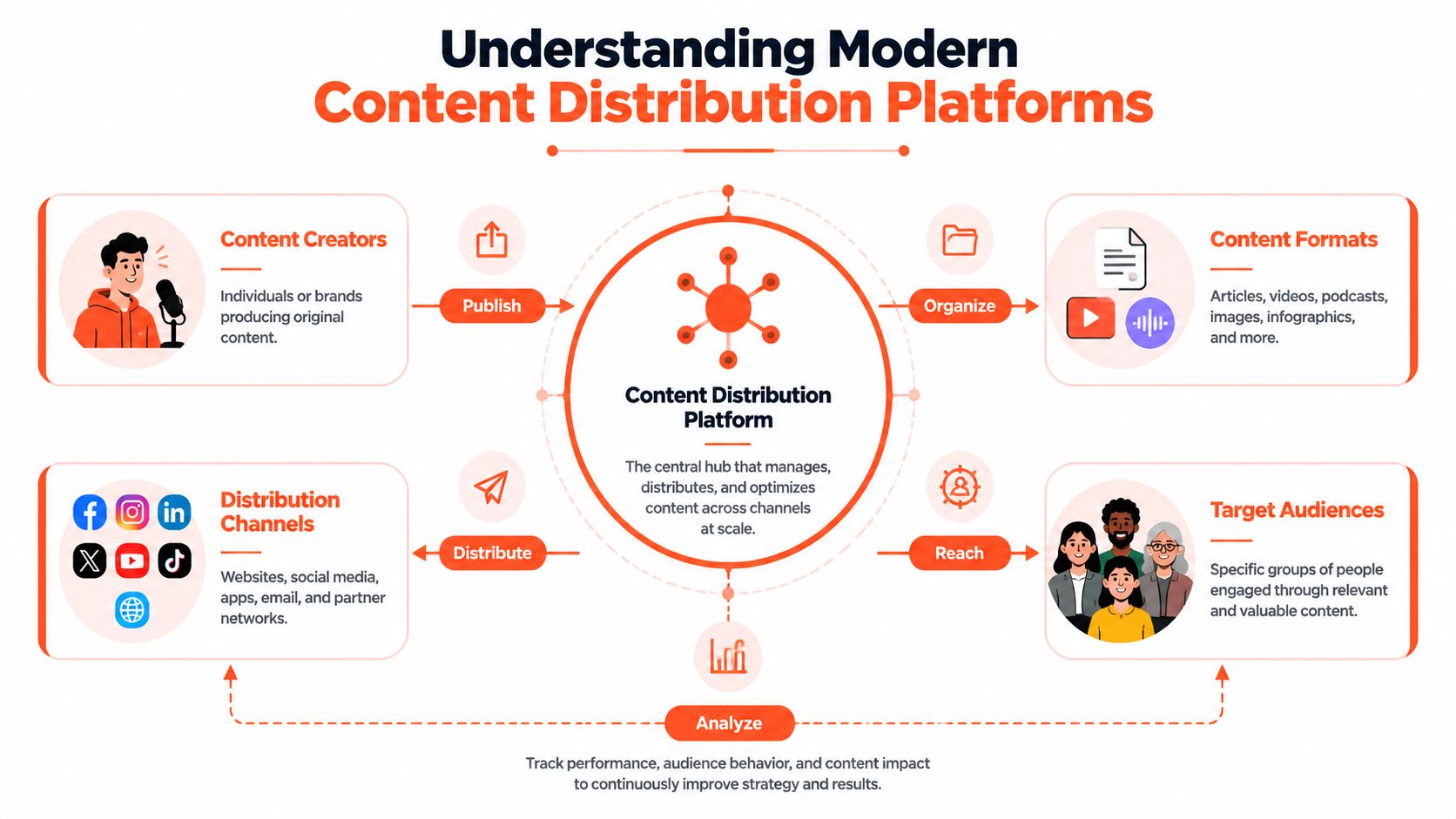
A content distribution platform is best understood as a logistics network for your ideas.
A basic social scheduler is like a delivery truck. You load a finished post into it, pick a time, and send it out. Useful, but limited. A real content distribution platform does more. It helps ingest source material, transform it into multiple native formats, organize assets, route them across channels, and measure what happened after publishing.
More than a scheduler
The specialized content distribution platform market is projected to reach USD 1.72 billion by 2030 at a 17.5% CAGR, reflecting strong demand for omnichannel campaign management and more precise audience targeting, according to Maximize Market Research on the content distribution platform market.
That demand exists because modern distribution sits across the PESO Model©, a framework created by Gini Dietrich:
- Paid means promoted placements and ads.
- Earned means coverage, mentions, shares, and third-party pickup.
- Shared means social platforms and communities.
- Owned means channels you control, like your site, blog, and email.
A true platform works across those lanes. It doesn't only queue posts. It connects the source asset to multiple destination formats and gives you one operating layer to manage the campaign.
Good distribution software doesn't ask, “When should we post this?” It asks, “How many useful assets can we extract from this source, and where should each one go?”
That's especially relevant for small teams trying to repurpose long-form content. If you want a practical model for turning one core asset into platform-specific outputs, this AI framework for content repurposing shows the kind of workflow you should expect from the category.
What belongs inside the platform
For consultants and SMB teams, the most useful capabilities usually fall into a short list:
| Capability | Why it matters |
|---|---|
| Source ingestion | Pulls from articles, newsletters, transcripts, or scripts so you don't start from scratch |
| Repurposing | Converts one long-form asset into short-form posts, clips, quote cards, or carousels |
| Brand control | Keeps fonts, colors, logos, and tone consistent without manual redesign |
| Native publishing | Adapts content to the requirements of each platform instead of cross-posting the same format everywhere |
| Reporting | Lets you review output and channel response in one place |
What it isn't is a CDN, a DAM, or a general storage layer. Those tools solve different problems. A CDN delivers content faster. A DAM stores and governs assets. A content distribution platform actively moves ideas into market-ready formats and publishes them where your audience spends time.
How These Platforms Actually Work
The easiest way to understand the workflow is to follow one asset.
Say you publish a newsletter about a client problem you see every week. On its own, that newsletter is one asset. Inside a content distribution platform, it becomes raw material for an entire distribution cycle.
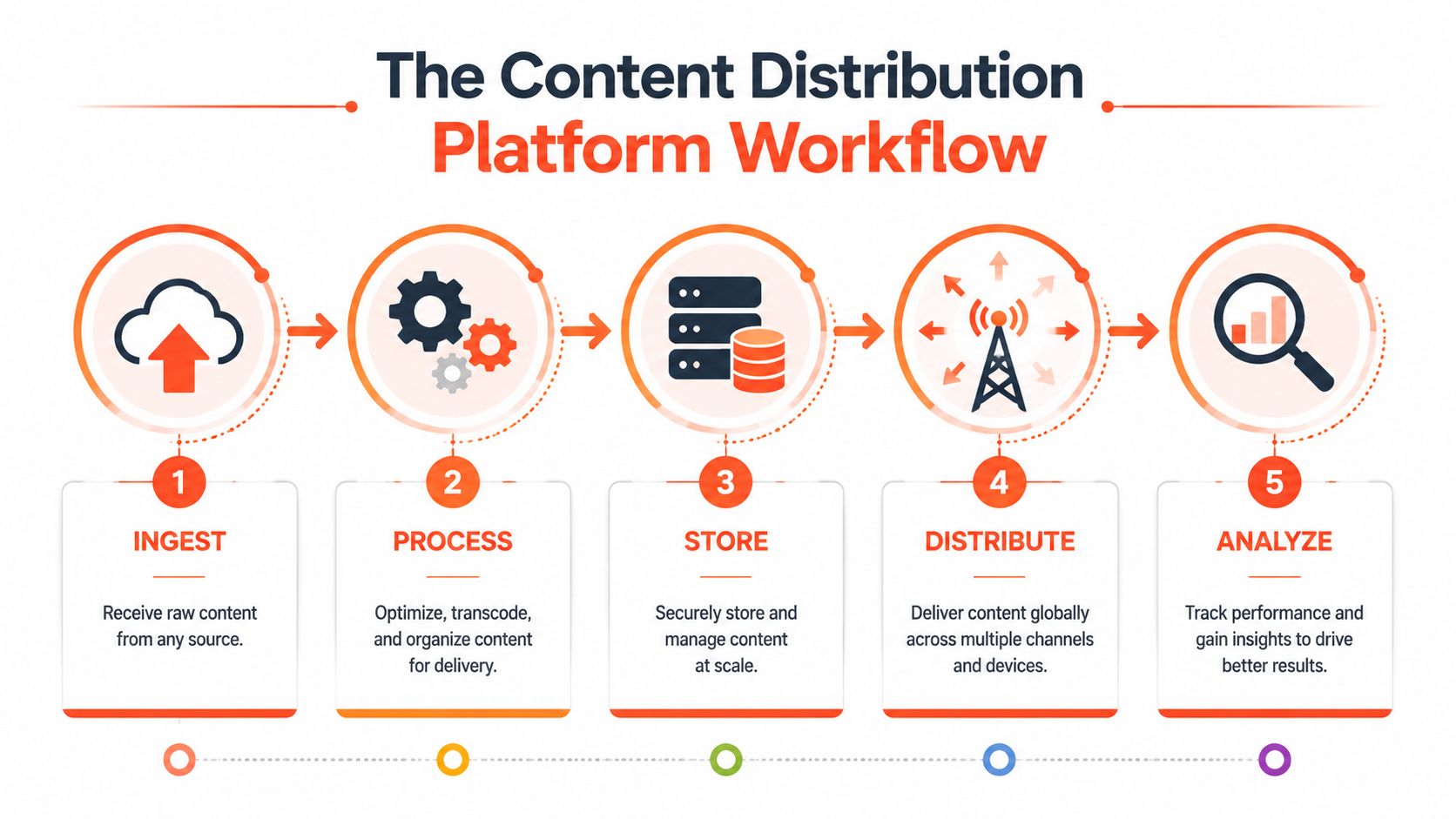
A good workflow usually starts with the source, not the post.
The daily workflow in practice
- Ingest the source content
The platform connects to a blog post, Google Doc, podcast transcript, YouTube transcript, newsletter draft, or RSS feed, as most smaller teams already create long-form content elsewhere. The platform shouldn't force a new publishing habit just to make distribution possible.
- Repurpose into native assets
Its primary strength lies in this. The system identifies usable angles, pull quotes, short arguments, hooks, and visual moments. It turns those into assets that fit each channel, such as a LinkedIn text post, an Instagram carousel, a quote card, or a short-form script.
Apply brand rules
Instead of redesigning every social asset manually, you lock in a brand kit once. Colors, font choices, logos, visual style, and tone guidelines stay attached to the output.
Schedule by channel
Different posts serve different jobs. Some introduce a problem. Some point back to the original article. Some isolate a strong quote. Some turn one section into a short explainer. A platform should let you build a release sequence, not just a one-time blast. If your current process breaks down here, it helps to compare it against a more structured social post scheduling workflow.
After the setup, the tool handles publication and queue management. That removes a lot of the repetitive admin that usually keeps content sitting in drafts.
A quick demo makes the workflow easier to visualize:
What good execution looks like
The strongest setups don't produce more content for the sake of volume. They create a tighter system around one core idea.
That usually means:
- One source, many expressions. A podcast episode becomes clips, text posts, quote cards, and a recap email.
- Native formatting. LinkedIn wants a different structure than Instagram or TikTok.
- Editorial judgment before publish. AI can draft variations, but a human still decides what's sharp, credible, and on-brand.
- Reuse over reinvention. The goal isn't endless novelty. It's better extraction from ideas you already know are good.
Teams waste the most time when they create from blank pages too often. Distribution works better when the platform starts from proven material.
What doesn't work is dumping the same caption and image into every channel and calling it omnichannel. That's cross-posting. Distribution is adaptation.
Unlocking Time Savings and Wider Reach
The operational value of a content distribution platform shows up in very ordinary places. Not glamorous places. Draft folders, design revisions, Slack messages asking for the latest logo, duplicate assets named “final-final-v3,” and the weekly scramble to figure out what to post.
Those frictions matter because they slow down output even when the strategy is sound.
Where the time goes today
Small teams usually lose time in four spots:
- Finding reusable material from old blogs, webinars, and newsletters
- Rewriting the same idea for each channel
- Rebuilding visuals that should already follow brand standards
- Coordinating approvals and timing across multiple accounts
The advantages of content architecture become clear. Aprimo notes that implementing strategic content architecture with enterprise taxonomy and metadata can reduce content discovery time by up to 50% and increase asset reuse across teams by 35% in its overview of content architecture and operational efficiency.
Even if you're not running an enterprise team, the lesson applies. Organized source content gets reused. Messy source content gets forgotten.
What changes when distribution becomes systematic
The business impact is straightforward.
A solo consultant stops treating every week's social presence as a fresh writing project. An agency handling several brands stops rebuilding similar carousels from scratch. A small B2B team starts turning one customer-facing article into a sequence of posts instead of asking the team for more net-new ideas.
If you're exploring broader workflow changes, this guide to content creation automation is useful because it shows where generation, editing, and publishing can be connected without making the process feel robotic.
Working rule: The best time savings come from removing repeat decisions, not from removing all human review.
Reach improves for a simple reason. You stop asking one format to do every job. Your original article can educate in depth. A carousel can simplify the core framework. A short video can create familiarity. A quote card can give the audience a quick, low-friction entry point.
That mix gives the same idea more chances to be seen, understood, and remembered.
How to Choose the Right Content Distribution Platform
Most buyers make the same mistake. They compare feature lists before they compare workflows.
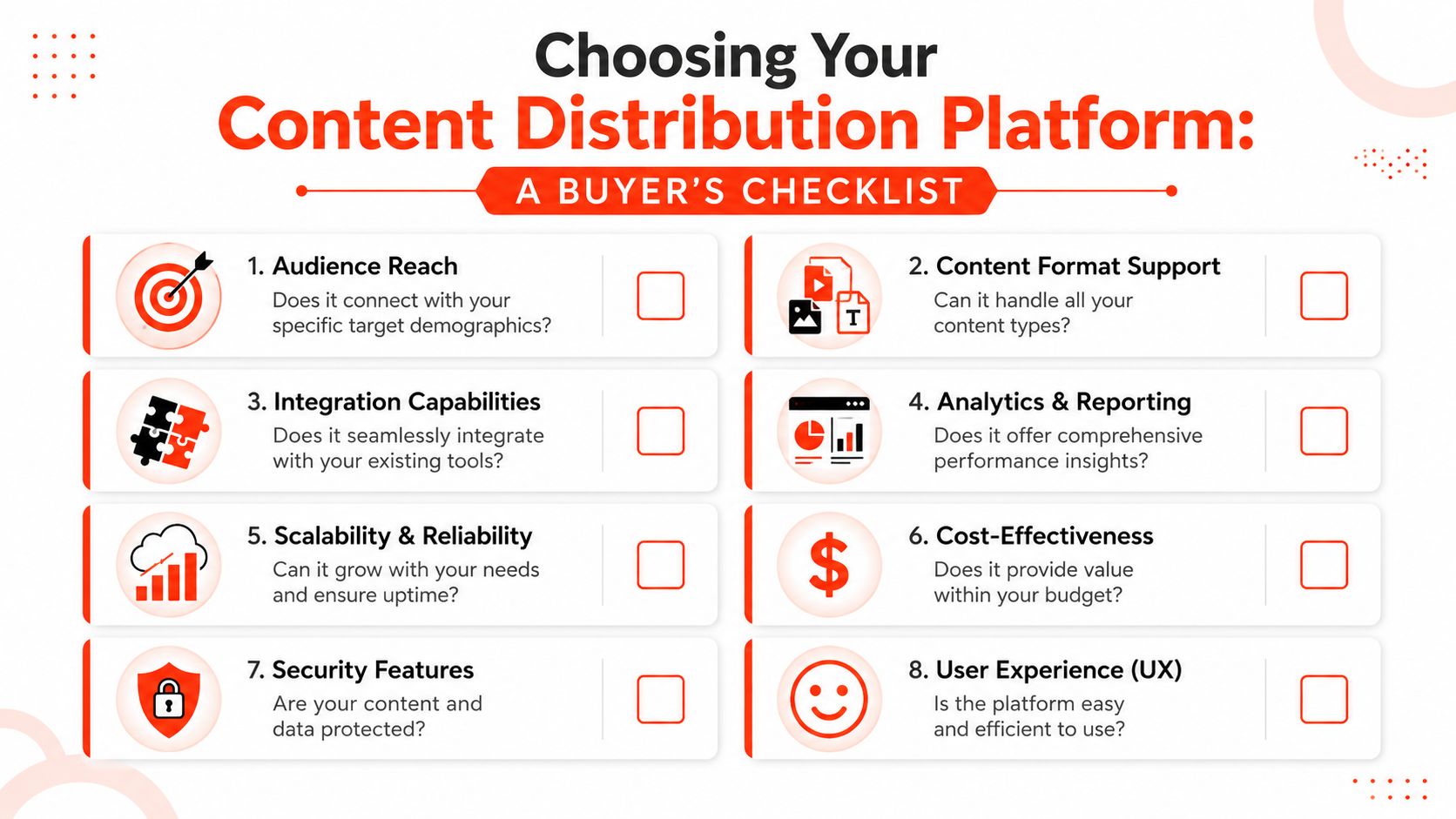
The better approach is to ask whether the platform fits the way your team already creates content. If you publish articles, newsletters, podcasts, or webinars regularly, the tool should turn those sources into distribution-ready assets without adding a pile of manual cleanup.
Questions worth asking before you buy
Ask vendors these questions directly.
Can it ingest my real source content
If your team writes in Google Docs, publishes from WordPress, records podcasts, or works from transcripts, the platform should connect to those inputs cleanly.Does it create native assets or generic rewrites
There's a big difference between a post summarizer and a repurposing engine. You want outputs that look like they belong on LinkedIn, Instagram, YouTube, or TikTok.How does brand control work
Brand kits matter more than teams expect. If every asset needs redesign or font fixes, the platform will create work instead of removing it.What publishing destinations matter most for your audience
Don't buy broad channel support you won't use. Buy the channels your audience actually pays attention to.Can a small team operate it without specialist help
The interface matters. If the workflow requires training, complicated setup, or constant troubleshooting, adoption drops.Will it support your broader creator workflow
Some teams also need external contributors or UGC support. If that's part of your model, it can help to know where to find content creators outside your internal team.
A simple scoring lens
Use a short decision table during demos:
| Question | Strong answer | Weak answer |
|---|---|---|
| Source compatibility | Pulls from your actual content systems | Requires copy-paste every time |
| Repurposing quality | Produces channel-specific assets | Produces generic summaries |
| Brand consistency | Reusable templates and kits | Manual edits on every asset |
| Scheduling | Built-in queue and approvals | Publish-only or limited planning |
| Ease of use | Fast for non-designers | Feels like enterprise software for admins |
For teams comparing category options, this roundup of social media scheduling apps is helpful because it clarifies where simple schedulers end and broader distribution workflows begin.
Solving Distribution Pain Points with WaveGen.ai
The most common gap in this category isn't publishing. It's retro-distribution.
That means going back to content you've already published, finding the strongest ideas inside it, and re-releasing them in formats people consume on social platforms now. Nielsen highlights this underserved angle in its discussion of scalable video distribution and metadata reuse, especially the need to transform legacy long-form assets into native short-form content instead of just reposting links.
Where retro-distribution matters most
This is the actual problem for consultants, coaches, newsletter writers, agencies, and subject-matter experts.
They often have a deep backlog of useful material: articles, old emails, webinar transcripts, workshop recordings, podcast scripts, client explainers. The ideas are still strong. The format is what's outdated. A long article won't perform on Instagram by itself. A webinar replay won't behave like a short clip. A thoughtful newsletter won't automatically become a carousel.
Why this workflow fits smaller teams
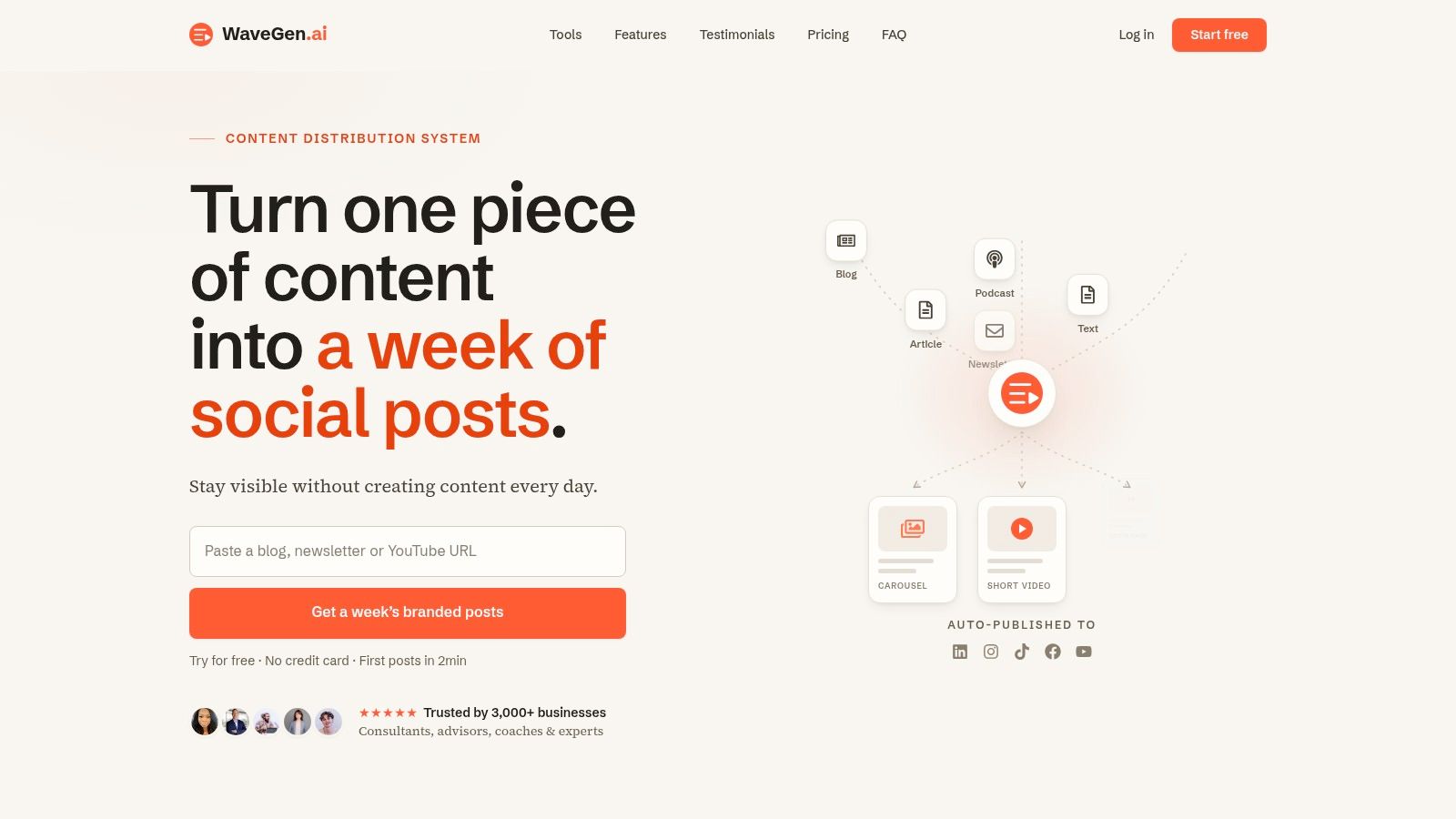
A tool like WaveGen.ai serves as a practical illustration within this category. It turns a single article, newsletter, blog post, podcast script, or YouTube transcript into platform-ready social assets such as carousels, short videos, quote cards, and captions. It also lets users set brand kits once, edit outputs in a visual editor, and publish across channels from one place.
For smaller teams, that matters less as a “software stack” story and more as a labor story. You don't need a writer, designer, video editor, and scheduler involved in every distribution cycle. You need one system that can take your source idea, reshape it into native formats, and keep the branding consistent.
What usually fails for this audience is the blank-page workflow. Every social post becomes a separate creation task. Every asset needs fresh design. Every week starts with “what should we publish?” Retro-distribution flips that. The better question becomes, “what do we already have that deserves another format?”
Old content often isn't exhausted. It's just trapped in the wrong format.
Common Questions About Content Distribution
Is this different from a social scheduler
Yes. A scheduler mainly handles timing and posting. A content distribution platform helps with transformation, packaging, and multi-format publishing. If you already have finished social posts, a scheduler may be enough. If your real challenge is turning long-form material into finished social assets, you need more than scheduling.
Can you build this yourself with automations
You can patch together a DIY system with separate tools for writing, design, storage, and publishing. Some teams do that successfully for a while. The trade-off is maintenance. Someone has to manage prompts, formatting, templates, naming conventions, approvals, and handoffs when one part breaks. That's usually where the hidden cost shows up.
How do you measure ROI without siloed analytics
This is still one of the weakest areas in most content operations. The U.S. Chamber notes that teams often struggle to connect distribution metrics like likes and shares to business outcomes like conversions or customer acquisition cost, and that few guides offer a workable cross-channel model in its overview of what a content distribution platform is.
A practical approach is to measure in layers:
- Channel response tracks saves, shares, comments, and clicks.
- Content contribution tracks which source assets keep generating traffic or leads after repurposing.
- Business outcome tracks whether distributed content contributes to inquiries, demos, subscribers, or sales conversations.
You don't need perfect attribution on day one. You do need a system where distributed content can be traced back to a source asset and reviewed across channels in one reporting habit.
If you already publish thoughtful long-form content but struggle to turn it into a consistent social presence, WaveGen.ai is built for that workflow. It helps transform articles, newsletters, transcripts, and scripts into on-brand social assets you can edit, schedule, and publish without rebuilding the same ideas by hand every week.
content distribution platform
content marketing
social media automation
content repurposing
marketing technology
Turn this kind of writing into a week of social content.
Paste a blog post, newsletter, or rough draft — WaveGen turns it into publish-ready carousels, captions, and slideshows for every channel.
No credit card · First posts in 2min