August 21, 2026
17 min read
Brand Voice Guidelines Template That Actually Scales
A practical brand voice guidelines template with fillable sections, real examples, and channel-specific rules for consistent social content across your team.
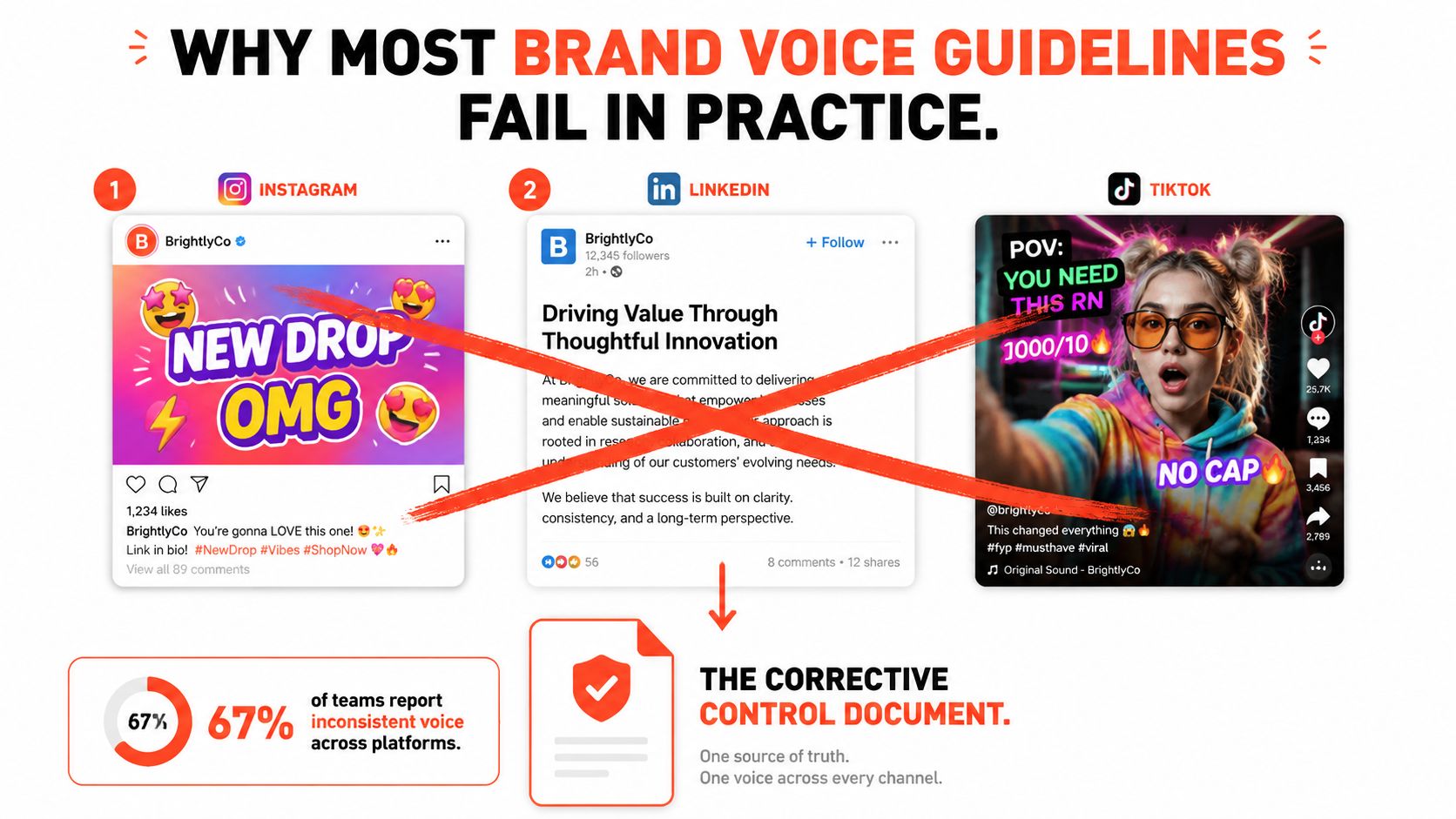
Your Instagram post is warm and playful. Your LinkedIn update sounds like it was written by a procurement department. Your TikTok account is chasing trends so aggressively that customers might assume it belongs to a different company. Meanwhile, writers, freelancers, and AI tools are each making reasonable decisions from incomplete instructions.
That's the practical problem a brand voice guidelines template must solve. It isn't a collection of flattering adjectives or a creative brief filed away after a rebrand. It's an operating document that tells people how to make consistent decisions when the format, channel, audience, and publishing team keep changing.
A consistent brand presentation across channels has been associated with revenue increases of up to 23%, with another industry summary describing the potential uplift as 23–33% (ProfileTree's overview of brand voice consistency). The template doesn't create that outcome by itself. It gives a distributed team a repeatable way to protect the consistency that makes a brand recognizable.
Table of Contents
- Why Most Brand Voice Guidelines Fail in Practice
- Core Building Blocks Every Template Must Define
- The Standard Structure of a Usable Voice Document
- Filling the Personality, Tone, and Vocabulary Sections
- Do and Do Not Sections With On-Brand Rewrites
- Adapting the Template Across Social Channels
- How Specific Your Template Actually Needs to Be
- Encoding the Template for AI and Repurposing Workflows
- Auditing Compliance and Keeping the Guide Alive
- Quick Reference Card and Common Rollout Questions
Why Most Brand Voice Guidelines Fail in Practice
A mid-sized brand can have talented people on every channel and still sound fragmented. The social manager writes Instagram captions with jokes and emojis, the demand-generation team turns LinkedIn into formal corporate commentary, and a creator adapts a TikTok trend without checking whether the humor fits the company. Each piece may perform its individual task, but the audience experiences a broken identity.
The usual cause is a guideline built around words such as authentic, bold, friendly, or professional. Those labels feel meaningful during a workshop, yet they don't tell a writer which synonym to choose, how direct a sentence should be, whether an emoji is acceptable, or how the voice changes in a support reply.
A useful guide answers those questions with working rules:
- Vocabulary controls: Preferred terms, banned terms, approved product names, and industry language to avoid.
- Channel instructions: Adjustments for social captions, sales pages, support replies, video scripts, and executive posts.
- Rewrite evidence: On-brand and off-brand examples that show the boundary more clearly than adjectives can.
- Review ownership: A named person or team responsible for resolving disagreements and updating the guide.
- Change history: A record of what changed, why it changed, and which examples now represent the standard.
The historical shift toward this kind of system has deep roots. The 1970 Unimark International brand manual by Massimo Vignelli and Bob Noorda is frequently cited among the iconic modern brand guidelines of the 1960s to 1980s, a period that helped establish the idea that a brand system should govern more than logos and color (BrandyHQ's history of iconic brand guidelines). Modern teams need to apply that same discipline to language.
For a plain-language foundation, what brand voice means should be separated from the mechanics of enforcing it. The remaining work is filling the document so another person can use it without attending the original strategy meeting.
Core Building Blocks Every Template Must Define
People often use voice, tone, personality, vocabulary, and point of view interchangeably. That creates avoidable confusion. A writer can be told to “make it warmer” when the core issue is excessive formality, or asked to “use our voice” when the team hasn't defined the approved vocabulary.
Use these definitions throughout the document:
- Brand personality: The human character the organization expresses. It might be practical, curious, calm, energetic, or candid. Personality describes who the brand seems to be.
- Voice: The stable verbal identity underneath every communication. Voice should remain recognizable even when the emotional situation changes.
- Tone: The situational mood applied to that voice. A launch can be more energetic, while a support response may need more patience and restraint.
- Vocabulary: The words the brand prefers, permits, or rejects. This includes product terminology, synonyms, jargon, inclusive language, and phrases that sound unlike the organization.
- Point of view: The grammatical stance used in copy. It covers pronouns, direct address, sentence defaults, and whether the brand speaks as “we,” addresses “you,” or describes the customer in the third person.
A freelancer should be able to receive one assignment such as, “Use our practical voice, reassuring support tone, customer-first vocabulary, and second-person point of view.” An AI workflow should receive the same information in a structured form instead of a vague request to sound “more on brand.”
| Building Block | Definition | Example in Use |
|---|---|---|
| Personality | The human character behind the communication | “We're a knowledgeable guide, not a distant authority.” |
| Voice | The consistent verbal identity across situations | “Use clear, useful language in every channel.” |
| Tone | The mood adjusted for context | “Be reassuring during support conversations.” |
| Vocabulary | Preferred and prohibited word choices | “Use ‘customers' rather than ‘users' in public-facing copy.” |
| POV | Pronoun stance and sentence defaults | “Address the reader as ‘you' and speak as ‘we.’” |
The distinction matters because each block produces a different editorial decision. Personality establishes direction, tone handles circumstances, vocabulary removes ambiguity, and POV controls sentence-level behavior. A compact brand voice and tone framework can help teams see the broader relationship between these elements, but the filled template must turn them into instructions people can apply while drafting.
The Standard Structure of a Usable Voice Document
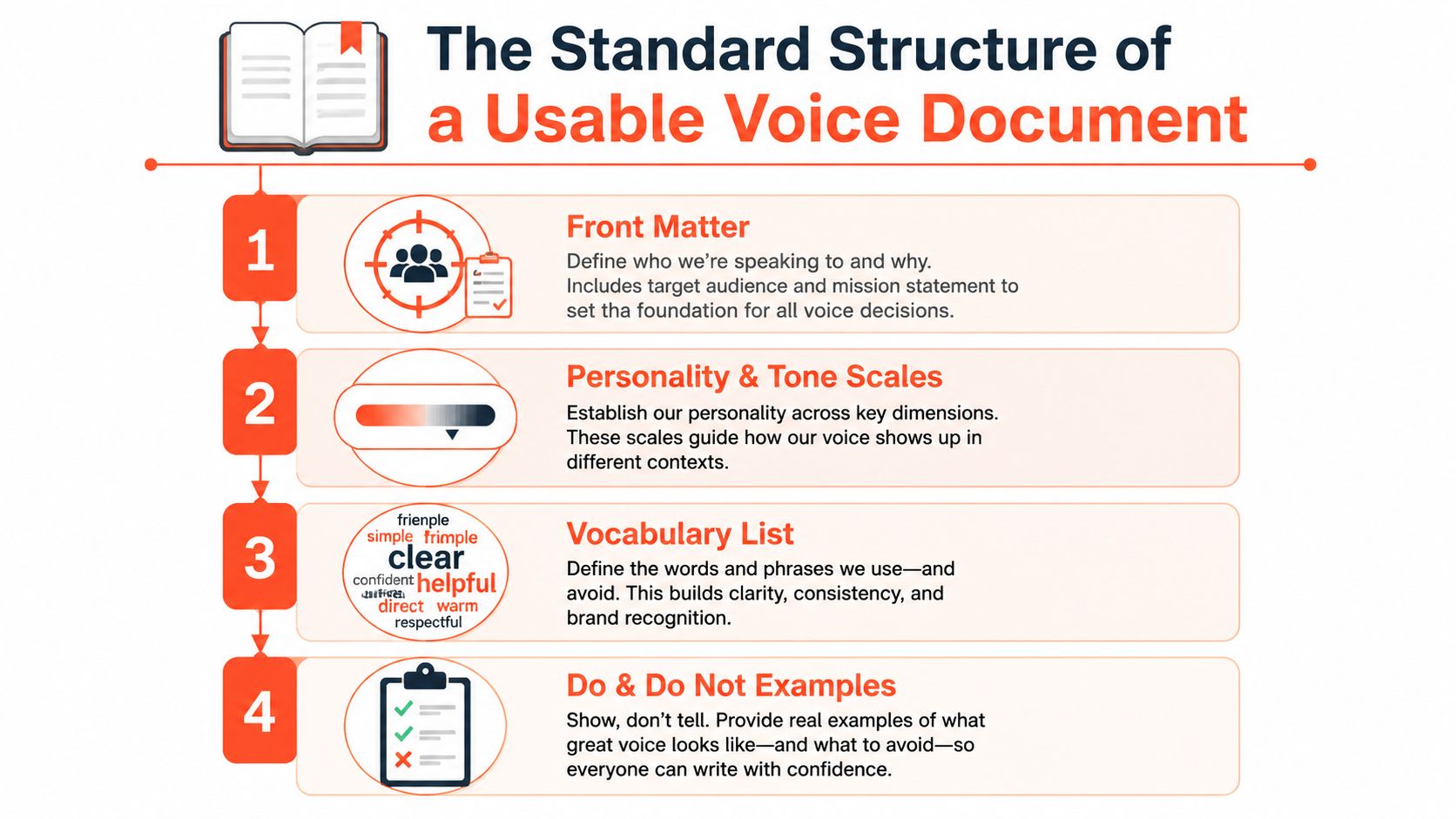
A strong document follows a dependency order. Writers need to know whom they're addressing and what the organization stands for before they can select personality traits. They need the traits before they can define situational tones. They need both before examples, channel rules, and AI instructions can make sense.
Use this sequence:
- Front matter: Record the audience, mission, communication objective, and a short voice statement.
- Personality and tone scales: Define the core traits, then show how tone moves by use case.
- Vocabulary list: Add preferred terms, banned expressions, naming conventions, and jargon filters.
- Do and don't examples: Demonstrate sentence patterns, punctuation, claims, calls to action, and rewrites.
- Channel adaptations: State what changes on Instagram, LinkedIn, TikTok, X, YouTube, email, and support channels.
- AI and collaborator instructions: Explain how writers and tools should retrieve, apply, and preserve the rules.
- Governance and audit: Specify review criteria, ownership, override handling, and publishing thresholds.
- Changelog: Keep version notes inside the same document so the current standard and its history stay connected.
This order prevents a common failure: examples that sound good but don't reveal the decision behind them. A channel rule should point back to a tone adjustment, and a tone adjustment should point back to a personality trait. The audit section belongs in the document because a rule nobody reviews becomes a preference.
A practical voice and tone guideline structure can provide useful terminology, but teams should still tailor the fields to their workflow. A small company may use one shared document, while an agency may maintain a core brand file with controlled client-specific overlays.
Operational rule: If a new writer can't find the audience, vocabulary rules, examples, and escalation path without asking someone, the document isn't finished.
Filling the Personality, Tone, and Vocabulary Sections
Start with personality, but don't stop at a list of adjectives. Select three to five core traits, then define each trait through its meaning, an example sentence, and explicit guardrails. This is the structure recommended by practical brand voice template guidance from IdeaPlan, because it turns an abstract identity into a writing standard.
You can express personality through a trait list, a set of opposing axes, or a short persona biography. Axes are useful when teams struggle with extremes. For example, a B2B software brand might sit high on clarity and confidence, moderate on warmth, and low on playfulness. A wellness brand might sit high on warmth and encouragement while avoiding exaggerated certainty.
Tone needs its own block. Define the default tone first, then add situational variations:
- Default content: Clear, confident, useful, and conversational.
- Product launch: More energetic and decisive, without hype that outruns the evidence.
- Support reply: Patient, direct, and accountable, with no defensive phrasing.
- Crisis communication: Calm, transparent, and specific, with careful review before publication.
Vocabulary is where many otherwise attractive guides become useful. Include the preferred term, the replacement, the reason for the choice, and the context where an exception is allowed. A wellness brand might prefer “daily practice” over “routine,” “support” over “fix,” and “people” over “patients” when it isn't communicating in a clinical setting.
| Block | B2B SaaS Example | Wellness Brand Example |
|---|---|---|
| Personality | Clear, capable, collaborative | Warm, grounded, encouraging |
| Tone | Launches can be energetic; support stays calm | Educational content is reassuring; promotions stay inviting |
| Vocabulary | Use “workflow,” “team,” and “customer”; avoid inflated technical jargon | Use “practice,” “support,” and “well-being”; avoid guaranteed outcomes |
Avoid stuffing the vocabulary list with every possible synonym. Include terms that affect brand recognition, customer understanding, legal review, or recurring editorial choices. The guide should help a writer make a decision quickly, not turn every sentence into a linguistic audit.
Do and Do Not Sections With On-Brand Rewrites
Abstract rules become enforceable when readers can compare a weak line with a corrected one. Build the do and don't section around recurring decisions, not random examples. A fictional project-management brand with a calm, practical voice might use the following model.
| Rule Category | Do (On-Brand) | Don't (Off-Brand) |
|---|---|---|
| Sentence patterns | “See what's blocked, then decide what moves next.” | “Revolutionize your productivity with our groundbreaking platform!” |
| Emoji and punctuation | “A clearer handoff starts here.” | “Your team is about to WIN!!! 🚀🔥” |
| Claims and superlatives | “Bring tasks, owners, and deadlines into one view.” | “The world's most powerful way to manage anything.” |
| CTA phrasing | “View the workflow” or “Start with the template” | “Don't miss out, act now before it's too late!” |
Each row should answer three questions: What does the brand do? What does it avoid? What would a writer publish? Add examples for captions, headlines, replies, product messages, and video scripts, because a rule can work in one format and fail in another.
Capture platform edge cases
Your template should include prompts such as:
- How should a thread opener sound on X?
- Can a pinned comment use humor when the main video is educational?
- Should a reply mirror a customer's slang or preserve the brand's normal vocabulary?
- Which claims require legal or subject-matter review?
- What happens when a trend conflicts with the brand's “don't” list?
A useful external reference on how to scale a voice that connects can help teams compare examples without copying another company's personality. The goal is not to make every sentence identical. It's to make the underlying choices recognizable.
Rewrite test: Remove the brand name from a post. If reviewers can't identify which rules shaped the sentence, the example is too generic.
Adapting the Template Across Social Channels
Cross-posting creates efficiency, but copying one caption everywhere creates drift of a different kind. The core voice should stay stable while the tone adjustment, format, pacing, and interaction style change for each platform.
Instagram usually permits more visual warmth and conversational captions. LinkedIn needs stronger context and less promotional language, or it can quickly become stiff. TikTok can be playful and trend-aware, but the joke must still serve the brand's identity. X rewards concise, responsive language, while YouTube benefits from a clearer narrative arc and more deliberate explanation.
| Channel | Tone Adjustment | Caption Length | Emoji Policy | Highest Drift Risk |
|---|---|---|---|---|
| Warm, visual, conversational | Keep to the shortest version that preserves context | Use only when they add meaning | Becoming overly casual or decorative | |
| Clear, informed, human | Lead with the practical insight | Rare and purposeful | Sounding corporate and abstract | |
| TikTok | Energetic, immediate, culturally aware | Prioritize the hook and spoken rhythm | Match the brand's defined permission | Chasing memes without relevance |
| X | Direct, responsive, lightly conversational | Cut repetition and setup | Use sparingly | Sliding into snark or argument |
| YouTube | Helpful, structured, approachable | Support the video's main promise | Use only if natural to the audience | Turning explanation into a sales pitch |
Set one permission for each platform. Instagram might permit behind-the-scenes language, LinkedIn might permit a thoughtful point of view, TikTok might permit trend formats, X might permit real-time replies, and YouTube might permit deeper teaching. Pair every permission with a boundary.
For teams that distribute one source across several networks, a workflow such as Post To All Social Media At Once can reduce repetitive publishing work. It shouldn't replace channel review. The source idea can travel unchanged, but the opening, examples, call to action, and response expectations usually shouldn't.
Mark unchanged rules
Create a small matrix beneath the channel table:
- Always unchanged: Core personality, prohibited claims, product naming, accessibility standards.
- Adjusted by channel: Sentence rhythm, context length, humor, emoji use, and call-to-action style.
- Reviewed by owner: Trend participation, crisis language, regional idioms, and sensitive topics.
That separation stops a platform adaptation from becoming a new brand voice.
How Specific Your Template Actually Needs to Be
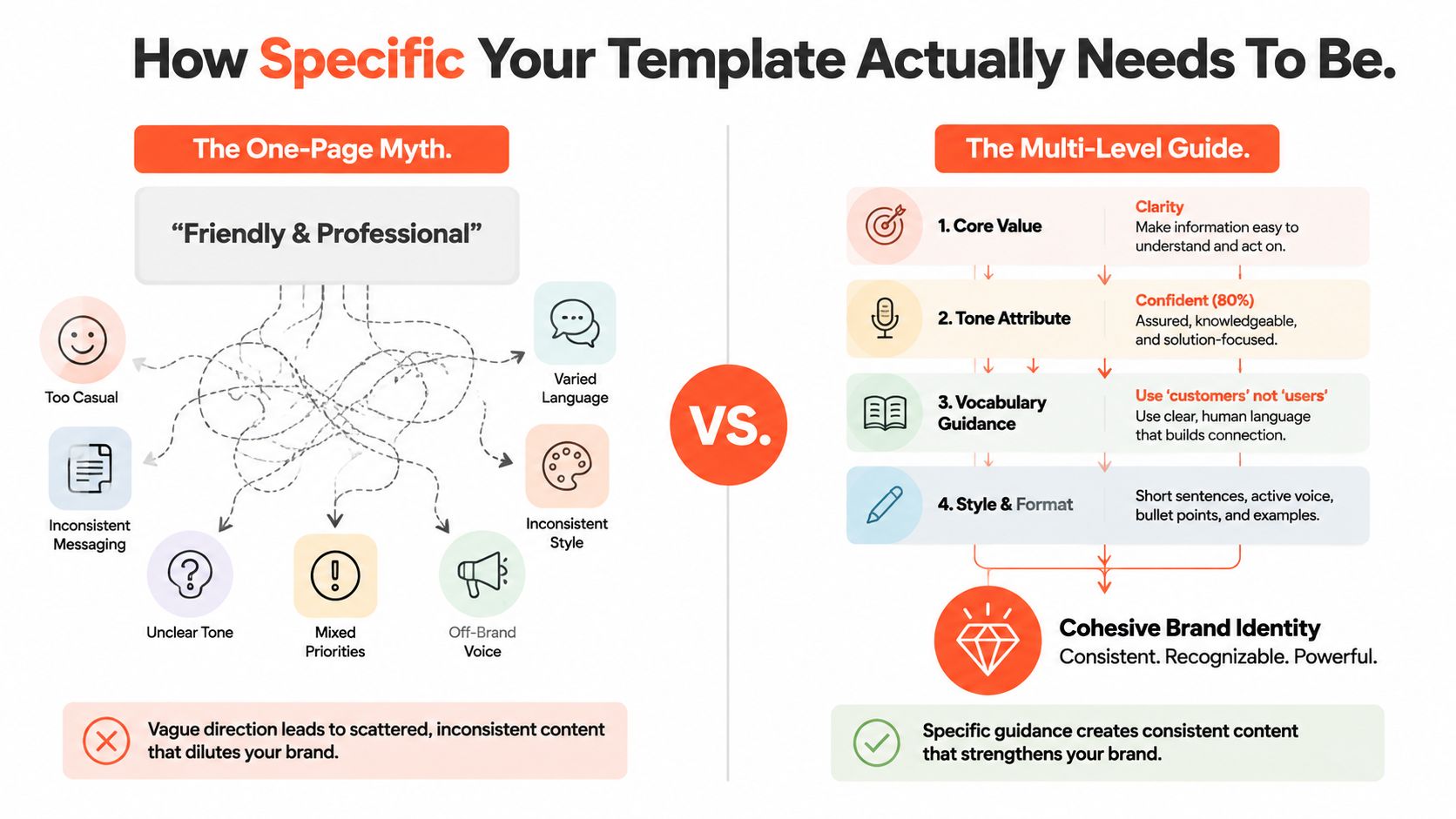
The advice to keep a voice guide to one page sounds efficient, but it fails when several teams, markets, or tools must make independent decisions. “Friendly yet professional” can mean concise and helpful to one writer, enthusiastic and emoji-heavy to another, and formal but warm to a third.
Specificity doesn't mean turning the document into an unreadable policy manual. It means every important adjective earns an observable behavior. “Confident” might mean lead with the answer, use active verbs, and remove unnecessary apologies. “Warm” might mean address the reader directly, acknowledge their situation, and avoid jokes when they're reporting a problem.
Use an enforceability checklist
A guideline is operational when a reviewer can answer yes or no to its application:
- Behavior: Does it tell the writer what to do?
- Boundary: Does it state what to avoid?
- Language: Does it name preferred and banned terms?
- Example: Does it show an original line and a rewrite?
- Context: Does it explain where the rule changes?
- Ownership: Does someone have authority to approve an exception?
Sentence length can be described qualitatively as short, moderate, or deliberately extended for explanation, but the document should still show examples that make the intended rhythm obvious. The key is not a rigid formula. It's a shared editorial threshold.
Specificity test: Give the same brief to two writers, hide the brand name, and compare their drafts. If the work sounds interchangeable with competitors, add rules about diction, rhythm, claims, and recognizable patterns.
Keep the core guide concise by separating always-on rules from channel overrides. Put detailed examples, edge cases, and approved prompt fragments in linked appendices or expandable sections, while keeping the governing decisions visible on the main page.
Encoding the Template for AI and Repurposing Workflows
AI tools don't understand “sound like us” unless the team supplies evidence and constraints. The usable input is a combination of a short voice statement, structured traits, banned terms, channel instructions, and examples that show the desired transformation.
Give a writing assistant four layers:
- Identity block: Audience, mission, product context, and point of view.
- Voice block: Core traits, definitions, behaviors, and anti-patterns.
- Vocabulary block: Preferred language, banned terms, naming rules, and claims restrictions.
- Output block: Channel, format, objective, length, CTA, and review requirements.
A caption generator shouldn't retrieve the entire document if it only needs the voice block, vocabulary block, and Instagram override. A LinkedIn generator may need the same voice rules but a different opening pattern, context requirement, and CTA instruction.
| Voice Rule | Human Reference | Encoded Prompt Payload |
|---|---|---|
| Lead with clarity | “Answer first, then explain.” | Prioritize the answer in the opening sentence. Add context afterward. |
| Stay practical | “Show the next useful action.” | Include one concrete action the reader can take. Avoid abstract motivation. |
| Avoid hype | “Don't claim superiority without proof.” | Do not use absolute superlatives or unsupported performance claims. |
| Use customer language | “Prefer ‘customers' to ‘users.’” | Use “customers” in public copy unless a product label requires “users.” |
A structured payload can preserve the rule through human review:
- Audience: Operations leaders evaluating workflow software.
- Voice: Clear, capable, collaborative.
- Tone: Informed and direct for LinkedIn.
- Vocabulary: Use “customer,” “workflow,” and “owner.” Avoid inflated claims.
- Task: Turn the source paragraph into a LinkedIn post.
- Output check: Flag banned terms, unsupported claims, and missing practical takeaway.
AI should draft against approved examples, not imitate a competitor or generate from adjectives alone. Keep a human review step for factual accuracy, cultural nuance, sensitive subjects, and intentional exceptions. The AI for content marketing guidance is useful background, but your own template remains the source of truth.
Auditing Compliance and Keeping the Guide Alive
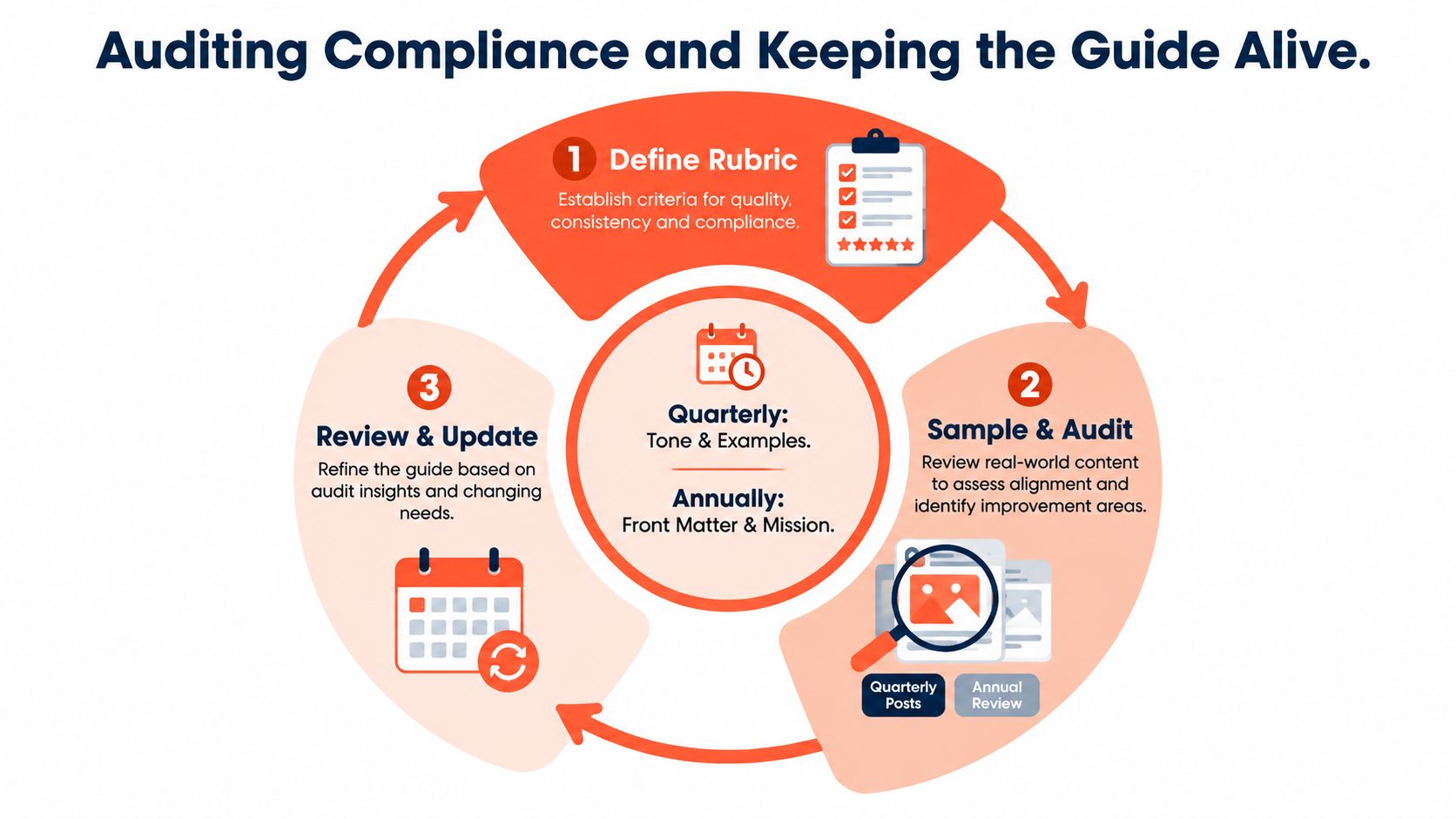
A guide becomes a control document when the team can inspect output against it. Start with a simple rubric that scores each sample for tone, vocabulary, and signature patterns. Use a consistent scale chosen by your team, then define what score requires editing rather than publication. The important decision is the threshold, not the complexity of the scoring system.
Assign review responsibility
Give each block an owner:
- Front matter and mission: Brand or leadership owner.
- Personality and tone: Content strategy owner.
- Vocabulary and claims: Editorial, product, and legal stakeholders where relevant.
- Channel rules: The person accountable for that platform.
- AI instructions: Content operations or whoever manages the generation workflow.
- Changelog: One document owner who records every approved revision.
Sample published material across formats and channels. Don't only review polished campaign copy. Replies, captions, comments, repurposed clips, and AI-assisted drafts often reveal drift earlier because they're produced under time pressure.
Log exceptions instead of hiding them
An override isn't automatically a failure. A regional team may use a local expression, or a campaign may intentionally adopt a sharper tone. Record the original rule, the exception, the reason, the approving owner, and whether the example should become part of the standard.
Review tone and examples on a recurring quarterly basis, while front matter and mission can receive a less frequent annual review, as reflected in the assigned audit visual. Update the guide sooner when the same exception appears repeatedly, reviewers disagree about a rule, new channels introduce new formats, or AI output keeps producing the same unwanted pattern.
For the mechanics of maintaining review workflows, tools and metrics for content QA can help teams organize checks without replacing editorial judgment. Keep version names clear, such as “2026.1,” and add a changelog entry that states the field changed, the previous wording, the new wording, and the reason.
Quick Reference Card and Common Rollout Questions
A printable card should contain only decisions people need while publishing:
| Core Rules | Rewrite Triggers |
|---|---|
| Personality: Clear, capable, collaborative | “Revolutionary,” “world-class,” or other unsupported superlatives |
| Default tone: Direct, useful, human | Corporate abstractions and empty motivational language |
| Vocabulary swaps: “Customers” over “users,” “help” over “leverage,” “start” over “activate,” “show” over “demonstrate,” “plan” over “strategy” when appropriate | Banned terms, unexplained jargon, or inconsistent product names |
| Hard don'ts: No inflated claims, no defensive replies, no trend participation without relevance | Excessive punctuation, forced memes, or a CTA based on pressure |
| Channel limits: Apply the platform override before publishing | A caption copied unchanged into every channel |
How do we onboard a new social media manager quickly?
Give the manager the card, the full guide, and a small set of approved examples. Ask them to rewrite current drafts using the card, then review the decisions against the vocabulary and channel fields rather than giving broad feedback such as “make it more on brand.”
What if a regional team says the voice doesn't fit its market?
Keep the core personality, product terminology, claims standards, and prohibited language unchanged. Add a regional override for idioms, formality, cultural references, or translation choices, then record the exception in the changelog so local adaptation doesn't become untracked drift.
How often should leadership approve updates?
Leadership should approve changes to mission, positioning, risk tolerance, or core personality. The content owner can usually refine examples, vocabulary, and channel instructions through the documented audit process, with leadership reviewing changes when they alter strategic meaning.
Store the card beside the full guide in the team's knowledge base, content calendar, and AI prompt library. Link it from onboarding materials and publishing checklists so it remains accessible when contributors or platforms change.
WaveGen.ai turns one article, newsletter, podcast script, or video transcript into platform-specific captions, carousels, short videos, quote cards, and other social assets while applying a saved brand kit and voice. Visit WaveGen.ai to see how your approved voice rules can support faster, more consistent repurposing across your publishing workflow.
brand voice guidelines template
brand voice
tone of voice
social media branding
content style guide
Turn this kind of writing into a week of social content.
Paste a blog post, newsletter, or rough draft — WaveGen turns it into publish-ready carousels, captions, and slideshows for every channel.
No credit card · First posts in 2min