August 12, 2026
13 min read
AI for Content Marketing: A Practical Playbook
Learn how to use AI for content marketing with a practical playbook covering ideation, repurposing, distribution, KPIs, governance, and brand-safe workflows.
You're staring at a blank doc, a half-finished content calendar, and a Friday analytics tab that still doesn't tell you what to publish next. The pressure isn't really to “use AI.” It's to ship more useful content, keep the brand voice intact, and stop burning hours on rewrites, resizing, and post scheduling that nobody on the team wants to own.
That's where ai for content marketing becomes useful in practice. The win isn't a chatbot that spits out a draft, it's a workflow that helps you research faster, turn one strong idea into many formats, and connect every asset to engagement data so the next round is better than the last.
Table of Contents
- A Real Week With AI in Your Content Workflow
- What AI for Content Marketing Actually Means
- The Six Use Cases That Actually Move the Needle
- Two Teams That Got This Right
- Measuring ROI Without Fooling Yourself
- Where AI Should Stay Out of the Way
- Your 30-Day Adoption Plan and Governance Checklist
A Real Week With AI in Your Content Workflow
Monday starts with the same problem most small teams know too well: too many ideas and not enough time to sort opportunities from noisy ones. A content lead feeds audience notes, support tickets, a few Reddit threads, and recent customer reviews into AI, then asks for topic clusters, missing angles, and a first-pass brief. That's a smarter use of AI than treating it like a title generator, because the model has something concrete to work from instead of generic prompts.
By Tuesday, the brief becomes a draft. The team doesn't ask the model to “write a thought leadership piece,” because that usually produces bland copy with no real point of view. Instead, it drafts section openers, summary blocks, and social captions, then hands the result to a human editor for brand voice, factual review, and structure.
Wednesday is where many teams feel the payoff. One source article becomes LinkedIn posts, short captions, quote cards, and a video script outline, so the team isn't staring at a content drought three days later. If you want a visual example of how source content gets sliced into social outputs, a useful reference is this YouTube thumbnail design guide, because it shows how packaging changes the way one idea gets distributed.
Thursday is for publishing and adaptation. Social copy gets localized for different channels, headlines get tightened, and the distribution queue fills up without a designer or copywriter rebuilding every asset from scratch. Friday is measurement, where the team checks what earned saves, clicks, replies, and traffic, then folds that feedback into next week's prompt set and content brief format.
The pattern is simple. AI is not replacing the whole content calendar, it's removing the friction around research, drafting, repurposing, and reporting so the team can spend more time on judgment.
What AI for Content Marketing Actually Means
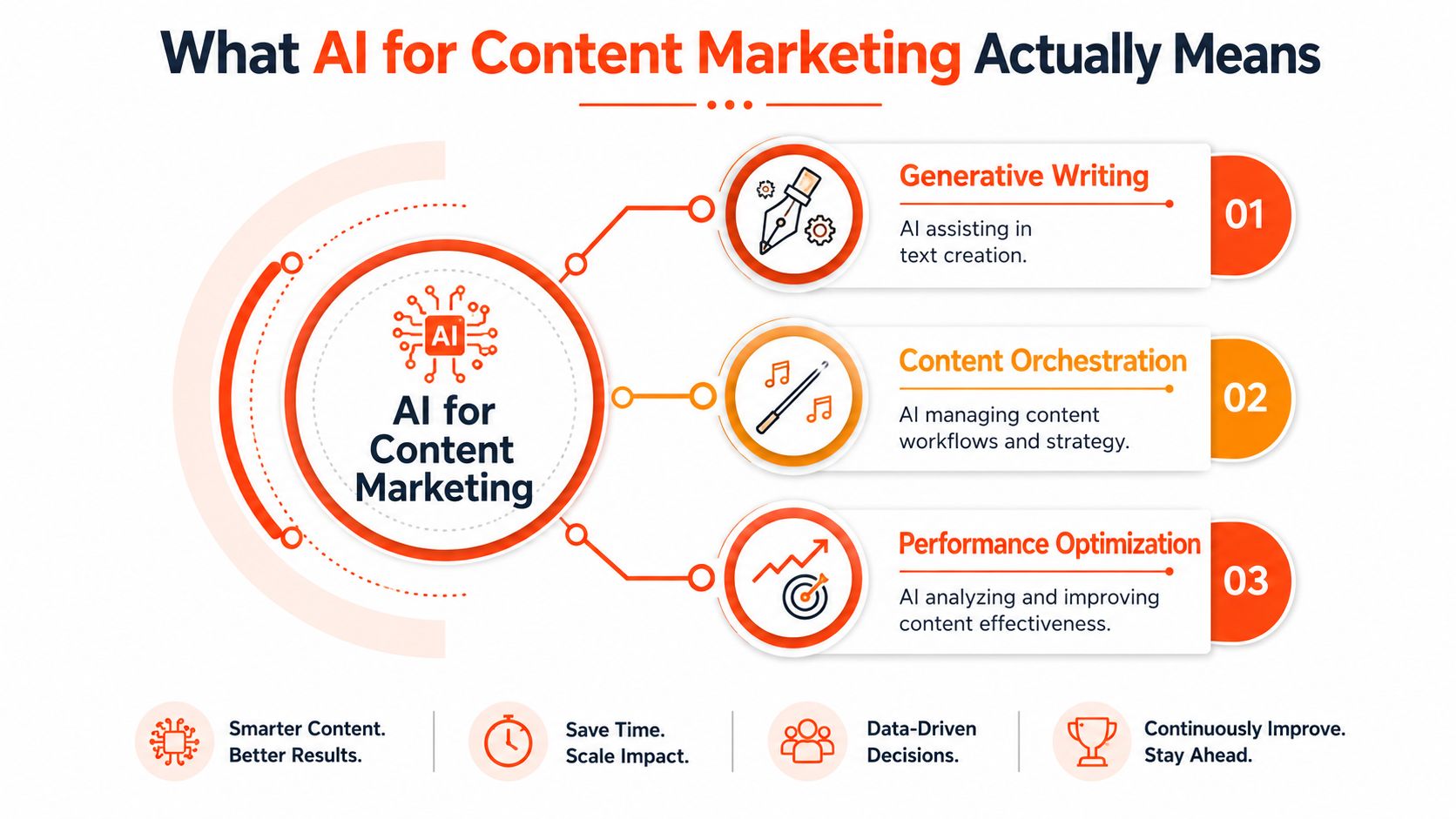
AI for content marketing works best when you stop treating it like a single app and start using it as three layers of infrastructure. The first is generative writing, which produces copy, outlines, captions, and variations. The second is predictive analytics, which reads patterns from past engagement and helps decide what to make next. The third is workflow automation, which pushes assets through approvals, formatting, scheduling, and distribution without manual handoffs.
A simple way to hold the stack is this. Generation is the engine, prediction is the GPS, and automation is the steering. If you only have the engine, you get words. Once the GPS is connected, the system starts pointing toward the kinds of topics and formats that are more likely to earn attention. Add steering, and the content moves through the workflow and into market without every step depending on a human to copy, paste, and chase updates.
That distinction matters because adoption is already broad. Statista's Content Marketing Trend Study 2026 found that just over half of 252 surveyed B2B content marketing professionals said their department uses AI to produce text, images, or videos, and 45% said they use AI for reporting and performance measurement, while SurveyMonkey's 2025 marketing survey found 51% of marketers use AI tools to optimize content, 50% create content with AI, 45% use AI to brainstorm content ideas, and 43% automate repetitive tasks with AI software (Statista content marketing AI usage). That is operational plumbing now, not a side experiment.
If you are evaluating tools, use that lens. A drafting app that never touches analytics only covers one layer. An orchestration system, such as AI brainstorming and outlining tools, can help early in the process, but the strongest setup connects research, output, and distribution so each piece informs the next.
Practical rule: if the tool cannot connect what it makes to what happened after publication, it is not a content system yet, it is just faster typing.
The Six Use Cases That Actually Move the Needle
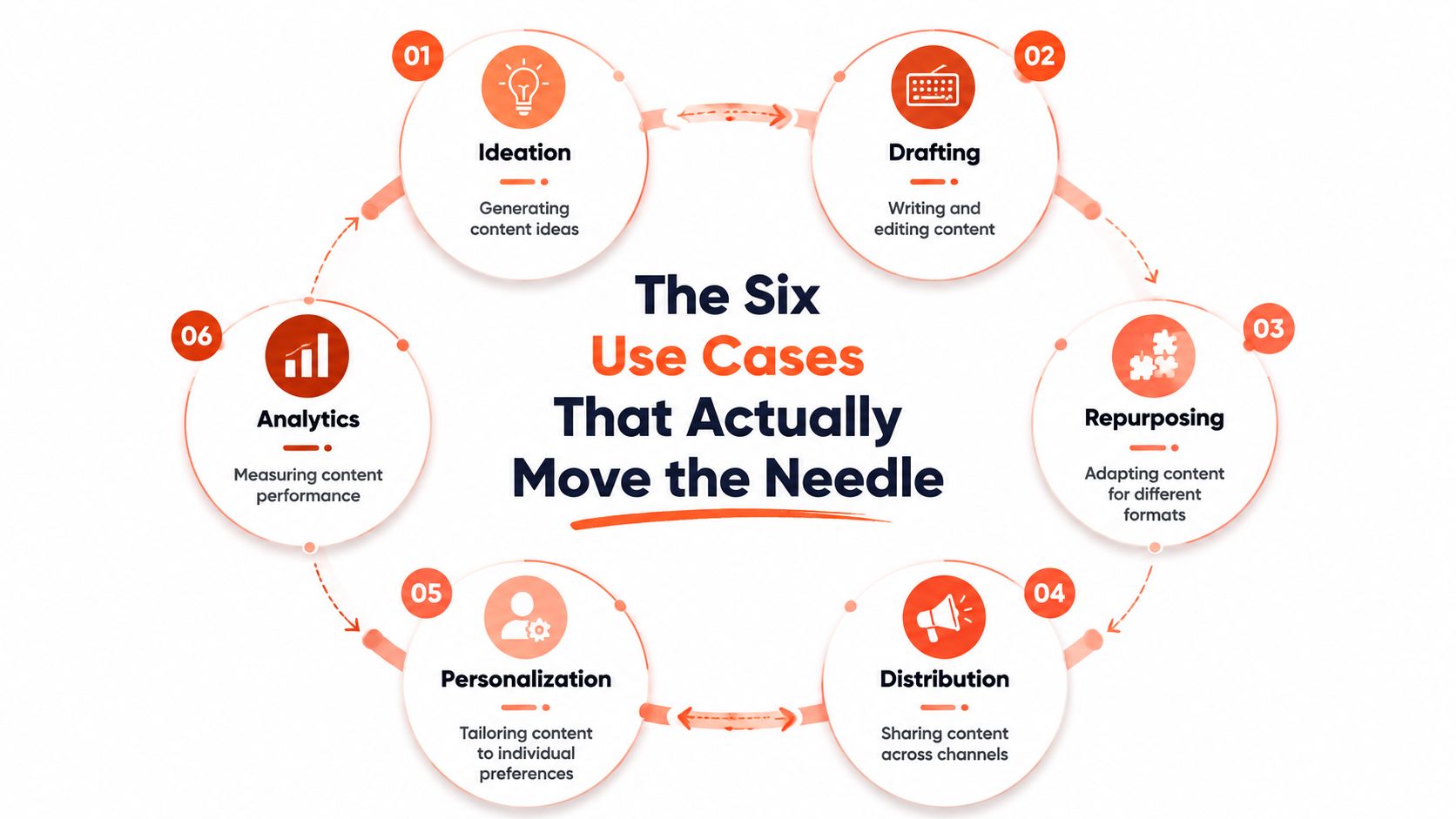
The most useful pipelines don't treat AI as a single step. They use it across ideation, drafting, repurposing, distribution, personalization, and analytics, and each stage feeds the next. That's where the time savings show up, because the work stops being a pile of disconnected tasks and becomes a repeatable content system.
Ideation and drafting
Use AI to mine source material, not just invent angles from scratch. Feed it customer language, competitor pages, and past winners, then ask for content gaps and draft structures. The mistake to avoid is accepting the first idea set without validation, because generic ideas are cheap and usually wrong.
Drafting should stay narrow. Let AI build the first pass for intro paragraphs, outlines, summaries, and platform-specific copy blocks, then let a human keep the thesis sharp and the examples grounded. If you want a tool roundup that sits in this layer, the internal guide on AI content creation tools is a relevant place to start.
Repurposing and distribution
Repurposing is where solo creators and small teams usually get the biggest return. One article can become short posts, quote cards, video scripts, newsletters, and platform-native captions without rebuilding the source idea every time. A repurposing system is especially useful for teams that publish one strong asset and need it to work harder across channels.
The strongest AI workflow is usually the one that starts with one good source asset and ends with many channel-specific versions.
Distribution is where automation earns its keep. Brand kits, scheduling, crossposting, and autopilot workflows reduce the repetitive work that makes consistency hard to maintain, especially for multi-channel teams. A platform like WaveGen.ai does this by turning one article, newsletter, blog post, podcast script, or YouTube transcript into a week of on-brand social content, including carousels, short videos, quote cards, and captions with platform-specific formatting, which makes it easier to keep the same core message alive across channels.
Personalization and analytics
Personalization should be about adapting proven material, not generating a fresh message for every segment. AI can help localize tone, format, and channel fit without asking the model to invent the brand story each time. Analytics closes the loop by showing which variations got the best response, then feeding that back into the next brief, caption set, or content angle.
Here's the connected version in a compact view.
| Use Case | Pipeline Stage | AI Capability | Measurable Output |
|---|---|---|---|
| Topic discovery | Ideation | Cluster ideas from source inputs | Faster brief creation |
| First draft creation | Drafting | Generate outlines and copy blocks | Shorter production cycle |
| Social adaptation | Repurposing | Turn one asset into many formats | More channel-ready assets |
| Cross-posting | Distribution | Format and schedule by platform | More consistent publishing |
| Audience tailoring | Personalization | Adjust copy by segment or channel | Better fit by audience |
| Feedback review | Analytics | Summarize performance patterns | Better next-round decisions |
Two Teams That Got This Right
A solo newsletter creator usually does not have a content team, a designer, or time for elaborate production. The workflow that holds up is tight, one strong weekly issue becomes the source asset, then AI turns it into a week of social posts, a short video script, a quote-card set, and a few adapted captions that keep the same voice. The creator still edits every public-facing line, because the goal is not volume for its own sake, it is making one idea travel farther without sounding automated.
The guardrail is simple, the original newsletter stays human, and the repurposed layer stays on-brand. That means using a brand kit, keeping a saved voice guide, and checking every output before it goes live. The creator who skips those steps ends up with content that looks busy but sounds like it came from five different people.
A small agency has a different problem, but the same underlying shape. Five client brands mean five voices, five approval styles, and five distribution rhythms, which is exactly where repetitive adaptation starts to swallow the calendar. The agency can use AI for the repetitive layer, social variations, caption resizing, and platform formatting, while strategists spend their time on positioning, content themes, and approvals.
A practical example of that setup appears in this Claude workflow for automating content marketing. The point is not the model name. The point is the handoff design. If the approval chain is clear and the brand kit is locked, the team can move fast without turning every client feed into a content quality risk.
The best setups share the same discipline. They do not ask AI to invent the brand, they ask it to extend an already-defined brand across more surfaces. They also keep a feedback loop in place, so engagement results shape the next repurposed asset, the next caption set, and the next distribution pass.
Measuring ROI Without Fooling Yourself
A team can save time with AI and still miss the point. A workflow that trims drafting hours but never changes distribution has only bought back capacity. Content that reaches more people but never helps leads, pipeline, or retention becomes extra noise with better packaging.
A four-tier KPI model
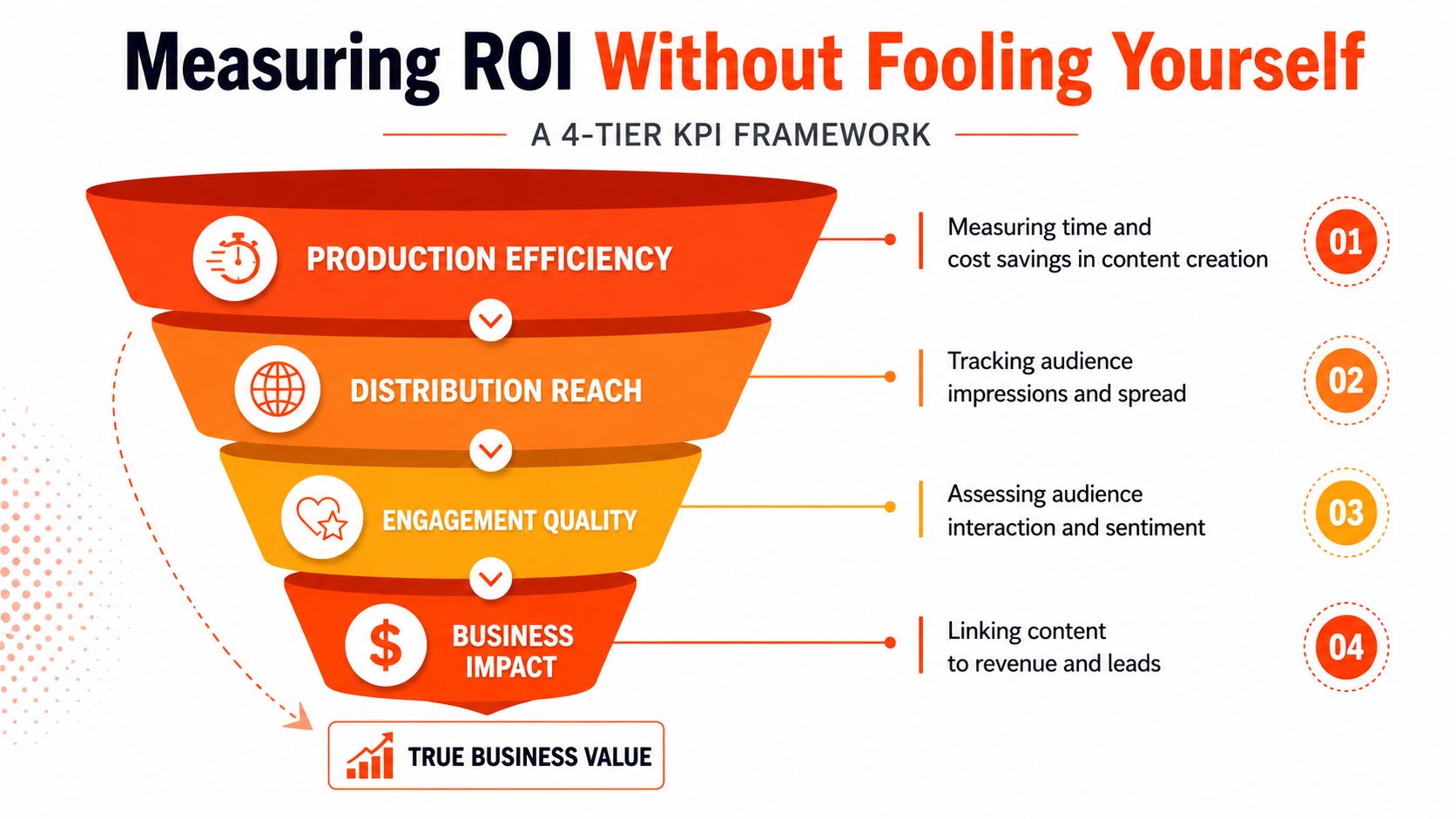
Start with production efficiency, which tracks how long a source asset takes to move from idea to publish-ready output. Then measure distribution reach, which shows whether the repurposed content was seen by the audience it was meant to reach. After that comes engagement quality, where comments, saves, replies, and meaningful clicks matter more than raw impressions. At the bottom is business impact, the only tier that justifies the system over time.
The simplest way to stay honest is to compare one AI-assisted asset with the team's normal process. Track the same piece through each tier, from the first draft to the last distribution pass. If production time drops but engagement quality slips, the workflow needs revision, not applause. If reach rises but business impact stays flat, the repurposing layer is doing distribution work without helping the content earn its keep.
What to calculate
Use these questions in every review:
- Production efficiency: How long did research, drafting, and repurposing take?
- Distribution reach: Did the content get scheduled, published, and seen?
- Engagement quality: Did people respond in ways that suggest interest, not just exposure?
- Business impact: Did the asset assist traffic, leads, or pipeline movement?
That framework keeps the math honest. A repurposed article that becomes five platform-native posts, a newsletter summary, and a video script is useful only if the team can show that the output made publishing easier and improved downstream results. The cleanest proof comes from tracking one source asset from first draft to final distribution, then comparing it with the old workflow on time, reach, and business outcome.
For teams setting up reporting around content creation automation, the measurement layer matters as much as the workflow itself. If the numbers stop at output volume, AI can look productive while doing little for the content system underneath it.
Where AI Should Stay Out of the Way
AI is strongest at adaptation, not invention. That line matters, because some content types need a human accountable for the idea, the tone, and the consequences if something goes wrong. Executive thought leadership, crisis communications, brand origin stories, highly regulated or technical content, and original research should stay human-led even if AI helps with structure or editing.
The main failure modes are predictable. Hallucinated facts happen when the model invents details that sound plausible. Generic voice drift shows up when every draft starts sounding like the same neutral internet brand. Legal exposure happens when regulated claims, disclosures, or proprietary statements get diluted by automation.
You can catch all three before publication. Fact-check any claim that matters, read the copy out loud against a real brand sample, and route sensitive material through the right reviewer before it leaves the draft stage. If a post needs judgment more than speed, AI should support the work, not author it.
If the content would damage trust when wrong, don't let the model be the final writer.
That doesn't mean AI belongs only in low-value work. It means the best use of AI is often in distribution, versioning, and formatting, where repetition is costly and the core message already exists. The farther a piece gets from the brand's actual point of view, the more careful the handoff needs to be.
Your 30-Day Adoption Plan and Governance Checklist
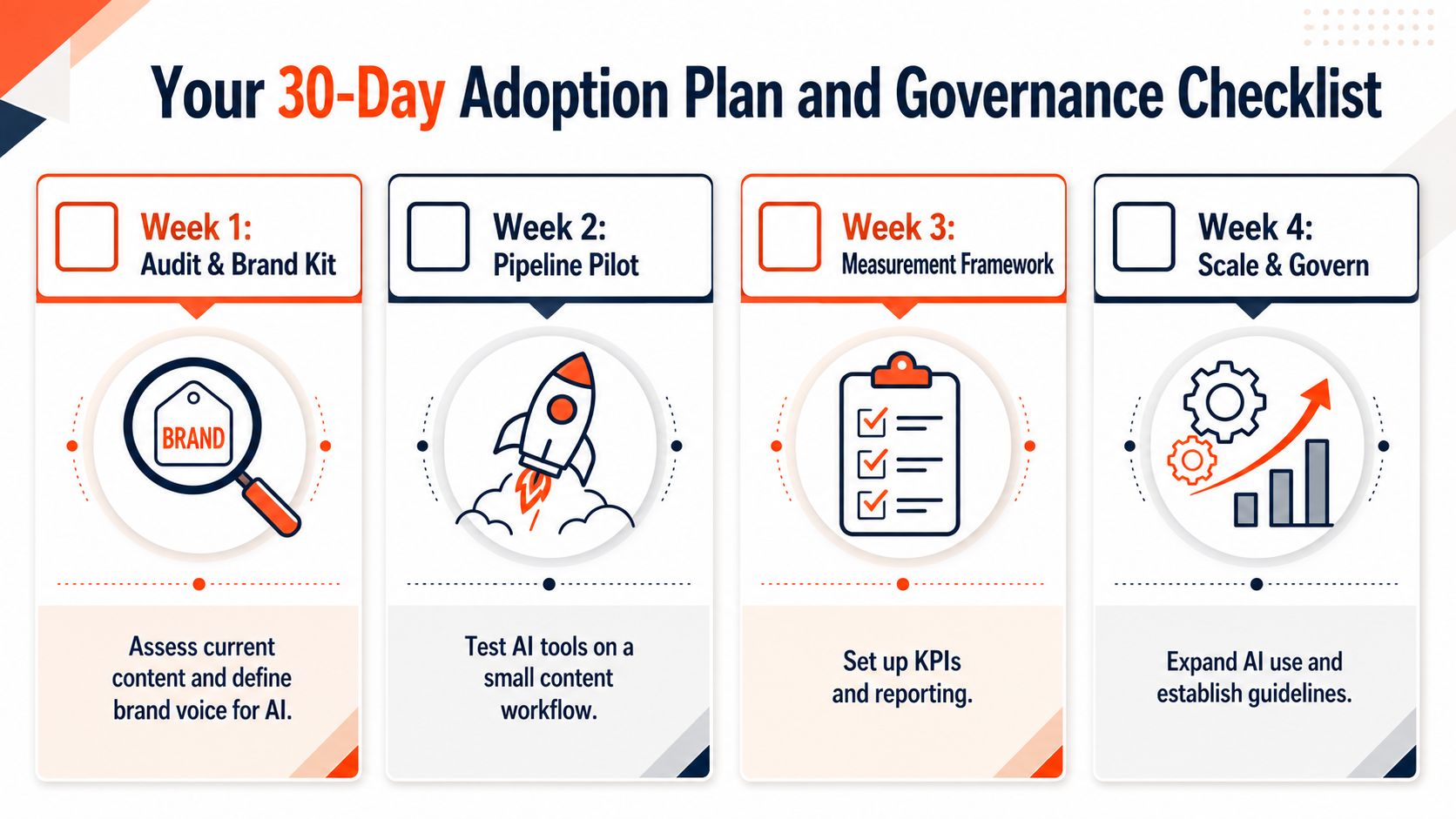
A lone marketer staring at a content calendar does not need a bigger pile of drafts. They need a system that turns one strong asset into usable variants, routes each version to the right channel, and keeps a human in control of what the model should never write. Start with the workflow you already have, then use AI to reduce repeat labor where the message already exists.
Week one is audit and brand kit. List the content types you already produce, identify the repetitive steps, and define voice rules, formatting rules, approval owners, and the parts of the workflow that must stay human. If your team already has a repeatable repurposing motion, tie it to content creation automation so the rollout is built around distribution, not random drafting.
Week two is pipeline pilot. Choose one source asset and run it through ideation, drafting, repurposing, and distribution so you can see where the handoffs break and where the model adds friction. Use a piece with a clear audience and a clear finish line, because vague inputs produce vague outputs.
Week three is measurement. Set the KPI tier you'll track for the pilot, then compare the AI-assisted asset with a normal one so you are not guessing about value. Look at time saved, quality of review comments, and whether the repurposed versions earn engagement or just fill space.
Week four is scale and govern. Expand to the next repeatable workflow only after the first one has a clear review process, a named owner, and a rule for what happens when the output drifts from the brief. That keeps AI in the role it handles well, versioning and distribution, while humans retain judgment on claims, tone, and priority.
Use this checklist:
- Audit current workflow: Identify where time gets lost.
- Lock the brand kit: Voice, visuals, and formatting rules need to be clear.
- Pilot one content stream: Start small and observable.
- Set review points: Fact-checking and approvals should be built in.
- Track the right metrics: Measure time saved and downstream response.
- Write usage rules: Decide what AI can draft and what it can't touch.
Keep the rules simple and visible. A good governance checklist is not there to slow publishing down, it exists so your team can repurpose more often without letting the model write outside its lane. Once the pilot proves it can protect quality while increasing output, the workflow is ready to expand.
ai for content marketing
content marketing ai
ai content workflow
ai marketing tools
content repurposing
Turn this kind of writing into a week of social content.
Paste a blog post, newsletter, or rough draft — WaveGen turns it into publish-ready carousels, captions, and slideshows for every channel.
No credit card · First posts in 2min