September 3, 2026
16 min read
Content Distribution Channels That Drive Real Reach
Learn how to choose and run content distribution channels across owned, earned, paid, and partner media. Includes tactics, KPIs, and a sample calendar.
Nine out of ten marketers use their website as a primary content distribution channel, while blogs reach roughly 78% to 84% usage, email newsletters 68% to 71%, and other email 61% to 63%. The concrete answer is to build a focused portfolio around content format, audience intent, and business goal, rather than publishing identical posts everywhere.
The popular advice says to distribute more, more often, across every platform available. That sounds ambitious, but it turns distribution into a checklist instead of a decision. A long-form guide, a product demo, a customer story, and a short opinion video don't earn attention in the same environment, and they shouldn't receive the same treatment.
Content distribution channels work best as a portfolio. Your website can hold the durable source asset, email can reach people who already know your brand, organic social can create discovery, partners can lend trust, and paid media can accelerate a proven message. The hard part isn't finding another platform. It's deciding which combination deserves your team's time, budget, and creative attention.
Table of Contents
- Why Posting Everywhere Is Quietly Costing You Reach
- The Four Channel Families Every Strategy Needs
- Channel by Channel Tactics and Formatting Tips
- How to Choose the Right Channel Stack
- Repurposing Workflows and Where Automation Helps
- Measurement and KPIs That Actually Predict Growth
- A Sample Weekly Distribution Calendar
- Common Distribution Mistakes and Quick Fixes
Why Posting Everywhere Is Quietly Costing You Reach
Posting everywhere can reduce reach when your team treats every channel as a duplicate publishing slot. Each platform has different audience expectations, creative constraints, ranking signals, and feedback loops. A blog article needs searchable structure and depth. A LinkedIn post needs a sharp opening and a useful native discussion. A short video needs immediate visual and narrative momentum.
The distribution market reflects this fragmentation. The global content distribution market was estimated at USD 113.25 billion in 2025, projected at USD 122.38 billion in 2026, and forecast to reach USD 169.41 billion by 2031, with a projected 6.72% CAGR from 2026 to 2031 in the content distribution market analysis. That expansion doesn't mean every brand should add every channel. It means delivery has become a complex commercial system involving owned properties, platforms, syndication, and audience access.
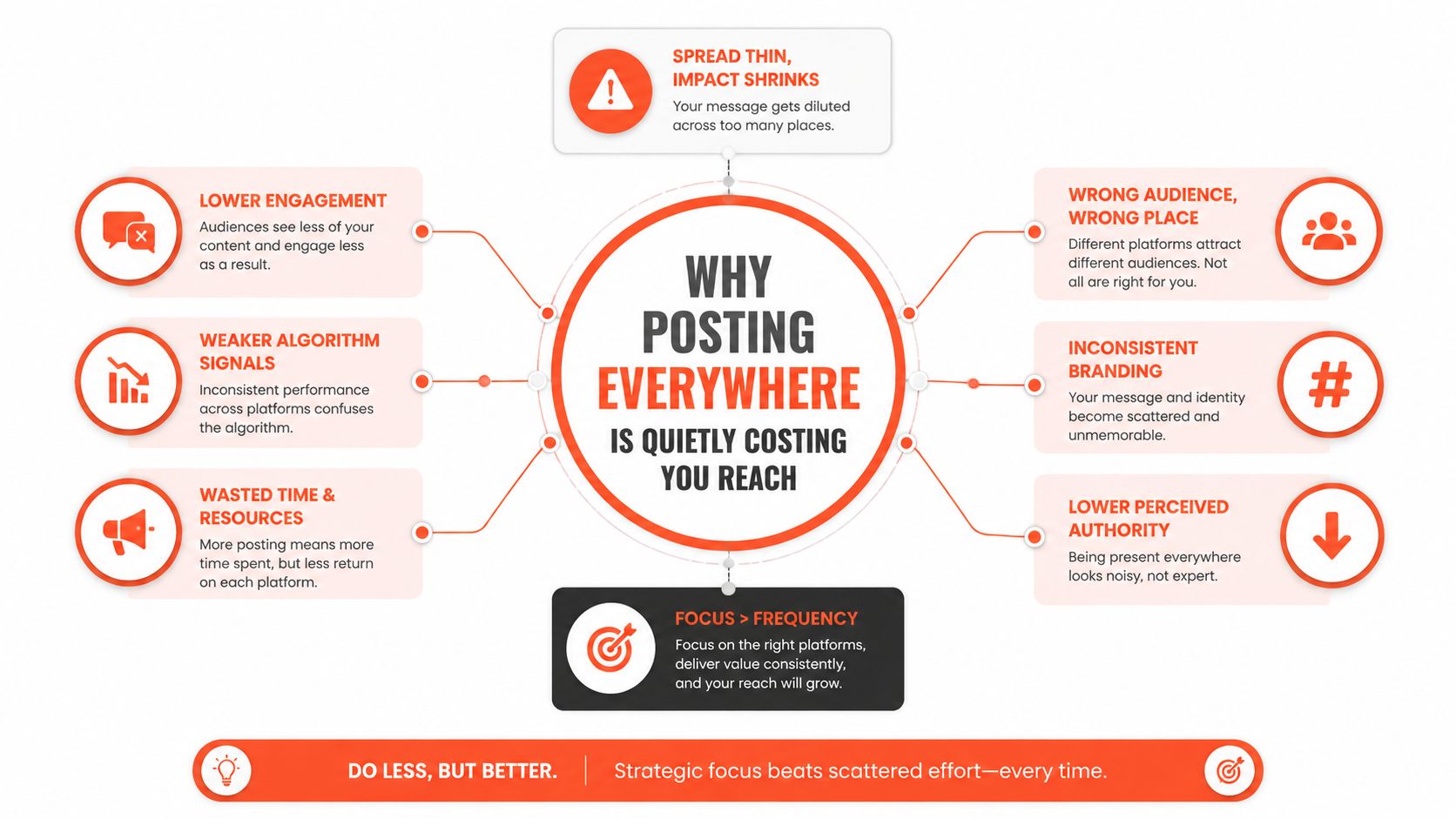
Reach follows fit more than volume
Social distribution also has a power-law shape. A discussion of viral information dynamics describes share distributions as heavy-tailed, meaning most posts receive modest attention while a small fraction captures outsized reach. You can't command the tail, but you can create more opportunities to reach it through disciplined experimentation, native formats, and repeated exposure.
Platform ranking makes the problem more technical. A 2025 formal model of recommendation systems describes how algorithms filter low-ability creators, narrow the audience for medium-performing content, and amplify high-ability or viral content in ways connected to platform revenue. Follower count alone doesn't guarantee delivery. Hook strength, watch time, dwell time, relevance, and early engagement can influence whether a post earns broader distribution.
Practical rule: Treat every channel as an investment decision. If a platform can't support the asset's format or the audience's intent, more posting won't fix the mismatch.
The four useful families are owned, earned, paid, and partner channels. Owned channels provide control, earned channels build credibility, partner channels borrow trusted audiences, and paid channels buy speed. A focused stack usually outperforms a scattered presence because it gives each channel enough quality, consistency, and learning time to earn traction. The rest of this guide uses that portfolio mindset to connect channels with content types, funnel stages, and measurable goals.
You can also use the broader definition of multi-channel marketing to distinguish coordinated distribution from merely duplicating posts across platforms.
The Four Channel Families Every Strategy Needs
Start by classifying every channel you use. This prevents a common planning mistake, treating a company blog, an influencer mention, and a paid search campaign as if they offer the same kind of control or value.
| Channel Family | Control Level | Typical Cost | Primary Value | Best For |
|---|---|---|---|---|
| Owned | High | Production and maintenance effort | Durable access and first-party relationships | Searchable education, nurture, conversion |
| Earned | Low | Outreach and relationship effort | Credibility and independent validation | Trust building and discovery |
| Paid | Medium | Media spend plus creative production | Speed, targeting, and scalable exposure | Demand capture and amplification |
| Partner | Shared | Coordination, incentives, or revenue share | Borrowed trust and audience access | Co-marketing and niche reach |
Owned channels build the base
Your website, blog, email list, resource center, app, and branded profiles belong here. You control the publishing environment, the calls to action, and much of the audience journey. An educational article that answers a recurring customer question is a strong owned asset because it can support search discovery, internal linking, sales conversations, and future repurposing.
Owned distribution isn't free. Your team still pays through writing, design, maintenance, deliverability, analytics, and technical upkeep. Its advantage is that each useful asset can keep working after the launch moment, especially when the page has clear navigation and a relevant next step.
Earned channels add credibility
Earned distribution includes media coverage, organic mentions, reviews, social sharing, community recommendations, and podcast guest appearances. You don't control the final context, placement, or timing, but an independent mention can carry trust that a brand-owned claim can't create by itself.
A customer review on a relevant third-party site illustrates the value. Your team may provide accurate product information, but the reviewer controls the judgment. That limited control is also the risk. Earned visibility depends on relevance, participation, newsworthiness, and the quality of the underlying idea.
Paid channels buy speed
Paid search, paid social, display, sponsored content, and native placements let you place a message in front of a selected audience. A search ad for a high-intent service query can capture demand that already exists, while paid social can introduce an offer or amplify a strong organic asset.
Paid media exposes weak creative quickly. Poor audience selection, an unclear landing page, or repetitive creative can waste budget even when delivery is technically efficient. Use paid channels to test and scale messages with a clear audience and conversion path, not to disguise content that has no useful promise.
Partner channels borrow context
Partners include complementary brands, affiliates, creators, influencers, associations, distributors, and syndication publishers. A software company might co-host a webinar with an implementation consultancy. A consumer brand might work with a creator whose audience already trusts their product category.
Partner distribution adds reach and context, but it requires shared incentives and careful coordination. The partner's audience has its own expectations, so a generic promotional asset can damage both sides. The strongest collaborations give the partner room to adapt the message while preserving factual and brand boundaries.
Skipping a family usually creates a strategic gap. Owned channels may lack outside validation, earned channels may be too unpredictable, paid channels may become expensive without a durable destination, and partner channels may never scale without a strong source asset.
Channel by Channel Tactics and Formatting Tips
The right tactic starts with the format, not the platform list. A searchable guide, a personal point of view, a demonstration, and a customer proof asset each need a different distribution path.
| Channel | Best-Fit Format | Primary Strength | Common Failure |
|---|---|---|---|
| Website and blog | Guides, articles, comparison pages, case studies | Durable discovery and conversion paths | Publishing without search structure or a clear next action |
| Email newsletter | Brief insight, curated links, launch message | Direct access to known readers | Fatigue from sending without segmentation or value |
| Point-of-view posts, document carousels, professional video | B2B discussion and expertise | Repeating corporate copy with weak openings | |
| X | Short arguments, threads, timely commentary | Fast conversation and idea testing | Chasing volume without a distinct point |
| Carousels, reels, visual proof | Visual explanation and brand memory | Adapting text-heavy assets without redesign | |
| TikTok | Demonstrations, stories, practical short video | Discovery through native video | Delayed hooks and overly polished ads |
| Community posts, video, offer-led content | Broad community and retargeting support | Treating every audience segment identically | |
| YouTube | Tutorials, explainers, interviews, searchable video | Depth, discovery, and retention learning | Weak thumbnails, unclear titles, or slow openings |
| Podcasts | Interviews, narrative episodes, expert discussion | Trust and sustained attention | Relying on the episode alone without clips or show notes |
| Paid search and social | Short creative, landing-page-led campaigns | Intent capture and targeted amplification | Creative decay, loose targeting, or mismatched pages |
| Syndication | Adapted articles, excerpts, expert commentary | Additional discovery through publishers | Duplicating pages without canonical and partner governance |
| Influencer and affiliate partnerships | Demonstrations, reviews, creator-native stories | Borrowed trust and category relevance | Over-scripted briefs or unclear disclosure |
Owned publishing needs structure
A blog or website is the natural home for long-form educational content, but publication isn't distribution by itself. Use descriptive headers, logical internal links, structured page elements where appropriate, and a visible call to action. A comparison page may lead to a product evaluation, while an educational guide may invite an email subscription before asking for a sales conversation.
Email works differently. Segment by role, lifecycle stage, topic interest, or engagement so a new reader doesn't receive the same message as a long-term customer. Test subject lines, but protect the plain-text feel of the message. Readers should understand the value before they click.
Social and video require native adaptation
LinkedIn rewards a useful professional idea presented early. X supports concise arguments and threaded development. Instagram needs visual hierarchy, TikTok needs immediate movement or tension, and Facebook often benefits from community context. The same source idea can travel across these platforms, but the opening, pacing, dimensions, and call to action should change.
YouTube and short-form video create a different feedback loop. Titles and thumbnails earn the initial click, while the opening sequence and pacing influence continued viewing. Chapters help long videos, captions support silent viewing, and clips can point viewers toward a deeper source asset. Don't judge video only by views. Watch where people leave, then revise the next version.
Podcasts need an ecosystem around the episode. Prepare show notes, guest amplification assets, short clips, quote-led posts, and a relevant landing page. A guest strategy works best when the guest has genuine category relevance and a reason to share the episode with their audience.
Paid, syndication, and partnerships need safeguards
Paid search is strongest where intent is explicit. Paid social can create demand or retarget people who already interacted with your brand. Build creative variants, layer audiences thoughtfully, and watch for ad fatigue. Syndication requires partner selection, publication rules, canonical handling, and a clear reason for the second placement.
Influencer and affiliate campaigns need a concise brief, accurate product guidance, disclosure requirements, and creative freedom. Creators understand their audience's language better than a brand team does. Your job is to protect accuracy and outcomes without turning the content into an unnatural commercial.
How to Choose the Right Channel Stack
Choose channels from the outcome backward. Start with the business goal you can measure, identify the content type that can earn that outcome, map the audience behavior that signals intent, and only then compare your team's capacity.
A B2B SaaS company seeking demo requests might prioritize LinkedIn thought leadership, an email nurture path, and partner webinars. A DTC brand focused on first-purchase conversion might choose TikTok demonstrations, creator partnerships, and paid social retargeting. These aren't universal recipes. They're examples of matching the buying situation to the channel environment.
Use one scoring grid
Score each candidate channel against the same criteria:
- Audience fit: Does the target buyer already spend meaningful attention there?
- Format fit: Can your team produce the content that the channel naturally distributes?
- Funnel fit: Does the channel support awareness, consideration, conversion, retention, or a useful transition between them?
- Cost per touch: What will you spend in media, production, tools, and coordination?
- Internal effort: Can the team maintain quality and respond to audience feedback?
The content distribution platform overview can help teams think about the operational layer separately from the strategic choice. A platform may make publishing easier, but it can't decide whether your audience wants a webinar, a tutorial, a review, or a short opinion post.
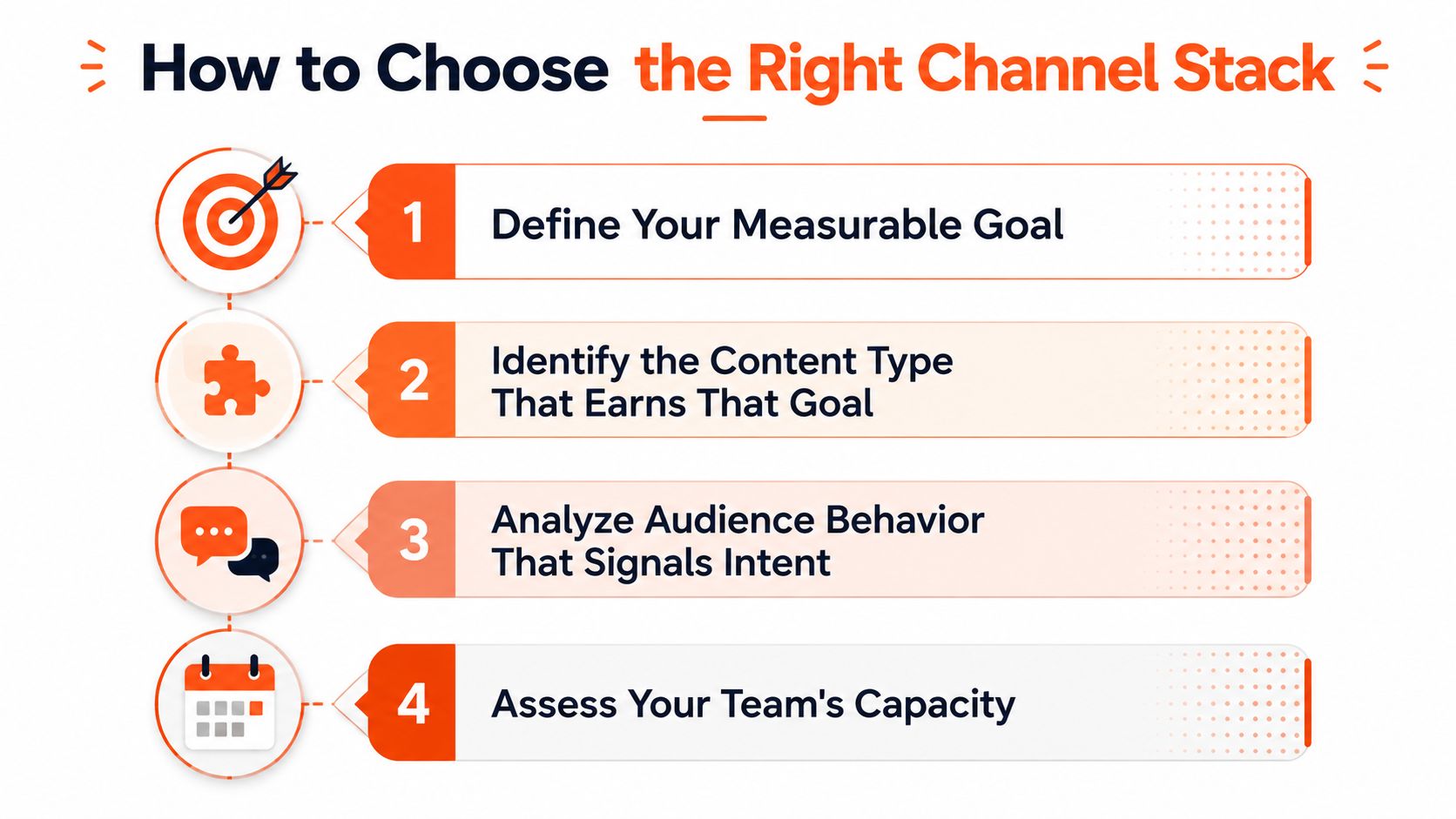
Avoid a channel because it feels familiar, and don't adopt one because a competitor dominates it. Audit customer conversations, sales questions, search behavior, community discussions, and existing engagement before committing. A channel is defensible when your team has a distinctive point of view, repeatable production capability, or access to an audience others can't easily reach.
Document a primary stack of three to five channels and reserve an experimental slot for one new channel per quarter. That structure keeps the portfolio focused while giving you a controlled way to test changing audience behavior. For music marketers evaluating specialized workflows, a curated guide to AI music promotion tool picks can support the tool-selection stage, but the audience and format decision should come first.
Repurposing Workflows and Where Automation Helps
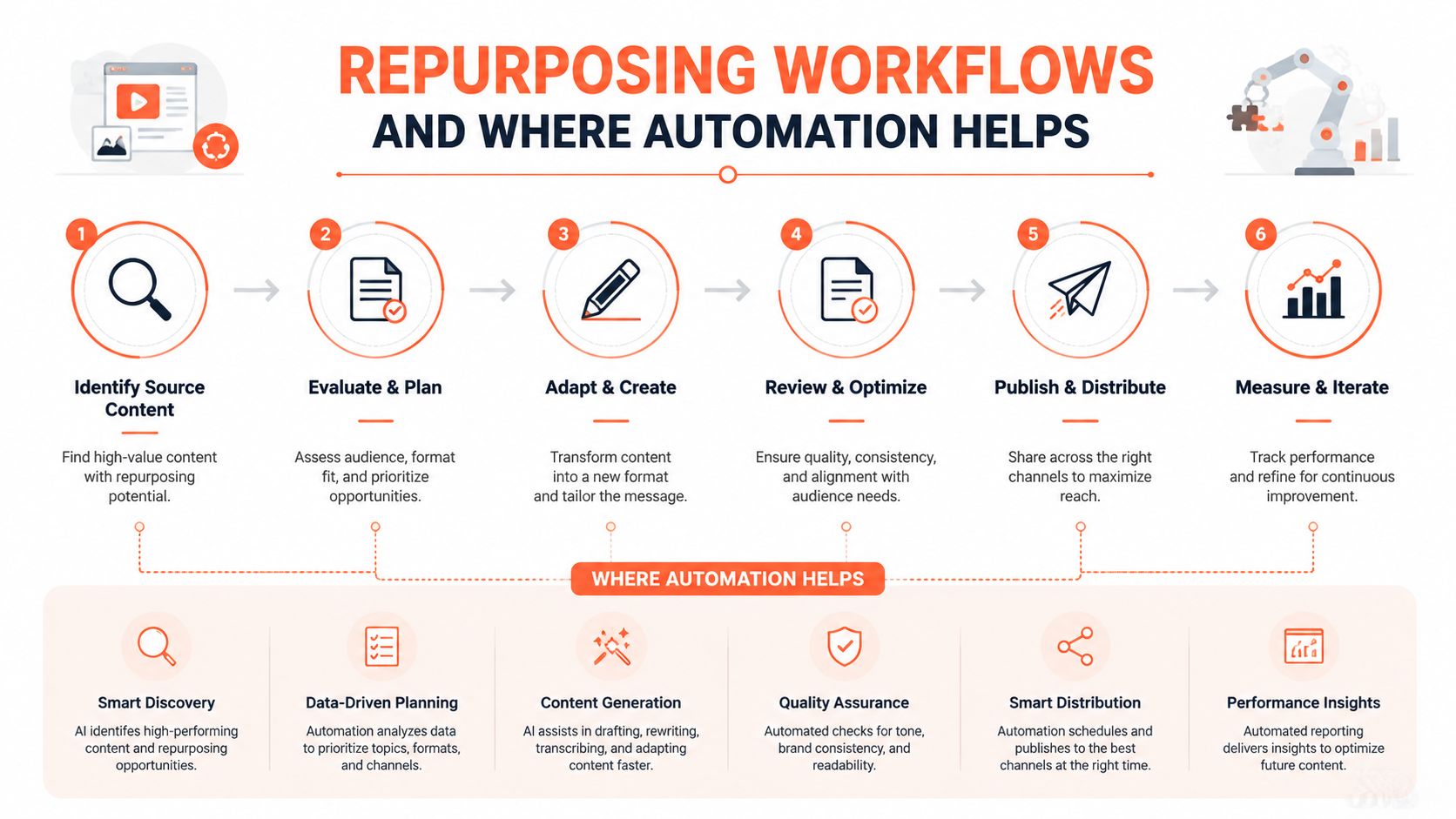
A strong source asset should produce more than one publishing event. Take a long-form article about a complex customer problem. The article remains the reference point, while its strongest claim, useful example, or practical framework becomes a set of smaller assets designed for different environments.
Start with the source atom, the one idea that can stand on its own. Extract three to five pull-quote concepts for LinkedIn and X, a captioned vertical clip for short-form video, a newsletter summary with one call to action, a pair of Instagram carousel slides, and a value-first discussion prompt for a Reddit or Slack community. You can also adapt a search-focused excerpt for Medium or LinkedIn Pulse when the publication rules and audience fit make sense.
Four stages keep repurposing useful
- Find the source atom. Choose one defensible claim, explanation, statistic, or story. Don't ask every derivative to summarize the whole asset.
- Extract formats. Turn the idea into a script, caption, carousel outline, quote card, email paragraph, or discussion prompt.
- Adapt for native norms. Change the hook, pacing, visual treatment, length, and call to action for each channel.
- Schedule and track. Use a distribution platform, attach UTM-tagged links where appropriate, and record the source asset behind every derivative.
A tool such as WaveGen.ai can accelerate extraction, drafting, visual assembly, scheduling, and platform-specific formatting from a source article, newsletter, podcast script, or YouTube transcript. Human review still matters for factual accuracy, brand voice, rights, context, and the subtle differences between a professional post and a community contribution. Teams working primarily with video can also use guidance on how to repurpose video content for clips before deciding which moments deserve short-form treatment.
This video offers another practical reference for turning source material into channel-ready assets.
Keep a one-page weekly SOP
Record the source asset, target audience, primary goal, derivative formats, owners, approval checkpoints, links, publishing dates, and review metrics. The team should know which assets require legal review, which claims need source verification, and which posts invite conversation rather than immediate conversion. More examples of this operating pattern appear in content repurposing examples.
Measurement and KPIs That Actually Predict Growth
A distribution dashboard should help your team decide what to repeat, revise, or stop. Separate leading indicators, which provide weekly feedback, from lagging indicators, which connect activity to business results over a longer period.
For awareness, track reach and unique impressions. For consideration, examine engagement quality, average dwell time, meaningful replies, video retention, return visits, and resource interactions. For commercial impact, connect assisted conversions and content-sourced pipeline to the originating channel. Customer acquisition cost and share of voice add context when you compare investment against competitive visibility.
| Channel Family | Awareness Metric | Consideration Metric | Conversion Metric |
|---|---|---|---|
| Owned | Unique visitors and reach from subscribers | Dwell time, scroll depth, return visits | Form completions, signups, content-sourced pipeline |
| Earned | Mentions and share of voice | Referral engagement and branded search interest | Assisted conversions and qualified inquiries |
| Paid | Impressions and incremental reach | Click quality and landing-page engagement | Conversion rate and customer acquisition cost |
| Partner | Partner audience reach | Webinar, referral, or co-content engagement | Partner-sourced leads, sales, or revenue |
A high-reach channel with few direct conversions may still create valuable retargeting pools or assist later decisions. A smaller channel with strong conversion quality may deserve more attention than its traffic volume suggests. Last-touch attribution hides that relationship when it awards all credit to the final click.
Follower count, raw view totals, and isolated likes are context, not strategy. Ask whether the audience is relevant, whether the asset moves people to a useful next step, and whether the channel contributes to pipeline or retention. A practical measurement framework can be developed further with this marketing KPI guide.
Review one dashboard weekly, with channel owners present and explicit kill criteria. Stop or redesign a channel when it repeatedly misses its defined purpose, consumes disproportionate effort, or fails to create useful downstream signals. Don't kill an awareness channel just because it doesn't close sales directly, but don't protect it indefinitely without evidence of contribution.
A Sample Weekly Distribution Calendar
Cadence matters more than the exact weekday. The sequence below creates waves of exposure from one source asset instead of releasing every derivative at the same moment.
| Day | Channel | Format | Goal |
|---|---|---|---|
| Monday | Blog and email | Pillar article and newsletter summary | Establish the source asset and drive owned engagement |
| Tuesday | LinkedIn and X | Point-of-view post and short thread | Create professional discussion |
| Wednesday | YouTube Shorts and Instagram | Captioned clip and carousel | Expand discovery through native visual formats |
| Thursday | Podcast or community | Clip, guest quote, or discussion prompt | Build trust and invite participation |
| Friday | Partners, Reddit, Slack, or Discord | Value-first share-back | Earn relevant amplification |
| Saturday | Paid social | Light testing of top-performing creative | Test reach and retargeting response |
| Sunday | Internal workflow | Next week's snippets and newsletter teaser | Prepare the next distribution wave |
Move the sequence around your team's availability and your audience's behavior. The important logic is to publish the durable asset first, adapt the message for each environment, invite outside amplification after the asset has context, and use paid support selectively.
Common Distribution Mistakes and Quick Fixes
Most distribution problems fall into four patterns:
- Treating every channel identically: Low engagement usually means the team copied one format everywhere. Rewrite the opening and rebuild the asset around each platform's native behavior.
- Ignoring format fit: Weak retention or high unsubscribe rates often signal that the content asks the audience to consume it in the wrong form. Turn the explanation into a video, carousel, email, or event based on the audience's intent.
- Skipping repurposing: Flat publishing output often means the team creates a new asset for every post. Build a source-atom workflow and assign derivatives before launch.
- Measuring only vanity metrics: Many likes or views can coexist with no commercial progress. Check assisted conversions, qualified engagement, and content-sourced pipeline.
Use a quarterly review to ask four diagnostic questions: Did we tailor the content to the channel? Did the format match the audience's intent? Did one source asset support multiple useful outputs? Did our dashboard show business contribution rather than attention alone? Small corrections compound when the team repeats the review instead of treating distribution as a one-time cleanup.
WaveGen.ai turns an article, newsletter, podcast script, or YouTube transcript into on-brand carousels, short videos, quote cards, captions, and scheduled social posts for channels including Instagram, TikTok, LinkedIn, YouTube, and Facebook. Visit WaveGen.ai to centralize your repurposing workflow, review each asset, and build a more consistent content distribution cadence.
content distribution
content strategy
owned media
social distribution
repurposing
Turn this kind of writing into a week of social content.
Paste a blog post, newsletter, or rough draft — WaveGen turns it into publish-ready carousels, captions, and slideshows for every channel.
No credit card · First posts in 2min