June 18, 2026
12 min read
Multi Channel Meaning: A Practical Guide for 2026
Understand the multi channel meaning in marketing. This guide explains how it differs from omnichannel, its benefits, and how to build a winning strategy.
You publish a thoughtful article, podcast, or video. It took real work. The idea is solid, the examples are sharp, and the editing is done.
Then the quiet part starts.
A few people click. A handful react. Most of the audience you hoped to reach never sees it, not because the content is weak, but because publishing isn't distribution. That gap is where most creators, consultants, and small marketing teams get stuck. They don't need more ideas. They need a practical answer to what happens after hitting publish.
That's where multi channel meaning becomes useful. Not as jargon, and not as a watered-down version of omnichannel. For many content-driven businesses, multi-channel means taking one strong message and placing it in the different environments where your audience already pays attention.
Table of Contents
- The Content Creator's Dilemma You Hit Publish Now What
- What Multi-Channel Marketing Really Means
- Multi-Channel vs Omnichannel A Critical Distinction
- Key Benefits and Common Pitfalls of a Multi-Channel Strategy
- Multi-Channel Strategy in Action with Examples
- How to Build Your Multi-Channel Content Engine
The Content Creator's Dilemma You Hit Publish Now What
A business coach records a strong episode on client retention. They upload the full audio, share the link once, and move on to the next task. A week later, the episode has done little. Not because the topic was wrong, but because only one slice of their audience ever saw it in the format they prefer.
That's a familiar pattern. A lawyer writes a useful newsletter but never turns it into LinkedIn posts. A consultant publishes a webinar replay but doesn't pull short clips for social. A blogger writes a detailed guide, then watches it sit on their site without enough distribution behind it.
The problem usually isn't content quality. It's the assumption that one format in one place is enough.
Practical rule: If a piece of content matters, it usually deserves more than one format and more than one home.
Multi-channel solves that problem in a grounded way. You don't need a giant customer data platform or a perfectly connected customer journey. You need a method for turning one idea into several channel-appropriate assets so the same insight can travel farther.
For creators who keep running out of post-publication momentum, this is often the missing system. A blog post can become a LinkedIn takeaway thread, an email summary, a short vertical video, and a graphic quote. If you need a starting point for those derivatives, these social media content ideas for repurposing long-form content are a practical place to begin.
The shift is simple. Stop treating publishing as the finish line. Treat it as the start of distribution.
What Multi-Channel Marketing Really Means
A simple mental model
The easiest way to understand multi channel meaning is to stop thinking about software first and think about access.
A food truck parks in different neighborhoods during the week. On Monday it serves office workers downtown. On Wednesday it parks near a university. On Saturday it handles an event. Same brand, same business, different places, different people, slightly different execution.
That's multi-channel marketing.
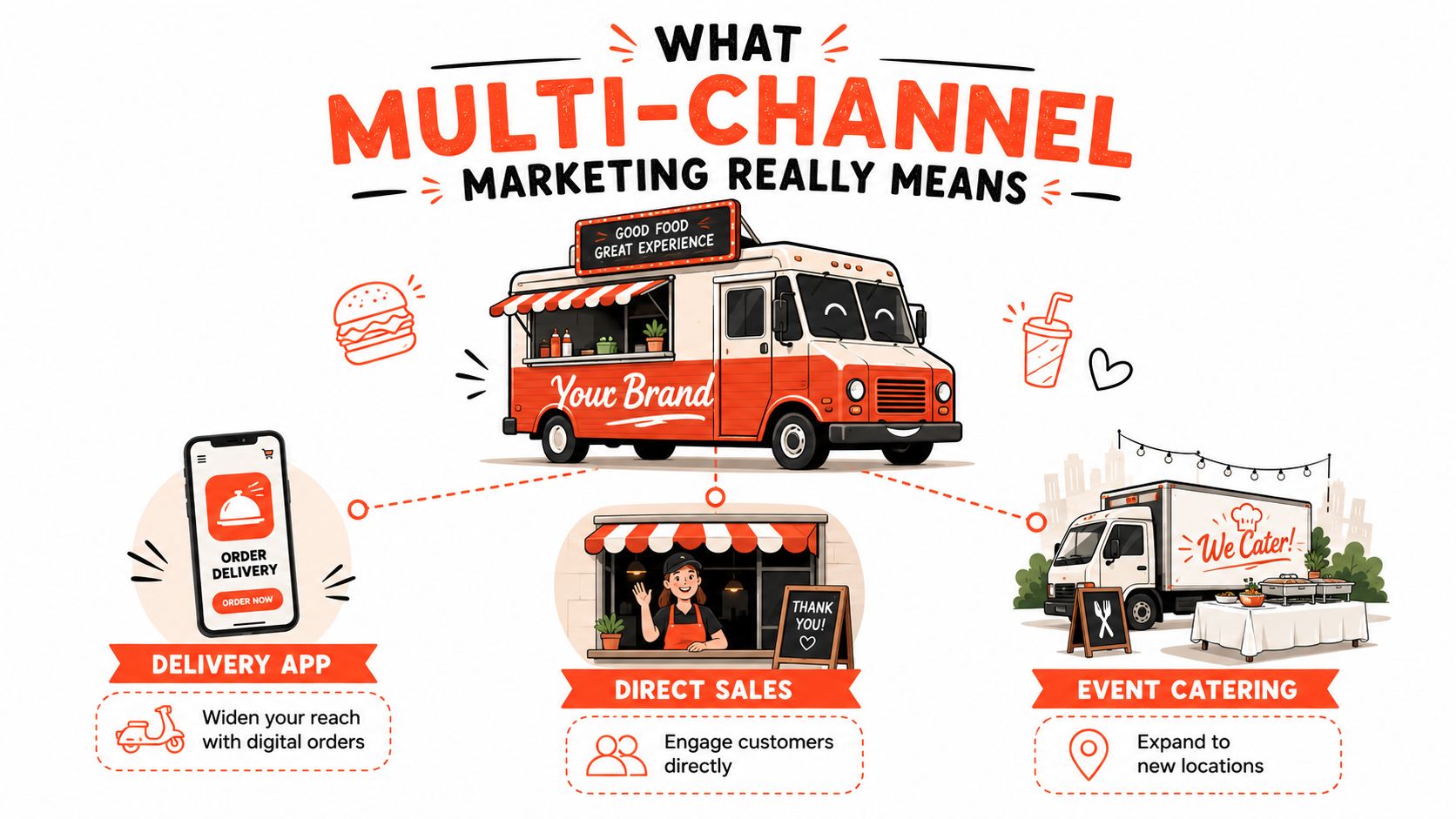
Your brand is the food truck. Your channels are the neighborhoods. A blog, email newsletter, LinkedIn page, Instagram account, YouTube channel, podcast feed, and in some businesses even in-person events can all be channels.
The key point is that each one can operate independently. The message can be related, but the channels don't have to share the same data, workflow, or user path.
Why the independence matters
That independence is the technical heart of multichannel. As the CDP.com glossary definition of multichannel marketing explains, channels such as email, social, web, mobile, and in-store operate independently rather than sharing data or coordinating messaging, so each touchpoint creates a separate measurement and optimization problem instead of a unified customer journey.
That sounds abstract until you feel it in practice:
- Your newsletter performs well, but you can't easily tell whether that later influenced a consultation booking from LinkedIn.
- Your Instagram posts get saves, but those signals may sit apart from website behavior.
- Your blog attracts search traffic, while your short-form videos drive awareness, yet you evaluate both in different dashboards.
This is why multi-channel is best understood as a hub-and-spoke distribution model. The hub is the core idea. The spokes are the versions of that idea adapted for each platform.
Multi-channel doesn't mean posting the exact same thing everywhere. It means distributing one core message across several distinct touchpoints.
For a creator, that's liberating. You don't need every channel to connect perfectly. You need each channel to carry the idea in a format that fits the place where people encounter it.
That's also why multi-channel shouldn't be dismissed as incomplete marketing. In many businesses, especially content-first ones, independent channels aren't a flaw. They're a practical operating model.
Multi-Channel vs Omnichannel A Critical Distinction
The confusion usually starts here. People hear “multi-channel” and assume it means “not yet advanced enough to do omnichannel.” That framing misses the operational tradeoff.
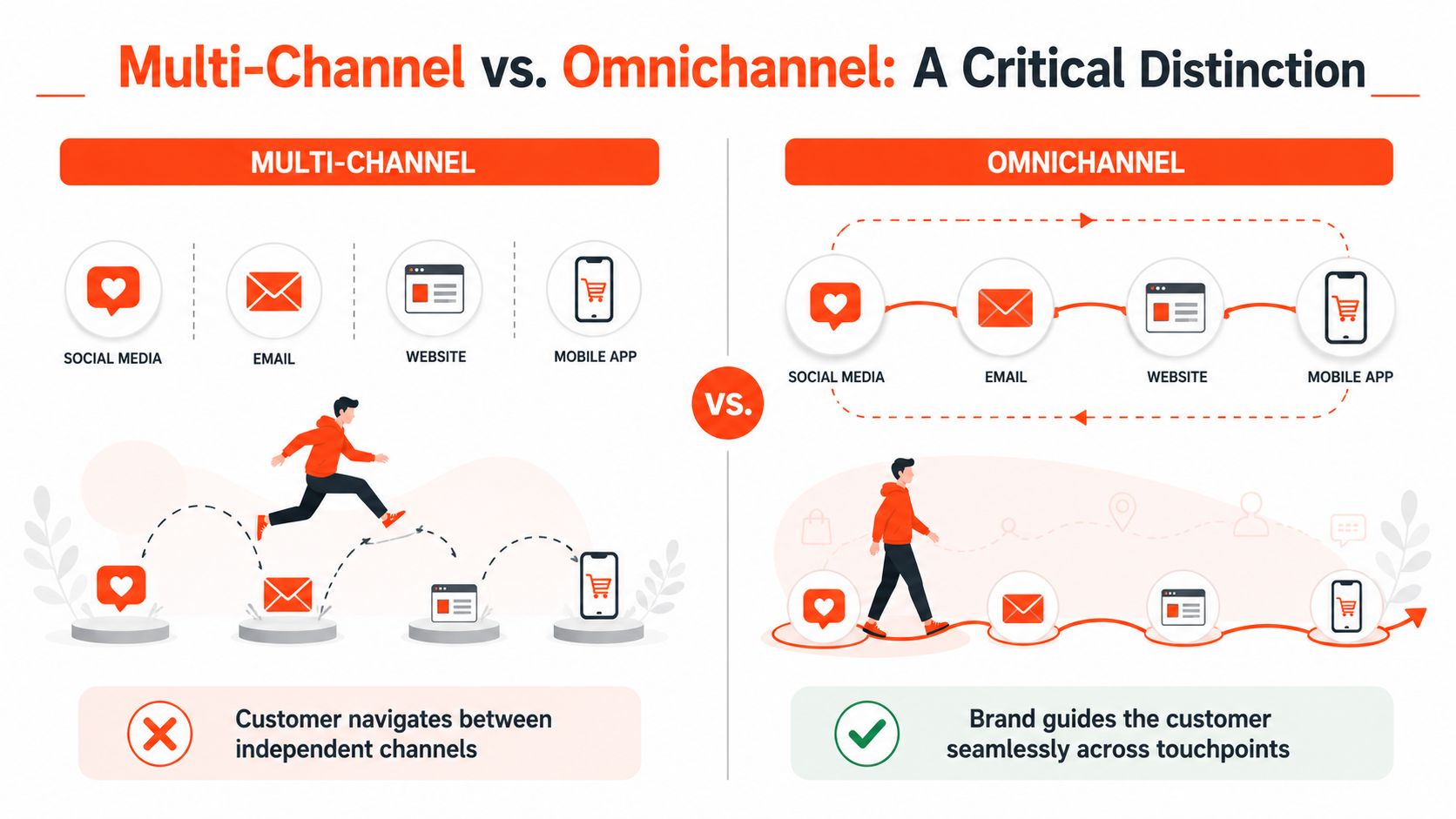
The better analogy is retail. A brand with separate stores, separate promotions, and separate systems is multi-channel. A brand that lets you browse online, buy on mobile, pick up in store, and return anywhere without friction is omnichannel.
The shortest useful distinction
Multichannel means you use more than one channel.
Omnichannel means those channels are integrated into one connected experience.
That distinction matters because customer expectations have changed. The CM.com discussion of multichannel and omnichannel notes that 73% of consumers prefer shopping through more than one channel, 91% of businesses use two or more social media channels, and the multichannel marketing market is projected to grow from $6.96 billion in 2023 to $28.6 billion by 2030 by 2030.
A creator or small business owner should read that carefully. It doesn't mean you need a giant integrated stack tomorrow. It means your audience already moves across multiple environments, and your business needs a response that fits your resources.
A short explainer helps make the contrast visual:
Multi-Channel vs. Omnichannel at a Glance
| Attribute | Multi-Channel | Omnichannel |
|---|---|---|
| Core focus | Brand presence across several channels | Customer experience across connected channels |
| Channel relationship | Channels can run separately | Channels are designed to work together |
| Data model | Often siloed or channel-specific | Shared data supports continuity |
| Content workflow | Adapt one message for multiple platforms | Coordinate messaging across a full journey |
| Best fit | Lean teams, creators, practical distribution needs | Larger systems, deeper integration needs |
| Main challenge | Inconsistent reporting and duplicated effort | Complexity of integration and governance |
Which one fits a lean content business
For a coach, advisor, or small B2B team, omnichannel can be the right long-term direction. But it also demands tighter operations: shared data, cleaner attribution, more coordination, and clearer brand rules.
Multi-channel is often the smarter choice when the objective is reach plus consistency, not perfect continuity. If you publish a strong article and turn it into email, LinkedIn, Instagram, and video snippets, you're not trying to create one uninterrupted customer journey. You're trying to meet people in the formats they already consume.
That's where clear operating rules matter. A simple set of brand guidelines for content teams helps separate “independent channels” from “chaotic channels.” The channels may stand alone, but your voice, visual identity, and claims still need to match.
Omnichannel is more integrated. Multi-channel is more modular. Neither is automatically better. The right choice depends on what your team can run well.
Key Benefits and Common Pitfalls of a Multi-Channel Strategy
Where multi-channel pays off
The strongest argument for multi-channel is reach with relevance. One person reads email during work. Another checks LinkedIn between meetings. Someone else saves short videos and ignores newsletters entirely. If you stay in one format, you'll miss whole segments of your audience.
There's also real performance upside when teams expand touchpoints thoughtfully. The Landbase roundup on multi-channel outreach statistics says campaigns using three or more channels achieve 287% higher purchase rates than single-channel campaigns. In the same discussion, LinkedIn response rates are reported at 10.3% versus 5.1% for email.
That doesn't mean “post everywhere and win.” It means more touchpoints can materially outperform a single-channel setup when the content is coordinated and matched to the platform.
Three practical benefits stand out:
- Wider discovery: A long-form article may catch search traffic, while a short clip can introduce the same idea to people who would never read the full post.
- Format matching: A consultant's framework might work best as a carousel on LinkedIn, a quote graphic on Instagram, and a deeper explanation in email.
- Lower content waste: Instead of publishing once and moving on, you extract more value from the work you already did.
Where teams get tripped up
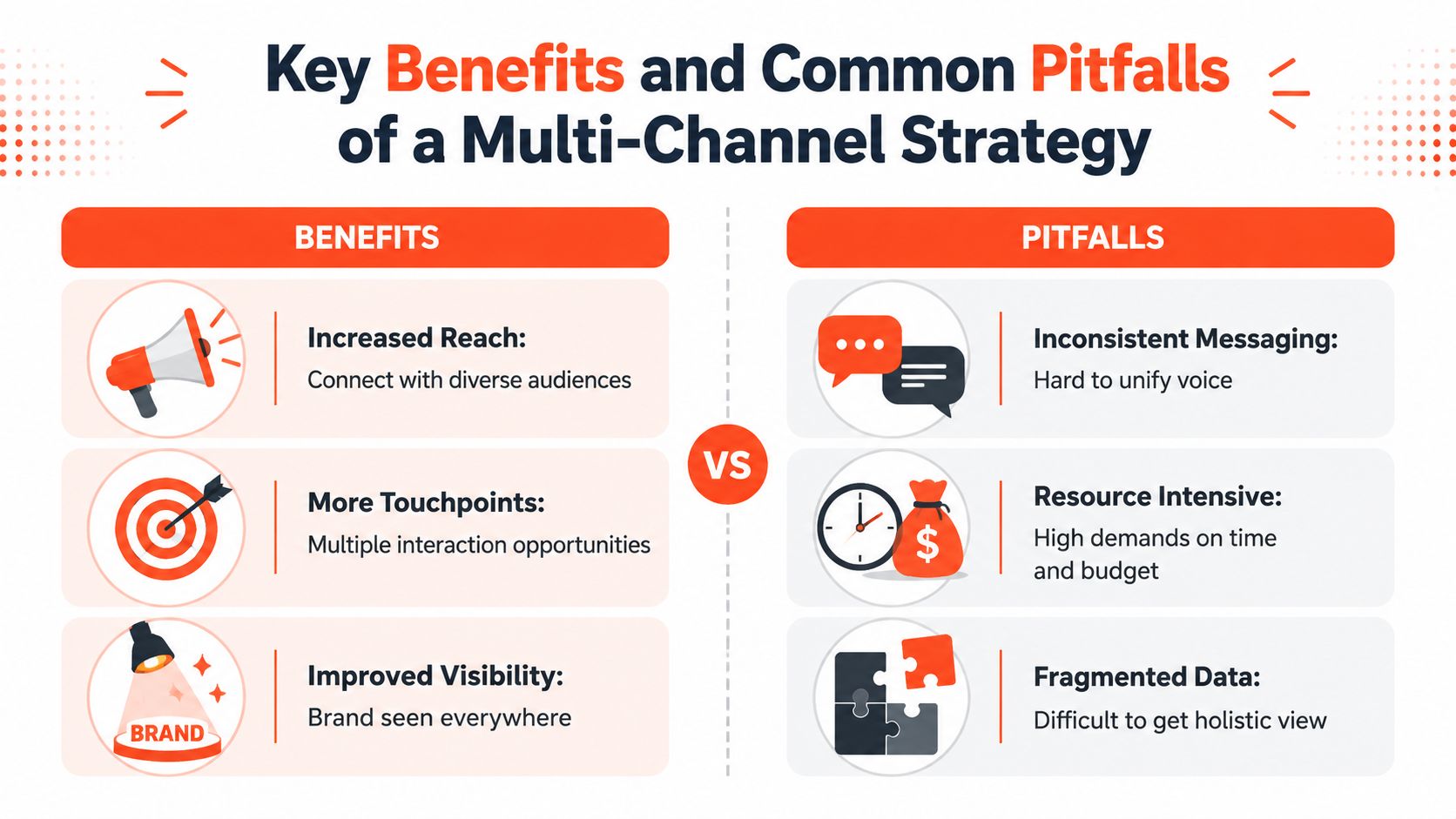
The downside is fragmentation. Once several channels are active, teams often create separate mini-systems for each. Different captions, different visuals, different timing, different metrics. Soon nobody knows what “worked” in a way that can be accurately compared.
Separate channels are manageable. Separate logic for every channel usually isn't.
Common pitfalls usually look like this:
- Inconsistent messaging: One platform sounds formal, another sounds casual, and the website says something else entirely.
- Scattered measurement: Social engagement sits in one dashboard, email in another, site conversions somewhere else.
- Duplicated effort: The team keeps recreating assets from scratch instead of adapting from a source piece.
- Channel overload: You add platforms faster than you can maintain quality on them.
Many articles get the concept backward. They treat these weaknesses as proof that multi-channel is second-rate. In practice, they're signs that the team needs a better operating system, not necessarily a fully omnichannel rebuild.
For content-led businesses, multi-channel works best when the unit of planning is the source asset. One webinar. One article. One podcast episode. Then every derivative asset stems from that source, instead of being invented channel by channel.
Multi-Channel Strategy in Action with Examples
One source asset many channel versions
Take a business coach who hosts one weekly webinar on pricing strategy.
The webinar recording becomes the source asset. From there, the coach creates a blog post summarizing the central lesson. A short email goes to subscribers with one key insight and a link to the replay. Two opinion-led LinkedIn posts pull out the strongest arguments. A vertical video clip highlights the clearest one-minute explanation. A simple quote graphic carries the sharpest line to Instagram.
Nothing about that process requires full omnichannel integration. The channels don't need to “talk” to one another in a technical sense. They just need to express the same idea in ways that feel native to each platform.
The smartest multi-channel workflows don't start with channels. They start with one durable idea.
A newsletter writer can do the same thing. Start with the weekly issue. Turn the opening argument into a LinkedIn post. Convert the best paragraph into a short talking-head video. Pull three contrarian lines into quote cards. Reframe the most practical section as a checklist for email subscribers.
Why this works for busy experts
This approach is especially useful for people whose expertise is deep but whose publishing time is limited. Lawyers, advisors, educators, consultants, and niche creators often have no shortage of strong ideas. What they lack is a repeatable distribution rhythm.
Multi-channel gives them one.
It also reduces the pressure to be “original” on every platform every day. A financial advisor doesn't need seven unrelated content ideas for seven channels. They need one solid source piece, then channel-specific edits. LinkedIn may want a sharper professional angle. Instagram may want a visual takeaway. Email may want context and a direct call to reply.
That's what makes multi-channel practical rather than theoretical. It turns content production from a constant invention problem into an adaptation problem. And adaptation is faster, easier to delegate, and easier to maintain.
How to Build Your Multi-Channel Content Engine
Start smaller than you want
Teams often choose too many channels too early. That usually produces thin output everywhere instead of strong output somewhere.
Start with two or three channels that fit both your audience and your content format. A consultant might pick blog, LinkedIn, and email. A creator with strong on-camera delivery might choose YouTube, Instagram, and TikTok. The point isn't coverage for its own sake. The point is reliable execution.
The Vonage article on multichannel vs. omnichannel makes the tradeoff clear: for many lean teams, multichannel is operationally preferable when speed and channel-native formatting matter more than full journey integration.
Build a repeatable repurposing system
Once your channels are chosen, the engine needs rules.
A practical setup looks like this:
Choose one source asset per cycle
Pick the anchor piece first: a podcast, article, webinar, newsletter, or transcript. That's the raw material every other asset pulls from.Define channel roles
Don't ask every channel to do the same job. Let LinkedIn spark professional conversation. Let email deepen trust. Let short video drive attention.Lock your brand basics
Colors, fonts, logo use, recurring phrases, and tone should be decided once. That avoids the “different company on every platform” problem.Create adaptation templates
Keep a repeatable list: one summary post, one contrarian post, one clip, one quote card, one email teaser. Templates reduce decision fatigue.Use scheduling and repurposing tools
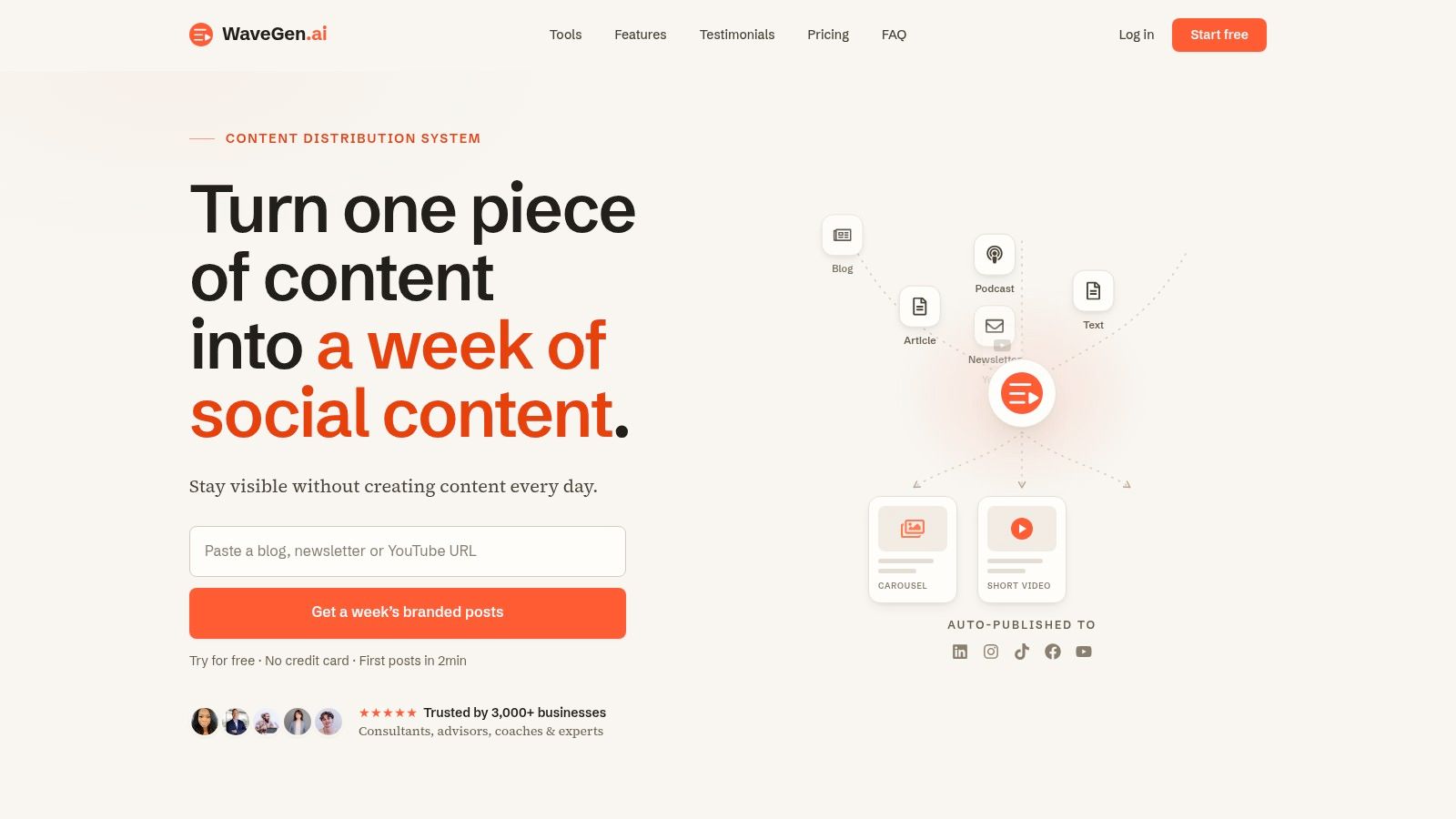
Tools like Canva, Buffer, Later, Descript, and WaveGen.ai for turning one source asset into platform-specific social content can help teams generate and publish channel-formatted assets without rebuilding everything manually.Review by source asset, not by channel alone
Use a lightweight planning system so each article or episode gets a full distribution pass. A simple editorial calendar template for content distribution helps keep those repurposing cycles visible.
The main idea is simple. Multi-channel works when you make it systematic. It fails when every platform becomes its own little factory.
If you publish long-form content and need a cleaner way to turn it into channel-specific posts, videos, and visual assets, WaveGen.ai is one option built for that workflow. It takes a source piece like an article, newsletter, podcast script, or transcript and helps convert it into on-brand assets for platforms such as LinkedIn, Instagram, TikTok, YouTube, and Facebook, with scheduling and editing in the same process.
multi channel meaning
multi channel marketing
content distribution
omnichannel vs multichannel
marketing strategy
Turn this kind of writing into a week of social content.
Paste a blog post, newsletter, or rough draft — WaveGen turns it into publish-ready carousels, captions, and slideshows for every channel.
No credit card · First posts in 2min