Turn your research paper into a carousel.
Upload the PDF, link the paper or paste the abstract. WaveGen makes a carousel that walks through the question, the method, the results and the limits in plain language, with the paper cited at the end.
GENERATED WITH WAVEGEN · DEMO
From an abstract to a six-slide research summary.
WaveGen made the carousel below from this sample. No brand kit was applied; with yours, it uses your colors, fonts and logo.
THE ABSTRACT
Street trees and sidewalk heat: measurements from 40 city blocks J. Okafor, L. Brandt, S. Mehta. Urban Climate Lab (sample abstract) Question: How much cooler are sidewalks under street trees on hot days? Method: We measured sidewalk surface temperatures every hour on 40 blocks in one city over 18 summer days above 30°C, and compared blocks by tree canopy cover. Results: At 3 pm, sidewalks on blocks with more than 40% canopy were on average 11°C cooler than on blocks with under 10% canopy. Air temperature at head height differed by 1.5°C. The difference was largest between noon and 5 pm. Limits: One city and one summer. We did not measure humidity or how people used the sidewalks. Takeaway: Street trees mostly cool the surfaces people walk and sit on, more than the air.
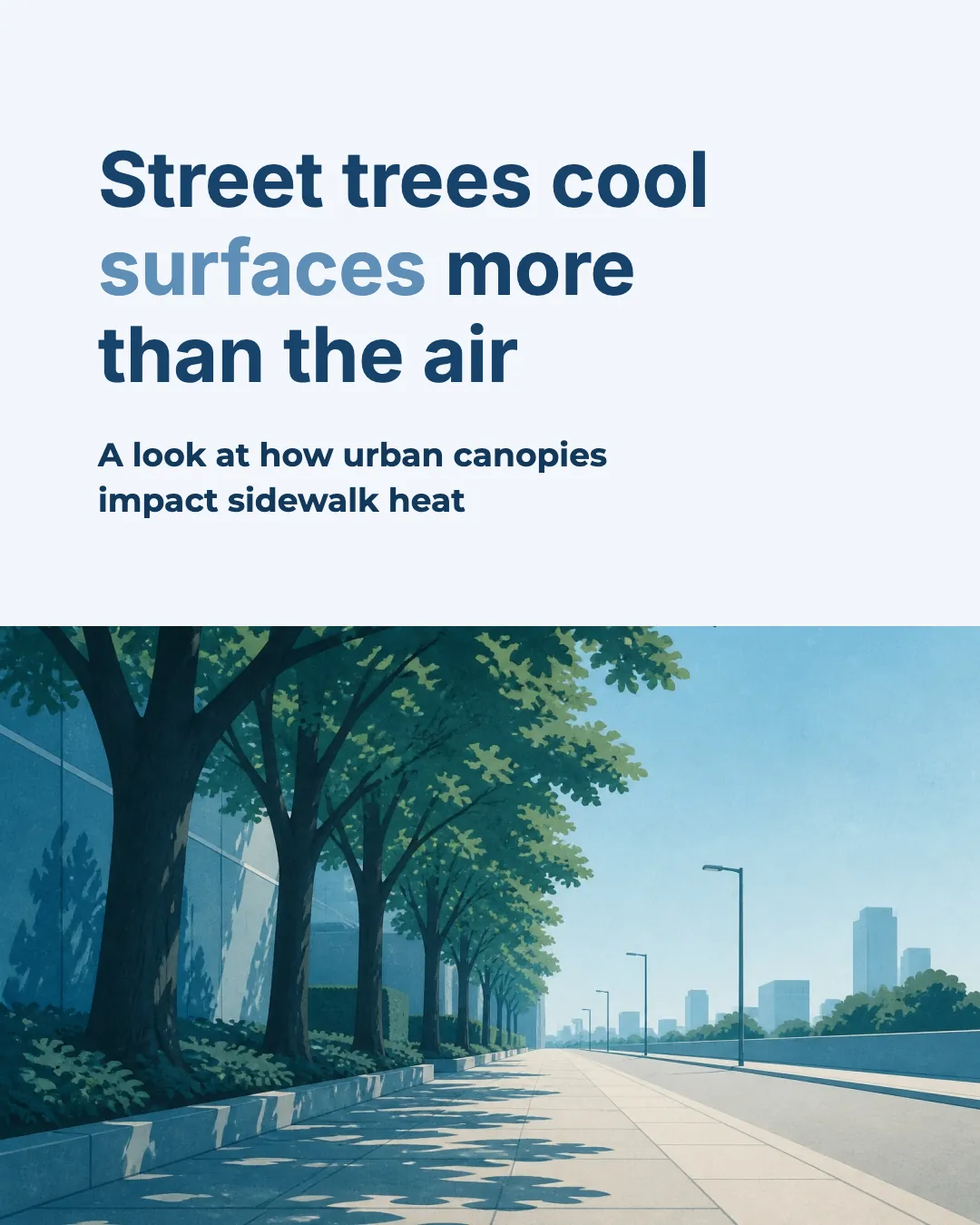
Slide 1 of 6
Finding first, limits included
The cover states the main finding in plain language, and a slide covers what the study didn't measure.
Cited at the end
The last slide gives the paper's title and authors, so readers know where the numbers come from.
Read the example caption
How much cooler are sidewalks under street trees on hot days? A recent study by J. Okafor, L. Brandt, and S. Mehta from the Urban Climate Lab measured sidewalk surface temperatures to find out. Over 18 summer days with temperatures above 30°C, researchers tracked 40 city blocks every hour. The results were clear: at 3 pm, sidewalks on blocks with more than 40% canopy cover were on average 11°C cooler than those with under 10% canopy. Interestingly, the air temperature at head height only differed by 1.5°C. The data shows that street trees primarily cool the surfaces we walk and sit on, rather than the surrounding air. While the study is limited to one city and one summer, and didn't measure humidity, it highlights the tangible impact of urban canopy on extreme heat. #UrbanPlanning #ClimateResearch #UrbanCanopy #StreetTrees #UrbanClimateLab
How to turn a research paper into a carousel
01
Add your paper
Upload the PDF, link the paper's page, or paste the abstract.
02
Generate the summary
WaveGen writes the question, method, results and limits in plain language, one idea per slide, with a caption.
03
Check it and share
Make sure every result and number matches the paper, then post it with a link to the full text.
Explain your work to people outside your field.
Most people who would care about your paper will never read it. A plain-language carousel can reach them, and other researchers too.
Lead with the finding
Put the result on the first slide in one sentence anyone can follow. The method can come after.
Keep the numbers and the limits
Say what you found and how sure you are. Mentioning the limits makes the post more credible, not less.
Cite the paper
End with the title, the authors and a link, so readers can go to the source.
Research Paper to Carousel FAQs
Who should know about your findings?
Upload your paper and turn it into a post anyone can follow.