July 31, 2026
17 min read
Voice and Tone Guidelines: A Complete Framework
Learn to write voice and tone guidelines teams follow, with frameworks, examples, and review workflows for consistent content across channels.
You can feel it in the first month after a style guide ships. One writer sounds crisp, another sounds like a product brochure, support sounds cautious, and marketing sounds like a different company entirely. The document exists, but the team still improvises, which is exactly why voice and tone guidelines fail when they're treated like a creative artifact instead of an operating system.
The fix starts with a clean distinction. Voice is the stable personality that should survive across channels and authors. Tone is the situational adjustment that changes with reader state, channel, and stakes. GOV.UK's 2011 tone standard made that plain-language mindset operational by telling writers to avoid promotional language, unexplained acronyms, unrealistic claims, and to keep communications focused on one subject, one idea per headline, and one thought per sentence, with short words replacing long ones where possible (GOV.UK tone of voice guidance).
That's why abstract adjectives fail. “Authentic,” “approachable,” and “friendly” sound good in a workshop and collapse in a shared doc because no one knows what to write next. A working system gives writers rules, examples, and review paths, so the guide helps people make decisions instead of asking them to interpret branding poetry.
Table of Contents
- Why Most Voice and Tone Guidelines Fail on Day One
- The Five Components of a Working Voice and Tone System
- Examples That Make the Boundary Between Voice and Tone Visible
- Adapting Voice Across Channels Without Breaking It
- A Review Workflow That Keeps Voice and Tone Consistent
- Measuring Whether Your Voice and Tone Guidelines Are Working
Why Most Voice and Tone Guidelines Fail on Day One
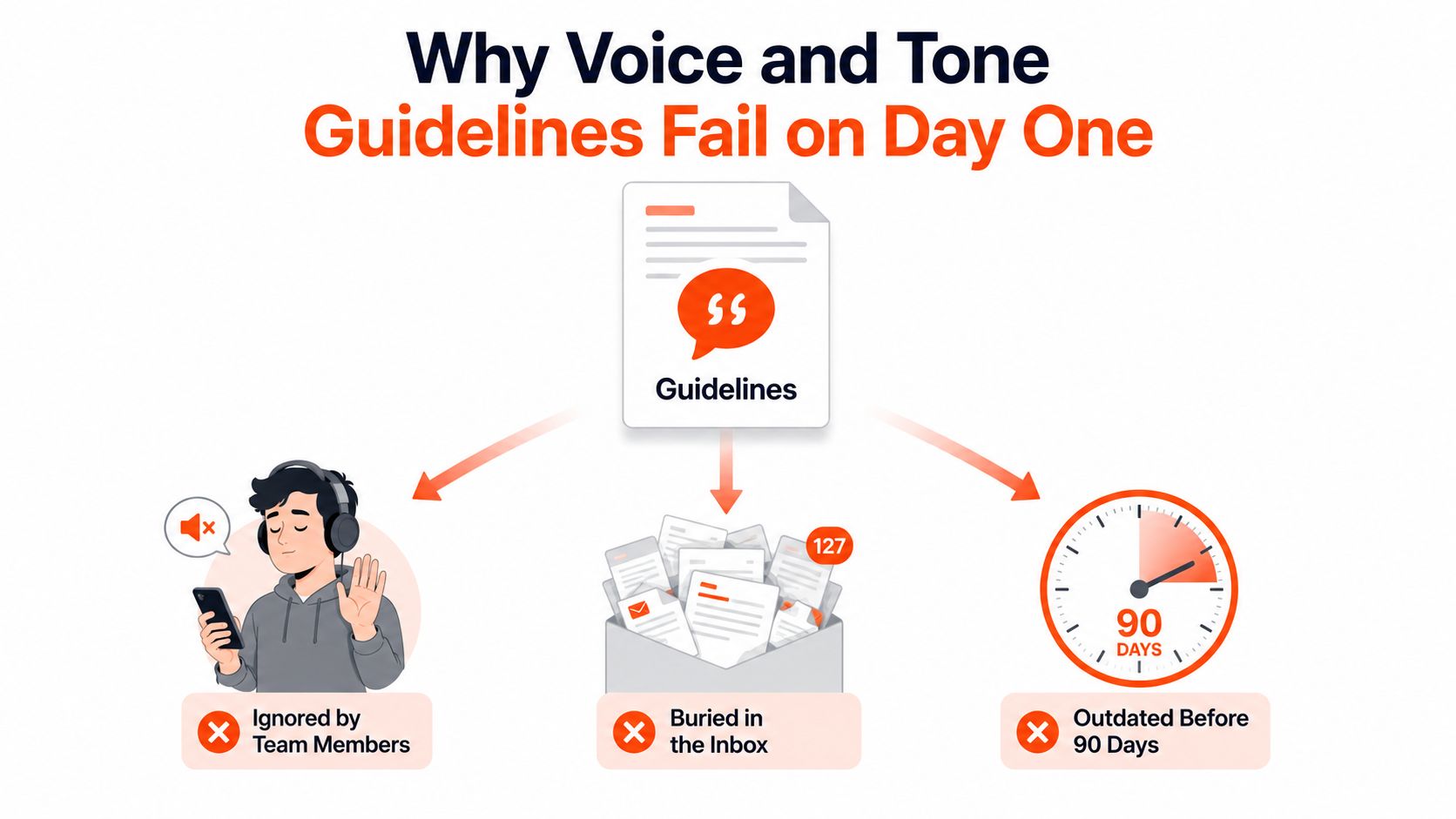
The failure pattern is familiar. A team spends weeks debating adjectives, publishes a polished PDF, then watches writers ignore it because the guide doesn't help them solve real writing problems. The content still lands in inboxes, CMS drafts, and support macros with slightly different personalities, because the rules were never specific enough to survive production.
Voice stays stable, tone changes on purpose
The core mental model is simple. Voice is the durable brand personality, the part that should feel recognizable whether the reader is on a pricing page or reading a password reset. Tone changes with context, so a warning, a launch announcement, and a support reply can all sound appropriate without sounding like different brands.
That distinction is baked into strong public guidance. GOV.UK's 2011 standard pushes writers toward one thought per sentence, one idea per headline, and simpler words, which is really a voice system disguised as plain language rules (GOV.UK tone of voice guidance). Healthwatch's 2024 guidance turns tone into an editorial discipline by recommending sentences of about 20 words or fewer and putting the most important information at the top of the page (Healthwatch tone of voice guidelines).
A useful shortcut is to ask two questions before writing: what never changes, and what must flex for this moment? If that answer isn't obvious, the guide isn't operational yet.
Practical rule: If a writer can't tell when to use the guideline, the guideline is decoration, not process.
For teams wanting a quick refresher on structure and examples, writing tone examples and checklists can help, but the work is turning those examples into rules people can apply without debate.
Why adjectives fail in real use
Adjectives fail because they're too easy to agree on and too hard to execute. “Friendly” can mean warm greetings to one writer, slang to another, and emoji to a third. “Professional” can mean concise for one team and stiff for another, which is how a brand ends up sounding polished in one channel and robotic in another.
The better test is behavioral. Say what the brand does, not what it is. A guideline that says “we're approachable” leaves room for interpretation. A guideline that says “we use contractions in customer-facing content, we answer directly, and we avoid jargon unless the audience uses it first” gives a writer something concrete to do.
The failure on day one usually isn't bad intent. It's that the document was built for approval, not use. That's the gap every strong system has to close.
The Five Components of a Working Voice and Tone System
A workable system needs more than a list of traits. It needs a structure that can survive handoffs, reviews, and channel changes without turning into a pile of subjective opinions. In practice, five pieces do the heavy lifting: a voice statement, a small set of tone dimensions, paired do and do-not examples, a tonal spectrum for context shifts, and a short list of anti-patterns that signal drift.
Start with one sentence that names the job
The voice statement should be short enough to remember and specific enough to guide decisions. A strong version does more than describe the brand with adjectives. It explains how the brand behaves and why that behavior matters. A B2B software company might define voice as “clear, calm, and direct, so customers can understand the product without translating marketing language.”
That sentence does two jobs. It tells writers what the voice feels like, and it tells them what the voice is for. Technical-writing guidance consistently favors that kind of stable voice paired with context-sensitive tone, because one sentence can be reused across support, product, and marketing without forcing every channel to sound identical (voice and tone in technical documentation).
Keep tone dimensions small and testable
Tone is the next layer. Many guides get bloated here because teams list every adjective they like. Better systems reduce tone to a small, testable set of dimensions, then define what each one looks like in practice. Nielsen Norman Group recommends keeping the list small and validating it with users using 3-point or 5-point Likert scales, which helps teams avoid mushy tone vocabulary and drift (NNG tone of voice dimensions).
A practical set might include directness, warmth, confidence, and urgency. Keep it tight. Add anti-tone words too, the terms that sound tempting but do not fit the brand, so writers know what to avoid when they draft quickly.
Keep the list short enough that a new writer can actually hold it in working memory.
Build examples and anti-patterns together
Examples are where guidelines become usable. A do and do-not pair shows the boundary faster than a paragraph of explanation. Anti-patterns do the same thing from the other side. If you only show approved copy, writers still have to guess where the line is. If you only show banned language, they do not know what to write instead.
The best guides pair each rule with at least one approved example and one weak version. That format makes review easier too, because editors can point to an example instead of arguing from taste. It also reduces the risk of off-brand writing becoming a hidden template that later authors copy. For teams that also manage email programs, the same discipline shows up in SaaS email automation advice, where reusable patterns matter more than one-off clever lines.
Map a tonal spectrum for situations
Tone needs a range, not a single setting. A launch email may sit higher on energy and lower on formality than a billing notice, while both still sound like the same company. Technical guidance makes the same point: tone shifts with the situation, whether the piece is a warning, a feature announcement, or a tutorial, because reader state changes what good sounds like.
Flag the anti-patterns that cause drift
The final component is a short drift list. This names the habits that break consistency, such as promotional language, unexplained jargon, or exaggerated claims. GOV.UK's plain-language rules are useful here because they show how operational a good anti-pattern list can be, especially when writers need clear constraints rather than abstract ideals (GOV.UK tone of voice guidance).
| Component | Purpose | Format |
|---|---|---|
| Voice statement | Defines the stable brand personality | One sentence |
| Tone dimensions | Shows how the voice flexes by situation | 3 to 5 testable traits |
| Do and do-not examples | Makes the boundary visible | Paired samples |
| Tonal spectrum | Guides context-based shifts | Simple range or scale |
| Anti-patterns | Prevents drift and generic writing | Short banned list |
A useful internal reference for shaping that structure is this brand voice overview, especially if your team needs a cleaner distinction between constant voice and variable tone.
Examples That Make the Boundary Between Voice and Tone Visible
Guidelines start to work when writers can compare bad copy with copy that sounds like the brand. Voice should stay steady across channels, but tone has to bend to the reader's moment, and the fastest way to teach that is with concrete examples. These four cases make the boundary visible without turning the document into a pile of abstract adjectives.
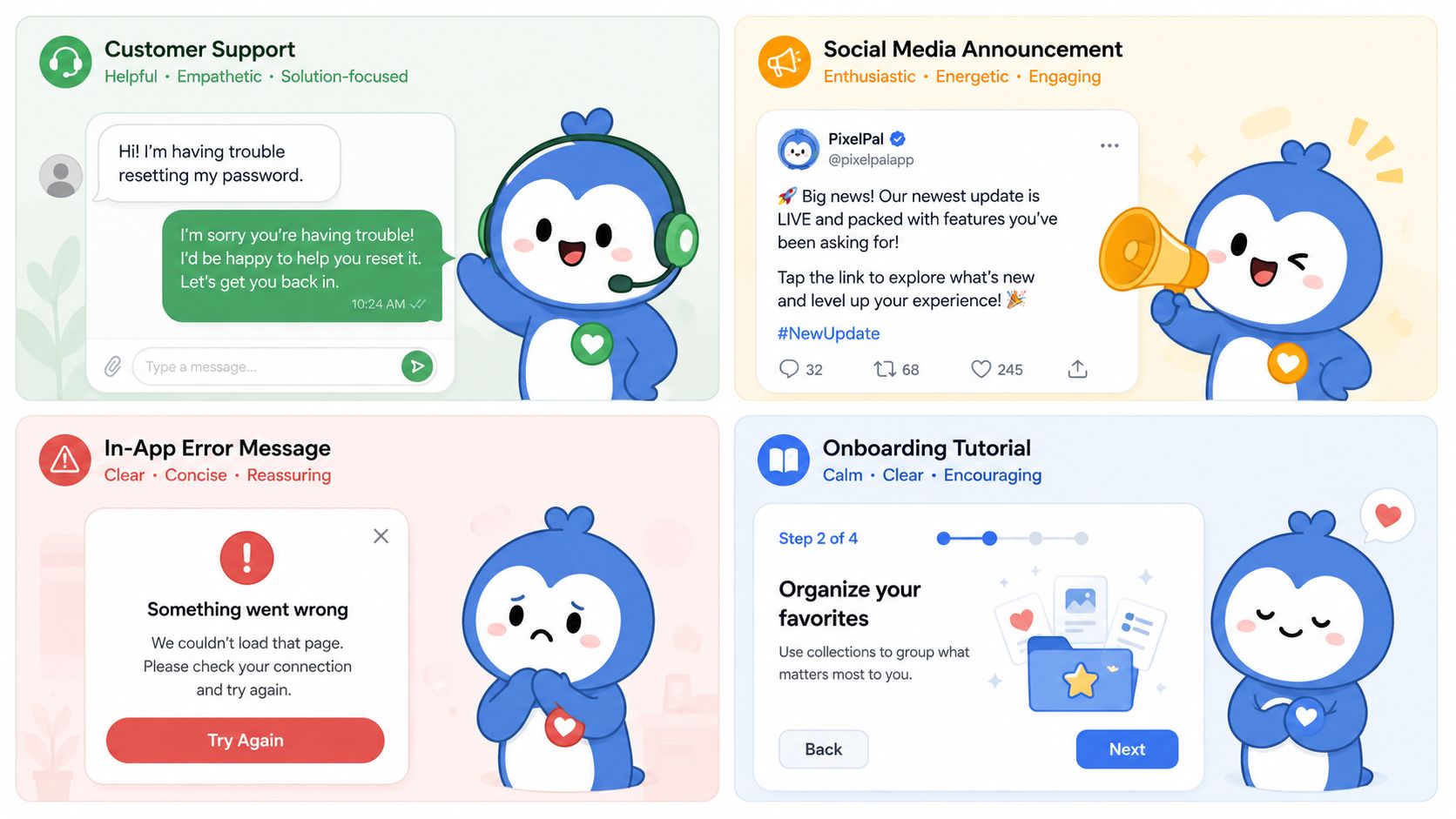
Customer support reply
Weak version. “Sorry for the inconvenience. We understand your frustration. Please try again later.”
Strong version. “I can see the login issue on your account. I've reset the session on our side, and you should be able to sign in now. If it still fails, send me the time you tried and I'll check the error path.”
The voice stays calm and direct, but the tone becomes more personal and solution-oriented because the reader needs help, not a brand promise. Support copy works best when it sounds accountable and specific, while still avoiding casual banter that would make the fix feel less serious.
Social media announcement
Weak version. “We're thrilled to announce our latest update. This new release transforms the way you work.”
Strong version. “We've shipped a cleaner dashboard and faster filters. If you've been waiting for less clicking and fewer tabs, this one's for you.”
The shift here is energy and brevity. Social usually rewards tighter phrasing and a clearer payoff, so tone carries more of the personality while the voice remains recognizable. For teams writing social-heavy messaging, content creation automation guidance is a useful reference for keeping output consistent without pushing every post through the same manual review path.
In-app error message
Weak version. “Something went wrong. Please contact support if the problem persists.”
Strong version. “We couldn't save your changes because the connection dropped. Try again in a moment, and if this keeps happening, contact support with code 418.”
The tone needs to be precise, not cheerful. A good error message reduces uncertainty, names the next step, and avoids language that sounds written for marketing instead of troubleshooting.
First-time user onboarding email
Weak version. “Welcome to the platform. We hope you enjoy all the features we offer.”
Strong version. “Welcome aboard. Start with your profile, invite one teammate, and then try the dashboard tour. You'll have the basics set up in a few minutes.”
The voice stays helpful and plain-spoken, but the tone is encouraging and action-led. Onboarding content works best when it cuts down choice and points people to one clear next move.
Annotation rule: Document what changed, not just the final copy. Note whether the shift was formality, warmth, urgency, directness, or specificity.
A simple template helps the library grow without turning into a junk drawer:
- Context: What content type is this?
- Weak version: What drifted or felt off?
- Approved version: What should future writers copy?
- Shift note: Which tone dimension changed, and why?
For teams building email-heavy systems, a practical companion is Voicy's guide to AI email writing, especially when the goal is to keep voice rules intact while the channel stays fast-moving.
Adapting Voice Across Channels Without Breaking It
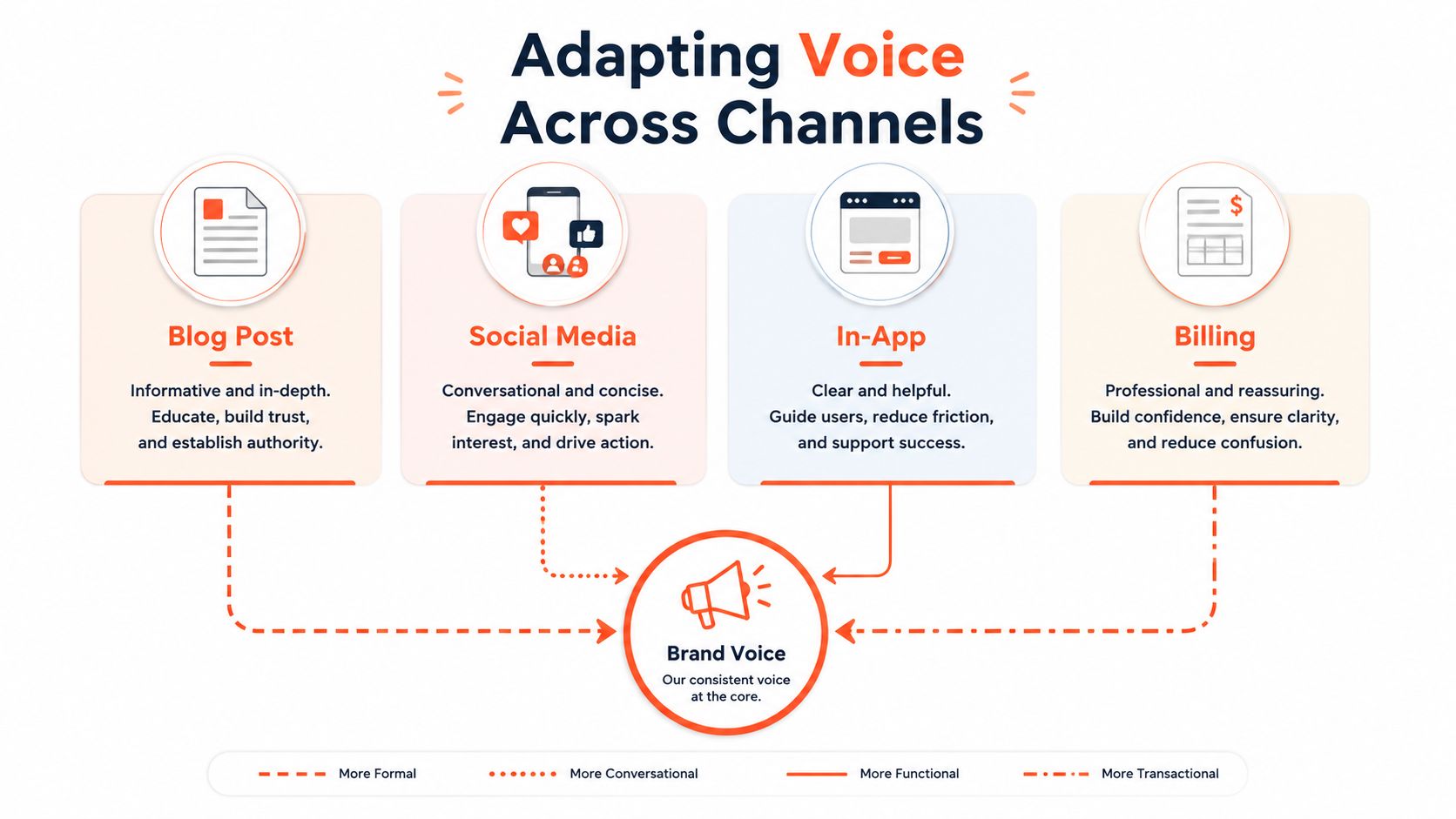
The same brand voice can't sound identical everywhere, and it shouldn't. A long-form website page, a transactional email, and a support reply all ask the reader to do different work, which means the voice stays steady while the tone shifts to match the channel. The trick is to flex the right dimensions without changing the brand's core rhythm.
Channel, audience, and stakes all matter
Website content can afford more explanation because readers are usually exploring. Email often needs a sharper point because it arrives in an already crowded inbox. Social needs quicker emotional read, while in-product copy has to be short and immediate. Support sits closer to problem solving, which means clarity outranks charm.
That's why channel rules help more than blanket adjectives. The team should decide which dimensions stay locked and which can move. A voice may always stay direct and plain-spoken, but formality, humor, and length can shift by channel.
| Channel | Formality | Humor | Directness |
|---|---|---|---|
| Moderate to high | Light, if any | High | |
| Lower | More room for personality | Medium | |
| Error states | High | Usually none | Very high |
| Transactional email | Moderate | Limited | High |
Keep one voice, build tonal sub-profiles
You don't need a separate voice for every channel. You do need a sub-profile when the stakes and user expectation change enough that the default tone would feel awkward. A billing notice, for example, should not borrow the energy of a campaign post, even if both are written by the same content team.
A practical rule is to ask whether the channel changes the reader's emotional state. If it does, tone probably needs its own notes. If it doesn't, the main voice system may be enough.
The best channel guidance is operational. It tells writers which words to avoid, which sentence lengths fit the channel, and how much personality the reader can absorb before clarity drops. That's the kind of detail most content creation tools still need to produce usable drafts, which is why some teams pair a voice guide with systems like content creation automation to keep outputs aligned across formats.
Build a quick channel checklist
Before a writer publishes, these checks catch most mismatches:
- Reader state: Are they browsing, deciding, fixing, or waiting?
- Information density: Does this channel need compression or explanation?
- Tone risk: Would humor, slang, or formality create friction here?
- Action required: Is the next step obvious without extra text?
The more channels a team supports, the more valuable this checklist becomes. It gives editors a way to approve variation without letting the voice fragment into a dozen inconsistent versions.
A Review Workflow That Keeps Voice and Tone Consistent
A voice guide only matters if someone uses it during production. The cleanest way to make that happen is a lightweight workflow with named roles, a small checklist, and one clear decision point before publication. The goal isn't bureaucracy. It's repeatability.
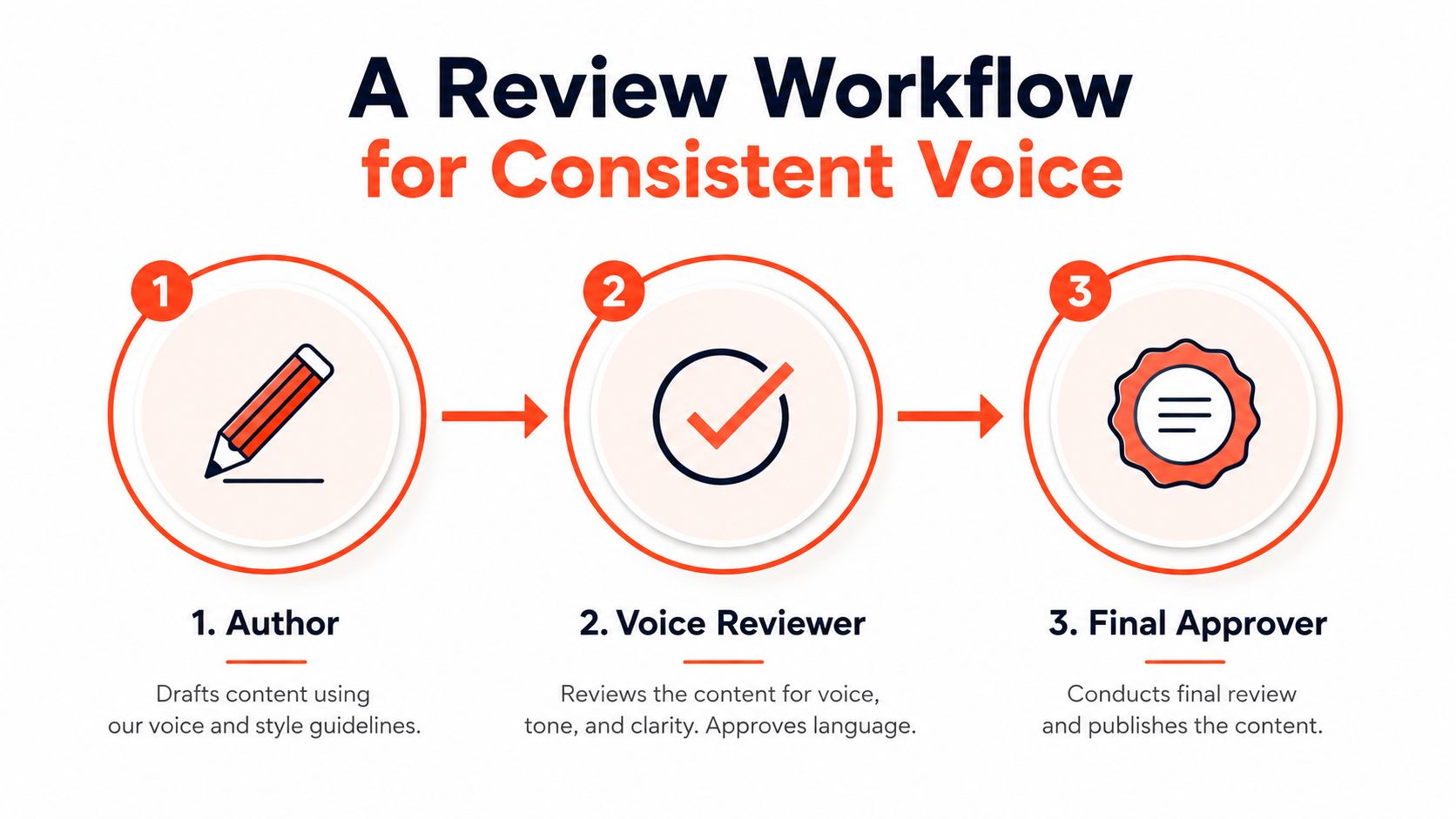
The three roles that keep drift out
The author drafts with the guide open. The voice reviewer checks whether the piece matches the approved voice, tone, and structural rules. The final approver gives the publishing sign-off, usually from a content lead, editor, or channel owner.
That split works because it separates creation from judgment. If the same person writes and approves everything, drift creeps in through familiarity. If too many people approve, the workflow slows to a crawl and the guide becomes something people consult only when they're stuck.
A simple rule works well: the reviewer is responsible for language, not for rewriting the strategy. If the message is wrong, that's a separate decision. If the message is right but the phrasing drifts, the reviewer corrects it against the guide.
A five-item checklist catches most problems
A short rubric is enough for teams:
- Voice match: Does it sound like the brand, not like a generic company?
- Tone fit: Does it match the reader's state and the channel?
- Clarity: Can the reader get the point without extra decoding?
- Structure: Is the information ordered in a way the audience can use?
- Drift markers: Are there banned phrases, jargon, or overpromises?
WaveGen.ai's brand kit and voice tooling can help teams apply that kind of consistency across repurposed content, but the same review logic still needs a human decision before anything goes live.
Keep the workflow fast enough to survive
A review system fails when it becomes a queue. That usually happens when every draft needs the same level of scrutiny, even when the content is low risk. Better teams define which content types require full review and which can use spot checks or templated approval.
The onboarding step matters too. New writers shouldn't have to memorize the whole guide on day one. Give them a one-page summary, two approved examples, and the checklist above. That's usually enough to start producing acceptable drafts while they learn the deeper rules.
For organizations formalizing the rest of the system, how to create brand guidelines is a helpful companion because it shows how voice fits inside the larger brand operating model.
Measuring Whether Your Voice and Tone Guidelines Are Working
Publishing the guide is the starting point, not the finish line. Until readers experience the tone you intended, the document is just a reference file. A voice and tone system only works if it holds up in real content, under real deadlines, and across the people who have to use it.
Test perception, not just polish
The first check is whether users can feel the difference you wanted. Short user tests work well because they force a direct answer. Does this reply sound reassuring, clear, cautious, or confident? Structured rating scales are useful here because they keep feedback consistent instead of turning every review into a vague opinion.
A few diagnostic questions go a long way:
- Does this sound like the brand we expect?
- Does the tone fit the situation the reader is in?
- Is there any word or phrase that feels off for this channel?
Use those questions in quick reviews, user sessions, or internal audits. They expose the gap between “technically correct” and “actually right,” which is usually where tone problems hide.
Audit drift on a fixed cadence
Guidelines drift because teams change, products change, and channel mix changes. A regular audit gives the team a chance to catch those shifts before they harden into habit. For high-use systems, a quarterly rhythm is often enough to reveal patterns without turning review into a burden.
The audit itself does not need to be heavy. Sample a small set of recent pieces, score them against the checklist, and note where writers keep missing the same rule. If the same issue keeps showing up, the problem is usually in the guide, the examples, or the approval path, not in the individual writer.
Keep the review practical. Healthwatch's advice to keep the most important information up top and sentences short is a useful benchmark when content starts to sprawl again (Healthwatch tone of voice guidelines).
Treat multilingual and AI-assisted content carefully
Tone gets harder when content moves across languages, regions, and AI rewrites. Humor, idioms, contractions, and informal phrasing can flatten or shift meaning after localization, so a tone that feels warm in one market can feel awkward in another. The stronger public guidance on voice and tone points toward research-informed wording choices and user testing, especially for global content systems (Australia's style manual on voice and tone).
That is why evidence-based tone decisions matter. If a team wants “friendly” to mean the same thing in every market, it needs to test the output instead of assuming the label will travel. The same caution applies to AI-assisted rewrites, which can preserve grammar while changing register or stripping out helpful nuance.
If the guideline cannot survive localization, it is not finished.
The practical response is straightforward. Test with real users, document the failure patterns, and revise the guide before the next publishing cycle. That is how voice and tone stop being a one-time branding exercise and start operating like a durable content process.
WaveGen.ai helps teams turn a single piece of content into channel-ready social assets while keeping brand kit settings, including voice, consistent across outputs. If you are trying to keep voice and tone guidelines usable across blogs, emails, and social posts, visit WaveGen.ai and see how a repurposing workflow can support that process.
voice and tone guidelines
brand voice
content style guide
tone of voice
content governance
Turn this kind of writing into a week of social content.
Paste a blog post, newsletter, or rough draft — WaveGen turns it into publish-ready carousels, captions, and slideshows for every channel.
No credit card · First posts in 2min