July 29, 2026
13 min read
What Is Brand Voice: Define and Apply It
Wondering what is brand voice? Learn to define, document, and apply it consistently across content and WaveGen.ai social assets.
You've probably lived this already. Your newsletter sounds thoughtful and precise, then your Instagram captions suddenly sound playful in a way that feels borrowed from another company. Your website says one thing, your support replies say another, and even though each individual message is fine, the brand itself starts to feel scattered.
That mismatch is usually what people mean when they ask what is brand voice. It's not a cosmetic layer you add at the end. It's the verbal system that helps every channel sound like it came from the same company, whether the copy was written by a marketer, a founder, a support agent, or an AI tool.
Table of Contents
- The Hidden Cost of Inconsistent Messaging
- What Brand Voice Really Means
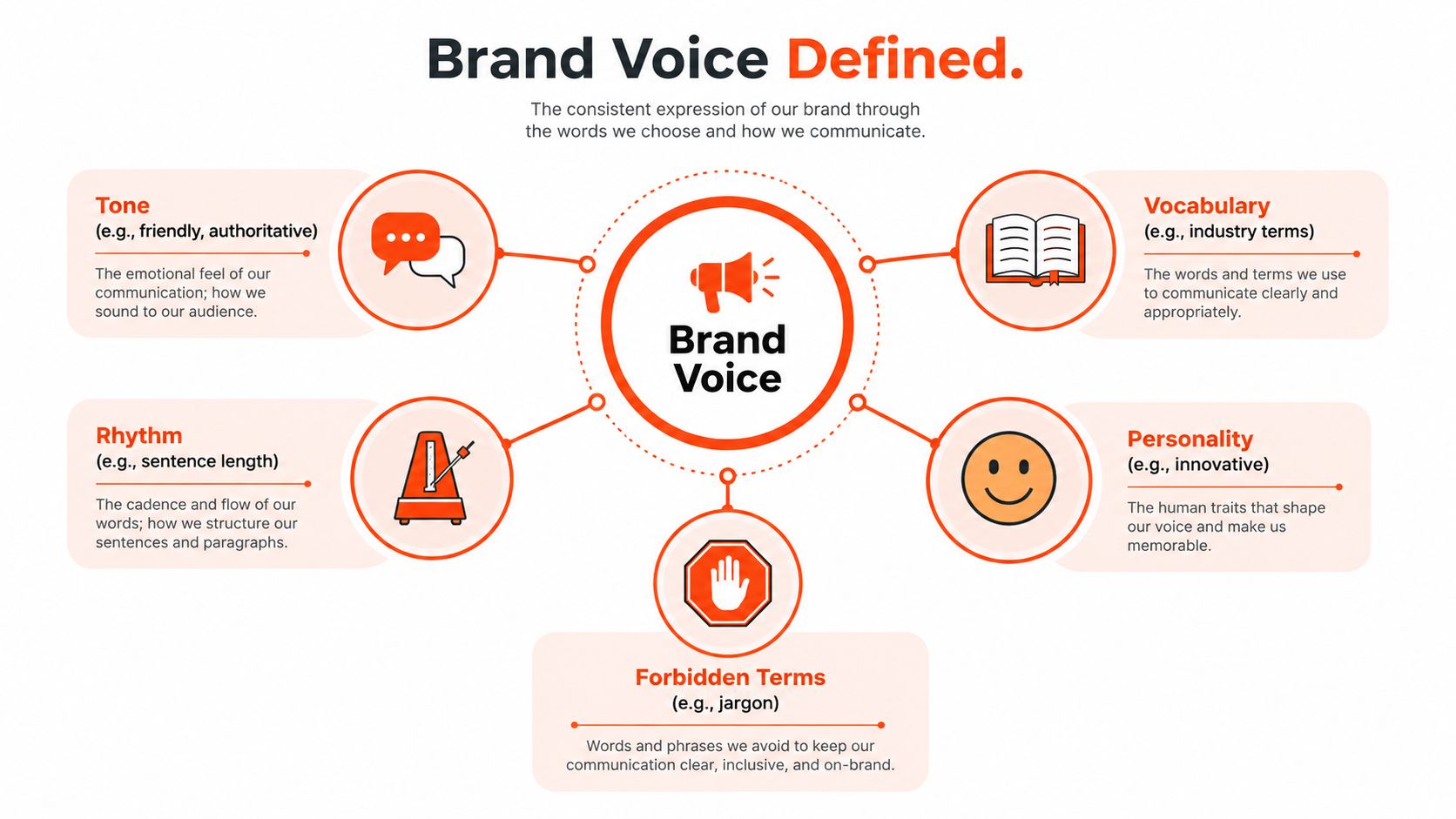
- Core Elements of a Documented Voice
- Strong and Weak Brand Voice Illustrations
- Business Impact of Voice Consistency
- Build and Apply Your Brand Voice System
- Key Takeaways on Brand Voice
The Hidden Cost of Inconsistent Messaging
A brand can look polished in one place and disjointed in another. A newsletter may sound calm and authoritative, a social post may sound playful and casual, and a customer reply may fall back into stiff corporate language. None of those messages is wrong on its own, but the mix makes the brand harder to recognize. It is like hearing the same person speak in three unrelated voices.
Brand voice is the verbal personality a company uses across channels, and consistency is what keeps that personality recognizable. Research on brand consistency points to the business cost of letting it drift. Analysts linked to Lucidpress reported that companies with consistent brand presentation saw 23% to 33% revenue increases, and a 2021 Content Effectiveness Report survey of 452 professionals found that 68% of companies with brand consistency programs reported 10% to 20% revenue growth (source). Voice is part of the system that keeps those messages aligned.
Why mismatch feels bigger than “just style”
People rarely judge a brand from one channel alone. They collect signals over time. If your homepage sounds expert, your emails sound uncertain, and your social posts sound like they belong to another company, buyers have to work harder to decide whether they trust you.
Consistency helps buyers feel like they are dealing with one brand, not a rotation of personalities.
That is why the problem matters before you ever write a formal definition. Inconsistent wording creates friction. A reader may not be able to name the issue, but they can feel that something is off.
Brand voice works like the connective tissue across websites, ads, emails, support, and social content. For teams building that broader asset layer, the comprehensive guide on brand asset management is a useful companion. Voice lives inside that system, because the words need the same discipline as the visuals.
The practical takeaway is simple. If different people can publish for your brand without shared verbal rules, the message will drift. Once that happens, each new post has to work harder to rebuild the same identity.
What Brand Voice Really Means
Brand voice is the company's stable verbal identity. A simple analogy helps here. Think of a person you know well. They might speak differently at a dinner table, in a client meeting, or in a quick text message, but you still recognize them because their habits stay consistent. Brand voice works the same way.
Voice is a system, not a mood
Modern guidance treats voice like a documented system, not a vague preference. Industry guidance recommends building a voice guide with 3 to 5 core characteristics, defining 10 to 15 example sentences, and testing it across at least 5 surfaces such as homepage copy, product UI, email nurture, social media, and customer support (source). That structure matters because voice has to survive different writers and different formats.
In practice, brand voice is usually operationalized through controlled language variables. Those variables include tone, vocabulary level, sentence rhythm and structure, personality traits, and forbidden terms (source). Once you define those pieces, voice stops being subjective. Teams can check whether a draft fits the system instead of arguing over whether it “feels right.”
Practical rule: If a guideline can't help two different writers make the same choice, it isn't specific enough yet.
A beginner often confuses voice with tone. Voice is the stable personality. Tone shifts with context. The same brand can sound reassuring in a support email, direct on a pricing page, and more energetic in a campaign, while still keeping the same underlying word choices and rhythm.
The easiest way to spot brand voice
If you strip away the topic and look only at the writing habits, voice shows up in recurring decisions. Does the brand use short sentences or longer ones? Does it prefer technical terms or plain language? Does it speak in second person, first person plural, or a more formal distance?
The internal question is not “Do we sound clever?” It's “Do we sound like ourselves, consistently, across channels?” That's the test for what is brand voice in practice.
For a broader framework on how voice definitions become formal brand systems, what is a brand kit is a useful next reference. A brand kit gives voice a place beside visual rules, so teams aren't guessing every time they create something new.
Core Elements of a Documented Voice
A documented voice guide turns a broad idea into a working system. It should do more than sound polished on paper. It needs to give a new writer, a freelancer, or an AI draft the same rules every time, without asking them to guess what the brand “probably means.”
What belongs in the guide
The best starting point is a short set of core characteristics, usually 3 to 5 of them, because too many traits get fuzzy fast. A voice guide also needs concrete examples, not just adjectives. That means writing sample sentences that show what the brand sounds like when it is on target, so the rules are easy to apply in real work, not just easy to admire in a document.
A useful structure looks like this:
- Core characteristics: the traits you want repeated every time
- Example sentences: short samples that show the traits in action
- Surface tests: checks across homepage, UI, email, social, and support
- Forbidden terms: words or phrases that pull the brand off course
These elements matter because the guide becomes a reusable governance system. If a team can point to a rule, they can use it with confidence. If they cannot, they are relying on memory and taste, which makes voice drift from one draft to the next. For teams that want to turn those rules into a repeatable brand system, how to create brand guidelines is a useful companion.
Why documentation needs examples and limits
The phrase “be friendly” sounds clear until three people interpret it three different ways. One person writes casual slang, another writes warm but polished copy, and a third adds emojis because they think friendliness means informality. A documented voice guide prevents that drift by naming the behavior more precisely, the way a recipe lists ingredients instead of asking the cook to improvise flavor from memory.
Testing the voice on real surfaces matters for the same reason. A homepage headline and a customer support reply should not sound identical, but they should still feel like they come from the same verbal system. A guide that only works in theory is not enough, because the true test is whether it holds up in the places customers read.
The strongest voice guides do not ask writers to guess. They remove the guesswork, then give the team a reference point they can apply across long-form content and AI-generated social assets through a brand kit. That is the value of documentation. It makes voice repeatable, and once it is repeatable, it can scale.
Strong and Weak Brand Voice Illustrations
The easiest way to understand voice is to compare it in the wild. A strong voice sounds coherent even when the topic changes. A weak voice feels as if different people wrote each piece with no shared standard.
Warm mentor versus crisp technical voice
A warm mentor voice might say, “Start with one clear message, then build from there. Your readers don't need more noise, they need direction.” It sounds encouraging, steady, and human. The vocabulary is plain, the rhythm is conversational, and the message feels like advice from someone who's been there.
A crisp technical voice might say, “Define the rule set first, then apply it across channels. Consistency depends on structure, not improvisation.” It's firmer and more compressed. The sentence rhythm is tighter, and the language signals precision over warmth.
Neither one is better. The important part is that each one stays consistent with itself.
Where brands lose recognition
Weak voice usually shows up when a brand mixes signals inside the same message. A homepage might say, “We deliver enterprise-grade clarity,” while the next sentence says, “And we keep it fun.” A support article might open with jargon, then end with slang. A social post might swing from polished to goofy in one paragraph.
Those shifts are distracting because they make the brand harder to place. Readers are left guessing whether they're talking to a serious software vendor, a lifestyle creator, or a casual community account.
A better approach is to choose a lane and stay in it.
- If the brand is expert-led: use clear, direct wording and minimize fluff.
- If the brand is supportive: sound steady, reassuring, and helpful.
- If the brand is playful: keep the playfulness controlled, not chaotic.
The mistake isn't choosing a personality. The mistake is changing personalities midstream.
Anti-examples that break the system
A mixed voice often sounds like this: “We're thrilled to revolutionize your workflow. But seriously, this thing is kind of a lifesaver.” That sentence is trying to be two different brands at once.
Or: “Our platform is powerful, but don't worry, it's also super chill.” That kind of phrasing doesn't build trust. It feels improvised.
When you review copy, ask a simple question. If this line were removed from context, would it still sound like the same company as the rest of our content? If the answer is no, the voice is drifting.
Business Impact of Voice Consistency
A customer reads your homepage, then your onboarding email, then a support reply. If each message feels like it came from a different company, the brand has to be re-learned every time. Voice consistency lowers that friction. It gives people a stable pattern to recognize, which makes the brand easier to trust and easier to remember.
What the numbers say
Research linked to Lucidpress reports that companies with consistent brand presentation saw 23% to 33% revenue increases. A 2021 Content Effectiveness Report survey of 452 professionals found that 68% of companies with brand consistency programs reported 10% to 20% revenue growth. Those figures do not prove that voice alone drives every outcome, but they do show that consistency is tied to measurable business results.
The business logic is simple. Repeated verbal signals reduce the mental work customers do to decode your message. When the language feels steady, the experience feels more reliable. One industry source also frames consistent brand communication as associated with a 23% to 33% revenue uplift (source).
Why consistency matters across the full journey
Voice shapes more than marketing copy. It shows up in product UI, help content, onboarding emails, ads, and support replies. If those surfaces sound unrelated, the customer has to adjust expectations at every step.
That adjustment cost is easy to miss, but it matters. A thoughtful brand voice makes discovery, evaluation, purchase, and support feel like parts of one experience. Customers may not label that pattern out loud, yet they notice when it breaks.
For teams that want a related view of how audiences respond to language shifts, BeyondComments sentiment analysis is a useful resource because it helps you watch how reactions change when wording changes. That kind of feedback can show whether your voice feels coherent or fragmented in public discussion.
Bottom line: consistency is not polish. It is a business function.
If your company already tracks performance across channels, voice belongs in that conversation. It shapes how people interpret your claims, how they respond to your offers, and how much confidence they bring into the next interaction. That is why the business case for brand voice is stronger than a style preference. It is a system choice.
Build and Apply Your Brand Voice System
A brand voice only becomes useful when a team can use it the same way every time. Start by reviewing a small set of current pieces that already feel on-brand, then look for patterns you can repeat. Notice sentence length, preferred terms, recurring openings, and any words that should stay out of the copy.
Turn voice into rules
A practical voice system usually works in three layers. First, state the core personality in plain language. Second, turn that personality into rules, such as whether you use contractions, how technical you get, and which phrases are off-limits. Third, place examples beside each rule so writers can see the pattern instead of guessing from the label alone.
That structure matters because both AI drafts and freelance contributors need explicit direction. Guidance on AI-era voice management recommends codifying rules, examples, and templates so the brand voice can hold up across different content types and channels (source). That matters even more when long-form content gets broken into smaller social assets.
Here is a simple workflow:
- Audit existing content. Find pieces that already sound on-brand.
- Extract repeatable traits. Turn instinct into rules.
- Add examples and anti-examples. Show what fits and what does not.
- Test across surfaces. Review posts, emails, support replies, and product copy.
- Revise after real use. Update the guide when teams run into edge cases.
Apply it across automated content
A brand kit makes the system easier to use. WaveGen.ai, for example, lets teams set brand kits once, including colors, fonts, logo, and voice, so repurposed content can stay aligned as it becomes carousels, short videos, quote cards, and captions. That helps teams publish across multiple platforms without rewriting every asset by hand.
If you manage several profiles at once, the operations side gets more complex. A separate workflow resource like master multiple social media accounts can help with account management, while your voice system keeps the writing itself consistent. The two tasks overlap, but they are not identical.
The core test is simple. If a new writer or an AI draft followed your guide tomorrow, would the result still sound like your brand? If the answer is no, the rules are still too loose. Strong systems do not depend on memory. They depend on repeatable language.
Key Takeaways on Brand Voice
Brand voice is the stable verbal identity behind your content, not a loose style choice. It becomes useful when you document it as a system, with a small set of core characteristics, example sentences, and clear limits on what the brand will and won't say. Once that structure exists, teams can apply it across channels without starting from scratch every time.
The evidence points in the same direction. Consistent brand presentation has been associated with measurable revenue growth, and the practical reason is simple. People trust what feels familiar, and they recognize familiarity when the language stays coherent across touchpoints.
The best brand voice guides do two jobs at once. They help humans write better, and they help AI tools produce drafts that don't sound generic. That's why the next step is not to “find your voice” in an abstract sense. It's to write it down, test it, and use it everywhere it matters.
WaveGen.ai helps teams turn one long-form piece into a week of on-brand social content, while keeping the same voice, visuals, and formatting rules in place. If you want a practical way to apply a documented brand voice across carousels, captions, and short videos, visit WaveGen.ai and see how its brand kit workflow fits into your content process.
what is brand voice
brand voice
brand consistency
content strategy
WaveGen.ai
Turn this kind of writing into a week of social content.
Paste a blog post, newsletter, or rough draft — WaveGen turns it into publish-ready carousels, captions, and slideshows for every channel.
No credit card · First posts in 2min