August 14, 2026
16 min read
Thought Leadership Positioning: Strategy Guide for 2026
Learn how to build thought leadership positioning that earns trust, drives RFP invites, and lifts premium pricing. A practical guide for 2026.

75% of decision-makers and C-suite executives said a single piece of thought leadership pushed them to research a product or service they weren't previously considering, and 73% said it's a more trustworthy basis for evaluating capability than marketing materials and product sheets, according to the 2024 Edelman-LinkedIn B2B Thought Leadership Impact Report. That's the job of thought leadership positioning. It's not content for content's sake, it's a commercial filter that changes who pays attention, who trusts you, and who ends up in the next conversation.
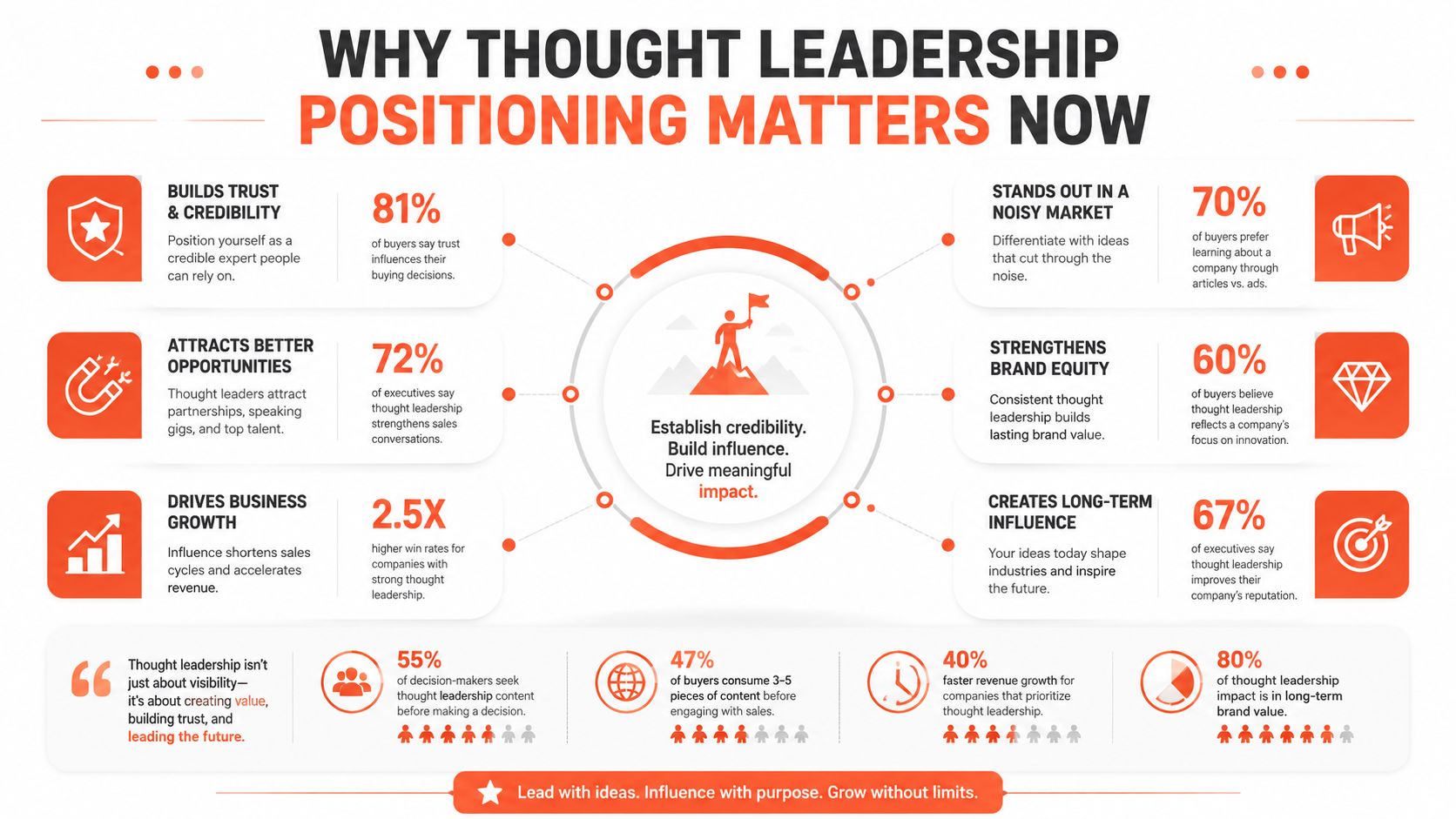
The mistake most B2B teams make is treating thought leadership like an output problem. They publish, promote, and hope the market notices. Buyers don't reward volume on its own, though, they reward clarity, relevance, and a point of view that helps them evaluate risk before a sales conversation starts.
When positioning is sharp, the content does work that product sheets can't. It pre-qualifies interest, raises trust, and makes your expertise easier to compare against alternatives. The same Edelman-LinkedIn research found that 86% of decision-makers would be moderately or very likely to invite an organization with consistently high-quality thought leadership into an RFP, and 90% were more likely to be receptive to sales or marketing outreach from that organization. It also found that 60% were willing to pay a premium to work with that company, which is why this is a revenue issue, not just a brand one. Edelman-LinkedIn B2B Thought Leadership Impact Report
Practical rule: if your content doesn't change buyer behavior, it's decoration, not positioning.
The opportunity is obvious for consultants, agencies, and B2B marketers who already publish but still struggle to prove pipeline impact. A vague stream of “useful” posts creates attention without direction. A defined position gives buyers a reason to lean in, and it gives your team a way to measure whether perception is shifting, not just whether impressions are climbing.
Table of Contents
- Why Thought Leadership Positioning Matters Now
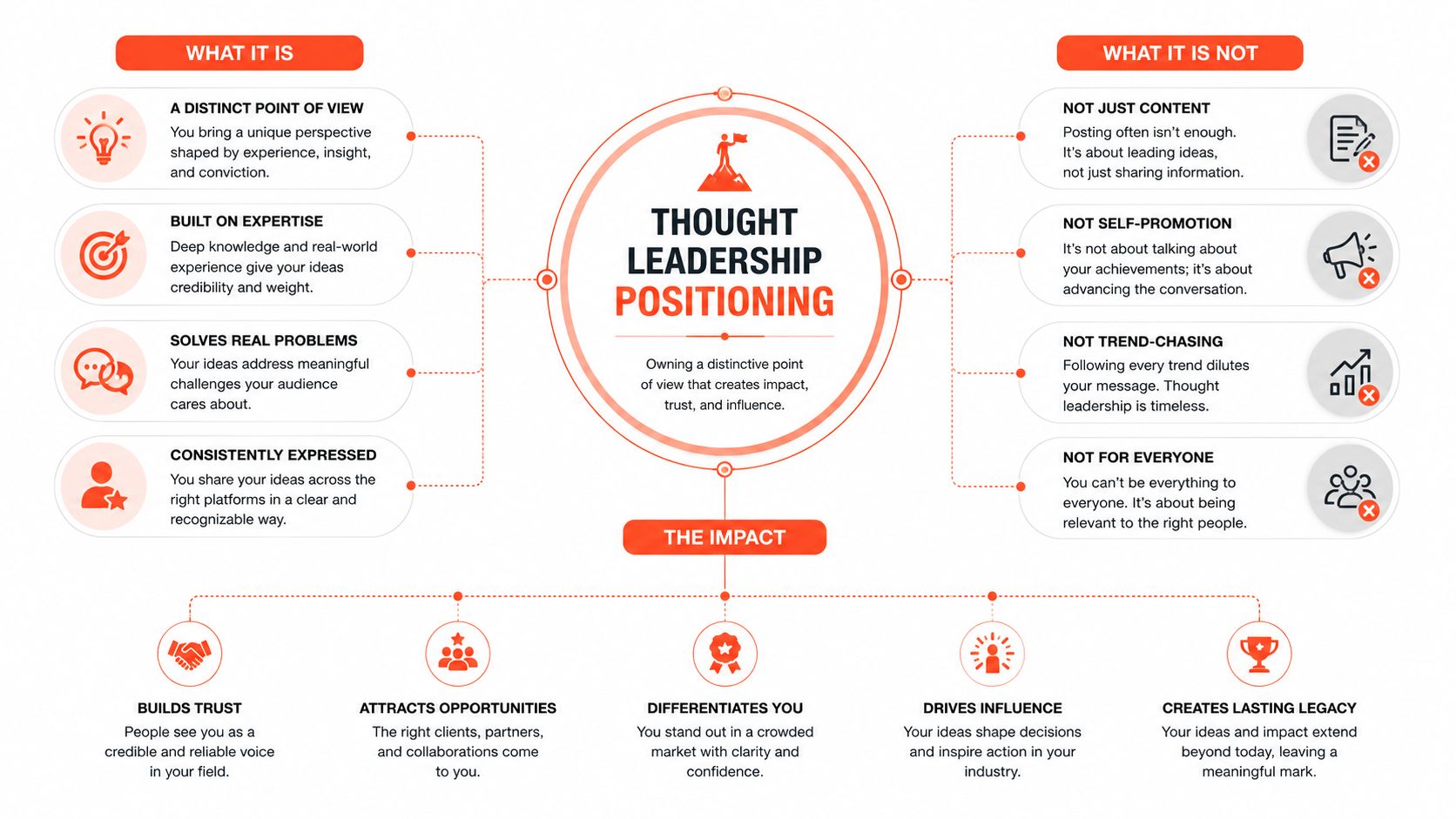
- What Thought Leadership Positioning Means
- The Four Building Blocks of a Defensible Position
- Leading With the Problem, Not Your Solution
- Content Strategy, Repurposing, and Distribution Cadence
- Measuring Position Strength and Market Influence
- Real-World Positioning Patterns That Work
- Common Pitfalls and a 90-Day Activation Plan
Why Thought Leadership Positioning Matters Now
Senior buyers now use thought leadership as a commercial filter. They use it to decide whether a vendor deserves a closer look, whether an RFP invite belongs on the table, and whether a sales conversation is worth the time. That is a different job from generic brand content, and weak positioning wastes budget because it creates attention without changing evaluation.
The buyer behavior is visible in the research cited above. The same study found that a large share of decision-makers said a specific piece of thought leadership pushed them to research a product or service they had not been considering, and many also said it is a more trustworthy basis for judging capability than marketing materials and product sheets. It also found that a majority of decision-makers and C-suite executives spend at least an hour a week consuming thought leadership, which shows the audience is active, not theoretical. See above for full study details.
That attention matters because trust changes how buyers move. When a point of view feels credible, buyers need less persuasion to shift from curiosity to evaluation. They are also more open to outreach from the same team, which means positioning affects both the first impression and the quality of the next conversation. For B2B firms, that matters more than raw reach, because a small shift in receptivity can change how often your sales team gets a fair hearing.
The older benchmark from the same research line still helps frame the problem. Analysts at LinkedIn and Edelman showed that an earlier group of decision-makers was already spending significant time with thought leadership, while only a small share rated most of what they saw as very good or excellent. That combination still describes the market well, a large audience with a clear quality gap. Strong positioning does not create demand from nothing, it helps a firm stand out in a crowded category where many messages blur together.
Once a position is sharper, the practical effects show up quickly. Buyers see a cleaner link between the problem they have and the expertise you bring. Sales teams get warmer conversations because the content has already filtered for fit. The content also stops acting like a cost center that needs faith to justify itself, because the market response becomes easier to observe in how people engage, respond, and progress.
If a buyer can't repeat your point of view in plain language, the market probably can't either.
What Thought Leadership Positioning Means
A buyer can often tell within a few seconds whether a piece of content is helping them decide, or just asking for attention. That is the commercial job of thought leadership positioning. It is the structure that connects who you serve, what problem you own, and the point of view you bring to that problem, so the market can sort you into the right mental category faster. Without that connective tissue, even strong ideas feel scattered, and scattered ideas rarely change buyer behavior.
The clearest way to understand it is through a research paper. The evidence, examples, and nuance can all be solid, but the thesis tells the reader what the argument is and what each section supports. Positioning works the same way in thought leadership. It keeps the audience from having to guess what you stand for, and it makes your message easier to recognize when buyers compare you with other voices in the market.
The practical layers look like this.
- The audience layer: who you are speaking to, and who you are willing to leave out.
- The perspective layer: the lens or disagreement that makes your view distinct.
- The problem layer: the specific pain point, decision, or tension you want to own.
- The proof layer: the evidence that makes the point believable instead of merely clever.
Those layers matter because many teams confuse “having a point of view” with “having positioning.” A point of view can be broad, abstract, or opinionated and still fail as a market signal. Positioning turns that view into something repeatable that the right buyers can recognize quickly, remember later, and use as a filter when they decide whether to engage. LinkedIn's positioning guidance gets to the same core point, define the problem, not just your solution, because buyers have to understand the pain before they evaluate the offer. LinkedIn thought leadership positioning guidance
There is a simple test for whether the position is working. Read a draft and ask whether it makes your point of view on a specific problem hard to confuse with anyone else's. If the answer is no, the content may still be useful, but it has not yet become a filter that changes how the market sees you, or how buyers move from interest to response.
The Four Building Blocks of a Defensible Position
A defensible position isn't built from one clever insight. It needs four parts that work together, and each part has a different job. If one is vague, the whole structure gets easier to ignore.
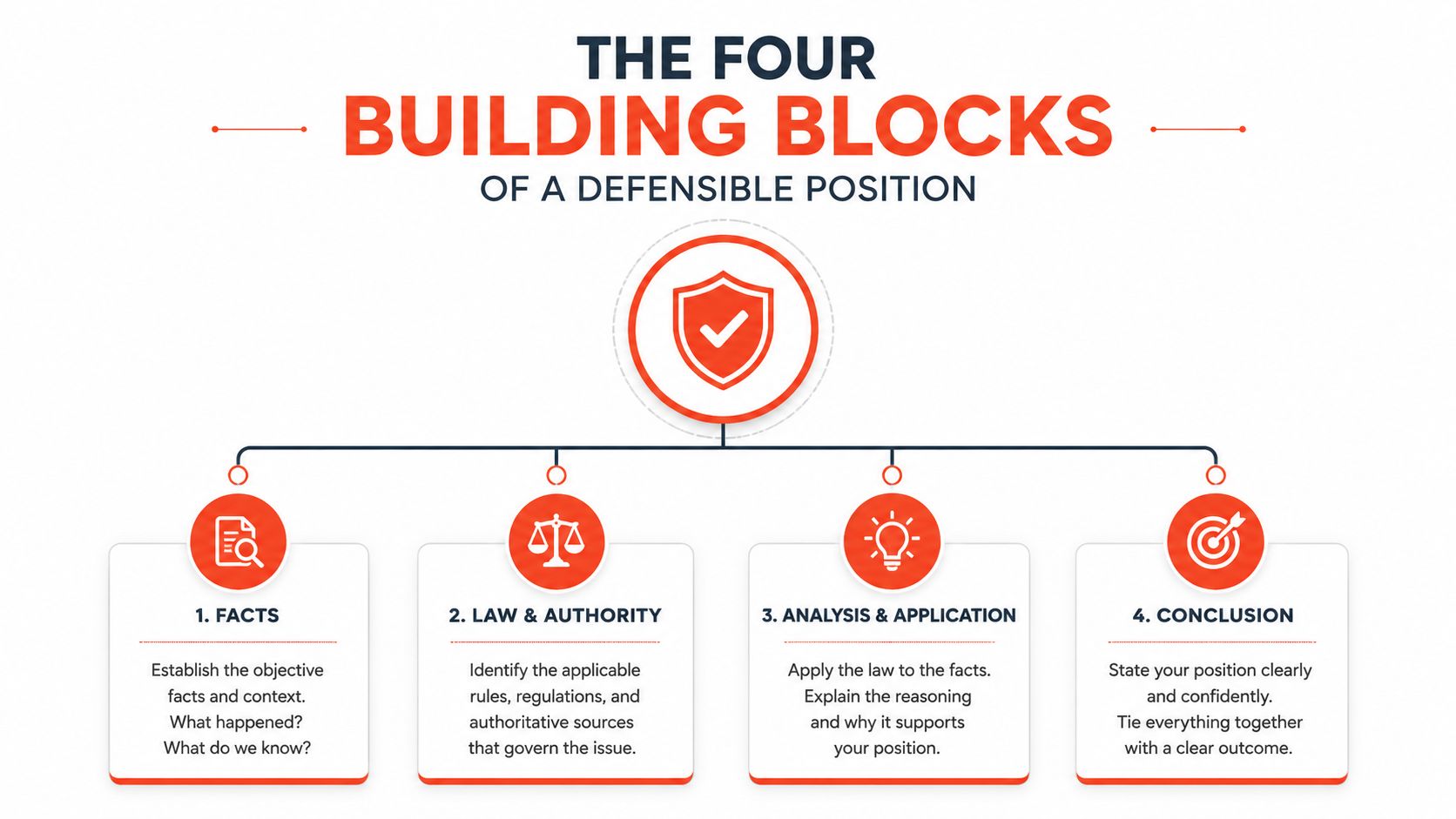
Audience
Audience means choosing who you're willing to be known by. That sounds obvious until a team tries to sell to everyone who might buy and ends up sounding generic to all of them. Specificity creates sharpness, and sharpness creates recall.
A strong audience choice also includes exclusions. If you'd happily serve every buyer type, the position is probably too broad. The discipline is to name the buyer you would turn down, or at least deprioritize, so the primary buyer becomes unmistakable.
Perspective
Perspective is the lens that changes how the problem is framed. It can be contrarian, but it doesn't have to be loud. The better test is whether it helps the audience see the problem differently enough to act differently.
Many teams overreach. They try to be provocative before they've been precise. The stronger move is to sharpen the market's existing language, or challenge one assumption with evidence and consequence.
Narrative
Narrative is the recurring storyline that keeps the work coherent across posts, interviews, and reports. It answers the question, “What do we keep saying in different forms?” Without narrative, a team publishes isolated insights that never accumulate into authority.
A position gets stronger when each piece feels like part of the same argument, not a new personality every week.
Proof
Proof is the evidence stack. It includes client outcomes, proprietary research, internal data, documented observations, and case examples that can survive scrutiny. A position without proof might get attention, but it won't hold trust for long.
Use proof to support the argument, not decorate it. If the evidence doesn't reinforce the same promise the audience keeps hearing, it's noise. A simple prompt helps here, what concrete examples make this point believable enough to repeat publicly?
Leading With the Problem, Not Your Solution
Weak positioning usually starts with the offer. A team picks a service, a category, or a popular topic, then builds content around that label. Buyers do not care whether the lane feels convenient. They care whether you understand their problem better than the alternatives they already know.
The better move is to define the problem first. LinkedIn's positioning guidance says to define the problem, not just your solution, and that advice works because it makes the pain visible before the offer enters the conversation. When the audience recognizes the problem in its own language, it is more likely to keep reading and more likely to treat your expertise as relevant rather than promotional.
The order matters
Write the problem statement in one sentence. Start with the problem itself, and leave the topic label and service line out of it. Then map the last 20 pieces of content you published against that statement and mark anything that does not directly support it.
That audit usually exposes the core issue. Teams think they are building authority around a theme, but they drift across adjacent subjects that do not compound. A growth advisor who positions around “helping agencies price retainers” will sound useful to a buyer who feels margin pressure. A competitor who says only “agency growth” is harder to place in the buyer's mind.
The unanswered question is the asset
Once the problem statement is clear, look for the question the market still is not answering well. That is where positioning starts to claim territory. The goal is not to say something nobody has ever said. The goal is to say something sharper, more useful, and harder to confuse with generic advice.
The practical move is straightforward. Audit what has already been said, identify what sounds repetitive, then build around the missing question your expertise can answer better than the rest. That is how problem-led content becomes position-led content.
Content Strategy, Repurposing, and Distribution Cadence
A position only lives if people keep seeing it in different formats without losing the thread. That's why distribution isn't separate from positioning, it's how the position stays recognizable after the first post. One strong article can fuel a week of assets if the derivatives all defend the same point of view.
The cleanest workflow starts with one source piece, then turns it into smaller assets for the channels your audience already uses. A long-form article can become a LinkedIn document post, a newsletter section, a short video clip, a quote card, and a podcast talking point. If the derivatives start introducing new angles, the position fragments. If they all reinforce the same problem and perspective, the market sees consistency instead of repetition.
For teams trying to operationalize this, framework for AI visibility is a useful resource because it treats content structure and distribution as a system rather than a one-off post. That matters when your authority needs to show up across search, social, and owned channels at the same time.
A workable cadence doesn't have to be elaborate. Solo creators usually need one core piece, then two or three supporting repurposes before the week ends. Small teams can assign the source article, the social cutdowns, and the newsletter edit to different people so the voice stays tight. Agencies need the strictest discipline, because each client brand can easily blur the original point of view if the editing checklist isn't explicit.
The internal process matters just as much as the output. Use one brief, one message spine, and one quality check for every derivative asset. If a caption, clip, or carousel can't be traced back to the original position, it shouldn't publish.
One tool that fits this kind of pipeline is WaveGen.ai, which turns source content into multiple social assets and lets teams keep brand kits consistent while repurposing the same ideas across channels. WaveGen's thought leadership content guide is also a good reference point for tracking the signals that matter when you're testing whether the market is responding to the position rather than just the format.
Measuring Position Strength and Market Influence
Reach tells you who saw the content. Position strength tells you whether the right buyers now describe you differently. Those are separate signals, and the gap between them is where a lot of content programs stall.
The measurement stack should move from attention to perception, then to commercial behavior. If you stop at impressions, you know the content was seen, but not whether it changed how the market thinks or buys.
| Tier | Metric Examples | What It Reveals | How to Track |
|---|---|---|---|
| Attention | Time spent, saves, repeat views | Whether the right people are leaning in | Native platform analytics, newsletter stats |
| Engagement quality | DMs from ideal buyers, podcast invites, inbound mentions | Whether the content is reaching the right audience | CRM notes, inbox tagging, media requests |
| Perception | Share of voice on key topics, branded search patterns | Whether the market associates you with the problem | Topic audits, search console reviews, competitor scans |
| Commercial outcomes | RFP invites, deal velocity, premium pricing acceptance | Whether positioning is affecting buying behavior | Sales records, opportunity reviews, pricing discussions |
Share of voice is one of the clearest ways to test position strength. Consultancy.eu recommends studying share of voice across topics, sectors, and geographies to benchmark current efforts against competitors and decide what to do next. That turns positioning into a competitive readout, not a vanity exercise. Consultancy.eu on thought leadership and data insights
The monthly question that matters most is simple. Would your last ten buyers describe you the way you describe yourself? If the answer is no, the position is weak even when reach looks healthy. That usually means the market has learned your category label, but not your point of view.
Impressions matter as a starting signal, especially on LinkedIn, where a post can get seen without changing much. For a more practical read on that gap, see how to interpret impressions on LinkedIn alongside saves, comments from target accounts, and repeat exposure from the same buyers. Those patterns show whether the content is reaching the right people often enough to shape recall.
Diagnostic rule: if your best metric is impressions, you are measuring exposure, not authority.
Real-World Positioning Patterns That Work
Strong positioning usually looks narrower than teams expect at first. That narrowness is the point. Buyers trust a sharp owner of one problem faster than a generalist with polished visuals and a broad promise.
A consultant who originally marketed “helping tech companies grow” narrowed to “helping bootstrapped SaaS founders fix unit economics before scaling ads.” The buyer hears a real constraint, not a vague service line. The first version sounds like a reasonable offer. The second sounds like someone who has sat inside the trade-offs that shape the decision. The proof stack also becomes more relevant, because client work tied to margin discipline fits the claim better than generic growth stories.
A financial advisor repositioned around equity compensation for tech employees instead of generic retirement planning. That shift changed the quality of the conversation, not just the wording. Equity brings timing, taxes, and decision anxiety into the same discussion, so the content can speak to a specific pressure point instead of a broad financial goal. The advisor's thought leadership started reading like guidance for a defined situation, not a mass-market brochure.
An agency moved its thought leadership toward a contrarian stance on AI content quality. It stopped celebrating output volume and argued for better editorial judgment and tighter review standards. That position made the agency easier to invite into serious conversations because the content signaled discernment, not automation hype. It also made the agency's editorial process part of the proof, which gave the position more credibility than a generic “we do AI” message could have.
The weak pattern sits beside those examples. A coach publishes often, sounds polished, and still never names a specific problem in the first line. The content may attract likes, but it does not give the market a stable reason to connect the name with a buying situation. That is what thought leadership positioning does when it is commercially useful. For a practical lens on how personal credibility supports that shift, see LinkedIn personal brand and thought leadership context.
Common Pitfalls and a 90-Day Activation Plan
Most positioning failures come from execution errors, not lack of effort. The team posts regularly, but the market still can't tell what they own. That usually means one or more of five things is happening.
- Volume is being mistaken for strength: If the calendar is full but the market can't repeat the argument, the content is busy, not positioned.
- Trending topics are pulling you off course: If every new theme feels urgent, your audience never learns what you own.
- Proof assets are going stale: If the case studies and examples don't match the current position, the message feels borrowed from another phase.
- Distribution is inconsistent: If the best ideas only appear once, the market has no chance to absorb the pattern.
- Only reach is being measured: If no one checks perception or commercial movement, the team optimizes for visibility instead of influence.
A quick diagnostic question for each one keeps the review honest. Can the market name your problem space without prompting, or do you still need to explain it every time? Can your proof assets support the promise you're making now, not last year's story? Are your best ideas being repeated often enough to matter?
A 90-day activation plan keeps this practical.
Days 1 to 30
Write the positioning brief, audit existing content, and identify the proof stack you can defend. Remove anything that sounds broad, trendy, or interchangeable.
Days 31 to 60
Publish the first three problem-led pieces and one flagship asset. Keep the point of view narrow enough that the audience can tell the difference between your position and the category's default language.
Days 61 to 90
Measure share of voice, review which topics attract ideal buyers, and cut anything that dilutes the position. If the market is describing you more clearly than before, keep sharpening. If not, the problem statement still needs work.
The teams that win here don't publish more noise. They publish a clearer argument, then repeat it with enough discipline for the market to believe it.
If you want a cleaner way to turn one strong idea into a week of on-brand assets, WaveGen.ai can help you repurpose source content into carousels, short videos, quote cards, and captions without breaking visual consistency. It's a practical fit for teams building thought leadership positioning that has to travel across channels, not just sit in a blog archive.
thought leadership positioning
thought leadership strategy
B2B content
content marketing
brand authority
Turn this kind of writing into a week of social content.
Paste a blog post, newsletter, or rough draft — WaveGen turns it into publish-ready carousels, captions, and slideshows for every channel.
No credit card · First posts in 2min