June 23, 2026
15 min read
Master Thought Leadership Content Strategy
Create authentic thought leadership content. Build your brand, attract clients, & master strategy, creation, & multi-channel distribution for 2026.

Most advice about thought leadership content is too soft to be useful. It says to “share expertise,” “post consistently,” and “add value.” That's fine as far as it goes, but it also describes half the internet. Publishing informed content doesn't make anyone a thought leader. Repeating familiar advice in polished language doesn't shape a market either.
Thought leadership content earns attention when it gives buyers, peers, or clients a better way to think. It clarifies a messy issue, names a pattern others missed, or frames a decision with unusual precision. That's why the strongest programs aren't built on volume alone. They're built on a point of view, evidence, and a distribution system that keeps the signal intact as the format changes.
A lot of teams still treat this as a writing problem. It's closer to an editorial operations problem. You need a reliable way to find strong ideas, turn them into durable assets, and distribute them without flattening the author's voice. That's also why formats like articles, webinars, transcripts, and even AI podcasts for thought leadership matter less than commonly perceived. Format helps, but the underlying argument does the heavy lifting.
Table of Contents
- Beyond the Buzzword What Is Thought Leadership
- The Anatomy of True Thought Leadership
- The Tangible Business Value of Leading the Conversation
- Choosing Your Format and Storytelling Approach
- A Framework for Creating Authentic Thought Leadership
- Scale Your Voice with Smart Distribution and Repurposing
- How to Measure the ROI of Your Thought Leadership
Beyond the Buzzword What Is Thought Leadership
Thought leadership content is not the same thing as expert blogging.
Expert blogging explains what's already known. Thought leadership content interprets what's changing, takes a position on what matters, and helps an audience act with more confidence. One is useful. The other is influential.
That distinction matters because too many teams publish competent summaries and wonder why nothing moves. The problem usually isn't quality control. It's that the content stays safely inside consensus. Buyers don't remember it, peers don't reference it, and internal teams can't build a larger message around it.
The real standard
A true thought leadership program does three things at once:
- It names a problem clearly: The reader should feel, “Yes, that's exactly the issue.”
- It introduces a distinct lens: Not a recycled framework with new branding, but a perspective shaped by real work.
- It creates usable clarity: The audience should leave with a sharper decision, not just a pleasant read.
Thought leadership isn't about sounding smart in public. It's about reducing uncertainty for people facing expensive decisions.
This is why the phrase gets diluted. People use it to describe any content written by a founder, consultant, or subject matter expert. In practice, authorship alone doesn't qualify the work. A founder can publish generic content. A strategist can publish timid content. A specialist can publish content that teaches but never leads.
What it looks like in the wild
The strongest pieces usually have a few recognizable traits:
| Signal | Generic expert content | Thought leadership content |
|---|---|---|
| Core move | Explains known best practices | Reframes the issue or challenges assumptions |
| Source of authority | Credentials and familiarity | Experience, evidence, and interpretation |
| Reader outcome | Better understanding | Better judgment |
| Shelf life | Short | Longer, because the idea can travel across formats |
Thought leadership is a system because a single strong article rarely changes market perception on its own. Repeated, coherent points of view do. When the same argument appears in a newsletter, webinar, LinkedIn post, sales conversation, and keynote, people start associating that insight with the person or brand behind it.
The Anatomy of True Thought Leadership
A useful way to judge thought leadership content is to compare a lighthouse with a floodlight. A floodlight illuminates everything. A lighthouse guides people through danger toward a destination. Most content marketing behaves like a floodlight. It covers topics broadly, checks SEO boxes, and fills a calendar. Thought leadership acts like a lighthouse. It is selective, directional, and memorable.
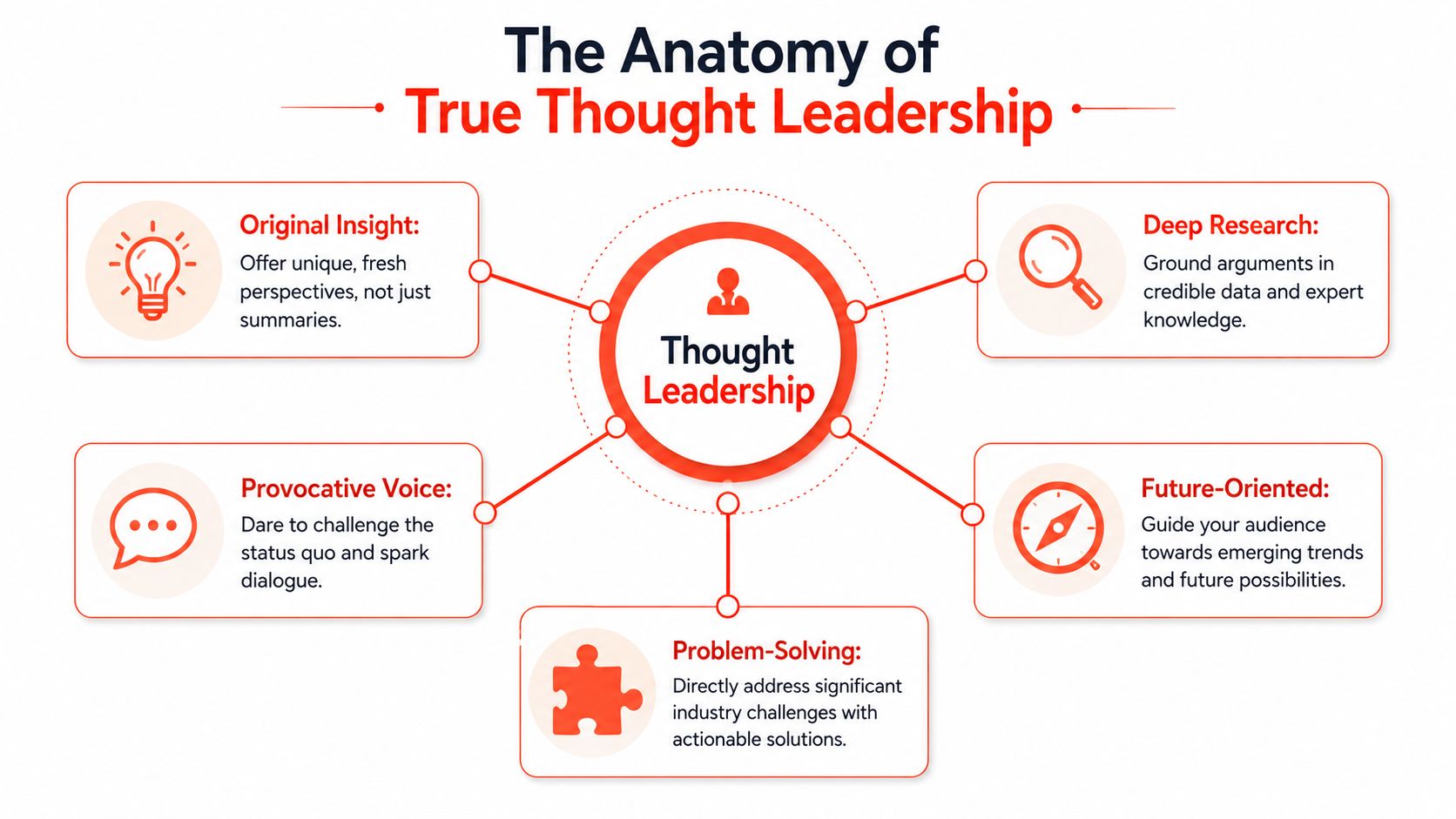
The lighthouse test
If a piece doesn't help the audience find a way through a hard decision, it may still be good content, but it probably isn't thought leadership.
Five components tend to separate authentic content from polished filler:
- Original insight: The idea adds something. It doesn't just summarize known advice.
- Deep research: The claim rests on evidence, observation, or disciplined reasoning.
- Provocative voice: It's willing to challenge weak assumptions or stale industry habits.
- Future orientation: It explains what's changing and what the audience should do next.
- Problem-solving value: It gives the reader a path forward, not just an opinion.
A lot of brands get the first and last parts wrong in opposite ways. Some are opinionated but unsupported. Others are well researched but bloodless. Strong thought leadership combines argument and utility.
A practical self-audit
Before publishing, ask harder questions than “Is this accurate?” or “Does this sound smart?”
Use this checklist:
- Would a smart reader learn a new distinction from this?
- Does the argument come from lived work, proprietary observation, or serious synthesis?
- Would someone disagree with part of it? If nobody could, the claim may be too generic.
- Is there a recommendation attached to the insight?
- Could this idea survive in more than one format? Good thought leadership can become a talk, a post, a client memo, and a panel argument.
Practical rule: If the piece could be published under a competitor's name without anyone noticing, it doesn't have enough point of view.
This is also where many executive ghostwriting efforts fail. The writing is clean, but the edge is missing. Real authority has fingerprints. It carries preferences, trade-offs, and informed bias. It says, in effect, “Here is how we see the problem, here is why, and here is what that means.”
The Tangible Business Value of Leading the Conversation
Thought leadership content isn't a branding luxury. It changes buyer behavior before a proposal lands in the inbox.
A 2023 Edelman–LinkedIn study of 1,200 business decision-makers found that 58% had chosen a specific organization as a result of its thought leadership content, and 55% used it as an important way to vet potential business partners (Edelman–LinkedIn study summary). That's the clearest reason serious B2B teams invest in it. Buyers don't just consume this material for education. They use it to reduce perceived risk.
Why buyers pay attention before the sales call
In consulting, advisory work, software, and other expertise-led categories, the buyer usually can't inspect quality the way they can inspect a physical product. They need proxies. Thought leadership content becomes one of those proxies.
When a leader publishes a clear position on an industry problem, buyers infer several things:
- This team understands the terrain
- This team can explain complexity
- This team has worked through the trade-offs
- This team may be safer to trust
That last point matters most. A lot of deals stall because the buyer fears making a visible mistake. Strong thought leadership lowers that fear. It demonstrates judgment before anyone books a discovery call.
What this changes inside a pipeline
The business value shows up in practical ways long before revenue is attributed neatly in a dashboard.
| Pipeline stage | What thought leadership changes |
|---|---|
| Awareness | You enter the consideration set earlier |
| Evaluation | Buyers use your ideas to assess your competence |
| Shortlisting | Your perspective creates preference, not just familiarity |
| Conversion | Sales conversations start warmer and with less basic education required |
This is why weak content programs underperform even when they publish often. They generate activity but not conviction. The market sees motion, not leadership.
Buyers often decide whether you're worth taking seriously before they decide whether to contact you.
For small firms and solo experts, this is one of the few scalable trust assets available. You may not have a huge sales team or a large ad budget, but you can publish analysis that makes your expertise legible. Done well, thought leadership content compounds. It keeps selling your judgment when you're not in the room.
Choosing Your Format and Storytelling Approach
A strong idea can fail in the wrong format. Not because the idea is weak, but because the delivery asks too much of the audience or too little of the argument.
Research on B2B content effectiveness shows that structured narratives built around a clear problem-solution arc can increase the likelihood of readers sharing the content by up to 2.3 times when the narrative is tied to specific challenges and practical recommendations (problem-solution narrative research). That aligns with what works in practice. Readers remember movement. They don't remember a stack of disconnected insights.
Match the format to the claim
Think about the nature of the idea before choosing the channel.
A contrarian opinion often works best in short form first. A LinkedIn post, brief video, or webinar clip lets you test whether the framing resonates or creates useful pushback. A more complex framework usually needs room. That may mean a long article, an executive memo, or a workshop deck.
A few useful matches:
- Newsletter essay: Best for nuanced takes and recurring market interpretation.
- Webinar or podcast: Best when the audience needs to hear reasoning unfold conversationally.
- Slide-based carousel: Best for frameworks, comparisons, and process models.
- Short video: Best for one sharp argument, one mistake, or one reframed assumption.
- Deep article or report: Best for evidence-heavy claims and ideas that need context.
Teams building a mixed media program often benefit from studying how narrative changes in video-first environments. A practical reference is this guide to video content strategy, especially if your ideas need to translate from text into a more visual format.
Use one narrative arc everywhere
The format changes. The structure shouldn't.
The most reliable arc for thought leadership content is simple:
Context
What changed in the market, buyer behavior, or operating environment?Challenge
What specific problem does that change create?Solution
What approach, framework, or decision rule solves it?Future implications
What happens next if the audience ignores or adopts the recommendation?
Here's what that looks like in real use. A consultant in employee experience might open a newsletter with a shift in workforce expectations. The challenge is that companies still manage retention with lagging feedback. The solution is a new operating rhythm for manager-level listening. The future implication is that firms that keep relying on annual surveys will keep acting too late.
That same idea can become a carousel, a keynote segment, a short video, and a sales enablement asset. The words change. The argumentative spine stays intact.
A Framework for Creating Authentic Thought Leadership
Most weak thought leadership fails before the first draft. The team picks a topic that feels important, assigns it to a writer, and hopes polish will create authority. It won't. Authority comes from insight selection, evidence, and editorial discipline.
A benchmark study of B2B programs found that 70% of senior executives said research-based thought leadership was more effective at building trust than other marketing materials, and 68% said original research was the most credible form of content for influencing decisions (research-based thought leadership credibility). That doesn't mean every piece needs a large survey. It means unsupported opinion is usually not enough.
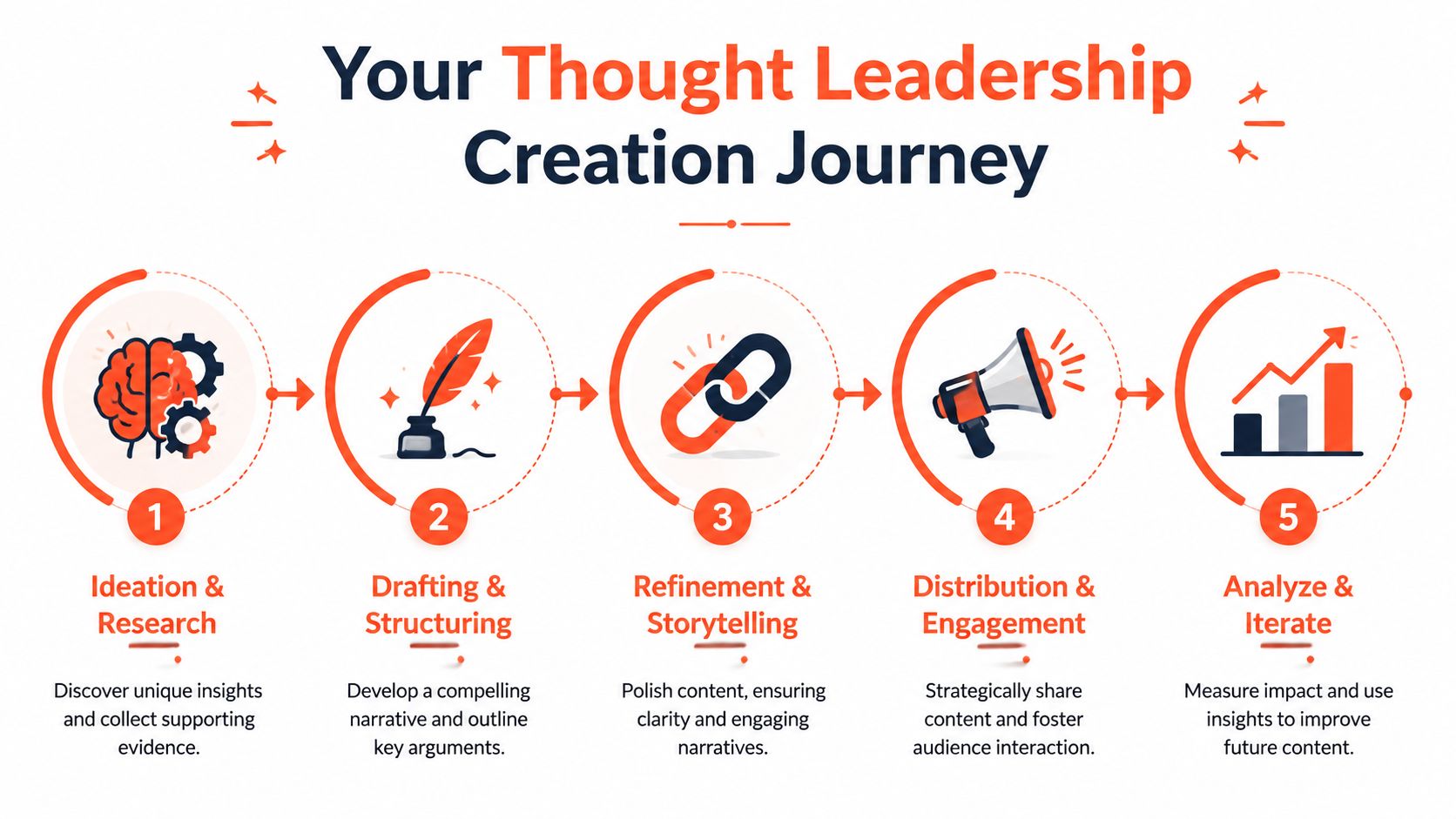
A visual model helps keep the workflow grounded:
Start before the draft
Good creation starts with idea mining.
Look for material in places where stakes are real:
- Client friction: Repeated objections, recurring mistakes, confusing buying criteria
- Operational patterns: Things your team sees every week that the market still describes poorly
- Decision trade-offs: Situations where common advice breaks under real constraints
- Internal debate: Points your own experts disagree on for useful reasons
Once you have a candidate idea, validate it. Ask whether it's specific, arguable, and useful. If the answer is vague, the topic isn't ready.
A related concern now is how AI fits into this process without flattening originality. That's where a disciplined editorial layer matters. This overview of a future-proof AI content strategy is useful because it treats AI as a workflow component, not as a substitute for judgment.
Later in the process, video can help reinforce the argument for audiences who prefer spoken explanation:
Build the piece around evidence and voice
A practical workflow usually has four working passes.
First, gather proof. That can include proprietary client observations, anonymized internal patterns, survey responses, process data, or structured interviews. Even small-scale evidence can sharpen a claim if you explain where it came from.
Second, shape the argument. Don't outline by sections alone. Outline by tension. What assumption are you challenging? What does the audience believe now? What should they believe instead?
Third, draft in the author's natural language. This matters more than people admit. Many ghostwritten drafts lose force because they sound like a committee wrote them.
Fourth, edit for precision. Cut abstraction. Replace broad claims with concrete distinctions. Keep one level of ambition in view. Don't try to solve the entire industry in one article.
The best thought leadership pieces sound like someone who has done the work, not someone who has researched the topic for an afternoon.
Authenticity is not a tone setting. It's the visible connection between lived expertise, evidence, and a distinct conclusion.
Scale Your Voice with Smart Distribution and Repurposing
Most professionals don't struggle to produce one good piece of thought leadership content. They struggle to keep showing up after that piece is published.
That's where repurposing often goes wrong. Teams treat it like slicing, not interpreting. They pull random quotes, trim paragraphs into posts, and distribute fragments with no narrative logic. The result feels repetitive, flat, or generic.
Neutral research shows that 60% of B2B marketers say generic content offers little value, while practical guidance on turning one source into a full week of fresh-feeling assets remains limited (content gaps in repurposing practice). That gap is real. Most advice explains where to post, not how to preserve authority while doing it.

Repurposing is extraction not duplication
The source asset should contain multiple publishable angles. Your job is to extract them.
From one article, webinar, or transcript, you can usually pull:
- A strong claim: One post built around the central argument
- A framework: A carousel that breaks the idea into parts
- A tension point: A post that names the common mistake or false trade-off
- A client-facing question: A discussion prompt that invites response
- A short script: A video explaining the core recommendation in plain language
This is why smart repurposing feels fresh. Each asset highlights a different unit of value.
A useful reference for that mindset is this guide on how to transform one asset into posts. The practical takeaway is that repurposing works best when each output has its own job.
A weekly workflow that preserves authority
A simple weekly cadence works well for small teams and solo operators:
| Day | Asset type | Purpose |
|---|---|---|
| Day 1 | Original article or newsletter | Establish the full argument |
| Day 2 | LinkedIn post | Distill the sharpest claim |
| Day 3 | Carousel | Teach the framework visually |
| Day 4 | Short video | Add tone, nuance, and presence |
| Day 5 | Quote card or text post | Reinforce a memorable line |
| Day 6 | Audience question | Turn the topic into conversation |
| Day 7 | Recap or roundup | Reconnect scattered assets to the main idea |
Tools can help here if they preserve the source logic rather than overwrite it. For teams exploring production support, AI content creation tools can reduce formatting work, and WaveGen.ai is one example of a system built to turn a source article, newsletter, script, or transcript into platform-specific assets like carousels, short videos, quote cards, and captions while keeping brand settings consistent.
The key is editorial control. AI-generated variations should be treated as raw material. Review the wording, check the sequencing, and make sure each post still sounds like the original author. Distribution should widen your voice, not blur it.
How to Measure the ROI of Your Thought Leadership
The easiest way to kill a thought leadership program is to measure it like a one-off campaign. The work compounds slowly, often across channels, and usually influences revenue before it cleanly captures it.
Independent B2B buyer research suggests that firms perceived as true thought leaders in their niche are roughly twice as likely to be invited into shortlists for large projects (thought leadership and shortlist inclusion). That makes ROI measurement less about vanity metrics and more about evidence of influence on serious opportunities.
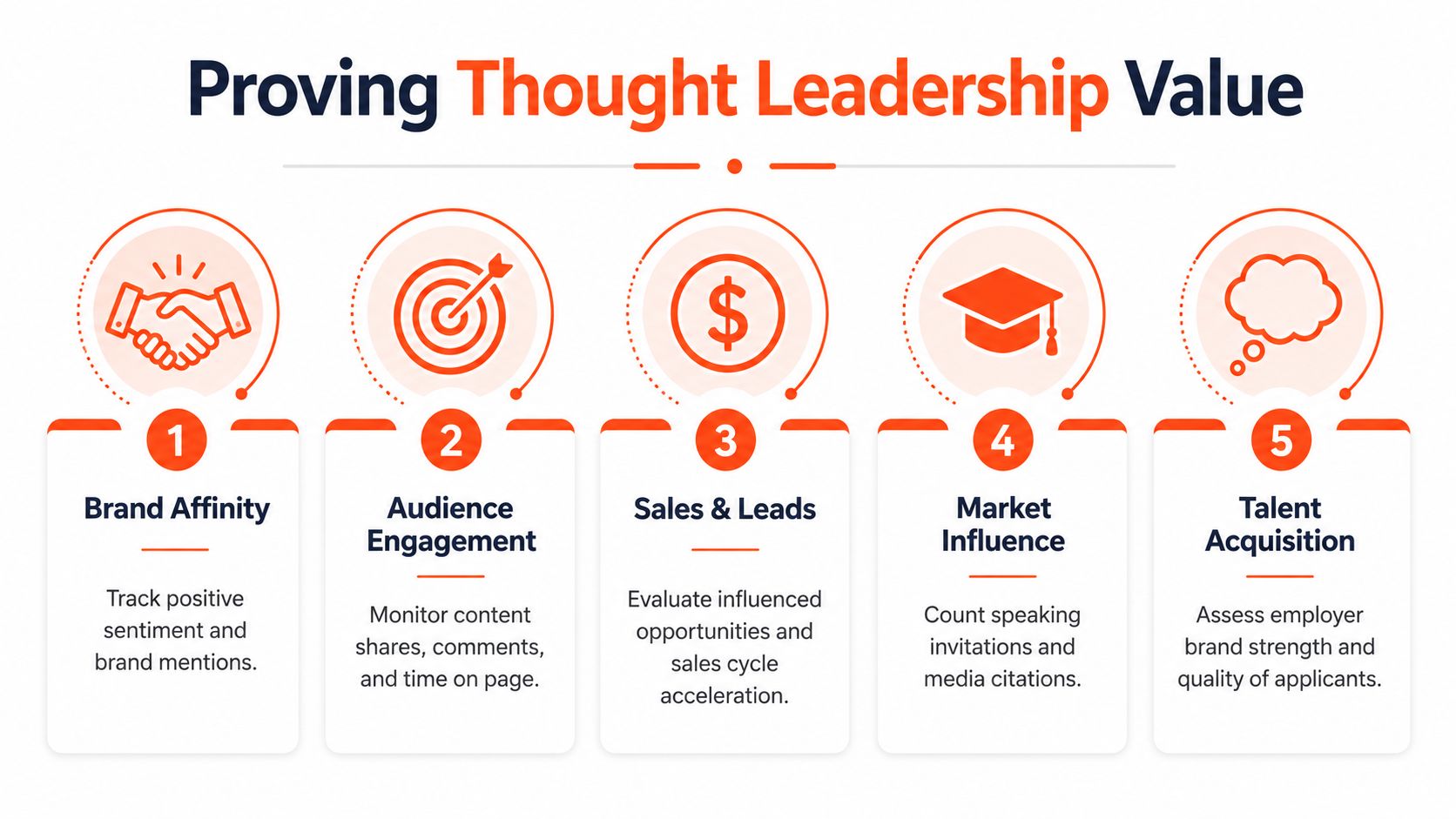
Leading indicators of authority
These tell you whether the market is paying attention.
Watch for:
- Content shares and saves: Signals that the idea is worth passing along
- Meaningful comments: Better than shallow engagement because they show interpretation
- Direct replies and inbound mentions: Useful evidence that people connect the idea to your expertise
- Speaking invitations and interview requests: A sign that your perspective is traveling
- Platform-level reach trends: Helpful in context, especially when paired with engagement quality
If LinkedIn is a major channel in your mix, this guide to understanding impressions on LinkedIn can help you interpret visibility without overvaluing raw exposure.
Lagging indicators tied to revenue
These are slower, but they matter more.
Track what sales and client teams can use:
- Lead source notes: Did the prospect mention an article, webinar, or recurring post?
- Sales conversation quality: Are early calls starting with more context and less education?
- Competitive shortlist inclusion: Are you showing up in more serious evaluations?
- Proposal conversion patterns: Are decision-makers already familiar with your point of view?
- Higher-value opportunities: Are better-fit buyers finding you because the content filtered them in?
If your thought leadership is working, the audience doesn't just consume it. They carry your framing into buying conversations.
A simple dashboard with both types of indicators is enough. You don't need perfect attribution. You need consistent evidence that your ideas are changing market perception and influencing opportunities over time.
WaveGen.ai helps teams turn one strong piece of thought leadership content into a consistent stream of social assets without starting from scratch each day. If you already publish articles, newsletters, podcasts, or video transcripts, WaveGen.ai gives you a practical way to repurpose that source material into platform-specific posts while keeping your brand voice and visual identity consistent.
thought leadership content
content strategy
brand authority
content marketing
content repurposing
Turn this kind of writing into a week of social content.
Paste a blog post, newsletter, or rough draft — WaveGen turns it into publish-ready carousels, captions, and slideshows for every channel.
No credit card · First posts in 2min