October 8, 2026
12 min read
Social Media Content Distribution: A 2026 Guide
Master social media content distribution in 2026. Learn to repurpose, optimize, and scale your content across platforms for maximum reach and engagement.
You publish a thoughtful article, share it once on LinkedIn, resize a video for Instagram, remember TikTok three days later, and then wonder why the results feel random. The content isn't necessarily weak. The workflow is.
Social media content distribution works when you treat it as a system that adapts one strong idea to several discovery environments, then follows attention through to qualified business outcomes. Posting more often won't fix a process that produces identical assets, weak calls to action, and no reliable connection between social activity and revenue.
Table of Contents
- Why Content Distribution Feels Like a Full-Time Job
- How Recommendation Algorithms Actually Shape Distribution
- The Repurposing Framework for Platform-Native Content
- Manual Workflows vs Automated Distribution Tools
- Measuring Distribution Impact Beyond Engagement Metrics
- Building Your Distribution Cadence and Workflow
Why Content Distribution Feels Like a Full-Time Job
A consultant spends six hours writing a practical guide for clients. The article answers a real problem, includes useful examples, and earns approval from the team. After publication, she shares the link once, drafts a hurried quote for Instagram, and saves the rest for “later.” Later never arrives.
That pattern looks like a motivation problem, but it usually isn't. The consultant has no distribution architecture. She must decide what to extract, which channels deserve attention, how each asset should be reformatted, who approves it, when it goes live, and how anyone will judge the result. Every new article restarts the same set of decisions.

The hidden cost of manual distribution
Manual work creates friction in several places:
- Reformatting: Someone crops videos, rebuilds graphics, and adjusts captions for every channel.
- Decision fatigue: The team repeatedly chooses hooks, publishing times, calls to action, and visual treatments.
- Inconsistent follow-through: A strong source asset may receive one social post instead of a coordinated sequence.
- Weak learning loops: If every post uses a different format and objective, performance data can't guide the next decision.
- Commercial blind spots: Teams celebrate reach without knowing whether the attention came from likely buyers.
The answer isn't to force every piece of content onto every network. That creates more work and often produces content that feels out of place. The better approach is to define a small set of channel roles, create reusable production rules, and connect each role to a measurable audience action.
Practical rule: Distribution should be designed before publication, not added after the article is finished.
A source article might provide the insight, evidence, and narrative. Distribution turns those raw materials into a short video, a saveable visual, a discussion prompt, and a deeper explanation. The message stays accurate, but the packaging changes according to what people do on each platform.
That shift removes guilt from the process. You aren't failing because you didn't post enough. You're missing a repeatable path from source content to native assets, audience response, and business follow-up.
How Recommendation Algorithms Actually Shape Distribution
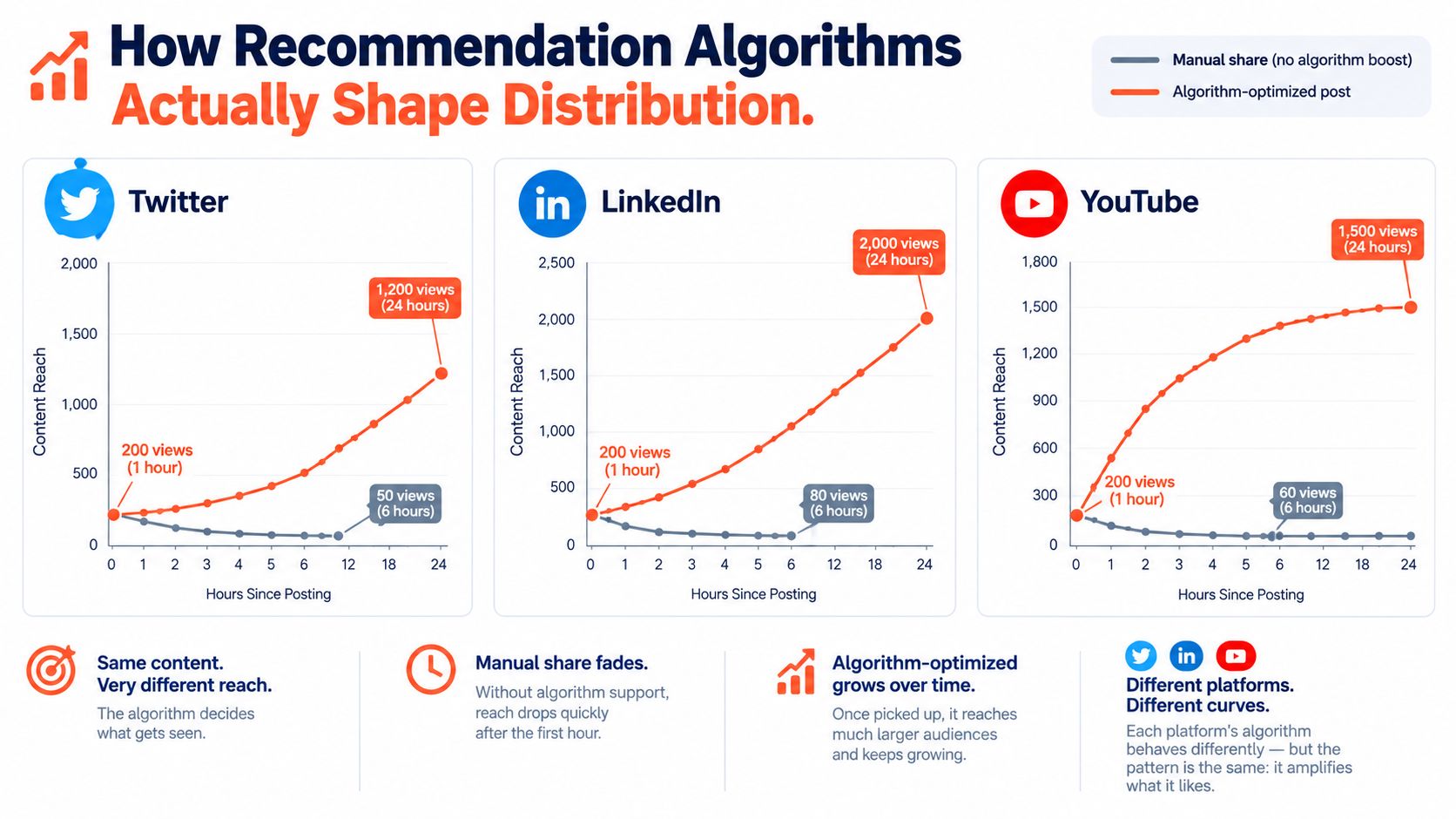
Social feeds aren't simple chronological lists. Platforms use personalized ranking systems and machine-learning models to estimate whether a particular person will view, click, like, comment on, or share each candidate post. Those predicted actions are combined into a relevance score that helps determine feed order, as described in this technical primer on social media recommendation algorithms.
That creates an early-signal loop. A post that earns meaningful interaction soon after publication may receive additional impressions, while weak initial response can limit later distribution. Experimental Reddit evidence found that moving a post from the top of a feed to positions 6–10 reduced engagement odds by approximately 40%, even though users rarely recognized that ranking position influenced their choices. The implication for practitioners is straightforward: the opening frame, first line, and first interaction request matter before a post has accumulated much reach.
Why one file can't do every job
A 2025 global benchmark covering companies with at least 1,000 followers reported average engagement of approximately 5.0% on TikTok, 3.6% on Instagram, and 3.4% on YouTube, according to the 2025 social media benchmark report. These figures describe different environments, so they shouldn't be treated as a universal league table.
The same benchmark found that YouTube Shorts supported stronger engagement and retention than standard YouTube content. That distinction matters. Short vertical video suits recommendation feeds and rapid feedback, while longer video usually serves deeper viewing intent and established subscribers. A single source idea can work in both formats, but it needs a different opening, pace, duration, and viewer promise.
| Platform | Average engagement | Suitable distribution job |
|---|---|---|
| TikTok | Approximately 5.0% | Fast discovery and retention |
| Approximately 3.6% | Sharing, saving, and visual explanation | |
| YouTube | Approximately 3.4% | Deeper viewing and searchable education |
The practical metric isn't total impressions alone. Track retention, completion, shares, saves, comments, and click-through rate by format and audience segment. These actions provide different signals, and a post with fewer views may be more valuable if it attracts the people who ask relevant questions or visit a commercial page.
For teams building their own systems, the Mallary.ai developer blueprint for AI social media engagement offers useful technical context on structuring platform-aware workflows. The strategic lesson remains simple: design the first interaction deliberately, then judge distribution by the behavior it generates.
The Repurposing Framework for Platform-Native Content
Repurposing isn't cutting one article into identical snippets. It means identifying the source idea's central value and assigning that idea a different job on each network.
Start with a single sentence: What should the audience understand, question, or do after seeing this asset? If the answer changes by platform, the creative should change too. If the answer never changes, the content may be too generic to earn meaningful interaction.
Four platform jobs from one source idea
Take a consulting article about improving client onboarding.
TikTok or Reels should earn the next second. Open with the costly mistake, show one practical fix, and keep the visual understandable without sound. A creator who prefers voiceover, screen recordings, or text-led video can find additional TikTok ideas for beginners without showing their face. The call to action might invite viewers to save the process or comment with the step they struggle with.
Instagram should make the insight worth sharing. Turn the methodology into a concise carousel, with one claim per slide and a final slide that summarizes the checklist. The benchmark evidence cited in the Emplifi social media benchmarks report found that shares per reach on Instagram increased by more than 150%, while analysis of more than four million posts found that Reels generated 36% more reach than carousels and 125% more than single images. Those figures don't make Reels universally superior, but they do support testing format against the intended behavior.
LinkedIn should create a credible discussion. Extract the counterintuitive lesson, explain why common onboarding advice fails, and ask practitioners how they handle the same constraint. Avoid copying the article's introduction. LinkedIn readers need a reason to contribute their experience.
YouTube should support sustained understanding. Build a tutorial or explanatory excerpt around the complete method, with enough context for viewers who didn't read the article. The title and opening should answer the viewer's problem quickly, while the body demonstrates how the method works.
A useful production brief records what stays constant, such as the factual claim, brand position, and terminology, and what changes, such as dimensions, pacing, caption style, and call to action. For a deeper treatment of the process, see this guide to content repurposing strategy.
The asset is shared across channels. The audience experience shouldn't be.
Common mistakes include squeezing a complete article into a caption, using the same thumbnail everywhere, and asking every audience for a click. Native repurposing takes more editorial judgment at the start, but it prevents the expensive failure of producing content that technically appears on a platform while behaving like an outsider.
Manual Workflows vs Automated Distribution Tools
A manual workflow gives you control, but control has a cost. Someone must extract the ideas, write channel-specific captions, resize or redesign the visuals, request approvals, schedule each post, check publishing, and record the results. That can work for a small number of priority channels, especially when the brand voice is still changing and every asset needs close editorial review.
The weakness appears when the team handles several brands or publishes from a steady stream of articles, newsletters, podcasts, and videos. Repetitive production consumes the time that should go toward selecting better ideas, responding to comments, and reviewing commercial signals.
What automation should and shouldn't do
A sensible automated pipeline handles repeatable mechanics:
- Source extraction: Identify claims, examples, quotes, and potential hooks from a long-form asset.
- Format generation: Produce candidate carousels, short videos, quote cards, and captions in channel-appropriate structures.
- Brand control: Apply approved colors, fonts, logos, and voice rules consistently.
- Review: Give an editor a visual workspace to change text, images, and tone before publication.
- Scheduling: Queue posts for selected dates, times, and recurring publishing slots.
- Measurement preparation: Preserve platform, format, campaign, and content identifiers for later analysis.
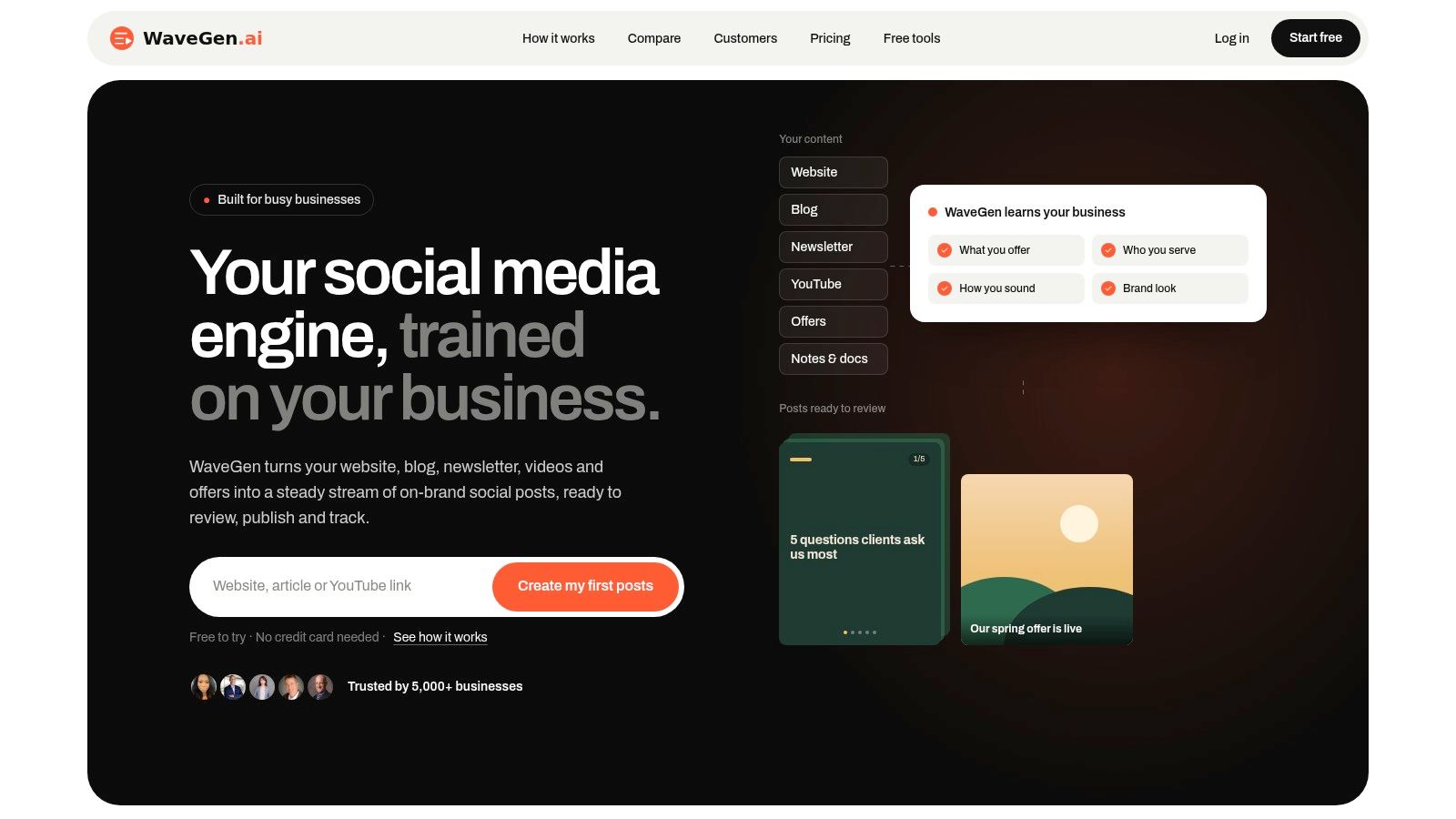
WaveGen.ai turns an article, newsletter, blog post, podcast script, or YouTube transcript into social assets such as carousels, short videos, quote cards, and captions with platform-specific formatting. Users can set brand kits, edit the results in a visual editor, and publish or schedule content for Instagram, TikTok, LinkedIn, YouTube, and Facebook. Its RSS-based autopilot option is designed to keep a regular source flow moving, but human review still matters when a claim is sensitive, technical, or commercially important.
A practical comparison
| Workflow | Strength | Trade-off |
|---|---|---|
| Manual production | Maximum editorial control and nuanced adaptation | Slow, repetitive, and difficult to scale |
| Templates plus scheduling | Consistent output with manageable oversight | Can become formulaic if templates aren't refreshed |
| Automated generation with review | Faster transformation from source to channel drafts | Requires strong brand rules and approval discipline |
Automation shouldn't decide what your business believes or which customer problem deserves attention. It should remove mechanical repetition so strategists can spend more time on positioning, audience insight, and response quality. Teams exploring adjacent workflows may also find this overview of content amplification for X creators useful when comparing distribution approaches.
For a detailed look at automation in a social workflow, see how to automate social media. The right choice depends on volume, risk, team capacity, and how much variation each channel requires. A solo advisor may prefer a lightweight template system. An agency managing multiple brands needs permissions, reusable brand kits, review stages, and reliable scheduling.
Measuring Distribution Impact Beyond Engagement Metrics
Reach answers whether a platform showed the post. It doesn't answer whether the right person noticed it, trusted the creator, entered a buying journey, or influenced a later decision.
The measurement gap is structural. 56% of global marketing leaders believe social drives revenue, while fewer than half, 44%, consider their social teams expert at measuring business impact, according to reporting on the Sprout Social measurement findings. The same source identifies incompatibility between social management tools and the broader marketing stack as a leading obstacle, while fewer than half of teams embed social data in CRM systems.
B2B teams face an especially difficult version of the problem. Customer-journey tracking is a top challenge for 57% of marketers, and 56% struggle to attribute ROI to content marketing, according to that same report. Buyers may encounter a post, discuss it privately, search the company later, and convert through a direct visit that hides the original influence.
Build a distribution-to-revenue trail
Use a measurement structure that gives each channel a job and each campaign a traceable identity:
- Create platform-specific links: Use distinct campaign parameters for TikTok, Instagram, LinkedIn, YouTube, and email. Keep naming consistent across the content library and CRM.
- Separate discovery from intent: Record reach, retention, shares, saves, replies, profile visits, clicks, and form completions as different events.
- Capture assisted influence: Report whether a contact consumed social content before requesting a call, downloading a resource, or entering an opportunity, even when social wasn't the final click.
- Ask the source question: Add a short, plain-language field to forms and sales calls. Self-reported discovery often reveals influence that analytics can't see.
- Review qualified actions: Compare booked calls, relevant replies, sales conversations, and pipeline influence by platform and format, not by one blended engagement score.
Measurement principle: A widely distributed post is a reach success. It becomes a business success only when you can show how it helped the right audience take a valuable next step.
This framework changes creative decisions. A provocative post may generate discussion but few qualified visits. A niche checklist may receive modest reach and produce serious sales conversations. Keep both if they serve different stages, but don't use the same score to judge them.
Building Your Distribution Cadence and Workflow
A sustainable cadence starts with source content, not with a blank social calendar. Choose the strongest existing material, define its commercial purpose, and create native outputs before publication day. A consultant might turn one article into a short discovery video, a saveable checklist, a professional discussion post, and a deeper tutorial, then connect each asset to a distinct tracked action.
A workable weekly rhythm
- Source session: Select the article, newsletter, recording, or transcript and mark its central insight, supporting evidence, objections, and calls to action.
- Repurposing session: Draft channel-specific concepts and decide which behavior each asset should invite.
- Production block: Generate or create the visuals, edit hooks, apply brand rules, and check factual accuracy.
- Scheduling block: Queue approved posts, attach campaign naming, and verify links, thumbnails, captions, and accessibility details.
- Community window: Reply to substantive comments, collect questions, and identify language that can improve the next source asset.
- Review session: Compare retention, completion, shares, saves, replies, profile actions, clicks, and qualified outcomes by platform.
Keep the system small enough to operate. Three well-supported channels are more useful than a scattered presence that no one can maintain. Assign ownership clearly, too. One person can own source selection, another can approve brand and claims, and a third can monitor responses, but every task needs a named owner.
Use automation for resizing, drafting, queuing, and recurring publishing. Keep humans responsible for claims, positioning, sensitive topics, comment responses, and decisions about what deserves amplification. Teams looking for a repeatable operating model can use these content cadence examples as a planning reference.
The strongest distribution systems don't chase maximum volume. They preserve the source idea, adapt the experience to each platform, and make commercial learning visible. Start with one source asset this week, assign it platform-native jobs, add tracking before publishing, and review qualified actions rather than impressions alone.
WaveGen.ai turns articles, newsletters, podcasts, and transcripts into editable, on-brand social assets with platform-specific formatting, scheduling, and publishing workflows. Visit WaveGen.ai to build a distribution process that preserves your ideas while reducing the manual work between creation and qualified audience action.
content distribution
social media strategy
repurposing content
WaveGen.ai
social media workflow
Turn this kind of writing into a week of social content.
Paste a blog post, newsletter, or rough draft — WaveGen turns it into publish-ready carousels, captions, and slideshows for every channel.
No credit card · First posts in 2min