September 19, 2026
16 min read
Newsletter Social Media Marketing That Actually Works
Learn newsletter social media marketing tactics to grow signups, repurpose content into social posts, plan cadence, and measure real results across channels.
You already know the feeling. The newsletter draft is done, the send is scheduled, and now you still owe LinkedIn posts, short videos, quote cards, and something for X or Threads. Teams often solve that by treating social as a second content job. That's where the wheel-spinning starts.
A better model is simpler. Treat the newsletter as the thing you create on purpose, then treat social as the extraction layer. That shift changes newsletter social media marketing from a channel checklist into an operating system. You stop asking, “What should we post today?” and start asking, “What's the strongest slice of this week's issue for this platform?”
That's also the part most advice misses. The work isn't “be on email and social.” It's deciding which channel owns discovery, which one builds trust, and which one asks for conversion. When those jobs are clear, signups get easier, social gets sharper, and the newsletter stops competing with your feed.
Table of Contents
- The Newsletter as Your Source Asset
- Why Newsletters Beat Social for Direct Engagement
- Driving Newsletter Signups from Social Channels
- Repurposing Newsletter Content into Social Posts
- Choosing the Right Channel for Each Goal
- Planning a Weekly Cadence That Sticks
- Measuring Signups, Reach, and Conversion
- Building a Repeatable Newsletter to Social System
The Newsletter as Your Source Asset
A lot of content teams still build backward. They make a week of social posts, then try to turn the best one into an email. In practice, that usually creates thin content on both sides. The post was too short to carry an argument, and the newsletter ends up padded with filler.
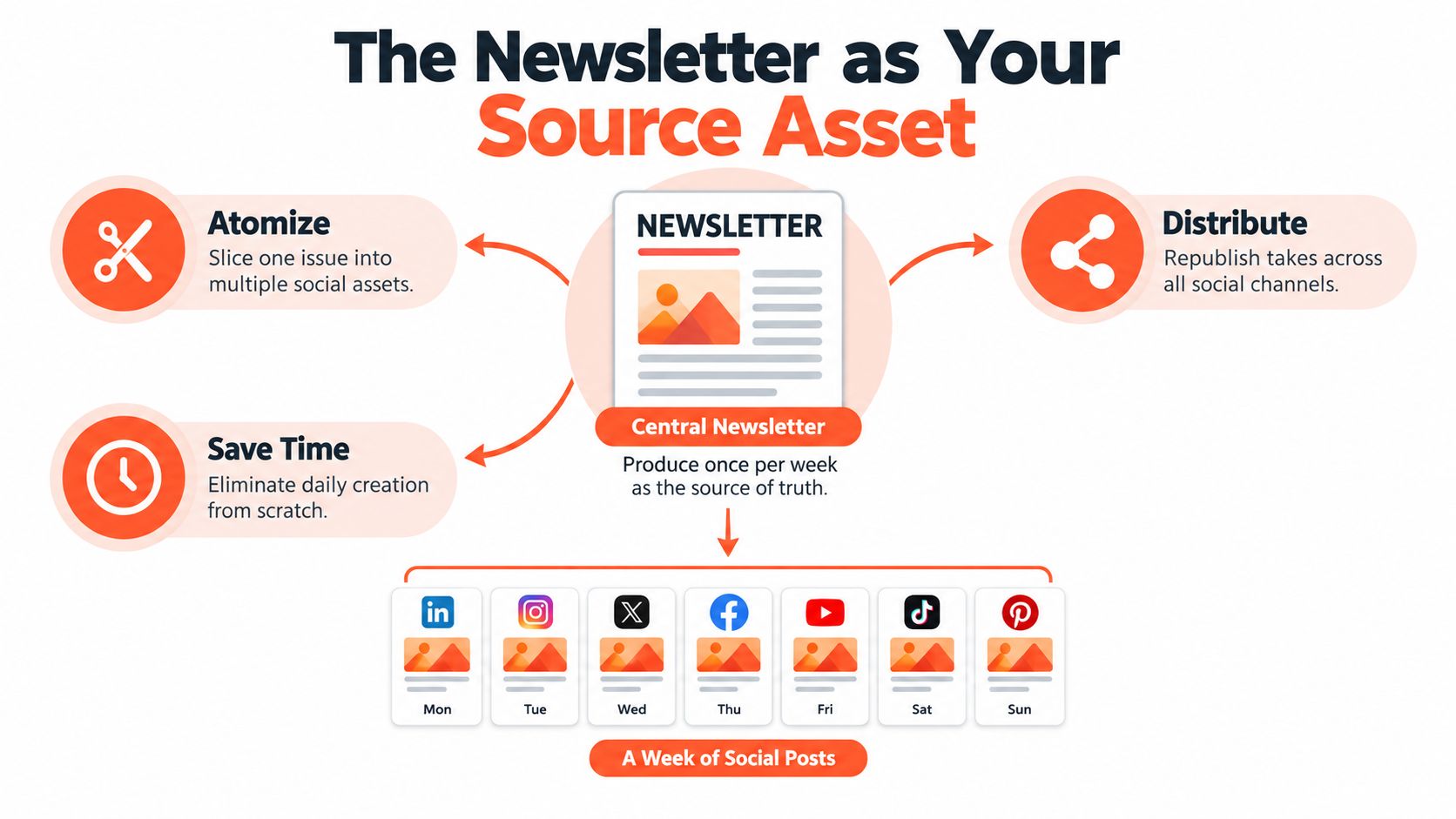
The cleaner workflow is to produce one strong newsletter first. That issue becomes the source asset for the week. Social doesn't need a separate strategy doc for every post. It needs extraction rules.
What a good newsletter already contains
A finished issue usually gives you four usable layers:
- A strong lede that can become a short-form video hook, first-slide carousel line, or text post opener.
- A core argument that can turn into a LinkedIn post, thread, or multi-slide framework.
- Supporting evidence such as examples, benchmarks, or screenshots that fit carousel slides and captions.
- A memorable line that works as a quote card or a punchy social caption.
When marketers say they “don't know what to post,” the problem often isn't ideation. It's extraction. They wrote the raw material already, but they didn't structure the newsletter so each layer can be lifted cleanly.
If your newsletter needs help becoming a better source document, the writing and formatting advice in these newsletter best practices is a useful place to tighten the asset before you repurpose it.
Practical rule: Ship the newsletter first, distribute second, measure third.
Why this inversion works better
Social platforms punish lazy reshares. A pasted headline with a link rarely goes far because it asks for attention before it earns it. But a well-built newsletter has already done the hard work. It has a point of view, examples, sequence, and language that has been edited for clarity.
That means newsletter social media marketing works best when social is not a megaphone for the issue. It's a set of native interpretations of the issue. The newsletter is the source of truth. Every post is one angle, one excerpt, or one reformatted argument from that source.
That also makes production less fragile. One good issue can feed a week without forcing your team to invent fresh opinions every morning.
Why Newsletters Beat Social for Direct Engagement
Owned attention behaves differently from rented attention. That's the strategic reason newsletters remain the stronger direct-response asset, and why they make such strong source material for social distribution.
One independent summary cites newsletter open rates around 15 to 25 percent versus 2 to 4 percent on social media, plus 2.90 percent click-through for email versus 1.36 percent for social. The same summary also notes that 81 percent of marketers use newsletters as a primary email type, and cites newsletter-specific open rates averaging 37.67 percent across 15.6 billion emails in benchmark data. The strategic point is straightforward. Email gives you direct access to an opted-in audience, while social depends on algorithmic reach and lower-intent browsing (benchmark summary on newsletter vs social performance).
Newsletter vs Social Engagement Benchmarks
| Channel | Typical Rate | Attention Context | Conversion Quality |
|---|---|---|---|
| Newsletter email | 15 to 25 percent opens in one summary, with newsletter benchmarks averaging 37.67 percent | One sender in an inbox environment, opted-in audience | Higher intent because the reader subscribed for ongoing updates |
| Social media | 2 to 4 percent in one summary, with 1.36 percent click-through in the same body of data | Competes against a crowded feed and algorithmic ranking | Lower intent because the user is browsing, not waiting for your message |
Attention density matters more than follower count
A social audience can look large and still be weak at conversion. That's because a follow isn't the same as an appointment. The algorithm decides whether your post gets seen, and the reader arrives in a distracted state.
Email is different. The subscriber invited you in. That doesn't guarantee action, but it does create higher-trust conditions. The reader opens because the sender is familiar and the content expectation is clear.
A newsletter audience doesn't just see more. It sees with more intent.
That's why a newsletter often repurposes so well into social. The source asset already proved it could hold attention in a direct channel. When you atomize it into carousels, clips, and posts, you're not inventing credibility from scratch. You're borrowing density from an asset that already earned it.
Driving Newsletter Signups from Social Channels
“Promote your newsletter on social” sounds practical until you try to operationalize it. Teams post a graphic once, drop the signup link somewhere hard to find, and call the experiment finished. That's not a signup system. It's a reminder.
What works is wiring every obvious surface before you publish the next post.
Signup mechanics that actually convert attention
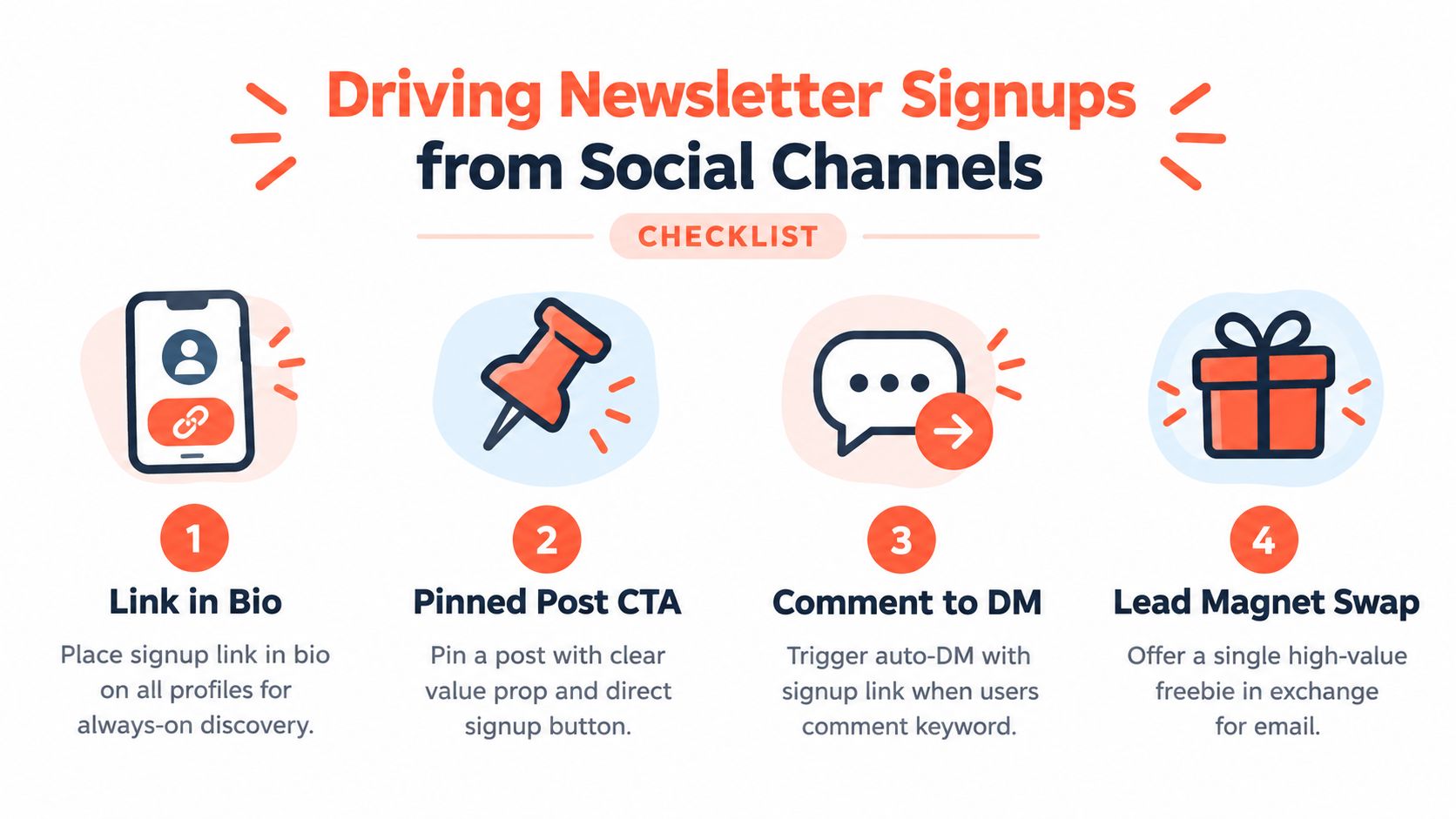
Start with the boring pieces first, because they matter more than clever copy:
- Link in bio: Your profile should point to a landing page built for one decision. Subscribe or leave.
- Pinned post CTA: Keep one pinned post that explains who the newsletter is for, what it covers, and why it's worth joining.
- Comment-to-DM flow: On platforms where this fits your audience, ask people to comment with a keyword, then send the signup link in a DM.
- Lead magnet swap: Offer one checklist, template, or worksheet that attracts the right subscriber, not just any subscriber.
The key trade-off is friction. A direct ESP form can work if your audience already knows you. A dedicated landing page usually works better when social visitors need context before they hand over an email address.
What social sharing design tells you
The design of your newsletter also affects social distribution after the send. Adding social sharing buttons to email newsletters has been linked to a 24.3 percent increase in the reach of an average email, and social-sharing-enabled messages produced a 30 percent higher clickthrough rate on average. The same HubSpot guide cites that emails with three or more social sharing icons generated 28 percent higher CTR than emails with one icon and 55 percent higher CTR than emails with none (HubSpot guide on integrating social media and email marketing).
That doesn't mean you should litter every email with icons. It means share paths are a real lever. If your issue contains original insight, make it easy for subscribers to pass it into their own networks.
A practical posting split
Aggressive signup CTAs on every post usually hurt feed performance. People don't share ads for your list. They share useful takes, strong stories, and clear opinions.
A better balance is simple:
- Most posts should teach, provoke, or entertain
- A smaller share should ask directly for the signup
- Pinned assets and profile surfaces should carry the always-on conversion job
That setup protects reach while still giving motivated readers a clean route into the newsletter.
Repurposing Newsletter Content into Social Posts
Repurposing works when you adapt, not when you paste. The fastest way to make newsletter social media marketing look clumsy is to drop a paragraph from the email into a caption and call it done. Social needs compression, pattern breaks, and format awareness.
Extraction rules that make one issue go further
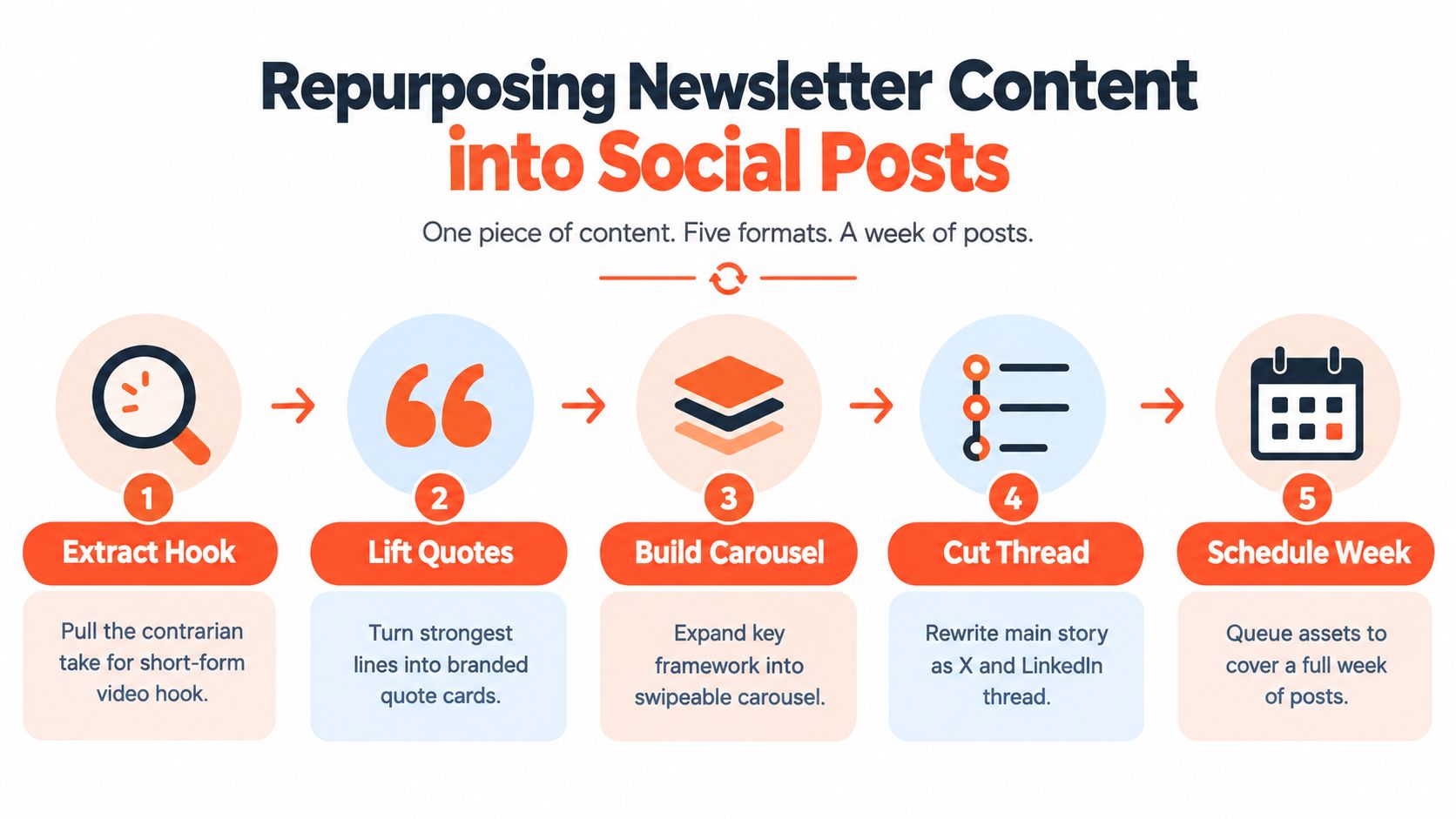
I use a simple pass when turning a newsletter into a week of assets:
- Pull the contrarian take for a short video hook. If the issue argues against common advice, that opening usually belongs on Reels, Shorts, or TikTok.
- Lift the strongest proof point for a stat-led carousel or single-image post.
- Screenshot or rewrite the sharpest paragraph into a quote card if the language carries weight on its own.
- Condense tactical steps into a thread, LinkedIn carousel, or swipe post.
- Turn the objection or caveat into a comments prompt, because that's often what gets discussion started.
A lot of teams only look for the headline. The better move is to mine tension. The line that disagrees with conventional wisdom is usually your strongest social entry point.
For teams that want a practical walkthrough from source email to finished assets, this guide on turning a newsletter into social posts is useful because it maps the transformation by format rather than by platform hype.
Adapt the shape, not just the words
The same idea needs different packaging depending on where it goes.
- Reels and Shorts: Write for vertical viewing and fast retention. The first line must stand on its own.
- LinkedIn and Instagram feed: A carousel or square visual often carries frameworks better than a caption block.
- X or Threads: Distill the argument into sequential text. Each line should make the next one feel necessary.
I'd keep 70 percent of the post anchored in the newsletter's original insight and spend the remaining 30 percent on platform-native framing, hooks, and commentary. That balance protects the substance without making the post feel imported.
A lot of marketers also need a workflow, not just examples. This video is helpful if you're trying to visualize the production motion from one source asset to multiple posts.
Quality control before you schedule
Before a repurposed asset goes live, check three things:
- Can it stand alone? If the post only makes sense after reading the newsletter, it's unfinished.
- Does it point back to the source? The relationship should be visible, even if you don't hard-sell the issue.
- Is there a next action? Save, comment, read, reply, or subscribe. A post without a next step wastes the attention it earns.
If you want more examples of format-specific workflows, these content repurposing strategies for reach are useful because they focus on how the same core idea changes shape across channels. Tools can help with the production side too. For example, WaveGen.ai can turn a newsletter into platform-formatted carousels, quote cards, captions, and short-form assets from one source draft.
Choosing the Right Channel for Each Goal
The mistake isn't using both email and social. The mistake is expecting each channel to do the same job. Strong newsletter social media marketing assigns roles on purpose.
One useful framing comes from current industry discussion: the question isn't whether newsletters and social should be combined, but which channel should own discovery, trust, and conversion at each stage. Coverage also suggests many marketers are leaning on LinkedIn and Facebook for newsletter promotion while email remains the deeper ownership layer, and a major gap remains attribution across those jobs (newsletter growth trends and attribution gap).
Channel-to-Goal Assignment Matrix
| Funnel Stage | Content Type | Primary Channel | Secondary Channel | Primary KPI |
|---|---|---|---|---|
| Awareness | Opinion, commentary, fast takes | X or Threads | Newsletter | Reach and new profile visits |
| Awareness | Visual insight, clips, examples | Instagram or TikTok | Newsletter | Saves, shares, and profile taps |
| Consideration | How-to, framework, story | Newsletter | Clicks to signup page or replies | |
| Consideration | Evergreen education | YouTube | Newsletter | Qualified traffic and returning viewers |
| Conversion | Summary, curated insight, offer | Newsletter | Subscriber conversion and clicks | |
| Retention | Ongoing education, editorial consistency | Newsletter | Community comments and replies | Opens, clicks, and continued engagement |
Assign ownership, then measure support
In B2B, LinkedIn often carries trust well because buyers expect to learn there. X and Threads can carry founder narrative and real-time discovery. Instagram and TikTok are better for visual atomization. YouTube is strong when the idea benefits from search and shelf life.
The newsletter should usually own conversion and retention. That's where people deepen the relationship, not just notice you.
If you're deciding where each recurring format belongs, this breakdown of content distribution channels is a helpful way to think in terms of role rather than volume.
Own two channels deeply before you add a third.
Fix the attribution blind spot
Social analytics often undercount newsletter performance because the signup happens later. Someone sees the post, visits your profile later, asks for the link in a DM, or searches your brand name days after the impression.
A cleaner setup uses:
- UTM-tagged links by platform
- Dedicated landing pages for major channels
- Ask-on-signup fields such as “Where did you hear about us?”
That won't make attribution perfect. It will make it useful enough to tell whether social is feeding awareness, list growth, or both.
Planning a Weekly Cadence That Sticks
Cadence breaks when the plan assumes you'll feel creative every day. A sustainable system ties output to one anchor publish event. For many teams, that anchor is the newsletter.
The rhythm I've seen hold up best is one flagship issue per week, a handful of short-form posts distilled from it, one deeper asset such as a carousel or thread, and a recurring block for comments, replies, and DMs. That keeps the newsletter at the center without turning your social feed into a replay channel.
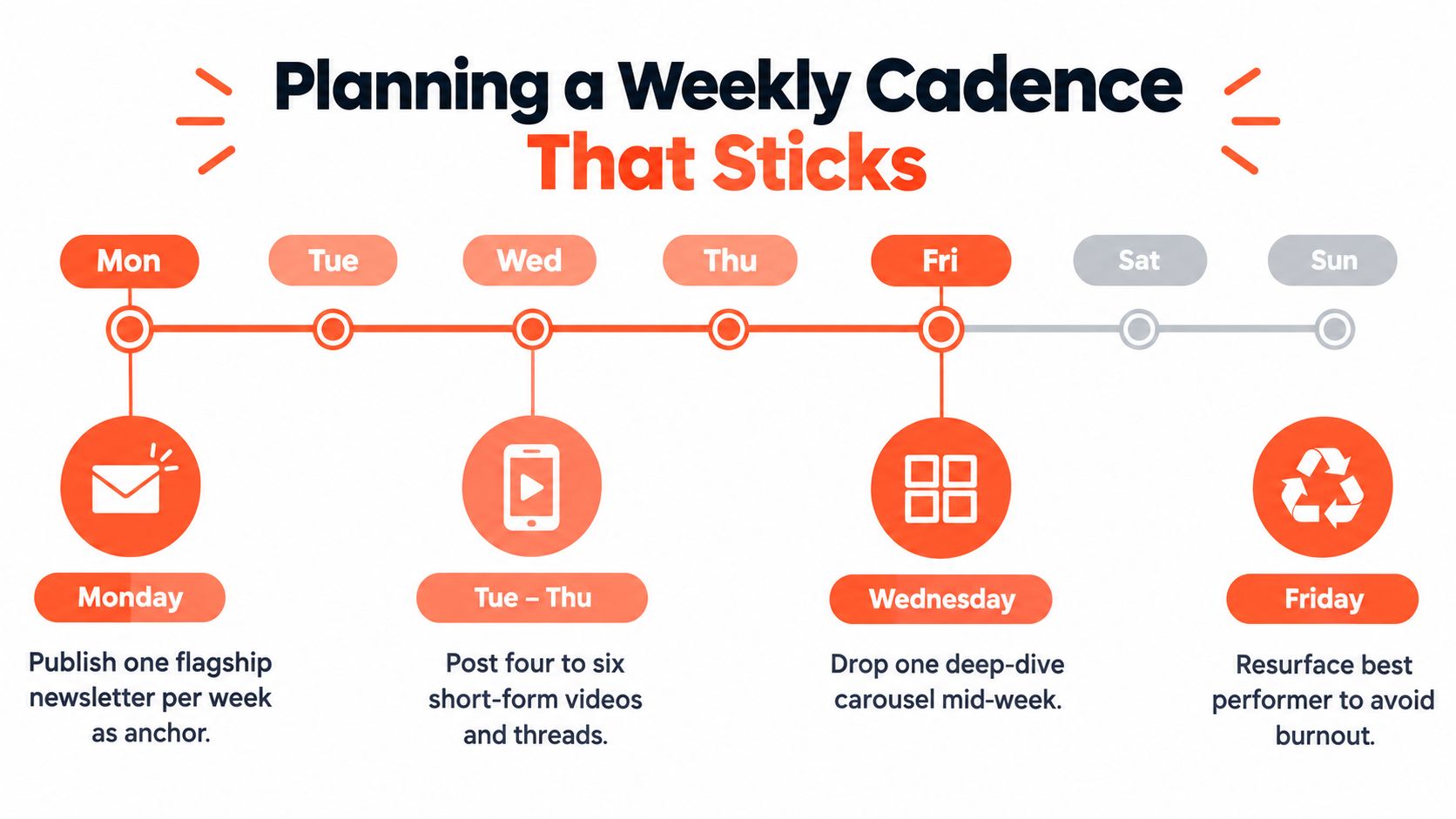
A realistic example week
Here's what that can look like in practice:
- Monday: Publish the newsletter and pull the best lines, proof points, and framework from the final draft.
- Tuesday: Publish a LinkedIn carousel based on the main idea.
- Wednesday: Post a short video hook built from the strongest contrarian point.
- Thursday: Run a quote card or text post with one memorable line from the issue.
- Friday: Publish a thread or short opinion post that reframes the issue for conversation.
- Daily: Reply to comments, answer DMs, and watch for objections that can become next week's material.
This works because the newsletter does the heavy lifting once. Social then stretches that work through the week.
Keep the feed from sounding recycled
A feed made entirely of newsletter fragments gets stale fast. I like a simple ratio:
- Three newsletter-born posts
- One platform-native post
That native slot matters. It can be reactive commentary, a behind-the-scenes observation, or a response to what your audience is already discussing. It keeps the account from feeling automated, even when the content system is highly structured.
For solo operators, batching is the difference between consistency and drift. Atomize the issue on newsletter day, queue the week in one sitting, and leave one slot open for live context or timely conversation.
The schedule should reduce decisions, not create more of them.
Measuring Signups, Reach, and Conversion
One reason newsletter social media marketing gets misread is that teams lump every metric together. Reach, signups, and downstream email quality answer different questions. If you blend them into one dashboard, the story gets muddy.
I separate measurement into three buckets: list growth, social distribution, and subscriber quality.
Newsletter Social Metrics by Goal
| Goal | Metric | Source | Healthy Baseline |
|---|---|---|---|
| List growth | Net new subscribers | ESP and signup forms | Compare against your own past issues and channels |
| List growth | Signup conversion from social referral traffic | Analytics plus landing page tracking | Higher is better when traffic quality is steady |
| Reach | Impressions and profile visits | Native platform analytics | Useful only when paired with saves, shares, or clicks |
| Reach | Saves, shares, and comments on repurposed posts | Native platform analytics | Look for patterns by format, not vanity spikes |
| Conversion | Click-to-open behavior from social-acquired subscribers | ESP segmentation | Compare social-acquired cohorts against other sources |
| Conversion | Early retention and unsubscribe patterns | ESP cohort reporting | Strong channels keep readers past the first few sends |
Build source tracking into the list itself
This is the part many teams skip. Don't just tag links. Store source information inside your email platform when the person subscribes. That gives you a way to segment social-acquired readers later and compare them against direct, referral, or search-acquired subscribers.
Use three layers together:
- UTM-tagged signup links for every major social surface
- Channel-specific landing pages when possible
- A source field inside the ESP so the attribution survives after the click
If you're diagnosing why signups aren't engaging after they join, inbox placement matters too. A practical explainer on what is email deliverability helps because poor delivery can make a social campaign look weak when the issue starts after the signup.
Don't stop at the signup
A social channel can be excellent at generating subscribers and still be poor at generating readers. That's why I'd compare the retention and engagement behavior of social-sourced subscribers against other sources after they enter the list.
If a channel brings in plenty of names but those readers stop opening early, you've learned something important. The problem may be the promise in the social CTA, the mismatch between post tone and newsletter tone, or the audience quality itself.
Building a Repeatable Newsletter to Social System
The teams that stick with this don't rely on enthusiasm. They use a repeatable sequence with one owner, one publish day, and a short repurposing window while the issue is still fresh.
A practical operating rhythm looks like this:
- Write the newsletter first
- Mark three to five extraction candidates during editing
- Turn those into platform-native assets within the next few days
- Schedule the posts for the coming week
- Review performance every Friday and retire weak formats
What belongs in the SOP
Keep the system documented on one page so it survives busy weeks and team changes.
Include the basics:
- Tone rules for captions, hooks, and CTAs
- Visual templates for carousels, quote cards, and clips
- Format rules by platform
- Hashtag or keyword guidance if you use them
- Source tagging rules inside the ESP and analytics setup
The failure modes are predictable. Teams paste newsletter copy into captions without adaptation. They spread effort across too many platforms. They ignore comments and DMs, even though that's often where a social reader asks the first real buying question. Or they skip subscriber source tracking and lose attribution entirely.
Review the system regularly. Formats wear out. Platform behavior changes. Posts that once earned saves can flatten if the framing gets repetitive.
The newsletter should stay the source asset. Social should stay the atomization layer. When those roles are clear, the whole machine gets easier to run.
If you publish a newsletter regularly and want to turn each issue into a week of channel-ready assets, WaveGen.ai is built for that workflow. It takes a source piece like a newsletter and generates branded social formats such as carousels, quote cards, captions, and short-form assets so you can keep the newsletter at the center and still show up consistently across platforms.
newsletter social media marketing
newsletter promotion
content repurposing
email to social
social distribution
Turn this kind of writing into a week of social content.
Paste a blog post, newsletter, or rough draft — WaveGen turns it into publish-ready carousels, captions, and slideshows for every channel.
No credit card · First posts in 2min