August 18, 2026
14 min read
Multi Platform Publishing: A Step-by-Step Workflow Guide
Master multi platform publishing with a step-by-step workflow for repurposing content, scheduling posts, and tracking performance across every channel.
You publish a thoughtful article, then spend the next few days shrinking it into captions, clipping it into video, turning it into a carousel, and formatting it for several feeds. By Friday, the calendar looks busy, but the system feels fragile. One missed source asset can leave every channel quiet, while unchanged cross-posts make your brand look automated rather than useful.
Multi platform publishing solves that problem only when it works as an operating system. The aim isn't to paste one post into every account. It's to turn one strong idea into a coordinated set of native experiences, each with an appropriate hook, format, cadence, and business goal.
Table of Contents
- What Multi Platform Publishing Means
- Why the Multi-Channel Shift Is Now Structural
- Defining Goals and a Sustainable Cadence
- Repurposing One Asset Into Platform-Native Variants
- Brand-Consistent Templates That Save Hours
- Scheduling, Crossposting, and Automation That Works
- Tracking Performance Across Every Channel
What Multi Platform Publishing Means
A useful test is simple: could someone move the post to another platform without changing its opening, layout, or CTA? If so, the content may be distributed, but it has not been adapted enough. Multi platform publishing starts with one idea and gives each destination a clear job, format, and reason to exist.
A LinkedIn paragraph may need only a light edit for another text-first network. The same material requires a different treatment as a TikTok script, Instagram carousel, YouTube Short, or Facebook video. Platform users scan, watch, comment, and act in different ways, so adaptation depth becomes an operating decision. Spend too little time and the post feels copied. Spend too much and the distribution effort consumes the value of the original idea.
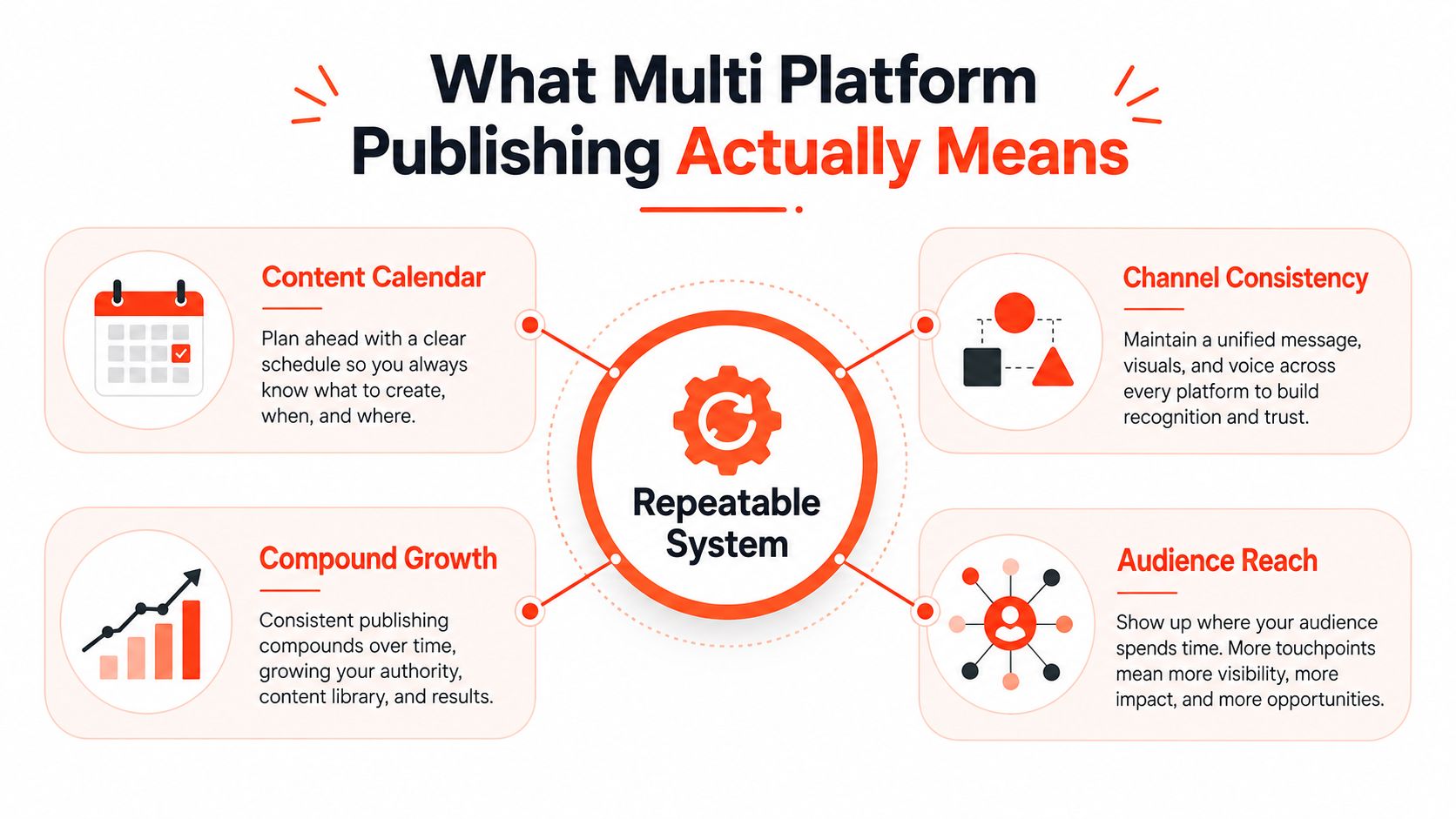
Start with one source asset, such as a newsletter, article, podcast script, or video transcript. Build a planned set of outputs around it:
- Discovery content: Short posts, clips, and visual summaries that introduce the idea.
- Depth content: The original article, newsletter, video, or downloadable resource.
- Conversation content: Questions, opinions, and prompts designed for replies.
- Conversion content: Calls to subscribe, book a call, request a demo, or visit a relevant page.
The source asset supplies substance. The variants supply reach. A documented multi-channel publishing strategy should connect each output to a goal, format, and required adaptation level instead of treating every post as a separate task.
Audit current channels as native, lightly adapted, or duplicated. The result shows whether you have a working system or a collection of cross-posting habits. Set a source cadence you can maintain. Consistency comes from a dependable input, not from creating every format from scratch each day.
Why the Multi-Channel Shift Is Now Structural
The commercial environment has changed because publishing now operates across a broad distribution ecosystem. One estimate valued the global digital publishing market at US$163.89 billion in 2025, with a projection of US$279.68 billion by 2034 at a 6.2% CAGR, while another estimated US$167.4 billion in 2024 and projected US$317.5 billion by 2030 at an 11.3% CAGR. A separate forecast placed the broader publishing and print media market at US$357.58 billion in 2026, rising to US$398.03 billion by 2031, implying a 2.17% CAGR. These are different market definitions, so they shouldn't be combined into one forecast, but they point in the same direction: publishing spans print, web, mobile, and platform-native formats. (Publisher Champ's market overview)
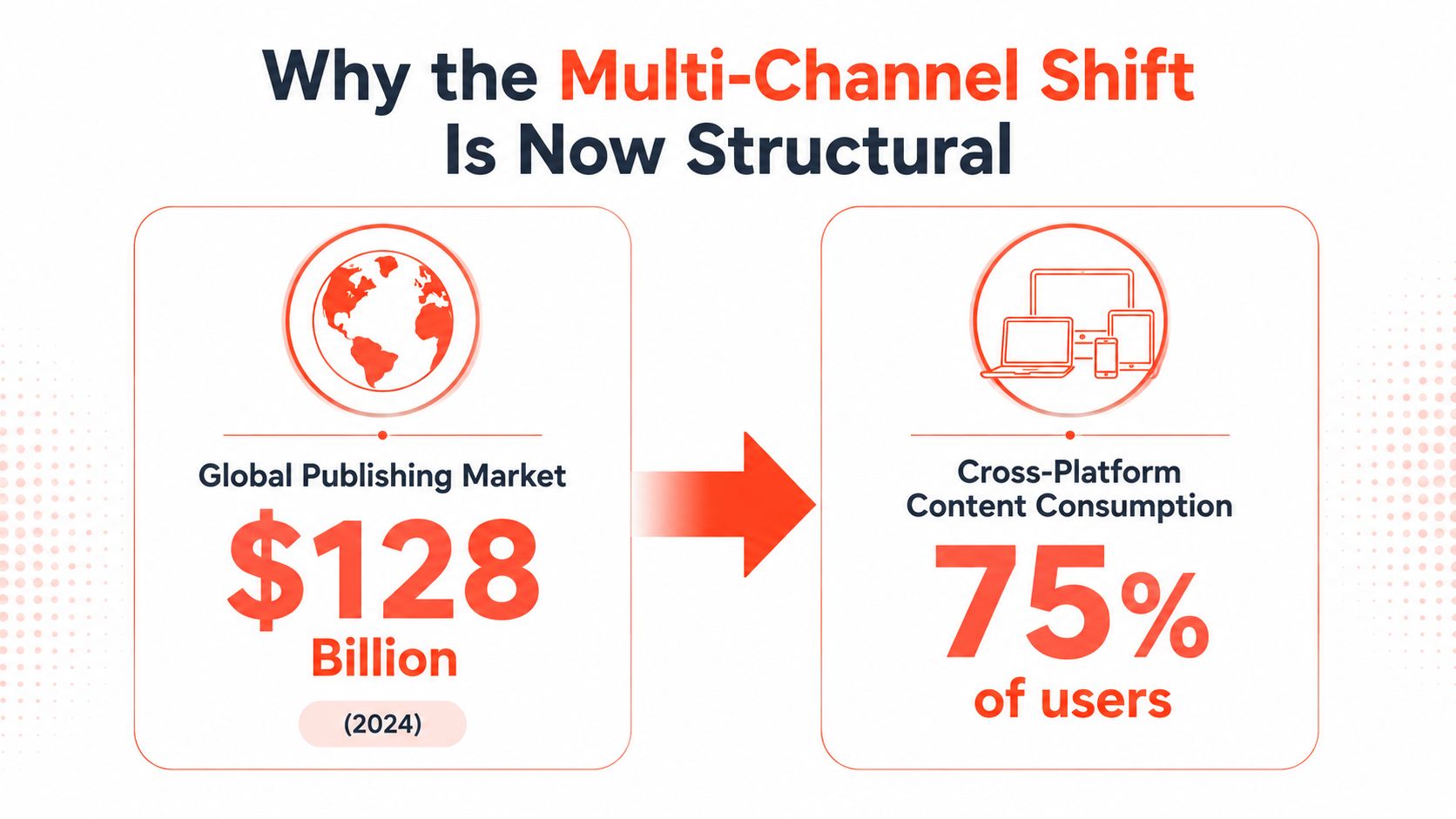
Audience measurement tells the same story from the other side. In Comscore's June 2026 multi-platform rankings for news and information publishers, Network18 reached 376 million unique visitors worldwide, Times Internet Limited reached 347 million, NBCUniversal News Group reached 316 million, and Yahoo News Network reached 294 million. The rankings included social platforms in the total digital population, which reinforces the operational reality that users encounter publishers through websites, apps, and social feeds, not only through an owned homepage. (The Comscore ranking summary)
What this means for smaller teams
A small business doesn't need the audience scale of a global publisher to face the same structural problem. A consultant may publish a detailed article on a website, but prospective clients may first encounter the idea through LinkedIn. A creator's video may earn discovery on TikTok while the email list provides the durable relationship. The channels work together, but they don't perform the same job.
That makes distribution a strategic choice, not an afterthought. A useful companion for teams balancing traditional search with emerging discovery surfaces is QuickSEO's hybrid SEO playbook. The key lesson for multi platform publishing is straightforward: build an owned source of depth, then design channel-specific entry points that lead people toward it or toward the next useful action.
Defining Goals and a Sustainable Cadence
Start with goals, not a scheduling tool. A platform can generate attention without generating qualified demand, and a post can collect reactions without moving anyone toward a business outcome.
Assign each channel a primary job. Instagram and TikTok may support discovery and reach through visual, short-form ideas. LinkedIn may support qualified conversations and leads for a consultant or B2B firm. YouTube can support authority through searchable explanations and deeper demonstrations. Facebook may support community distribution, while a newsletter or website remains the place where you develop the relationship.
Write each goal as an observable action:
- Reach goal: Introduce a new audience to a specific problem or point of view.
- Engagement goal: Encourage saves, shares, thoughtful comments, or watch completion.
- Lead goal: Move a relevant person to a form, consultation, reply, or sign-up.
- Authority goal: Demonstrate expertise through clear teaching and proof of process.
Then work backward from the content you can produce. Suppose a newsletter writer publishes one substantial article each week and wants to support five platforms. The sustainable plan isn't five entirely new campaigns. It's one source asset with a defined distribution package:
| Destination | Weekly role | Output from the source |
|---|---|---|
| Newsletter or website | Depth and ownership | Full article |
| Professional conversation | Text post plus document carousel | |
| Visual explanation | Carousel and adapted caption | |
| TikTok | Discovery | Short vertical script or clip |
| YouTube | Authority and search | Short or expanded video |
The cadence should follow the source, not an aspirational number of daily posts. If the source is delayed, the team can use an evergreen library, but it shouldn't pretend that every channel has an independent editorial engine.
A sustainable calendar protects quality by making the source asset the production constraint.
Create three fields for every planned output: platform goal, adaptation depth, and CTA. That forces a decision before production begins. A light edit may be enough for two text-first versions, while a video platform may need a new opening and a different visual sequence. Your calendar becomes a resource plan, not just a list of publishing dates.
Repurposing One Asset Into Platform-Native Variants
Take a long-form article and identify its central promise, strongest supporting point, most practical example, and clearest next step. Those elements become a content bank. Don't distribute the article as one unmodified block. Rebuild the presentation around what each audience can consume naturally.
The evidence supports transformation rather than duplication. A six-month internal analysis across 258 brands with 50,000 to 100,000 followers found that repurposed content averaged 114,907 monthly social media views, compared with 45,516 for non-repurposed content, a reported 152% lift in visibility. The analysis specifically framed repurposing as adapting one core asset into formats such as threads and memes, not publishing identical copies everywhere. (Neil Patel's content repurposing statistics)
Use an adaptation threshold
The question isn't whether every post must be completely new. The useful question is whether the audience's required behavior changes.
| Platform | Native format | Hook style | Minimum adaptation |
|---|---|---|---|
| Carousel with caption | A visual promise or contrast | New slide sequence, cover, caption, and CTA | |
| TikTok | Short vertical clip | Immediate spoken problem or payoff | New opening, vertical framing, pacing, and on-screen text |
| Text post or PDF carousel | Professional lesson, opinion, or observation | Rewrite opening and CTA, then format for scanning | |
| YouTube | Short or long-form video | Searchable question or clear outcome | New spoken structure, title, thumbnail, and edit |
| Native video or discussion post | Relatable problem or community prompt | Adjust context, caption, and conversation prompt | |
| Pin | Specific searchable benefit | New vertical graphic, title, description, and destination |
A light edit works when the platform's consumption pattern and intent are close to the source. A new hook is required when the audience discovers content through video, visuals, or a different professional context. The same idea can survive intact, but the first few seconds, lines, or frames usually can't.
For solo creators, templates prevent adaptation from becoming a design project every time. Build a carousel grid, video cover, quote card, and document layout once. Keep the brand elements stable, but leave room to change the hook, examples, and CTA. A system such as AI for content marketing can help turn the source into draft variants, but a human still needs to decide whether each version sounds native.
Measure the transformed asset against the original-only baseline using monthly views, engagement rate, saves, shares, watch behavior, and downstream actions. If a variant requires heavy rewriting but produces no meaningful signal, reduce its adaptation depth or stop publishing it.
Brand-Consistent Templates That Save Hours
Brand consistency doesn't mean every channel should look identical. It means a viewer should recognize the source while still seeing a format designed for the platform.
Create a compact brand kit with decisions that don't need to be revisited for every asset:
- Visual rules: Approved colors, font pairings, image treatment, logo placement, and spacing.
- Voice rules: Preferred sentence length, level of formality, words to use, and claims to avoid.
- Template library: Carousel, quote card, video cover, blog header, document post, and thumbnail layouts.
- CTA rules: Approved actions for awareness, engagement, lead generation, and retention.
- Review rules: Who checks accuracy, tone, accessibility, and links before scheduling.
Templates should encode editorial structure as well as appearance. An Instagram carousel template can reserve the opening slide for the promise, middle slides for one idea at a time, and the final slide for the CTA. A LinkedIn template can leave space for a concise opening, a practical sequence, and a discussion question. A short-video cover can prioritize readable wording rather than squeezing an article headline into a tiny frame.
Lock the system before production
Use a shared naming convention for source assets and variants. Store the approved copy, visual files, captions, alt text, and destination links together. That prevents the common failure where a designer uses an old logo, a writer changes the CTA, and the scheduler publishes an outdated link.
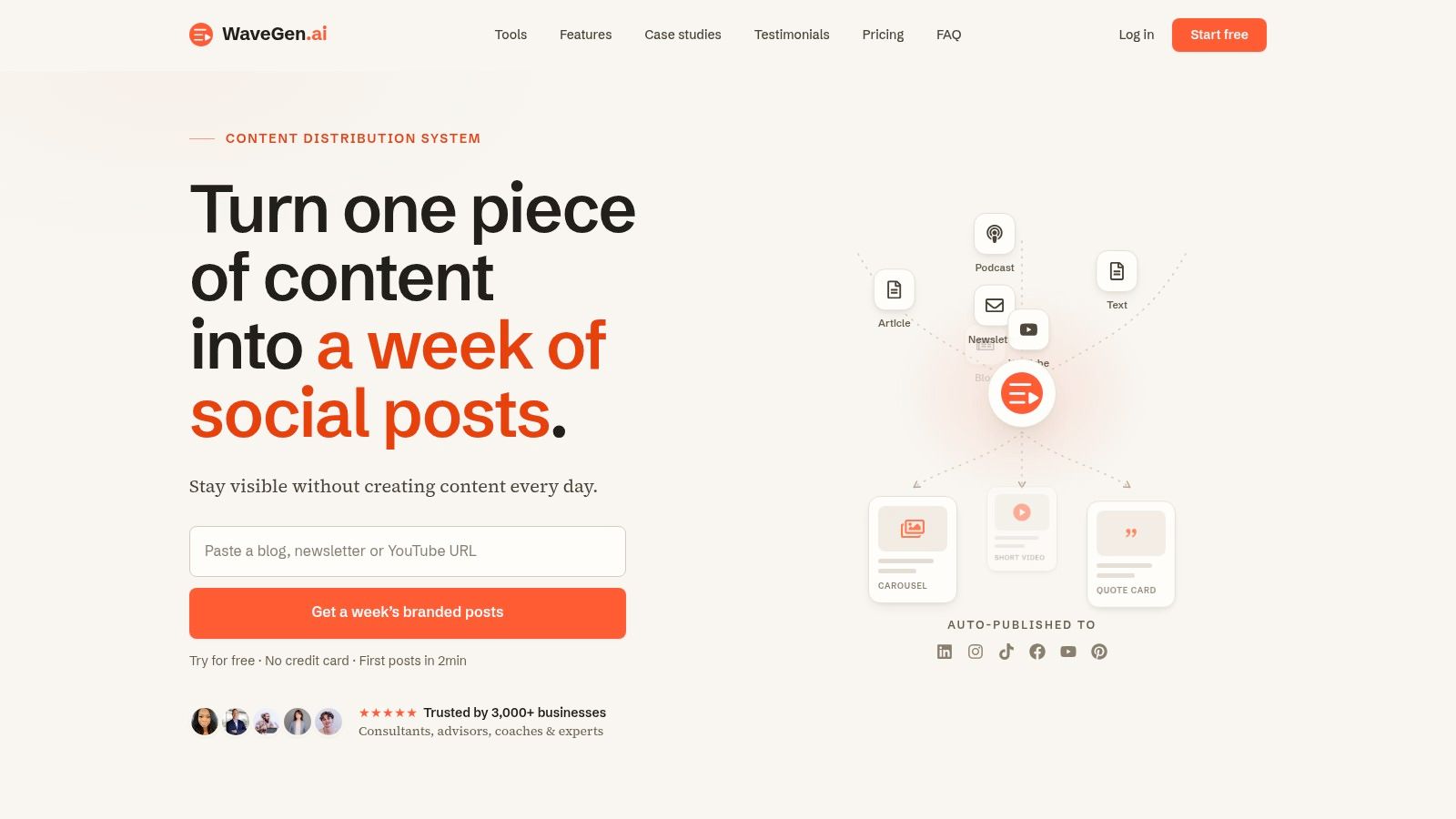
Automation can apply the brand kit repeatedly, but it won't know whether a claim is legally sensitive, whether a joke fits your audience, or whether a trend has changed the context. If you use WaveGen.ai, treat its brand kit, visual editor, scheduling, and RSS-based autopilot as production infrastructure, not as a replacement for editorial judgment. The system can create drafts and maintain consistency, while your review process protects accuracy and reputation.
Scheduling, Crossposting, and Automation That Works
A weekly publishing queue can fail before the first post goes live. The usual cause is treating every channel as a separate production project, or sending one unchanged file everywhere. Choose the lightest tool stack that fits the workflow. Native schedulers suit a small channel set. Third-party schedulers centralize calendars, approvals, and queues. End-to-end distribution systems connect source assets to adapted formats, though they demand clear brand rules and review checkpoints.
The key decision is adaptation depth. Crosspost unchanged content only when the asset already fits both destinations. One video file may suit TikTok and YouTube Shorts when its framing, opening, captions, and length work on both. A horizontal interview clip dropped into a vertical feed needs reframing and a rewritten opening. If the changes required exceed the expected reach or learning value, skip that channel. Crossposting should reduce production effort without lowering audience fit.
A practical automation sequence
- Connect the source: Import an article, newsletter, transcript, or RSS-driven content.
- Set the brand kit: Define colors, fonts, logo treatment, voice, and CTA preferences.
- Generate variants: Create carousels, short videos, quote cards, captions, and platform-specific drafts.
- Review in the editor: Check claims, tone, visual hierarchy, hooks, and destination links.
- Schedule selectively: Publish each approved variant at a channel-appropriate time and cadence.
- Activate autopilot carefully: Use RSS-driven output for dependable source content, with review gates for sensitive topics.
Automation handles resizing, format variations, hashtag suggestions, queue population, and movement through a defined pipeline. It cannot reliably judge whether a post sounds like the business, whether a comment needs a nuanced reply, or whether a fast-moving event has changed the context. Keep human review for claims, tone, legal sensitivity, and timely references.
WaveGen.ai can serve as production infrastructure through its brand kit, visual editor, scheduling, and RSS-based autopilot. For teams refining handoffs and approvals, content workflow help from Encelade provides process context. Scheduling should remain tied to a documented calendar. Social media scheduling guidance can help formalize the publishing queue.
Measure distribution, not just delivery
The same idea may reach Instagram, TikTok, LinkedIn, YouTube, and Facebook. Use consistent campaign names, tagged destination links, platform-level landing pages where practical, and a record of the source idea behind each variant. Compare unique engaged audiences rather than adding every platform's reported views.
A channel can show rising views while combined reach stays flat because the same people consume the content across platforms. Monitor increasing follower overlap, repeated engagement from the same accounts, and flat combined reach alongside higher channel-level numbers. That pattern can indicate cannibalization. Extra frequency may still be useful, provided the team knows what it contributes.
Tracking Performance Across Every Channel
A multi platform publishing program needs two measurement layers. The first shows whether the content works inside a platform. The second shows whether the distribution supports the business.
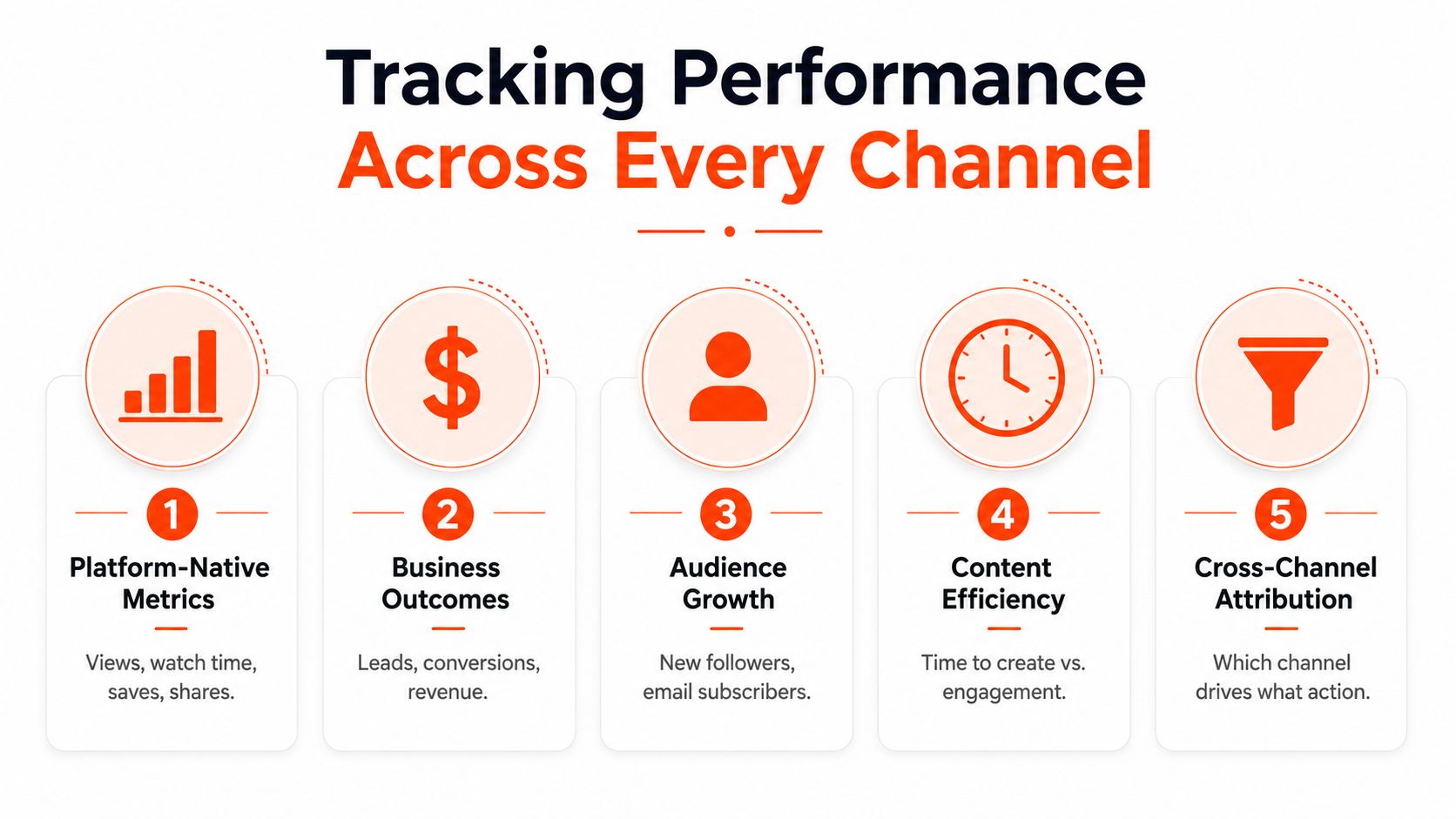
Platform-native metrics include views, watch time, saves, shares, comments, profile visits, and engagement rate. Business metrics include leads, email signups, booked calls, qualified conversations, purchases, and revenue. Keep the layers separate at first, then connect them through tagged links, forms, CRM fields, and campaign naming.
Likes are easy to count, but they often say less than engagement rate. A post with fewer likes may generate more meaningful comments, saves, shares, or profile actions relative to its audience. Use engagement rate as the primary signal for whether adaptation preserved resonance, then inspect the underlying actions to understand why.
Build a monthly measurement stack
Track the same fields for every source asset:
- Platform-native response: Views, watch time, saves, shares, comments, and engagement rate.
- Audience movement: New followers, returning viewers, email subscribers, and profile visits.
- Business action: Leads, signups, booked calls, sales conversations, and conversions.
- Production efficiency: Time spent on the source, adaptation, review, and publishing.
- Cross-channel behavior: Tagged clicks, assisted conversions, audience overlap, and repeated exposure.
Don't add platform totals together without checking audience overlap. A single person can appear in several channel reports, so aggregate views aren't the same as unique reach. Use a monthly comparison that asks whether the combined audience is expanding, whether each channel reaches a distinct segment, and whether one format is attracting attention without producing useful action.
A simple cannibalization check compares total unique reach, per-platform reach, and overlap signals over time. If each platform's views rise but total unique reach remains flat, investigate whether the same audience is moving between channels. If total unique reach expands while engagement rate and business actions remain healthy, the distribution is likely adding exposure rather than merely splitting it.
Measurement principle: A channel earns more production effort when it brings a distinct audience or a stronger business action, not merely a larger view count.
A four-week rollout
Week one, define the baseline. Audit every active channel, identify its primary goal, record current metrics, and choose a dependable source cadence. Remove channels that have no audience fit or no realistic owner.
Week two, build the production system. Create the brand kit, adaptation matrix, naming convention, approval checklist, and tracking fields. Draft the first platform-native templates before you generate a large content queue.
Week three, ship one complete package. Take one source asset through every stage, including adaptation, review, scheduling, and measurement. Record how much time each variant takes and note where the workflow breaks.
Week four, make the first allocation decision. Review engagement rate, meaningful actions, production effort, audience overlap, and business outcomes. Concentrate future effort on the two platforms that combine audience fit with useful results, then revise the templates that caused unnecessary manual work.
Compact FAQ
How much adaptation is enough?
Use a light edit when the platform, format, and audience intent are similar. Create a new hook, visual treatment, pacing, or CTA when the audience discovers content through a different behavior, especially short-form video or visual browsing. If the post feels like a file uploaded to a platform rather than a post made for it, adapt it again.
How can I tell whether reach is growing or splitting?
Track combined unique reach, per-platform engagement rate, tagged business actions, and audience overlap. Rising platform views with flat combined reach and increasing overlap may indicate cannibalization. Rising combined reach with distinct engaged audiences and healthy downstream actions suggests that distribution is expanding your presence.
Use tomorrow morning to choose one source asset, assign each channel a job, and fill in the adaptation matrix before opening your scheduler. WaveGen.ai turns an article, newsletter, podcast script, or transcript into platform-specific drafts, visual formats, brand-consistent assets, and scheduled posts, so visit WaveGen.ai to set up your first multi-channel publishing workflow.
multi platform publishing
content repurposing
social media workflow
content distribution
publishing automation
Turn this kind of writing into a week of social content.
Paste a blog post, newsletter, or rough draft — WaveGen turns it into publish-ready carousels, captions, and slideshows for every channel.
No credit card · First posts in 2min