August 22, 2026
15 min read
Multi Channel Content Management for Modern Teams
Learn multi channel content management strategies, workflows, and tooling to plan, create, schedule, and measure content across social platforms.
A consultant finishes a strong newsletter on Monday morning. The argument is clear, the examples are useful, and the call to action is ready. Then the work begins: reshaping the same idea for Instagram, LinkedIn, TikTok, Facebook, email, and perhaps a short video.
By Friday, the consultant has spent more time copying, trimming, resizing, and checking captions than developing the next idea. Worse, each version has drifted slightly. One post uses an outdated product description, another has a different call to action, and a third no longer matches the offer on the website. Multi channel content management isn't mainly about publishing in more places. It's about keeping one reliable message accurate while adapting it for every place your audience sees it.
Table of Contents
- The Daily Struggle of Scattered Posting
- What Multi Channel Content Management Means
- Why Coordinated Campaigns Outperform Single Channel
- Building Your Orchestration Workflow
- The Hidden Governance Gap Nobody Covers
- Centralized Repurposing Versus Ad Hoc Crossposting
- Measuring and Governing Across Channels
- Start With One Source and Stay Consistent
The Daily Struggle of Scattered Posting
A coach starts the week with one useful article about helping clients prepare for a difficult business decision. She pastes the article into a document and begins making platform versions. LinkedIn gets a thoughtful summary. Instagram gets a carousel. TikTok needs a spoken script. Facebook needs a shorter post. The newsletter needs a personal introduction.
Each adaptation looks manageable on its own. The trouble appears when the coach has to remember which version contains the latest wording, which image has the approved logo, and whether the offer mentioned in yesterday's caption still exists. A small edit to the original article creates a second round of checking across every channel.

Manual posting also encourages people to treat every channel as a separate writing assignment. That approach creates brand drift. The coach sounds warm in the newsletter, overly formal on LinkedIn, and promotional in the video because each version was written at a different moment, often under time pressure.
The hidden time tax
Disconnected publishing creates several kinds of waste:
- Repeated editing: The team reshapes the same argument instead of building reusable content components.
- Context switching: Every platform has different length, visual, and audience expectations, so the writer keeps changing mental gears.
- Approval repetition: A manager may review nearly identical claims multiple times because each channel version lives in a separate file.
- Correction chasing: When a price, feature, date, or promise changes, someone must locate every affected post.
The cost isn't only measured in hours. A delayed update can leave one channel making a claim that the website no longer supports. A missed platform convention can make useful content feel awkward or irrelevant. A duplicated workflow also makes it harder to understand which version is the source of truth.
Practical rule: If a team can't identify the approved source asset quickly, it doesn't have a publishing problem. It has an operating problem.
The answer isn't to copy the same paragraph everywhere. Good coordination keeps the central idea stable while allowing the format, length, opening, visual treatment, and call to action to fit each channel.
What Multi Channel Content Management Means
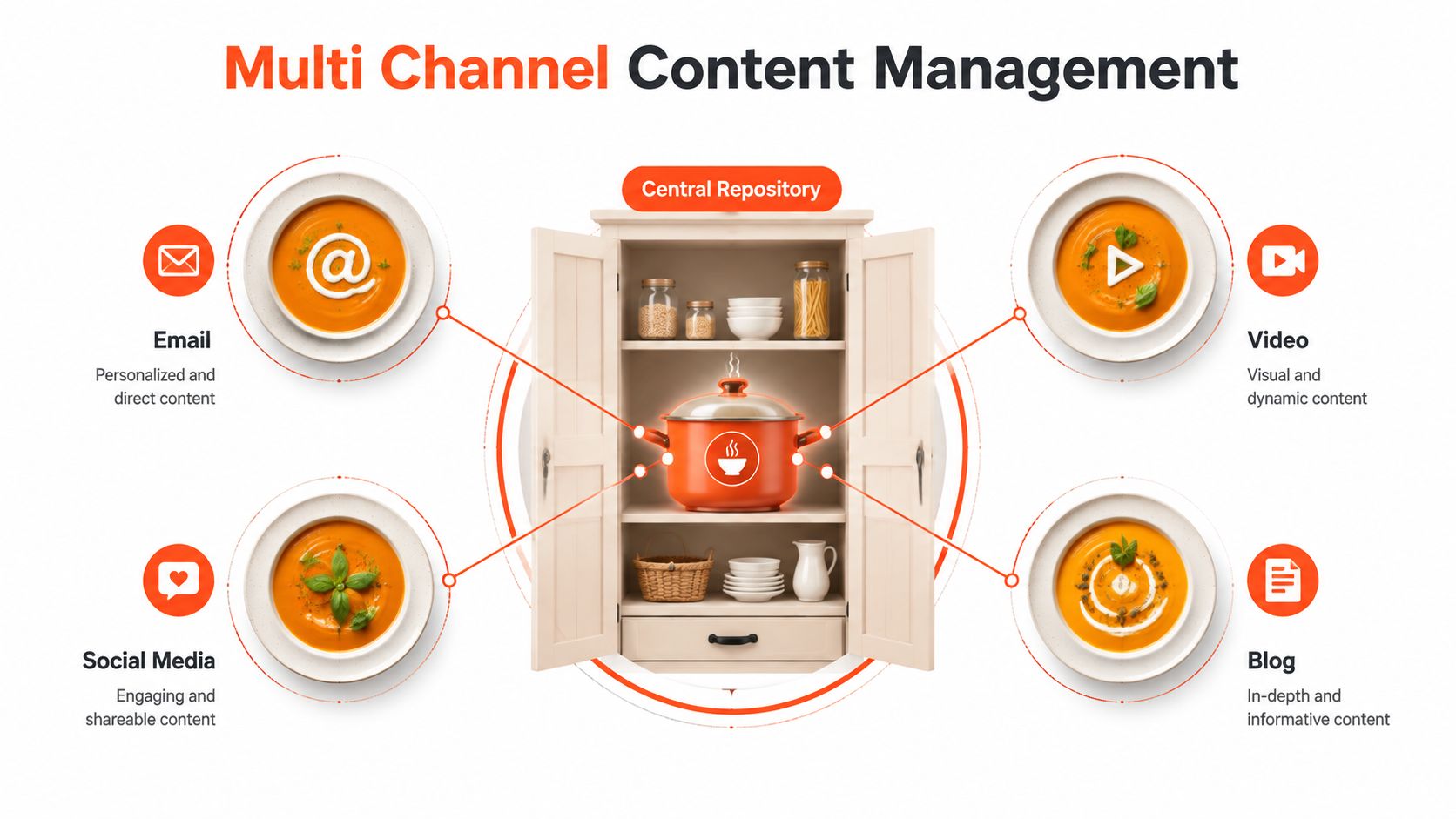
Think of a central kitchen preparing one batch of soup for several guests. The kitchen stores the ingredients and the recipe in one place. The server then plates the soup differently for each guest, perhaps adding different garnishes or serving it in a different bowl. The meal changes presentation, but the kitchen doesn't prepare unrelated recipes by accident.
A multichannel publishing system works in a similar way. It stores structured content in a central repository, then transforms that content for websites, mobile experiences, email, and social platforms. This approach is described in Smartium's explanation of multichannel publishing systems, which distinguishes the source content from the way each channel presents it.
Separate the message from the wrapper
A traditional workflow often stores a finished page, post, or email as one indivisible object. A more flexible system separates:
- Core content: The approved claim, explanation, product detail, offer, and supporting evidence.
- Presentation rules: The format, length, layout, dimensions, tone adjustments, and publishing requirements for a specific channel.
- Delivery method: The connection that sends the structured content to a website, app, email tool, or social platform.
That separation matters because an update to the core content can flow into multiple outputs without forcing someone to rewrite the original message from scratch. APIs can deliver the structured asset to different destinations, making simultaneous publication more practical and reducing channel-specific formatting errors.
The system doesn't mean every channel should receive identical wording. A blog can carry the complete explanation. An email can frame the practical benefit. A social post can lead with one sharp observation. A video script can turn the same argument into spoken language. The source remains stable while the packaging changes.
Use a content hub as a control room
A useful hub records more than the final copy. It can hold the asset owner, approval status, revision date, audience, campaign, channel versions, and any claims that need extra review. That information gives the team an answer when someone asks, “Which version is current?”
The model works particularly well for teams that already publish long-form material. A newsletter, article, podcast script, or transcript can become the source for platform-specific outputs. Teams that need help adapting ideas into video formats can also consult practical video marketing guides while keeping the approved message in the central workflow.
The important distinction is simple: multi channel content management isn't a collection of publishing buttons. It's a controlled path from one approved source to many purposeful presentations.
Why Coordinated Campaigns Outperform Single Channel
A single channel gives a campaign one route to an audience. A coordinated campaign gives the same idea several connected opportunities to be noticed, understood, and acted on. The advantage doesn't come from repeating identical copy. It comes from combining channel roles while preserving the same strategic message.
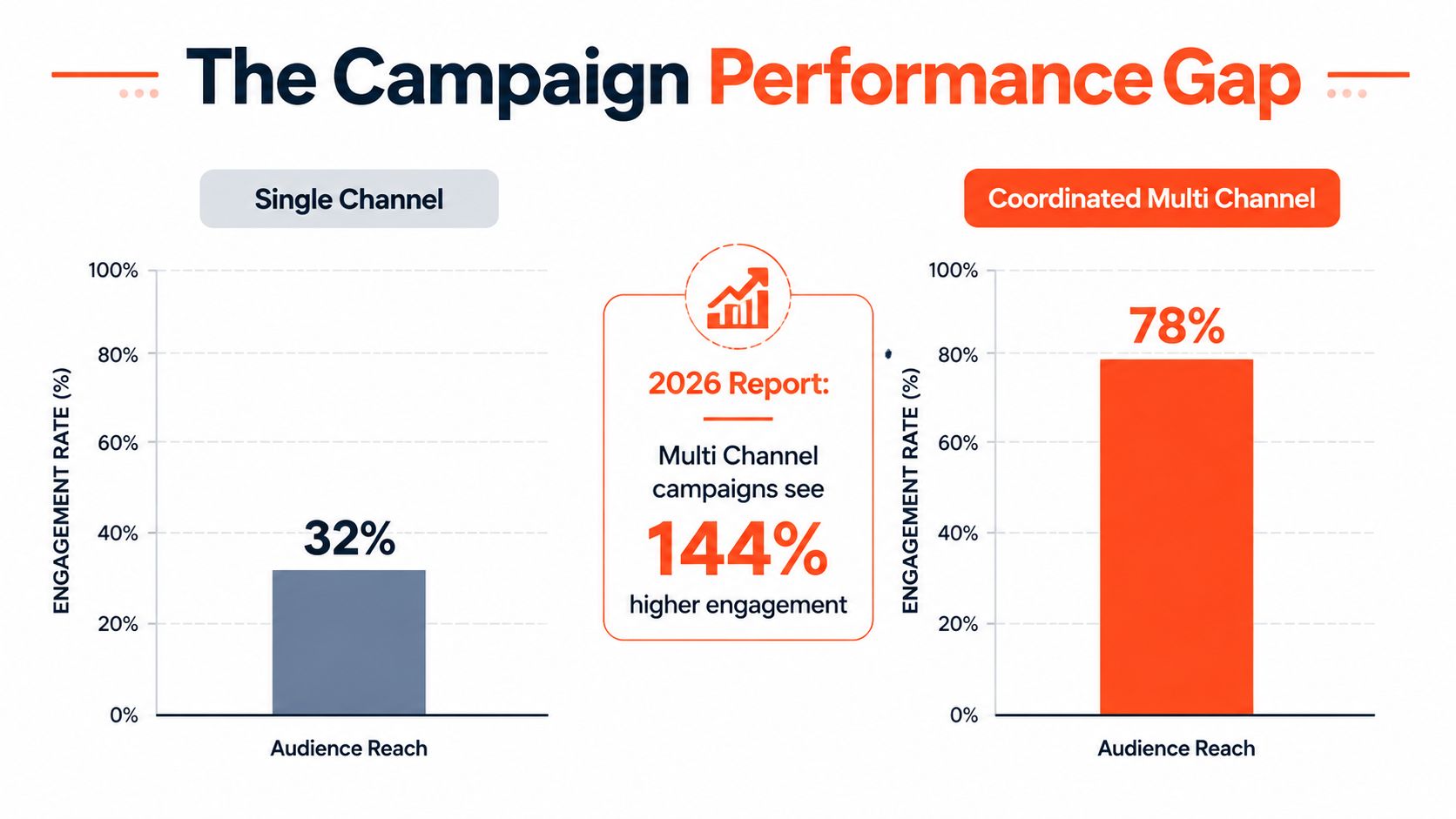
Research summarized in 2026 reports that campaigns using three or more channels can produce a 494% higher order rate than single-channel efforts, with an 18.96% engagement rate compared with 5.4% for single-channel campaigns. These figures are reported in the 2026 multichannel marketing statistics summary.
Coordination matters more than channel count
More channels can create more chances to reach people, but expansion alone won't fix a fragmented workflow. If the email promotes one benefit, the video emphasizes another, and the landing page uses an outdated offer, additional distribution can multiply confusion.
The same reporting says 52% of marketers use three to four channels on average, while only 14% of organizations say their campaigns are coordinated across every channel. Just 5% describe their strategy as very well-integrated, according to that same source. The gap shows why publishing everywhere isn't the finish line. Many teams have a channel presence without a shared operating system.
A coordinated campaign assigns each channel a job:
- The anchor asset develops the complete argument and gives the team a durable source.
- Email provides context and directs an existing audience toward the next action.
- Social content extracts a useful idea in a format suited to fast discovery.
- Video demonstrates the concept through voice, movement, or a visual example.
- The website holds the definitive details, supporting information, and conversion path.
Consistency is the performance lever
A buyer may encounter the campaign in a social feed, return through an email, and check the website before taking action. Each touchpoint should feel related, not duplicated. The promise, terminology, and offer need to agree even when the format changes.
That requires more than an editorial calendar. The team needs shared source material, clear ownership, and a method for updating every derivative when the source changes. Otherwise, the business may gain reach while losing trust.
The commercial case for coordinated publishing is therefore also an operational case. Strong results depend on the audience receiving a recognizable message at each relevant touchpoint, not on the team producing disconnected posts at high speed.
Building Your Orchestration Workflow
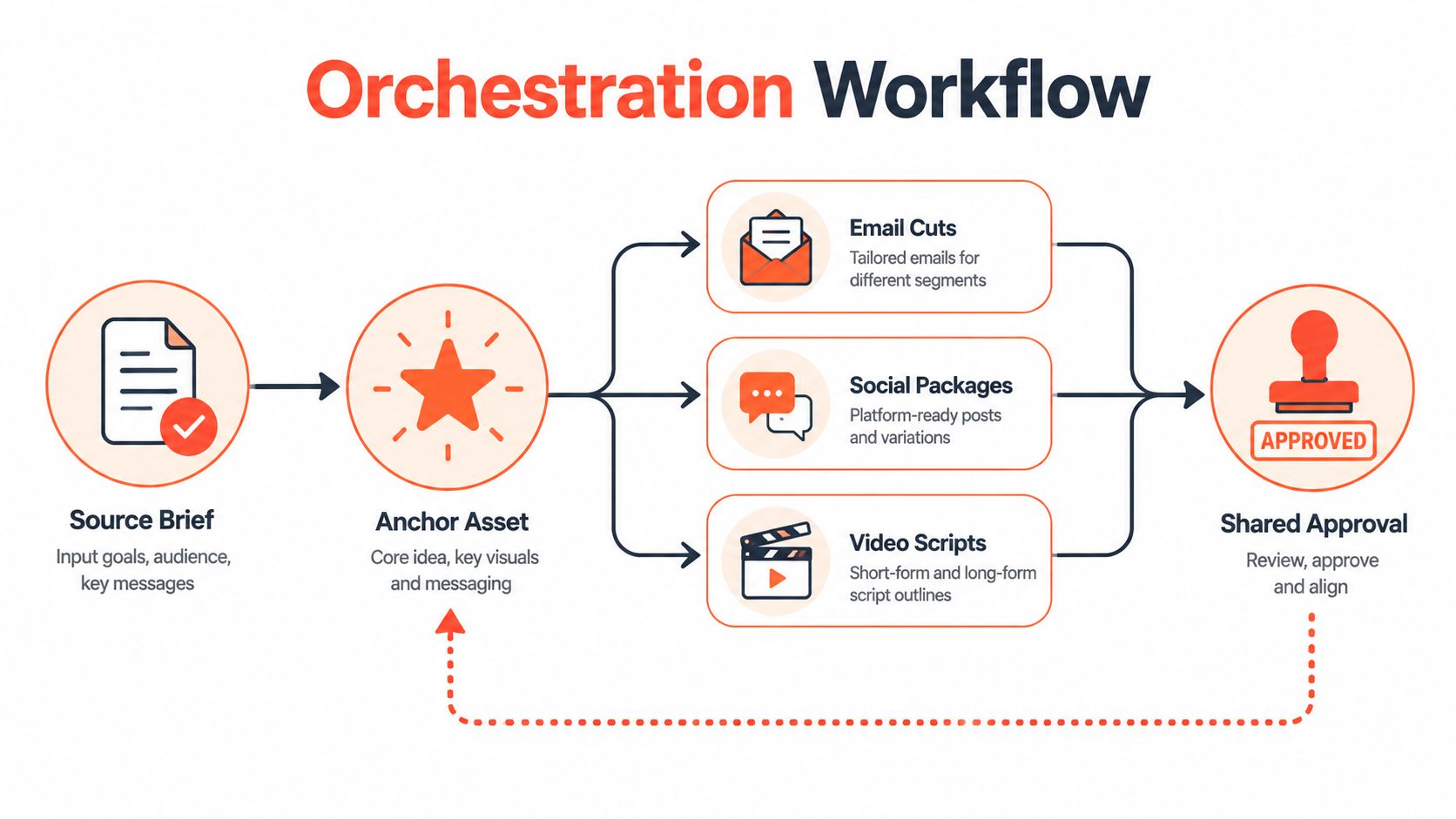
A practical workflow begins with one approved brief, not with a request for separate posts. The brief should state the audience, problem, main argument, evidence, offer, call to action, responsible owner, and any claims that require checking.
From that brief, the team creates an anchor asset. It might be an article, newsletter, webinar outline, podcast script, or long-form video plan. The anchor becomes the source that later versions reference.
Build derivatives from approved material
Once the anchor asset is approved, the team extracts channel-native derivatives:
- Email cuts turn the central lesson into a concise introduction and a clear next step.
- Social packages use distinct hooks, captions, visual cards, carousels, or short posts.
- Video scripts convert the argument into spoken language with an opening, supporting points, and close.
- Website components preserve the full explanation and the most complete version of the offer.
The source brief should remain attached to every derivative. That connection helps an editor understand why a sentence exists and makes later updates easier.
Workflow guidance from InPublishing's multichannel workflow discussion recommends treating the system as an orchestration layer. Shared approval can be reused when the claims haven't changed. If the product detail, offer, or central claim changes, the affected derivatives need a fresh review.
Make approval proportional to risk
Not every edit deserves the same review path. A spelling correction can follow a light check. A product promise, legal statement, medical claim, financial detail, or time-sensitive offer needs the appropriate subject-matter owner.
A simple approval record should answer:
- Who wrote or adapted the asset?
- Who checks factual accuracy?
- Who owns the brand voice and visual treatment?
- Which claims can be reused without another review?
- What change would trigger reapproval?
- When should the asset expire or be revisited?
This structure prevents a common mistake: asking one manager to approve every small variation while giving nobody clear responsibility for major updates.
Teams building a broader publishing process can also compare this workflow with WaveGen's multi-platform publishing approach. The central principle remains the same, regardless of the software: create once, adapt deliberately, approve against the source, then distribute through a documented schedule.
Measure the production-to-approval ratio to see how much work reaches review, and track weekly distribution performance to learn which outputs deserve more attention. These measures reveal whether the team is creating a healthy pipeline or repeatedly re-mining the same asset without improving throughput.
The Hidden Governance Gap Nobody Covers
Most publishing advice starts with channel selection. It asks whether the team should add another social platform, launch a video series, or distribute more frequently. That question comes too early.
The harder question is what happens when the source information changes. A product feature gets renamed. A campaign date moves. An advisor revises a recommendation. A compliance reviewer removes a claim. If the team can't identify every derivative connected to that information, distribution speed becomes a liability.
A 2026 industry report found that 88% of teams struggle to keep product content consistent across channels, while 56% manage product information separately from the digital assets used to market and sell products. Only 32% can update content or product information across channels immediately, on the same day or in real time, according to InsiderOne's report on omnichannel marketing challenges.
Version drift is an ownership failure
Version drift doesn't usually begin with careless writing. It begins when no one owns the relationship between the source and the outputs.
A social manager may own the Instagram post. A copywriter may own the newsletter. A product marketer may own the feature description. Each person can do competent work while the overall campaign becomes inconsistent because nobody owns the update path.
Assign ownership at three levels:
- Source owner: Maintains the approved message and decides when the source changes.
- Channel editor: Adapts the message to the platform without changing its meaning.
- Approver: Confirms factual, legal, product, or brand requirements before release.
Treat update latency as a real control
Update latency is the time between changing the source information and correcting every affected channel. A team doesn't need complicated technology to begin tracking it. It needs a change log, a list of affected assets, and a named person responsible for closing the loop.
The best publishing system is the one that tells the team what became wrong when the source changed.
For each source asset, record its current version, last review, linked derivatives, active channels, and expiration conditions. When an update occurs, pause scheduled outputs that depend on the old information, revise the source, regenerate or edit the derivatives, and document the new approval.
This governance layer protects the customer experience. It also protects the team from publishing contradictory information across channels while believing the campaign is coordinated.
Centralized Repurposing Versus Ad Hoc Crossposting
Ad hoc crossposting starts with a finished post and asks, “Where else can we paste this?” Centralized repurposing starts earlier. It asks, “What is the source idea, which channel formats fit it, and how will we keep the versions connected?”
The difference becomes obvious during a busy launch. In the ad hoc model, a writer copies a paragraph into several platform composers, trims each version manually, searches for images, adds hashtags, and checks whether the visual still matches the brand. A late correction sends the writer back through the same chain.
A centralized model keeps the source content, brand rules, adaptations, approvals, and schedule in one workflow. The team can still edit each version, but it doesn't have to rediscover the same idea every time.
A practical comparison
| Ad hoc crossposting | Centralized repurposing |
|---|---|
| Starts with separate platform drafts | Starts with one owned source asset |
| Repeats formatting and design work | Applies channel-specific templates and rules |
| Stores versions across scattered files | Keeps derivatives connected to the source |
| Requires repeated approval | Reuses approval when claims remain unchanged |
| Finds updates through manual searching | Flags affected outputs through asset relationships |
| Measures posts one at a time | Reviews production and distribution as a system |
WaveGen.ai is one example of this centralized approach. It can turn an article, newsletter, podcast script, or YouTube transcript into carousels, short videos, quote cards, and captions with platform-specific formatting. Teams can set brand kits with colors, fonts, logos, and voice, edit the resulting assets in a visual editor, and publish or schedule content for Instagram, TikTok, LinkedIn, YouTube, and Facebook. Pinterest is on the roadmap, and the system also supports crossposting and RSS monitoring through an autopilot mode.
That description doesn't remove the need for review. Automation can generate a useful first version, but a human still needs to check claims, context, accessibility, and whether the adaptation sounds natural on the destination channel.
For a deeper explanation of turning a newsletter into social content, see this guide on repurposing a newsletter into social media posts. Teams focused on long-term visibility can also explore how to build authority with content repurposing, especially when one durable idea needs to support many audience conversations.
Measuring and Governing Across Channels
Small teams don't need a larger collection of dashboards before they have a clear operating model. They need to know which source is current, who can change it, who approves the change, and what evidence shows that distribution is working.
A 2026 marketing-statistics roundup cites that only 29% of marketers have a systematic content repurposing process, while another figure in the same reporting says 48% of B2B marketers identify insufficient content repurposing as a major scaling challenge. These figures appear in SearchAnswerLab's roundup on omnichannel content readiness.
Use a small control sheet
A lightweight governance sheet can include:
- Asset name: The source article, transcript, brief, or campaign.
- Current version: The approved revision identifier or date.
- Source owner: The person responsible for factual accuracy.
- Channel owners: The people adapting or scheduling each output.
- Approval state: Draft, in review, approved, scheduled, live, or retired.
- Change sensitivity: The information that requires renewed review.
- Update path: The derivatives that must change when the source changes.
- Performance notes: What the team learned from weekly distribution.
This record gives a small team shared memory. It prevents the owner from becoming the only person who knows which caption is safe to reuse.
Measure flow before chasing reach
Start with operational measures. How many source assets become approved derivatives? How long does approval take? How often does an update require emergency correction? Which channel formats can the team produce reliably?
Then add distribution measures that match the campaign's purpose. A brand-awareness campaign may focus on meaningful engagement and qualified discovery. An educational campaign may monitor saves, replies, or visits to the full resource. A conversion campaign may connect channel activity to the agreed business action.
A content creator tools review can help teams evaluate production software, but tool selection shouldn't replace ownership decisions. AI can assist with adaptation, drafting, formatting, and variations, as discussed in this guide to AI for content marketing, but people still need to define the source message and approve material that carries business risk.
The bottleneck is often fragmented information, not a lack of applications. A modest system with clear owners will outperform a crowded stack that leaves version control unresolved.
Start With One Source and Stay Consistent
Choose one owned idea, such as a newsletter, article, podcast script, or transcript, and make it the source of truth. Route it through a central hub, create channel-native derivatives, and record who approves each one.
Track how quickly updates reach every active output. That measure exposes the governance gap more clearly than a larger posting schedule ever will. WaveGen.ai's repurposing workflow illustrates the central principle, adapt one useful source into consistent formats without turning every channel into a separate production project.
WaveGen.ai turns articles, newsletters, podcast scripts, and transcripts into on-brand carousels, short videos, quote cards, and captions for multiple social platforms, with brand kits, editing, scheduling, and crossposting in one workflow. Visit WaveGen.ai to see how a centralized source-to-distribution process can help your team publish consistently while keeping approvals and updates under control.
multi channel content management
content strategy
social scheduling
crossposting
content workflows
Turn this kind of writing into a week of social content.
Paste a blog post, newsletter, or rough draft — WaveGen turns it into publish-ready carousels, captions, and slideshows for every channel.
No credit card · First posts in 2min