August 16, 2026
19 min read
10 Lead Generation Strategies for Sustainable Growth
Compare 10 lead generation strategies with actionable steps, channel-specific tactics, KPIs, examples, and content repurposing ideas for 2026.
More channels won't automatically produce more leads. A team can publish on LinkedIn, run paid search, host webinars, send newsletters, and still create a weak pipeline if discovery never connects to capture, nurture, qualification, and follow-up.
The better question is where your buyer is in the journey and what your operation can support consistently. Search and paid campaigns capture existing intent. Content and short-form video create demand. Email and communities build trust. Partnerships and outbound follow-up convert attention into conversations. Your audience's intent, your available source assets, the length of your sales cycle, and your measurement maturity should determine the mix.
This list prioritizes 10 lead generation strategies across that journey. Each one includes a best-fit use case, implementation steps, practical KPIs, a realistic scenario, trade-offs, and a way to extend the asset into other channels. The path runs from content distribution and organic discovery through owned audiences, events, partnerships, paid acquisition, and community.
The target isn't vanity reach. It's qualified pipeline, measured through lead quality, sales acceptance, opportunity creation, cost, and time to conversion. That distinction matters because benchmark compilations report that roughly 79% to 80% of marketing leads never convert into sales, while only about 27% are contacted by sales in some datasets (Saleshandy's lead generation benchmark compilation). More volume won't fix a broken handoff.
Table of Contents
- 1. Content Repurposing and Multi-Channel Distribution
- 2. SEO and Organic Search Optimization
- 3. Email List Building and Newsletter Marketing
- 4. Lead Magnets and Opt-In Content
- 5. LinkedIn Content Marketing and Thought Leadership
- 6. Short-Form Video Content
- 7. Strategic Webinars and Live Events
- 8. Strategic Partnerships and Referral Networks
- 9. Paid Advertising
- 10. Community Building and Social Engagement
- 10-Point Lead Generation Strategy Comparison
- Turn the List Into a 90-Day Pipeline Plan
1. Content Repurposing and Multi-Channel Distribution
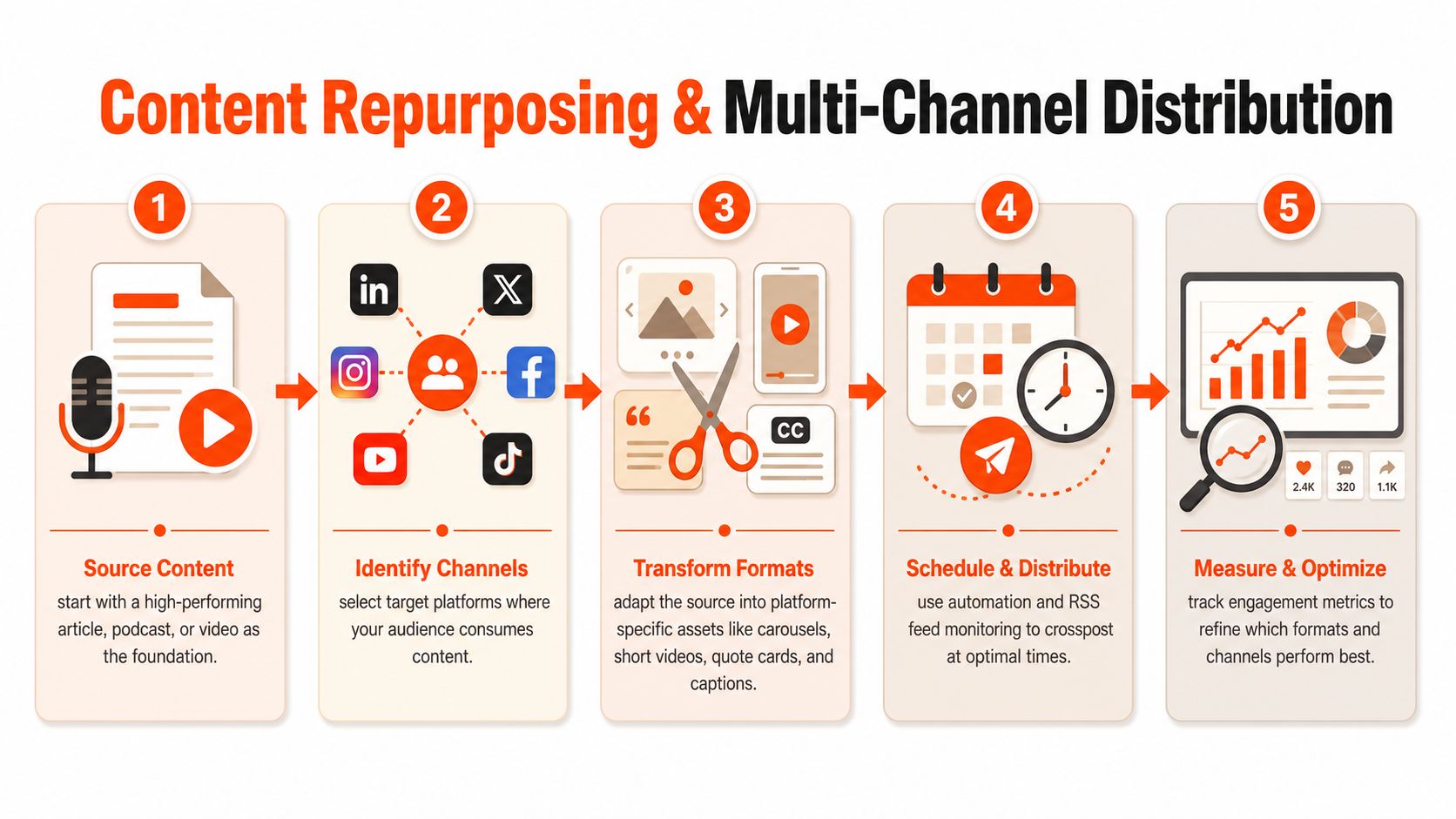
A strong source asset can feed an entire week of demand generation. Start with a substantial article, newsletter, podcast script, or YouTube transcript that answers a real customer question. Then adapt its ideas into LinkedIn posts, carousel slides, short videos, quote cards, email sections, and community prompts.
The adaptation matters. Copying one caption across every platform usually produces flat content because people consume a professional framework differently on LinkedIn than a quick demonstration on Instagram or TikTok. Keep the core insight consistent, but change the hook, pacing, visual format, and call to action.
Practical rule: Repurpose the idea, not just the file. Each channel needs a version that feels native.
A practical repurposing sequence
- Choose a proven source: Start with an evergreen asset that already receives thoughtful replies, email clicks, or sales questions.
- Extract the argument: Identify the main claim, supporting points, objections, examples, and actionable steps.
- Create platform versions: Turn the argument into a text post, carousel, short video script, quote graphic, and nurture email.
- Apply the brand system: Use consistent colors, fonts, logo treatment, and voice while adjusting the layout for each platform.
- Review the signal: Track saves, meaningful comments, profile visits, email signups, and qualified conversations, not reach alone.
A consultant might turn a weekly newsletter about pricing strategy into a LinkedIn document, several opinion posts, a short video explaining one pricing mistake, and an email inviting readers to a diagnostic call. WaveGen.ai can support this workflow by converting long-form material into channel-ready assets, as described in its guide to AI for content marketing.
Trade-off: Repurposing saves production effort, but it doesn't replace editorial judgment. Weak source content creates many weak derivatives. Measure which format produces intent, then give that format more attention.
2. SEO and Organic Search Optimization
SEO works best when your page meets an existing problem at the moment someone searches for help. A law firm targeting “personal injury attorney near me,” a consultant answering how to improve team productivity, and an agency building a city-specific service page are all aligning content with identifiable intent.
Start with the searcher's desired outcome, not a list of keywords. A query seeking a definition needs a different page from a query comparing vendors or looking for a provider. Build the page around the decision the visitor is trying to make, then provide enough evidence, process detail, and next steps to make contacting you feel sensible.
Build the page before building the cluster
- Select specific queries: Favor long-tail searches that reveal a problem, audience, location, or buying context.
- Match the format: Use a guide for education, a comparison for evaluation, and a service page for direct demand.
- Strengthen navigation: Link related articles to service pages and connect foundational guides to deeper explanations.
- Show firsthand expertise: Include original processes, practitioner observations, author credentials, and clear business information.
- Maintain the asset: Refresh outdated sections, examples, screenshots, and calls to action as the offer changes.
Technical foundations still matter. Check crawlability, mobile usability, page speed, indexation, structured page organization, and broken links. WaveGen.ai's technical SEO basics guide can help teams establish that foundation, while a practical sales prospecting guide from CleanMyList provides a relevant example of how search content can support commercial education.
Trade-off: SEO compounds slowly and depends on competition, site quality, and consistent updating. It can deliver high-intent discovery without paying for every click, but it won't solve an unclear offer or an inconvenient conversion path.
3. Email List Building and Newsletter Marketing
Your email list is an owned audience, but collection alone doesn't create demand. Subscribers stay engaged when every message helps them make a decision, avoid a mistake, or apply a useful idea. A newsletter should feel like a dependable editorial product, not a sequence of disguised sales pitches.
Offer a clear reason to subscribe. “Marketing tips” is too broad for most landing pages. A consultant could promise a weekly teardown of B2B landing pages. A financial advisor might publish plain-language market explanations. A coach could send one practical exercise tied to a specific transformation.
Turn the first subscription into a relationship
Create a welcome sequence that delivers the promised resource immediately, explains what future emails contain, and gives subscribers a low-friction way to identify their interests. Segment by topic, buyer stage, role, or service need when the information improves relevance. Don't collect unnecessary fields just because your form allows them.
A useful newsletter usually has a recognizable structure: one central insight, supporting context, an example, and one clear next step. That next step might be an article, webinar, assessment, reply prompt, or consultation. Test subject lines and send timing, but interpret opens cautiously and prioritize clicks, replies, signups, qualified leads, and sales acceptance.
Email is also an efficient acquisition and nurture channel. Recent benchmark data reports email marketing at about $53 per lead, while SEO is reported at about $31 per lead (Martal's lead generation benchmarks). Those figures are directional benchmarks, not promises for every company.
Trade-off: Newsletters require editorial consistency and list hygiene. They give you direct access to subscribers, but irrelevant messages increase unsubscribes and reduce trust. Write for the problem your audience opted in to solve.
4. Lead Magnets and Opt-In Content
A lead magnet earns contact information by solving a defined problem faster than a general article can. The strongest assets are specific and immediately usable, such as a campaign brief, proposal template, SEO review worksheet, onboarding checklist, assessment, or set of customer-service scripts.
Start with a problem that appears during a real buying conversation. If prospects repeatedly ask how to audit their content pipeline, create an audit worksheet. If they struggle to prepare for a sales call, create a preparation template. The resource should make your expertise visible while helping the reader take a meaningful first step.
Reduce friction after the form submission
Keep the landing page focused on the outcome. Explain what the resource helps the visitor do, show what it contains, and state who should use it. Ask only for information you can use. A long form can filter for detail, but it can also reduce completion and create distrust.
Deliver the asset immediately. The confirmation page can offer a related action, such as a short consultation, webinar registration, or article that helps the reader apply the resource. Follow with a welcome email and a nurture sequence connected to the original problem, rather than switching suddenly to unrelated company news.
Track landing-page visits, form completion, source, engaged downloads, replies, meetings, sales acceptance, and opportunities. A download is a lead event, not proof of buying intent.
Trade-off: Gated content grows your database, but the gate can reduce reach and attract people who want the document rather than your service. Keep high-value educational content ungated when distribution matters, and reserve the form for assets with clear practical value.
5. LinkedIn Content Marketing and Thought Leadership
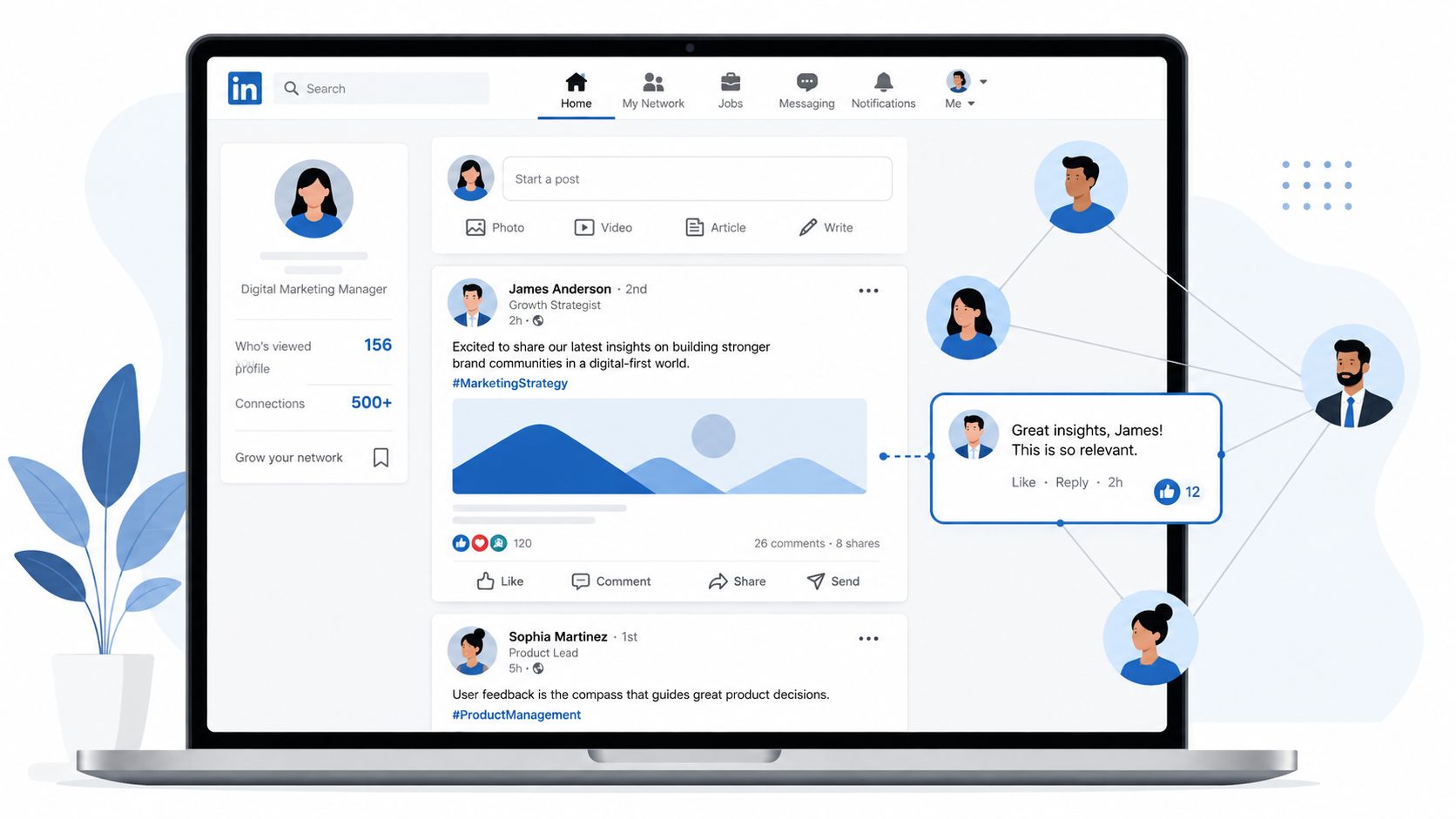
LinkedIn is useful when your buyers evaluate expertise before they evaluate vendors. A consultant can publish a contrarian interpretation of an industry problem, explain a repeatable framework, or share what a failed approach taught them. The post becomes a starting point for conversation, not a brochure.
Build around a few durable themes. One can explain the problem, another can demonstrate your method, and another can address objections or show the decisions clients face. Native documents, carousels, text posts, and newsletters give you different ways to present the same source idea without sending every reader away from the platform.
Treat engagement as research
Ask questions that invite experience rather than empty agreement. Respond to comments with useful detail, then notice the language people use to describe their constraints. Those responses can improve your landing pages, email subjects, webinar topics, and sales conversations.
Personal stories help when they clarify a business lesson. A founder might explain why a content calendar failed because no one owned distribution. A financial advisor might unpack a common misunderstanding without turning the post into individualized advice. Keep claims precise and make the next step proportional to the reader's intent.
For a deeper personal-brand workflow, use WaveGen.ai's LinkedIn personal brand guidance. A useful measurement set includes qualified profile visits, direct messages with a clear business context, newsletter subscriptions, landing-page visits, and opportunities influenced by LinkedIn.
Trade-off: Organic LinkedIn content can build authority without media spend, but reach is inconsistent and posting frequency alone won't create credibility. Thought leadership works when the person posting has a distinct point of view and participates in the conversation.
6. Short-Form Video Content
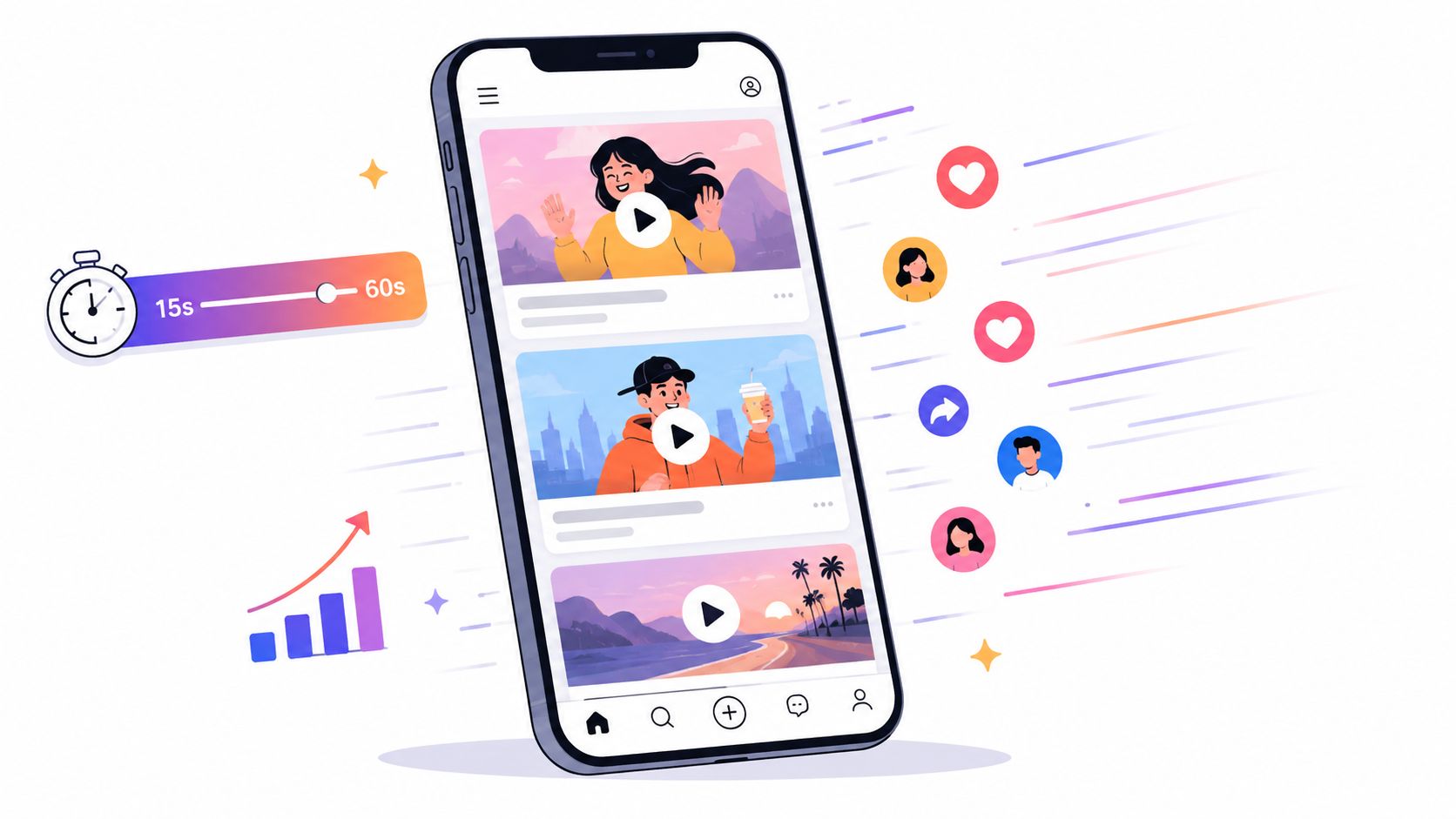
Short-form video gives expertise a face, voice, and rhythm. It suits demonstrations, myth-busting, quick explanations, behind-the-scenes decisions, and excerpts from longer material. A coach can explain one exercise, an advisor can clarify a financial concept, and an agency can show how it diagnoses a campaign problem.
Open with the tension the viewer already recognizes. The first line might name a costly mistake, challenge a common assumption, or promise a specific explanation. Add captions and clear on-screen structure so the message works without sound. Use trends only when they support the subject and brand.
Turn one recording into a content series
Record a longer explanation, then identify self-contained moments that can stand alone. Each clip should answer one question and point to one next action, such as following the account, joining the email list, downloading a framework, or watching the full explanation. Link the clips back to a source asset so attention has somewhere to go.
A practical production loop is simple:
- Extract one idea: Don't force an entire article into a single video.
- Edit for pace: Remove pauses, repeated context, and unnecessary introductions.
- Add proof: Use a screen recording, diagram, example, or visual demonstration.
- Review retention: Identify where viewers stop watching and revise the opening or structure.
- Route intent: Give interested viewers a clear path to a page, email list, or conversation.
You can also embed a relevant video explanation in the journey:
Trade-off: Video can expand discovery quickly, but attention isn't the same as demand. Track profile actions, clicks, opt-ins, replies, and qualified opportunities rather than treating views as the primary outcome.
7. Strategic Webinars and Live Events
A webinar creates a longer, more interactive proof point than a social post. It can show how you think, answer objections, and reveal which attendees have a problem urgent enough to discuss. The format works particularly well for consultants, SaaS companies, agencies, and coaches with an educational sales process.
Choose one problem with a visible consequence. “Improve your marketing” is weak. “How to diagnose a content pipeline that produces attention but no sales conversations” gives the audience a reason to register and gives the presenter a focused teaching job.
Design the event around the follow-up
Use a registration page that states the audience, outcome, and scope. Promote through email, social content, partners, and targeted outreach. Send reminders, make the presentation useful without hiding the answer, and reserve time for questions. The offer should be a logical next step, such as an audit, trial, strategy call, or implementation session.
After the event, separate attendees by behavior. Someone who asked a detailed implementation question deserves a different message from someone who registered but never attended. Send the recording and key resources promptly, then offer a relevant next step while the topic remains fresh.
Use the recording as a source asset for clips, a written summary, an email sequence, a FAQ, and community prompts. The video marketing best practices guide offers supporting production guidance.
Trade-off: Webinars require preparation, promotion, technical reliability, and follow-up. They can create richer qualification than a passive download, but poor attendance or a generic topic can consume time without producing useful conversations.
8. Strategic Partnerships and Referral Networks
A referral partner already has access to people who trust their judgment. The best partnerships connect adjacent services without forcing either party to become a salesperson. An accountant can refer a financial advisor, a resume writer can refer a career coach, and a wedding planner can refer a photographer.
Begin by mapping the other providers your ideal clients already hire. Then define the shared customer problem and the reason a referral improves the client's outcome. A vague request to “send business” creates little action. Give partners a short explanation, qualification criteria, referral form, booking link, and language they can use naturally.
Make reciprocity operational
Set expectations before the first referral. Decide how you'll acknowledge an introduction, how quickly you'll respond, what information you'll share, and whether compensation is appropriate for your industry and jurisdiction. Track the partner, referral date, lead status, sales acceptance, opportunity, and outcome in your CRM.
Joint content can make the relationship useful before referrals begin. Host a webinar, publish a co-authored guide, record a discussion, or run a practical workshop. Each partner gains a source asset and a reason to promote it to an audience that may not know the other brand.
A strong referral program protects the partner's reputation. Respond quickly, communicate respectfully, and close the loop without exposing confidential customer details.
Trade-off: Partnerships can deliver warm, well-contextualized introductions, but they develop through trust rather than instant scale. A partner who sends poor-fit contacts may create more administration than pipeline, so qualification and feedback matter.
9. Paid Advertising
Paid advertising offers speed and control, but it punishes vague positioning. Search campaigns can capture someone actively looking for a provider. LinkedIn can target professional roles and companies. Meta platforms can support retargeting and audience-led discovery. Each channel needs a different reason for the click.
Start with one conversion event and one audience. For search, separate high-intent problem terms from research queries and build landing pages that mirror the ad language. For LinkedIn, narrow the audience around a clear business context and use an offer that fits professional evaluation. For retargeting, address the objection that stopped the first visit instead of repeating the same headline.
Measure beyond the platform dashboard
Install source-level conversion tracking and connect form submissions to your CRM. Review cost per lead alongside lead quality, sales acceptance, opportunity rate, and time to conversion. A cheap lead that sales rejects is not efficient acquisition.
Recent benchmark data reports a median B2B cost per lead of $213 in 2026, with channel-level figures ranging from $98 for organic content and SEO to $487 for account-based marketing (Digital Applied's 2026 marketing data). The same source reports an average lead-to-customer conversion of 0.94%, so teams should inspect the stages between click and customer rather than judging ads on lead count alone.
Trade-off: Paid campaigns can produce immediate traffic and clean testing conditions, but costs rise when targeting, creative, landing-page relevance, or qualification is weak. Test with a controlled budget, pause poor-fit segments quickly, and scale only after downstream quality is visible.
10. Community Building and Social Engagement
Community is a relationship channel, not a place to paste promotions. Members stay when they receive useful answers, recognition, access, and a sense that participation improves their work. Slack, Discord, Facebook Groups, LinkedIn communities, Reddit discussions, and membership platforms can all work when the host defines a clear purpose.
Choose a narrow reason for the community to exist. A group for “business owners” has little natural boundary. A space for consultants sharing delivery systems, for SaaS operators solving onboarding problems, or for creators improving distribution gives members a reason to return and contribute.
Design participation before promotion
Set guidelines that protect attention and make the expected behavior clear. Ask questions that invite members to share experience, spotlight useful contributions, and create recurring formats such as office hours, challenges, AMAs, or critique threads. Let trusted members lead discussions so the community doesn't depend entirely on the founder.
Your content can enter the community as a prompt rather than an announcement. Turn an article into a debate, a webinar into a Q&A, or a short video into a practical exercise. Watch for recurring questions, requests for recommendations, and private messages that signal a member may need a deeper conversation.
Measure active participation, meaningful replies, event attendance, referral activity, qualified conversations, and opportunities. Member count is a weak indicator if people don't interact.
Trade-off: Communities build trust and word of mouth over time, but moderation and programming require sustained attention. Self-promotion may create short-term clicks while damaging the environment that makes referrals possible.
10-Point Lead Generation Strategy Comparison
| Strategy | 🔄 Implementation Complexity | ⚡ Resources & Speed | 📊 Expected Outcomes / ⭐ Effectiveness | Ideal Use Cases | 💡 Key Advantages / Tips |
|---|---|---|---|---|---|
| Content Repurposing & Multi-Channel Distribution | Medium, process automation + manual tweaks 🔄 | Low–Medium, uses existing content + scheduling tools ⚡ | Increased reach & engagement; ⭐⭐⭐⭐ | Content marketers, agencies, creators | Scales content ROI; tip: start with evergreen pieces and tailor per platform 💡 |
| SEO & Organic Search Optimization | High, technical + ongoing optimization 🔄 | High effort & time; results slow (3–6+ months) ⚡ | Sustainable, high-intent traffic; ⭐⭐⭐⭐⭐ | Local services, e‑commerce, long-term growth businesses | Long-term 24/7 lead gen; tip: target long-tail keywords and focus on E‑E‑A‑T 💡 |
| Email List Building & Newsletter Marketing | Medium, set up automation and content cadence 🔄 | Medium, ongoing content but high ROI ⚡ | Strong retention and conversions; ⭐⭐⭐⭐⭐ | Course creators, consultants, SaaS, creators | Owned channel with best ROI; tip: use valuable lead magnets + segmentation 💡 |
| Lead Magnets & Opt-In Content | Low–Medium, create assets + landing pages 🔄 | Low, one-time build, scalable delivery ⚡ | Builds qualified opt-ins for nurturing; ⭐⭐⭐⭐ | Bloggers, SaaS, coaches, consultants | Converts interest to leads; tip: make resources specific and immediately actionable 💡 |
| LinkedIn Content Marketing & Thought Leadership | Medium, consistent posting & networking 🔄 | Medium, regular time investment, slower ROI ⚡ | High-quality B2B leads & authority; ⭐⭐⭐⭐ | B2B consultants, advisors, founders | Professional audience targeting; tip: post natively 3–5x/week and encourage comments 💡 |
| Short-Form Video Content (TikTok, Reels, Shorts) | Medium, creative + trend monitoring 🔄 | Low–Medium, fast production but requires frequency ⚡ | Rapid awareness and viral reach; ⭐⭐⭐⭐ | Coaches, creators, consumer brands, educators | Highest organic reach currently; tip: hook in 3s and repurpose long-form clips 💡 |
| Strategic Webinars & Live Events | High, planning, promotion, tech setup 🔄 | High, time‑intensive but high conversion ⚡ | Highly qualified leads & strong conversions; ⭐⭐⭐⭐⭐ | Consultants, SaaS, course creators | Deep engagement & authority building; tip: strong title + timely follow-up (24h) 💡 |
| Strategic Partnerships & Referral Networks | Medium, relationship development & agreements 🔄 | Low–Medium, performance-based, time to cultivate ⚡ | Warm, high-converting referrals; ⭐⭐⭐⭐ | Service pros, agencies, complementary businesses | Leverages existing audiences; tip: formalize agreements and track referrals 💡 |
| Paid Advertising (Google/Facebook/LinkedIn) | Medium–High, targeting, testing, optimization 🔄 | High, budget-driven, immediate results ⚡ | Immediate traffic and measurable ROI; ⭐⭐⭐⭐ | E‑commerce, local services, SaaS with budget | Scalable & precise; tip: match ad to landing page and monitor CPA closely 💡 |
| Community Building & Social Engagement | High, continuous moderation & culture building 🔄 | High time investment, growth is slow ⚡ | Loyal advocates, referrals, long-term retention; ⭐⭐⭐⭐ | Creators, SaaS, membership businesses, coaches | Creates advocacy and insights; tip: foster safe spaces, host events, empower members 💡 |
Turn the List Into a 90-Day Pipeline Plan
Don't launch all 10 strategies at once. Select one intent-capturing foundation, one owned-audience nurture channel, and one distribution or relationship channel. For a service firm, that might be SEO plus email plus LinkedIn. For a founder with a strong network, it might be a lead magnet plus newsletter plus partnerships. For a team with paid media expertise, it could be search ads plus email plus webinars.
Begin by defining the ideal customer and the conversion event. “Generate leads” isn't specific enough. Choose a sales call, qualified application, product signup, consultation request, or another event that represents a credible step toward revenue. Define what makes a lead sales-accepted, including fit, need, authority, timing, and the information sales needs for a productive conversation.
Next, create or improve the offer and landing page. The offer should match the visitor's intent. A high-intent searcher may need a consultation page. An early-stage reader may need a practical guide or newsletter. Keep the page focused, make the next action obvious, and deliver the promised resource without delay.
Install source-level tracking before publishing. Record the original source, campaign, content asset, form, stage changes, sales acceptance, opportunity creation, and time to conversion. Review qualified leads, conversion rate, cost per lead, sales acceptance, opportunity rate, and time to conversion together. A visitor-to-lead conversion benchmark of 1.8% and Lead-to-MQL benchmark of 28.0% are reported in the 2026 Digital Applied dataset, but those figures should serve as comparison points rather than targets (the benchmark source has already been cited above).
A focused 90-day sequence
- Days 1 through 30: Define the audience, offer, conversion event, tracking fields, qualification rules, landing page, and first source asset.
- Days 31 through 60: Publish consistently, route leads promptly, run the nurture sequence, and collect sales feedback on fit and readiness.
- Days 61 through 90: Compare channels by qualified opportunities, not reach. Improve the weakest stage, refresh the strongest asset, and reinvest in the channel producing the best pipeline signal.
Speed deserves special attention. A benchmark compilation reports that the probability of qualifying a lead drops 10x when the first response takes more than 1 hour compared with under 5 minutes (Digital Applied's response-speed benchmark). Set routing alerts, assign ownership, and create a service-level expectation for high-intent inquiries.
Finally, repurpose every strong asset. An article can become a newsletter, LinkedIn series, short-form clips, webinar outline, and community discussion. WaveGen.ai is one option for turning existing long-form content into branded, platform-specific output while keeping distribution connected to the source idea. The system becomes more efficient when creation, publication, capture, nurture, and sales feedback operate as one loop.
WaveGen.ai turns an article, newsletter, podcast script, or YouTube transcript into social assets such as carousels, short videos, quote cards, and captions for multiple platforms. If you want to build a more consistent distribution layer for your lead generation system, visit WaveGen.ai and explore the available workflow.
lead generation strategies
B2B lead generation
content marketing
email marketing
digital advertising
Turn this kind of writing into a week of social content.
Paste a blog post, newsletter, or rough draft — WaveGen turns it into publish-ready carousels, captions, and slideshows for every channel.
No credit card · First posts in 2min