October 6, 2026
17 min read
How to Create Case Studies That Actually Convert
Learn how to create case studies that build trust and drive sales. A step-by-step framework for writing, designing, and promoting high-impact client stories.

A strategy consultant had a promising sales conversation with a large prospect. The buyer liked the consultant's thinking, understood the proposed engagement, and then asked for customer evidence. The consultant sent a polished PDF. The prospect came back with one objection: it read like marketing fluff.
That reaction is common when a case study presents praise without proof. Buyers aren't looking for another testimonial. They want to understand what happened, under which conditions, how the result was measured, and whether the situation resembles their own.
A useful case study is an evidence report that also happens to support a sale. It documents a bounded customer situation, separates observation from interpretation, and makes limitations visible. The following process shows how to create case studies that can survive skeptical review and still give sales teams material they can use.
Table of Contents
- Why Most Case Studies Fail Before They Start
- The Five-Stage Case Study Workflow
- Interview Scripts That Get Real Numbers
- Writing the Evidence-Backed Narrative
- Handling Anonymity and Uncooperative Customers
- Making One Case Study Work for Multiple Audiences
- Designing, Measuring, and Distributing the Finished Case Study
Why Most Case Studies Fail Before They Start
The consultant in the opening scenario didn't necessarily deliver poor work. The problem was the asset's editorial design. It led with services, polished language, and a positive customer quote instead of answering the prospect's practical questions about the customer's starting point and the intervention's effect.
Case-study research developed around the idea that detailed evidence from a bounded case can complement broader statistical analysis. Historical accounts associate Frederic Le Play with introducing case-study methods into social science in 1829, while The Polish Peasant in Europe and America, first published in 1918, became a major milestone in sociological field research. The University of Chicago's sociology department later became a leading US center for the method from the early 1900s until approximately 1935. This history supports a useful business principle: define the case, its context, and its timeframe before interpreting the result. The methodological history of case-study research explains why a case is more than an isolated success claim.
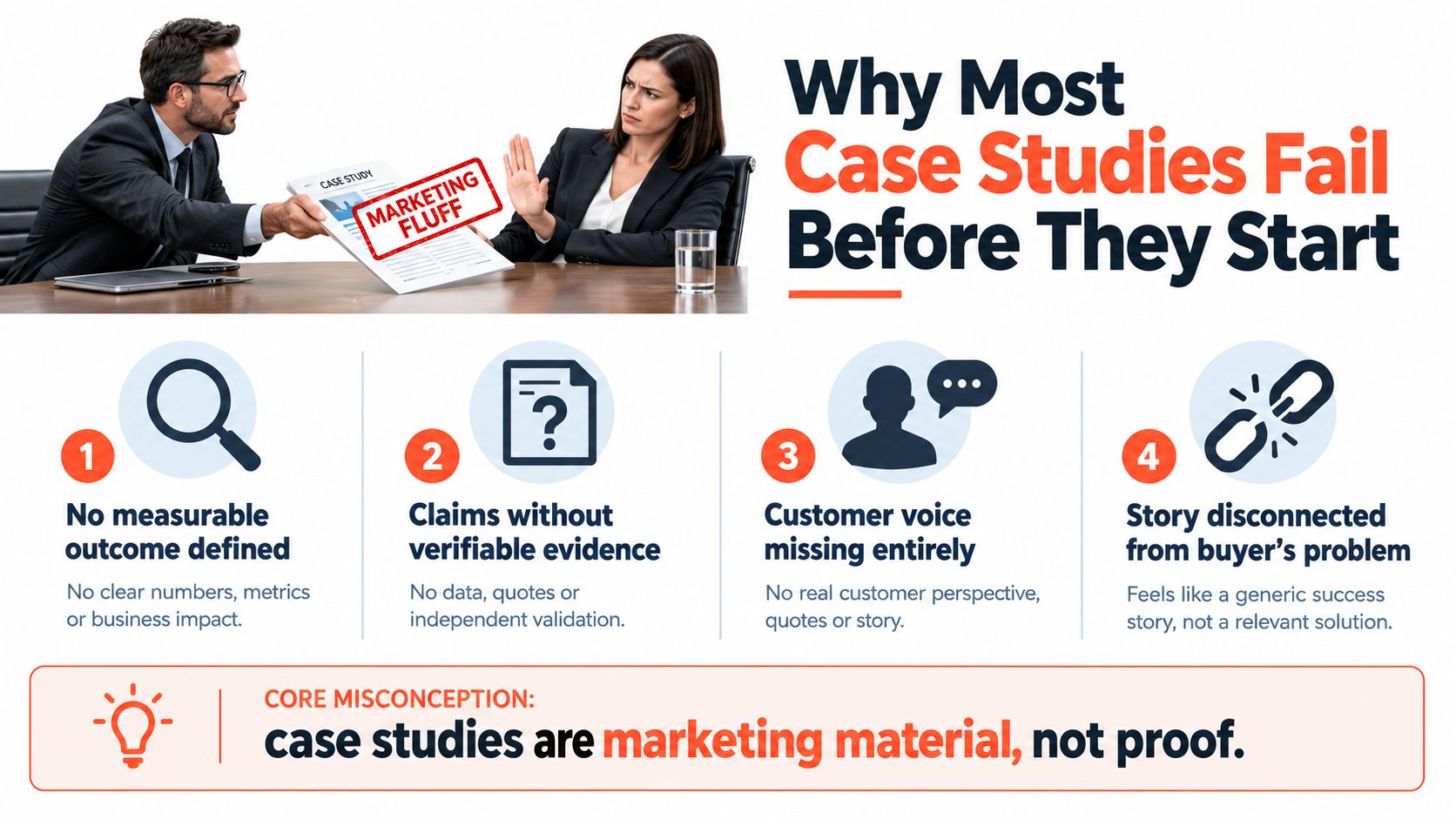
Four failure patterns appear repeatedly:
- The service comes first: The story opens with what the vendor sells, so the reader has to work to find the customer's actual problem.
- The outcome has no measurement frame: “Engagement improved” doesn't tell the reader which metric changed, from what baseline, during which period, or across what population.
- The metric doesn't transfer: A large reach number may sound impressive, but it might not help a buyer assess qualified leads, operating time, retention, or another outcome relevant to their decision.
- The limitations disappear: A case that hides implementation friction, missing data, or competing explanations asks readers to trust the author rather than evaluate the evidence.
Editorial rule: If a headline claim can't be traced to a defined source, rewrite the claim, qualify it, or remove it.
A case study should answer how and why, not merely announce that a customer was happy. That means anonymity, incomplete records, and a non-cooperative customer should change the format and confidence level, not the truth. If the customer won't approve a quote, don't manufacture authority around an unattributed sentence. If the data is self-reported, label it as self-reported. If the result can't be verified, present the operational lesson rather than a precise performance claim.
The Five-Stage Case Study Workflow
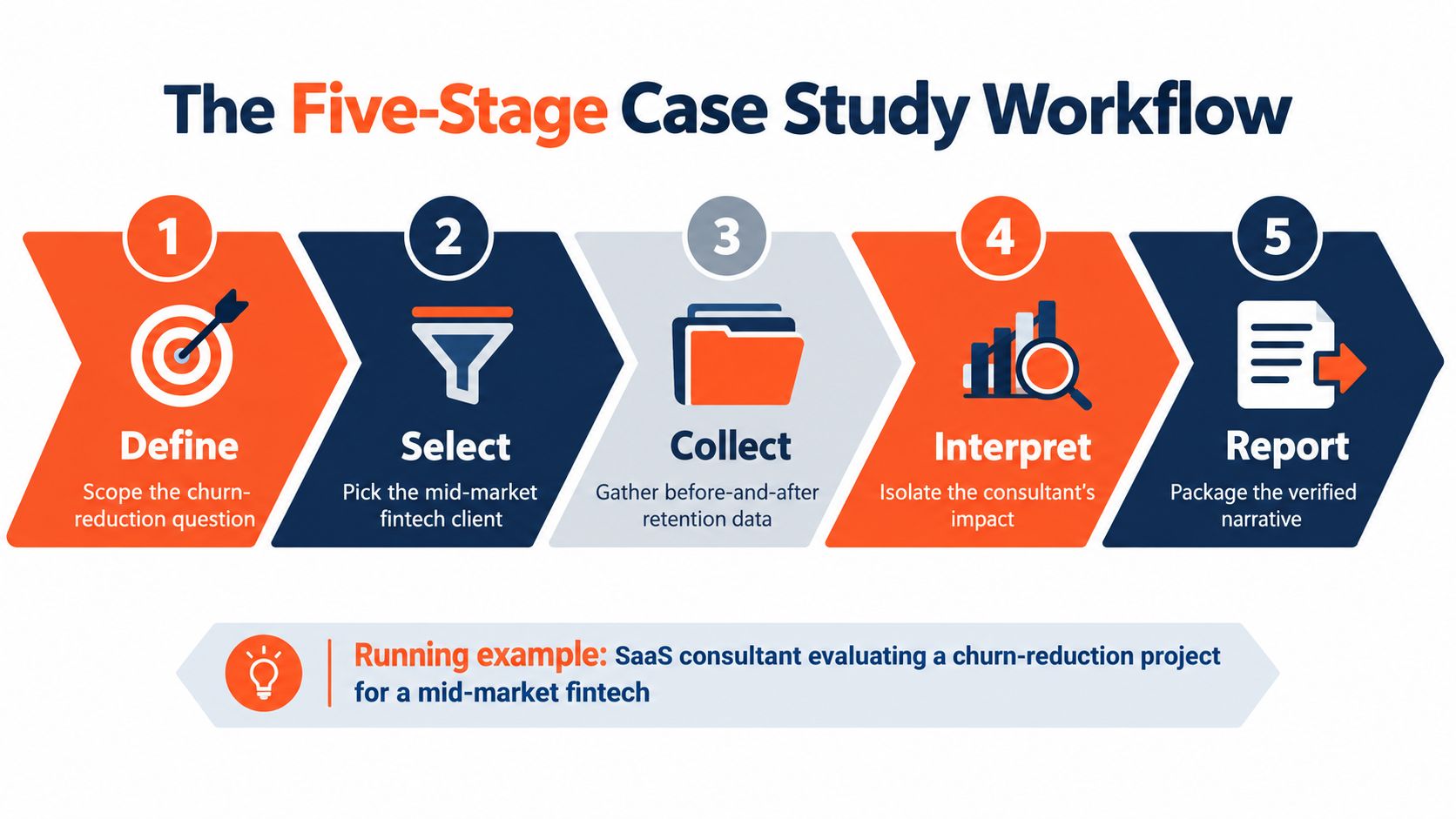
A repeatable workflow prevents the common mistake of interviewing a customer first and figuring out the story afterward. Use five stages: define, select, collect, interpret, and report.
1. Define the case and question
Start with a buyer question, not a product category. For a SaaS consultant evaluating a churn-reduction project for a mid-market fintech, the question might be, “Can the company reduce churn without raising prices?” Define the customer segment, the project boundary, the observation period, the intervention, and the outcome that would count as meaningful.
Output: a one-page case brief containing the research question, customer context, baseline to investigate, and proposed evidence sources.
2. Select the right customer story
Don't automatically choose the largest logo or the most enthusiastic contact. Score candidate projects against impact, transferability, and data access. A smaller customer with clean records and a similar buyer context may produce a more persuasive case than a famous brand with no approved metrics.
Selection needs an explicit rationale. State why this case was chosen and what it can, and can't, demonstrate. Case studies aren't statistical proof of what will happen across an entire market. They show what occurred in a particular setting.
Output: a selection record naming the case, its relevance to the target audience, known constraints, and the evidence you expect to obtain.
3. Collect more than one kind of proof
Interview the customer, then gather dated performance records, product-usage data, invoices, screenshots, internal reports, or other documents that can test the same claim. Methodological guidance associated with Robert K. Yin identifies three core principles, use multiple data sources, create a case-study database, and maintain a clear chain of evidence. This practical overview of case-study methodology describes why a single anecdote is a fragile foundation.
For the fintech example, collect the retention report, the implementation timeline, the customer's description of the problem, and records showing what changed in the product or workflow.
Output: a searchable case file with source documents, interview notes, dates, calculations, and approval status.
4. Interpret competing explanations
A churn change may coincide with the consultant's work without being caused entirely by it. Pricing, product releases, customer mix, seasonality, sales policy, or a separate support initiative may also matter. Compare the expected pattern with the available evidence and state where causality remains uncertain.
Use explanation building and pattern matching where possible. Ask which evidence supports the proposed mechanism and which evidence challenges it. The point isn't to weaken the story. It's to make the conclusion believable.
Output: an interpretation memo that separates observed facts, customer explanations, alternative causes, and remaining gaps.
5. Report for one primary audience
Write the full evidence record first. Then package it for the buyer who needs it most. A CFO may care about cost and risk, while a product leader may care about adoption conditions and operational change. The underlying evidence stays consistent, but the order and emphasis can change.
Include context, baseline, intervention, outcome, limitations, and transferability. Case-study design guidance from the Social Research Association emphasizes respondent validation, a documented protocol, and a clear chain from question to data, analysis, and conclusion.
Output: an approved case study plus a source pack that sales, editorial, and legal teams can inspect.
Interview Scripts That Get Real Numbers
A good interview doesn't ask a customer to perform enthusiasm on demand. It reconstructs the decision, workflow, evidence, and constraints in enough detail for another reader to judge the result.
Send the participant a short agenda beforehand. Ask permission to record, explain how the material will be used, and confirm whether specific figures can be cited. Afterward, share the transcript or a claim summary for respondent validation. Don't treat approval as permission to improve the customer's words into a stronger claim.
Discovery and baseline questions
Ask:
- What problem led you to seek help?
- Who experienced the problem, and where did it appear in the workflow?
- What did the process look like before the project?
- Which metric or operational signal showed that the problem mattered?
- What would have happened if you had changed nothing?
Use follow-ups when the answer is broad:
- “Which report or system recorded that?”
- “What was the starting value?”
- “What unit are we using, such as hours, accounts, tickets, or conversion rate?”
- “What period does that baseline cover?”
- “What population or denominator does the figure include?”
Intervention questions
Ask:
- What did the consultant or vendor change?
- Which people, systems, channels, or workflows were involved?
- How long did implementation take?
- What did your team have to provide or change internally?
- Which parts of the proposed approach weren't adopted?
These questions reveal implementation conditions. A result achieved with a dedicated analyst, clean data, and executive sponsorship may not transfer to a small team without those conditions.
Outcome questions
Ask:
- What changed after implementation?
- Which metric best captures that change?
- What was the baseline, and what was the later value?
- Over what measurement period did the comparison take place?
- Where is the underlying record stored?
If the customer says, “Engagement went up,” don't accept the phrase as a result. Ask, “Which engagement metric?” Then ask for the baseline, timeframe, denominator, source, and calculation. If the customer can only describe a perceived improvement, classify it as qualitative feedback.
Limitations and approval questions
Ask:
- What else changed during the observation period?
- Which parts of the result can't be attributed confidently to this project?
- What took longer or worked differently than expected?
- What would you change if you repeated the project?
- Which claims, figures, and quotations can we publish?
| Block | Goal | Example Question |
|---|---|---|
| Discovery | Establish the problem and context | What problem led you to seek help? |
| Baseline | Define the starting measurement | What was the metric before the project? |
| Intervention | Document what changed | Which workflow or system did you change? |
| Outcomes | Verify the observed result | Where is the later measurement recorded? |
| Limitations | Test competing explanations | What else changed during the same period? |
Avoid questions such as “How would you describe working with us?” They invite praise but rarely produce evidence. Replace them with questions about a decision, a before-and-after comparison, a source document, or a constraint. Those answers create usable material for both the narrative and the verification record.
Writing the Evidence-Backed Narrative
The standard challenge-solution-results template is a useful skeleton, but it often skips the mechanism connecting the intervention to the outcome. A stronger narrative follows this sequence:
- Context: Who was involved, and what conditions shaped the project?
- Baseline: What was happening before the intervention?
- Intervention: What changed in the workflow, product, or decision process?
- Mechanism: Why should that change affect the selected outcome?
- Measured result: What changed, according to which source?
- Boundary conditions: Where might the result not transfer?
The editorial threshold is deliberately strict. Every headline claim should contain a number, unit, timeframe, denominator, and documented source. If one element is missing, the claim isn't ready for the headline. A qualitative statement can still be useful, but it shouldn't masquerade as a quantified outcome.
| Required Element | Weak Example | Strong Example |
|---|---|---|
| Number | “Revenue grew” | “Monthly recurring revenue increased from the recorded baseline to the later dashboard value” |
| Unit | “Production became faster” | “Content-production time, measured in team hours, changed from the baseline level” |
| Timeframe | “Conversion improved” | “Conversion changed during the defined comparison period” |
| Denominator | “More users activated” | “Activation changed among the specified new-user cohort” |
| Source | “The client saw results” | “The approved analytics export and customer interview support the claim” |
Don't insert a precise figure merely because a headline looks better with one. The source must come first. Store the raw export, calculation, interview note, screenshot, or signed attestation in the case database, then link the published claim to that record internally.
Practical rule: A reader should be able to verify the headline's meaning in under five seconds, even if the full evidence takes longer to inspect.
Use a headline that states the measurable change, followed by a subhead that supplies context and qualification. Beneath it, layer the customer quote, a simple before-and-after visual, the measurement method, and a note about limitations. A quote should explain the decision or experience. It shouldn't carry the entire burden of proof.
For guidance on using customer evidence without confusing persuasion with verification, see this practical discussion of social proof in marketing. The case study itself should still distinguish verified data, customer-reported information, and editorial interpretation. Add confidence labels where the evidence is incomplete. That small disclosure often builds more trust than another glowing adjective.
Handling Anonymity and Uncooperative Customers
Some customers won't approve their name, metrics, quote, industry, or operating details. Others agree in principle, then disappear into legal review. Regulated businesses and professional services firms may have strong evidence but little permission to publish it.
Use an evidence ladder rather than forcing every story into a named-logo format:
- Verified platform data: Strongest for a metric that the platform records directly, provided the customer approves its use.
- Third-party analytics: Useful when an independent system records the outcome and the measurement rules are clear.
- Signed customer attestation: Acceptable when the customer confirms the claim in writing but can't release the underlying data.
- Screenshots with metadata: Helpful supporting evidence, though the page should explain what the screenshot proves and what it doesn't.
- Self-reported qualitative claims: Valuable for context and experience, but label them as customer-reported rather than independently verified.
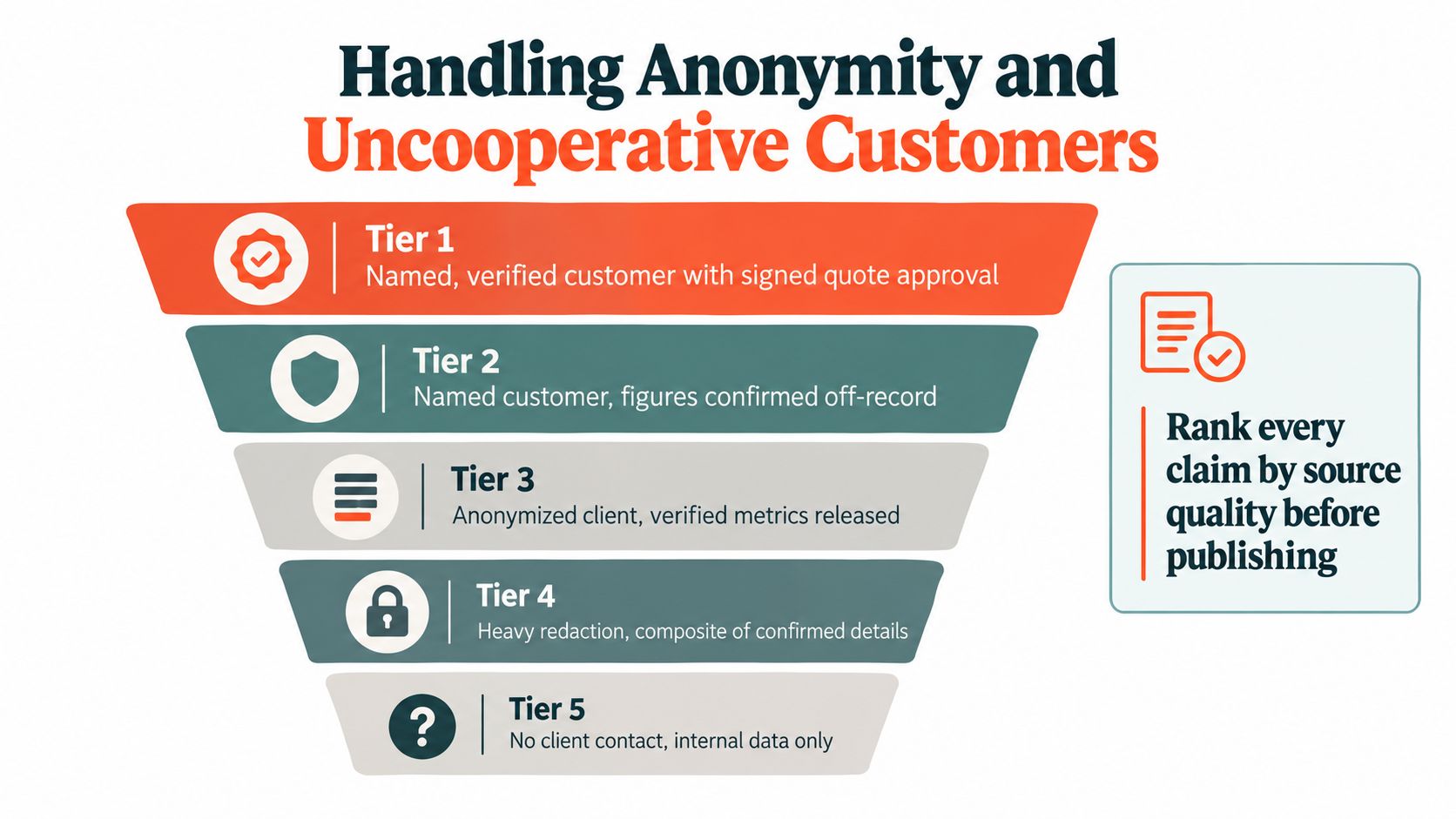
Anonymity doesn't require vagueness. Describe the setting without exposing the company, such as a regulated financial-services team in a specified region or a growing software company with a defined customer segment. Use aggregated or range-based reporting only when the calculation method, measurement period, and source quality remain clear. Don't use a composite story unless you label it as composite and explain which details represent multiple customers.
The 2025 B2B buyer content report reports that 54% of surveyed buyers selected case studies as trust-building content, while original research, expert opinions, peer insights, and testimonials also mattered. It also reports that more than one-third of marketers produced two or fewer customer stories in six months, while 78% produced five or fewer. Those findings reinforce a practical point: one anonymous case can't cover every buyer concern, so disclose the evidence limits and build a portfolio of proof types.
Use direct negotiation language:
- “We can send a draft for factual review after you confirm the claims you're comfortable supporting.”
- “If legal approval is delayed, can you approve the measurement method and an anonymized description?”
- “Would you approve the outcome without your name, or should we remove the outcome and publish only the implementation lesson?”
Publish when the evidence is traceable and the disclosure is approved. Park the story when the evidence is promising but permissions are unresolved. Skip it when the only support is an uncheckable testimonial and the customer won't validate even the basic facts.
Making One Case Study Work for Multiple Audiences
A finished case study shouldn't be treated as a single PDF. Treat it as a modular evidence record with different reading paths for different buyers.
Suppose a SaaS onboarding overhaul improved the experience for a customer. The long-form version can hold the complete context, baseline, workflow changes, evidence sources, customer voice, limitations, and transferability notes. From that same record, create three audience-specific versions:
- CFO version: Lead with cost-to-serve, implementation effort, financial measurement rules, and risk. The reader needs to know what changed economically and which assumptions support the conclusion.
- Marketing-lead version: Lead with retention, campaign attribution, audience behavior, and the relationship between onboarding changes and customer communications.
- Operations-lead version: Lead with time-to-value, ticket volume, ownership, process changes, and the work required from the internal team.
The evidence doesn't change between versions. The framing does. This is safer than writing three independent stories, which can produce inconsistent figures, conflicting dates, and unsupported claims.
Add a transferability panel to every version. State the customer segment, company size category, industry, starting maturity, implementation conditions, and the results that aren't likely to generalize. Recent buyer research indicates that relevance depends on factors including similar industry, use case, company size, and role, not industry alone. Separate research reports that 70% of surveyed US B2B buyers viewed original research as trust-building, compared with 54% for case studies, which is a reason to expose the method rather than present an isolated win. This overview of case-study statistics for 2025 provides context for treating transferability as a core editorial requirement.
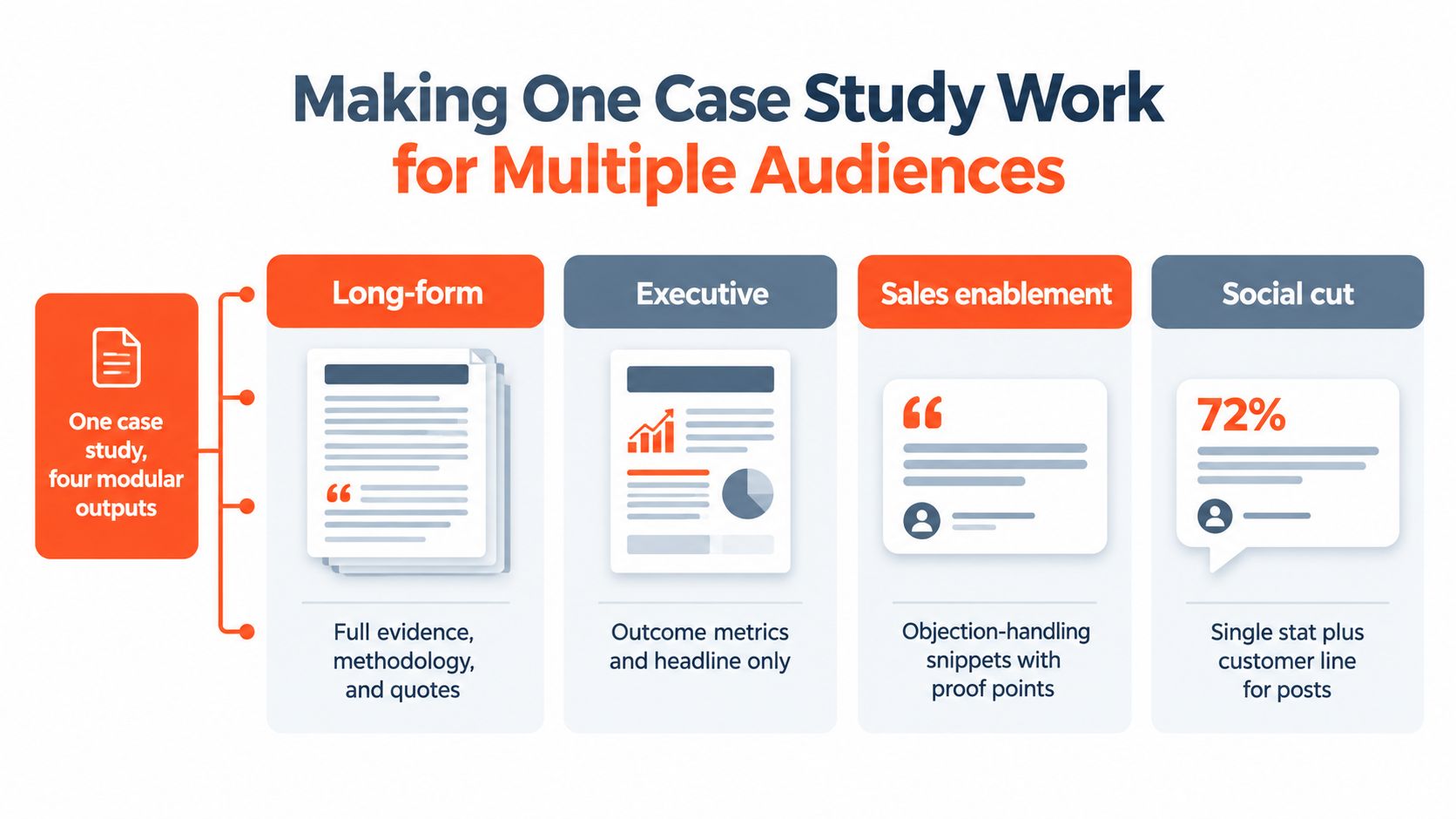
The same source can support a sales-call slide, a LinkedIn carousel, a short post, and a conference-talk abstract. A client success stories framework can help organize those outputs, but each derivative should retain the original claim's context and confidence level. Remove the evidence, and repurposing becomes claim inflation.
Designing, Measuring, and Distributing the Finished Case Study
A case study can be accurate and still fail because readers can't find the important information. Design should help a buyer orient quickly, inspect the proof, and decide whether the situation is relevant.
Start with a summary block near the top containing the customer context, problem, intervention, measured outcome, evidence status, and key limitation. Use scannable headings and short paragraphs. Give each page or major screen a clear focal point, but don't turn every metric into a hero statistic. A single prominent result is easier to understand when the supporting baseline and source appear nearby.
Use accessible contrast, meaningful alternative text, descriptive chart labels, and plain language. A screenshot should show how a workflow worked, not merely decorate the page. A pull quote should reinforce a documented decision or constraint, not substitute for the result.
Match the asset to the buying stage
Distribution works best when each format has a job.
| Channel | Format | Funnel Stage | Primary KPI |
|---|---|---|---|
| Search landing page | Ungated HTML case study | Awareness and consideration | Organic entrances and engaged reading |
| Sales follow-up | Evidence-focused one-pager | Decision | Influenced opportunities and replies |
| Resource library | Gated PDF | Consideration and decision | Form completion and qualified follow-up |
| LinkedIn or similar social feed | Short insight, quote, or carousel | Awareness | Relevant engagement and visits |
| Email nurture | Case-study excerpt with one CTA | Consideration | Clicks and progression to the next asset |
| Conference or webinar | Methodology slide and customer lesson | Awareness and consideration | Direct inquiries and attributed conversations |
Publish the ungated web version for discoverability and a fuller PDF for late-stage conversations. The PDF shouldn't merely duplicate the web page. Give it a sharper executive summary, evidence notes, and a clear next action. Social cuts should pull different angles from the same source, such as the starting problem, the implementation constraint, and the measured outcome.
A case study about the SaaS onboarding overhaul might launch as a central asset on a Tuesday. The team can then track early reading behavior, sales usage, and later influenced pipeline over the following review period, without claiming that every downstream conversation was caused by the case study. Guidance on conversion-rate improvement is useful when connecting content engagement to action, but attribution still needs explicit rules.
Use a short review cadence
Review performance after launch rather than judging the asset from one day's activity. Inspect:
- Awareness: Are the intended buyers finding the page through search, social, partner links, or direct sharing?
- Consideration: Do readers reach the methodology and limitations, or leave after the opening?
- Decision: Do sales teams use the asset in relevant opportunities, and do those opportunities progress?
- Evidence quality: Did prospects ask questions the case study failed to answer?
- Repurposing value: Which excerpt or format created useful conversations?
A fourteen-day review cadence can capture early distribution signals, while a later check should examine influenced opportunities and feedback from sales. Keep the findings with the case file. The next customer interview should include questions inspired by what readers couldn't understand.
For teams planning their content library, the practical case studies for 2026 resource offers a useful point of comparison for formats and editorial expectations. Use it as a planning reference, not as a substitute for your own evidence.
Run a final publishing check
Before release, confirm:
- Claim threshold: Every headline result has a number where appropriate, unit, timeframe, denominator, and documented source.
- Source trail: Raw exports, calculations, notes, and screenshots are stored and traceable.
- Customer approval: Names, quotes, metrics, screenshots, and anonymized descriptions have the required permission.
- Limitations: Alternative explanations, missing data, implementation friction, and non-transferable conditions are visible.
- Audience fit: The opening answers the target buyer's problem and shows why the case is relevant.
- Asset hygiene: The page title, URL, image names, alternative text, PDF filename, and metadata are clear and consistent.
- Distribution plan: Each channel has an owner, format, CTA, and measurement rule.
WaveGen.ai can accept a case study URL and turn it into on-brand social formats such as carousels, short videos, quote cards, and captions, with brand settings and a visual editor for review before publishing. That can help a team distribute one approved evidence record without rewriting every social asset from scratch. The verification work still belongs to the case-study process. Automation should multiply approved proof, not create new claims.
Case studies become more useful when you build the evidence record before the sales asset, verify every headline claim, and publish limitations alongside results. If you want to turn an approved case study into consistent, on-brand social content without losing its context, visit WaveGen.ai to explore its URL-based repurposing workflow and distribution tools.
case studies
content marketing
B2B marketing
client stories
social proof
Turn this kind of writing into a week of social content.
Paste a blog post, newsletter, or rough draft — WaveGen turns it into publish-ready carousels, captions, and slideshows for every channel.
No credit card · First posts in 2min