October 4, 2026
17 min read
Social Proof in Marketing: A Practical Guide That Works
Learn how social proof in marketing works, the types that convert, and how to deploy them across channels without looking generic or AI-written.
93% of consumers say online reviews influence purchasing decisions, while 88% trust user reviews as much as personal recommendations, according to a 2026 compilation of review and rating statistics. That gap between what a brand says and what other people experienced explains why social proof in marketing remains powerful, but it also exposes the weakness in most advice: collecting more testimonials isn't enough when buyers cross-check claims, notice stale evidence, and question whether a polished quote was written by a person at all.
Social proof works when it answers a specific doubt with credible evidence from a relevant person, group, or authority. It fails when it looks like decoration, manufactured popularity, or a generic badge pasted onto every page. The practical task isn't to display proof everywhere. It's to keep the right proof fresh, traceable, and close to the moment when a buyer needs reassurance.
Table of Contents
- What Social Proof Actually Is and Why It Works
- The Main Types of Social Proof and When to Use Each
- Real-World Examples Across Channels and Formats
- How to Implement Social Proof in One Week
- The Freshness Problem Most Guides Ignore
- Measuring Whether Social Proof Is Actually Working
- Templates, Checklist, and Common Questions
What Social Proof Actually Is and Why It Works
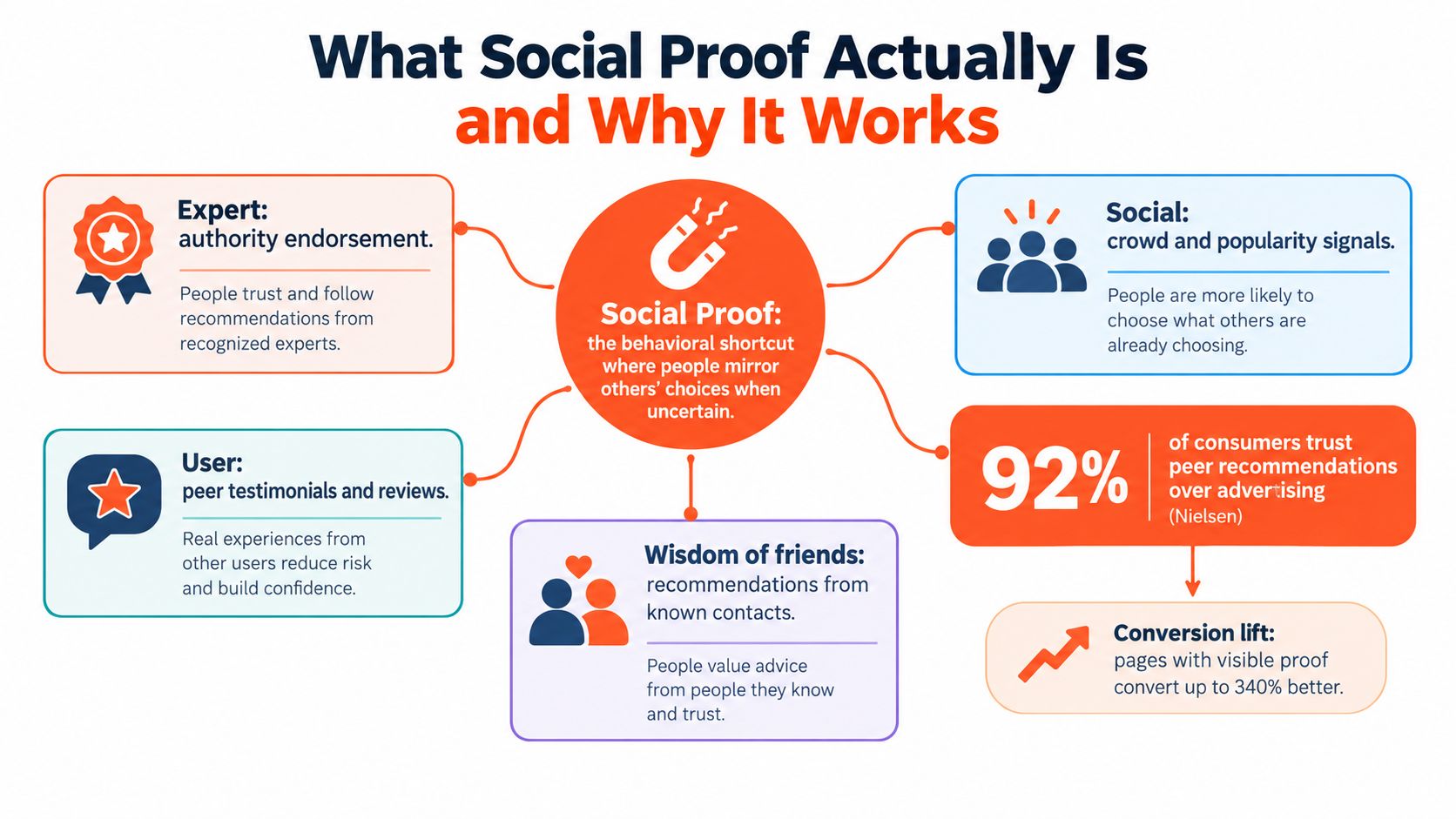
Social proof is the behavioral shortcut people use when they're uncertain. Instead of evaluating every option from first principles, they observe what other people chose, trusted, or recommended. In marketing, that shortcut appears as a customer review, a specialist endorsement, a usage signal, a friend's recommendation, or a detailed story from someone with a similar problem.
A simple restaurant analogy makes the mechanism clear. You walk down a street and see two restaurants. One is empty, and the other has a queue outside. You haven't inspected either kitchen, compared every dish, or interviewed the diners. The queue becomes evidence. It suggests that people with information you don't have have already judged the second restaurant worth entering.
That signal is useful, but it isn't proof of universal quality. The diners may have different tastes, the queue may be staged, or the restaurant may be popular for reasons unrelated to your needs. The same limits apply online.
Three reasons buyers follow other buyers
Uncertainty reduction matters most when the product is unfamiliar, expensive, complex, or difficult to assess before purchase. A named customer explaining how a service solved a recognizable problem gives the prospect information the brand's own claims can't provide.
Herd behavior becomes stronger when a buyer sees visible adoption. Review volume, ratings, customer counts, or active community participation can make an unfamiliar option feel less risky. This works best during discovery, but popularity alone rarely answers deeper comparison questions.
Identity matching helps buyers recognize themselves in the evidence. A consultant wants to hear from another consultant. A small retailer may trust a review from a business with similar constraints more than a famous enterprise logo. Similarity makes the proof feel diagnostic rather than merely impressive.
People developed these shortcuts because observing others can be a low-cost way to make decisions in environments where other people's behavior usually contains useful information. The shortcut backfires when the signal conflicts with the buyer's experience. A vague testimonial, unexplained rating, or suspiciously perfect review creates a second question: why is this brand trying so hard to make me believe it?
Practical rule: Use social proof to answer the buyer's current doubt, not to fill empty space on a page.
Trust also depends on how openly a business explains what it knows, what it can't promise, and where its evidence comes from. That principle is explored further in transparent communication for customer trust. The more consequential the decision, the more the buyer needs context around the proof, including who provided it, when they provided it, and what outcome they experienced.
The Main Types of Social Proof and When to Use Each
Different proof types solve different decision problems. A review can help a buyer compare alternatives, while an expert endorsement may help an unfamiliar brand earn initial attention. Treating every proof asset as interchangeable is how marketers end up placing a celebrity mention beside a high-risk purchase and expecting it to answer technical objections.
Research summarized in a review of social proof experiments reports average effects ranging from roughly 5% to 30%, with user reviews associated with an 18% to 28% lift in e-commerce conversion in the cited synthesis. Those findings support a useful conclusion, not a universal benchmark: proof performs better when its format matches the decision and the buyer's level of involvement.
| Proof Type | Best Funnel Stage | Credibility Test | Common Failure |
|---|---|---|---|
| Expert endorsement | Awareness and early consideration | Is the expert qualified and independent enough to judge the problem? | Borrowed authority with no relevant explanation |
| User review | Comparison and purchase reassurance | Is the review recent, detailed, attributable, and hosted in a credible context? | A large pile of vague or outdated ratings |
| Customer testimonial | Consideration and evaluation | Does it identify the customer, situation, process, and outcome? | Polished praise that could describe any product |
| Influencer or creator mention | Awareness and identity building | Does the creator genuinely fit the audience and use case? | A scripted endorsement that ignores the creator's normal voice |
| User-generated content | Awareness, consideration, and community engagement | Did a real customer create it, and did the brand obtain permission to reuse it? | Stock imagery, staged scenes, or unclear ownership |
| Popularity signals and case studies | Discovery, comparison, and risk reduction | Can the business substantiate the count, logo, badge, or result? | “Trusted by everyone” language with no context |
Match the signal to the hesitation
Expert endorsements work early, when buyers need a reason to take an unfamiliar solution seriously. A certification or specialist view becomes more useful when the expert explains the criteria behind the recommendation. A logo alone is an ornament.
Reviews perform strongly during comparison because they expose practical details that brand copy often omits. Buyers want to know how the product feels to use, what went wrong, which context the reviewer had, and whether the business responded. Reviews lose force when a company hides negative experiences or leaves old feedback untouched.
Customer testimonials are more controlled than open reviews, which makes them useful on landing pages and sales materials. Control creates a credibility obligation. Preserve the customer's voice, identify their role, and avoid editing a complex experience into a frictionless slogan.
Influencer and creator mentions help with awareness and identity matching. The creator's relationship with the audience matters more than reach alone. A specialist creator who demonstrates a relevant use case may provide stronger proof than a broader personality who merely repeats campaign copy.
User-generated content shows people using the product in their own settings. It can make an abstract promise tangible, but it also attracts misuse. Ask for permission, retain the original context, and don't turn an ordinary customer post into a claim the customer never made.
Popularity signals such as counters, badges, logos, and case studies can reduce perceived risk, but only when the underlying evidence is clear. A case study has more diagnostic value when it names the problem, approach, and result instead of presenting a logo as a substitute for a story.
A website owner who wants to add social proof to your site should treat widgets as a delivery method, not a credibility strategy. The source, wording, freshness, and placement still determine whether the proof helps.
A useful planning model is to select one primary proof type and one supporting proof type for each important page. Don't build a checklist that forces every page to display every signal. Build a toolkit that responds to the buyer's skepticism level.
Real-World Examples Across Channels and Formats
Consider a fictional skincare subscription called Luma Skin. Its product promise is easy to repeat, but the buying questions are more specific: will the routine suit my skin, will I use it consistently, and can I trust the results shown online?
Instagram carousel
Luma Skin starts with customer-created videos showing how subscribers use the routine. Each carousel includes the creator's handle, the posting date, and a short caption explaining the skin concern or routine context. The brand doesn't replace the creator's language with a polished claim.
That timestamp matters because viewers can distinguish a current customer experience from a campaign asset recycled indefinitely. A creator's own setting also provides identity matching. Someone with a similar routine can decide whether the content is relevant before clicking.
A platform such as ShortGenius AI UGC ad platform may help a team organize or produce short-form creative workflows, but the credibility still comes from the underlying customer permission and real experience. Production assistance can't turn invented evidence into trustworthy proof.
Landing page hero
The landing page leads with a verified review count and a visible recency label. It doesn't rely on a broad claim such as “trusted by thousands of skincare lovers.” Visitors can inspect the source and understand whether the feedback represents current customer experience.
The placement serves awareness and early consideration. The proof doesn't need to answer every ingredient question above the fold. It only needs to reduce the first fear that no one like the visitor has tried the subscription.
Checkout reassurance
Near checkout, Luma Skin places a short case study snippet with a named client and a specific result. The copy explains the starting problem, what the customer changed, and what improved. It avoids stock photography and doesn't present a vague statement such as “this changed my life.”
This is a higher-intent moment, so the proof must address risk rather than create excitement. A named source, relevant context, and clear permission make the asset more credible than a decorative testimonial wall.
Objection-handling email
After a visitor asks whether the routine is difficult to maintain, Luma Skin sends an email quoting a peer customer's reply to that exact concern. The quote remains recognizable as a real response, with light editing for clarity and attribution where permission allows.
The brand avoids an AI-polished answer that sounds unnaturally precise. It also avoids copying a competitor's proof structure. A format that works for a software comparison page may feel intrusive in a personal-care email. Channel behavior should determine the asset, not the competitor's template.
How to Implement Social Proof in One Week
You don't need to wait for a complete testimonial library. You need a short operating cycle that finds existing evidence, requests better evidence, and assigns every asset a job.
Days one and two
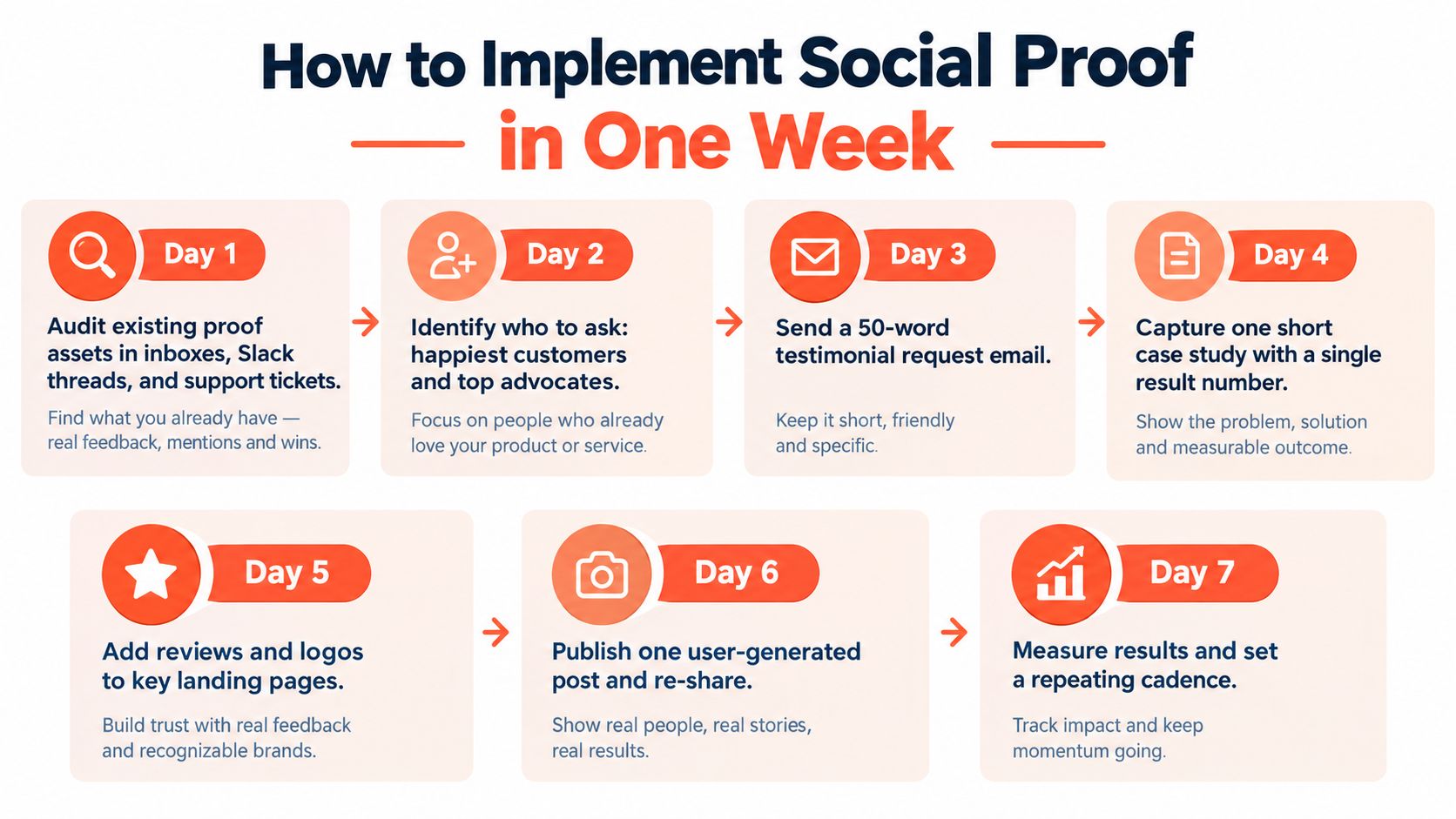
Day one is an evidence audit. Search inboxes, Slack threads, support tickets, sales notes, direct messages, and post-project surveys. Look for specific language about an outcome, a previous concern, or a moment when the product changed the customer's workflow. Ask for permission before publishing anything that wasn't originally provided as a testimonial.
Day two is a selection exercise. Choose the three paying clients who can describe a clear result and represent the customers you want more of. Don't send a generic blast to your entire database. Relevance improves the chance that the final proof will answer a real prospect's question.
Days three and four
Day three is the request. Give each client a short prompt rather than a blank page:
What problem were you trying to solve, what changed after working with us, and who would benefit from the same approach?
Ask for a short written response, a brief video, or a screenshot of a result they can verify. A request for a specific context produces more useful material than “Could you say something nice about us?”
Day four is the case study capture. Select one customer and document the problem, the approach, and a single measurable outcome. Confirm what can be named, which claims are approved, and whether the customer wants the asset used on a website, in sales material, or in social content.
Days five through seven
Day five is placement. Put the most relevant review near the primary action on the landing page. Put a detailed case study on the comparison or pricing path. Put a concise reassurance statement near checkout or the form. The same customer story can be adapted, but don't strip it of the context that makes it credible.
Day six is distribution. Turn an approved customer story into a post, carousel, or short video. Keep the original voice visible and record the permission status in your content system.
Day seven is the operating record. Tag every asset by audience, proof type, source, date, permission, and funnel stage. Record where it appears and when it should be reviewed. A spreadsheet is enough if the fields are consistent.
Place the asset where the relevant doubt occurs. A homepage visitor needs orientation. A pricing-page visitor needs risk reduction. A sales-qualified prospect may need a detailed, identity-matched example. Collection isn't complete until the proof has a placement and an owner.
The Freshness Problem Most Guides Ignore
The deeper question is whether the proof still resembles the buyer's current reality.
A testimonial that sits unchanged on a hero section for years may still describe a genuine experience, but its presentation can feel stale. The product may have changed, the market may have shifted, and the audience may wonder why the brand has nothing newer to show. Buyers also cross-check company claims against review platforms, communities, and search results before they accept a polished testimonial at face value.
Recent coverage describes a sharp trust gap. One 2025 BrightLocal-based summary reports that 42% of consumers trust reviews as much as a personal recommendation, down from about 88% a decade earlier, while 96% still read reviews and 74% check two or more review sites before deciding. The same source reports that 48% distrust reviews that look AI-written. These figures don't mean every automated workflow is deceptive. They do show why synthetic-sounding language can damage an otherwise valid proof system.
Treat proof as inventory
Separate proof into two groups:
- Evergreen evidence: A well-documented case study can remain useful when the customer, process, and outcome are still relevant. Review it when the product, offer, or claim changes.
- Perishable evidence: Reviews, usage counters, social posts, and “recently purchased” signals lose persuasive force as they age. Monitor them more actively and replace them when they no longer represent current experience.
- Context-dependent evidence: A creator video may stay valuable for one audience while becoming irrelevant for another. Keep the original context attached to the asset.
Don't invent a universal refresh schedule. A local service, a fast-changing software product, and a long-lived professional service have different expectations. Instead, define a freshness window for each channel and proof type, then review the asset when the product or customer experience changes.
Stale proof isn't always false. It simply asks the buyer to do more work before trusting it.
Authenticity also depends on diversity. If every testimonial uses identical sentence structure, the same vocabulary, and the same glowing tone, the collection looks manufactured even when the underlying customers are real. Preserve differences in voice, include useful nuance, and respond openly when customers describe a limitation.
Measuring Whether Social Proof Is Actually Working
A large review count is an inventory measure, not a performance measure. It tells you how much evidence exists, but not whether the evidence helps a visitor make a decision.
Start at the page level. Compare a page with a clearly attributed testimonial against a comparable version using a different proof asset or no proof asset. Keep the offer, traffic source, and primary action as consistent as practical. You don't need a complex experimentation program to learn whether a specific proof placement earns attention.
Track behavior around the proof
Testimonial call-to-action clicks show whether visitors engage with a case study, review expansion, video, or customer story. A click isn't a sale, but it tells you whether the asset creates enough interest to continue.
Conversion differences between page variants connect the proof to the business outcome. Look at the action that matters for that page, such as a purchase, consultation request, demo request, or completed signup.
Scroll depth past the proof section helps diagnose placement. If visitors don't reach the evidence, the problem may be hierarchy or page length rather than testimonial quality.
Assisted conversions matter when proof appears in the middle of a journey. A customer may read a case study, return through branded search, and convert later. Last-click reporting would undervalue the earlier asset.
The conversion rate improvement guide provides useful context for treating conversion as a process rather than a single page adjustment. Apply the same discipline to social proof. Change one meaningful variable at a time, such as placement, source detail, format, or proof type.
| Metric | Why It Matters or Doesn't |
|---|---|
| Testimonial CTA clicks | Shows whether visitors engage with the evidence |
| Page-level conversion difference | Connects a proof variant to the page's intended action |
| Scroll depth | Reveals whether visitors reach the proof section |
| Assisted conversions | Captures influence that happens before the final click |
| Total review count | Useful as inventory, weak as proof of performance by itself |
| Aggregate star rating | Easy to display, but limited if visitors don't inspect the reviews |
| Social follower count | Indicates reach or popularity, not necessarily purchase confidence |
| Number of assets created | Measures production activity, not buyer response |
Retire proof that receives attention but creates no meaningful progression, especially if the content is vague or poorly matched to the page. Refresh assets when engagement declines, the source becomes outdated, or the claim no longer describes the current offer.
Templates, Checklist, and Common Questions
Templates speed up collection, but they shouldn't flatten every customer's voice. Use the following starting points and adapt the wording to the relationship.
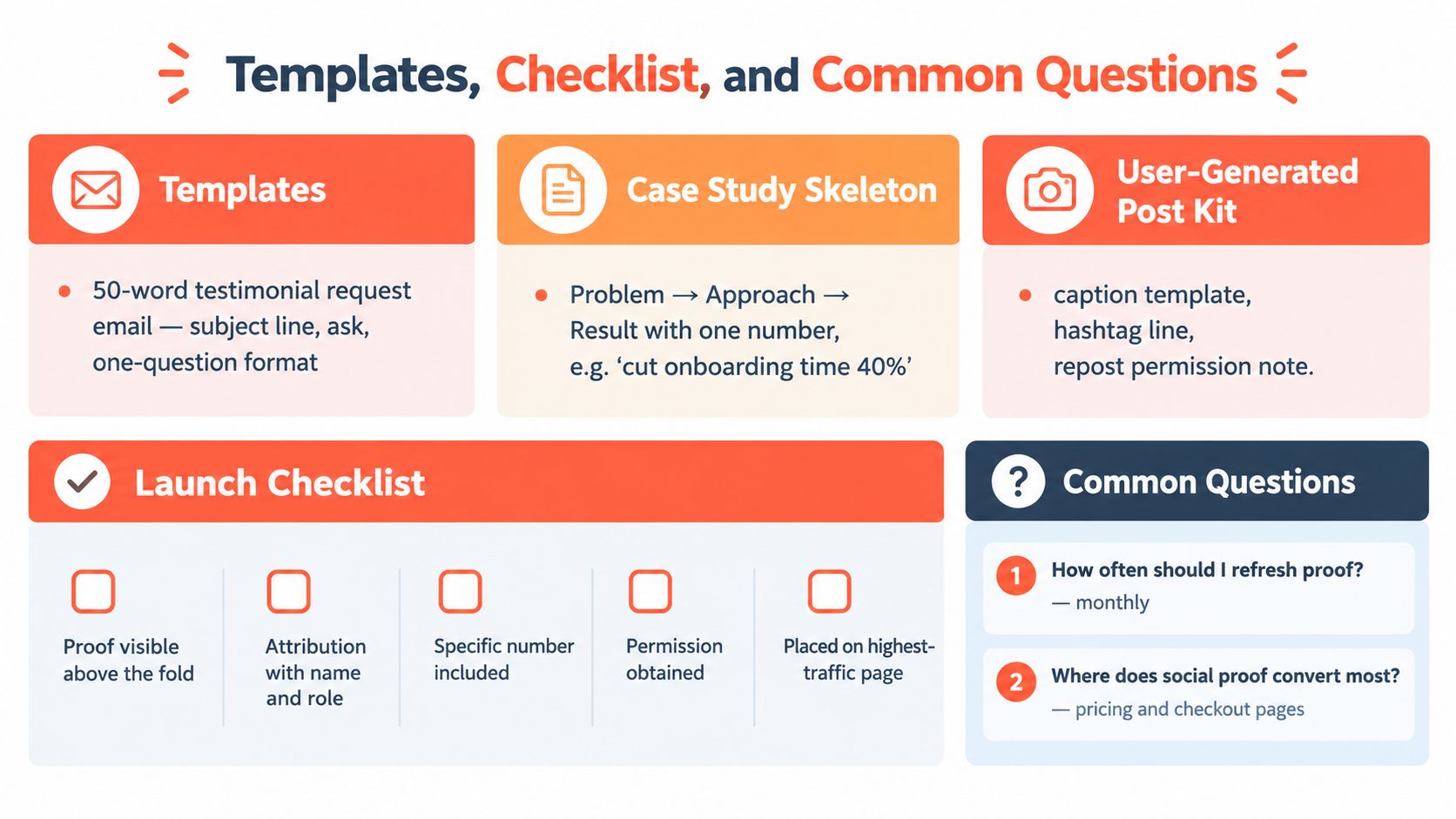
Testimonial request email
Subject: Could you share how [product or service] helped with [problem]?
Hi [name],
You mentioned that [specific context or outcome]. Would you be willing to share a short testimonial? In a few sentences, what problem were you facing, what changed, and what would you tell someone in a similar situation? With your permission, we may use your words with your name and role on [placement].
Thank you, [customer contact]
Use this after a clear customer milestone, not as an automatic request with no context.
Short case study skeleton
- Problem: What was happening before the customer started?
- Approach: What did the customer implement, and what support did you provide?
- Result: What changed, supported by one approved number or observable outcome?
- Attribution: Customer name, role, organization, and permission status.
Place the complete version on a comparison or sales page. Adapt the opening result into a social post only after preserving the supporting context.
User-generated content rights request
Hi [name], we loved your post about [specific product or experience]. May we repost it on [channels] with credit to @[handle]? We won't alter the meaning of your post, and we'll contact you if we want to use it in paid advertising.
Keep the approval record with the asset. A tag isn't the same as permission to reuse content everywhere.
Homepage proof bar
Use a compact row containing approved customer or partner logos, a clearly sourced review count, and an average rating with a path to inspect the underlying reviews. Don't hide attribution or imply that logos represent an endorsement if they only represent past customers.
One-week checklist
- Collect: Audit existing customer language and request permission.
- Format: Turn approved material into reviews, case studies, video, and social posts.
- Tag: Record source, date, audience, proof type, funnel stage, and permitted channels.
- Place: Assign every asset to a page and a buyer question.
- Refresh: Schedule reviews for stale, changed, or channel-sensitive proof.
Common questions
How often should testimonials be refreshed?
Refresh them when the product, promise, customer context, or channel expectation changes. Review perishable proof more often than evergreen case studies, and replace assets that no longer represent the current experience.
Do influencer mentions count as social proof for B2B?
Yes, when the creator has relevant expertise and the audience trusts their judgment. For a high-consideration B2B purchase, pair the mention with detailed customer evidence, credentials, or a case study that addresses practical risk.
How should you handle negative reviews?
Don't delete valid criticism because it weakens the average rating. Respond with facts, explain what you can change, correct inaccurate details without hostility, and show newer evidence when the customer experience has improved. A transparent response can make the review record more credible than a suspiciously perfect profile.
WaveGen.ai turns a long-form article, case study, newsletter, podcast script, or video transcript into on-brand carousels, short videos, quote cards, and captions for multiple social platforms. Use WaveGen.ai to distribute approved customer stories consistently while keeping their source, context, and voice visible across the content pipeline.
social proof
marketing psychology
testimonials
user-generated content
conversion
Turn this kind of writing into a week of social content.
Paste a blog post, newsletter, or rough draft — WaveGen turns it into publish-ready carousels, captions, and slideshows for every channel.
No credit card · First posts in 2min