October 7, 2026
14 min read
Content Marketing Platform: A Complete Guide for 2026
Discover what a content marketing platform is, its key features, and top use cases. Learn how to leverage it for better engagement and ROI in 2026.
How does publishing more content create growth if your team can't reliably produce, approve, distribute, and measure what it already plans? That question exposes the weakness in conventional content advice. More ideas don't automatically create more demand. Results depend on whether a team can turn useful ideas into consistent, audience-specific experiences across the channels where buyers pay attention.
A content marketing platform is best understood as operating infrastructure, not merely a calendar or a collection of publishing buttons. It connects strategy, production, brand control, distribution, and measurement so a small team can get more value from every source asset without rebuilding the workflow from scratch each time.
Table of Contents
- The Hidden Execution Gap in Content Marketing
- From The Furrow to Digital Automation
- Core Features of a Modern Platform
- Common Use Cases for Repurposing
- Measurement and Attribution Strategy
- How to Choose the Right Platform
- Building a Scalable Content Stack
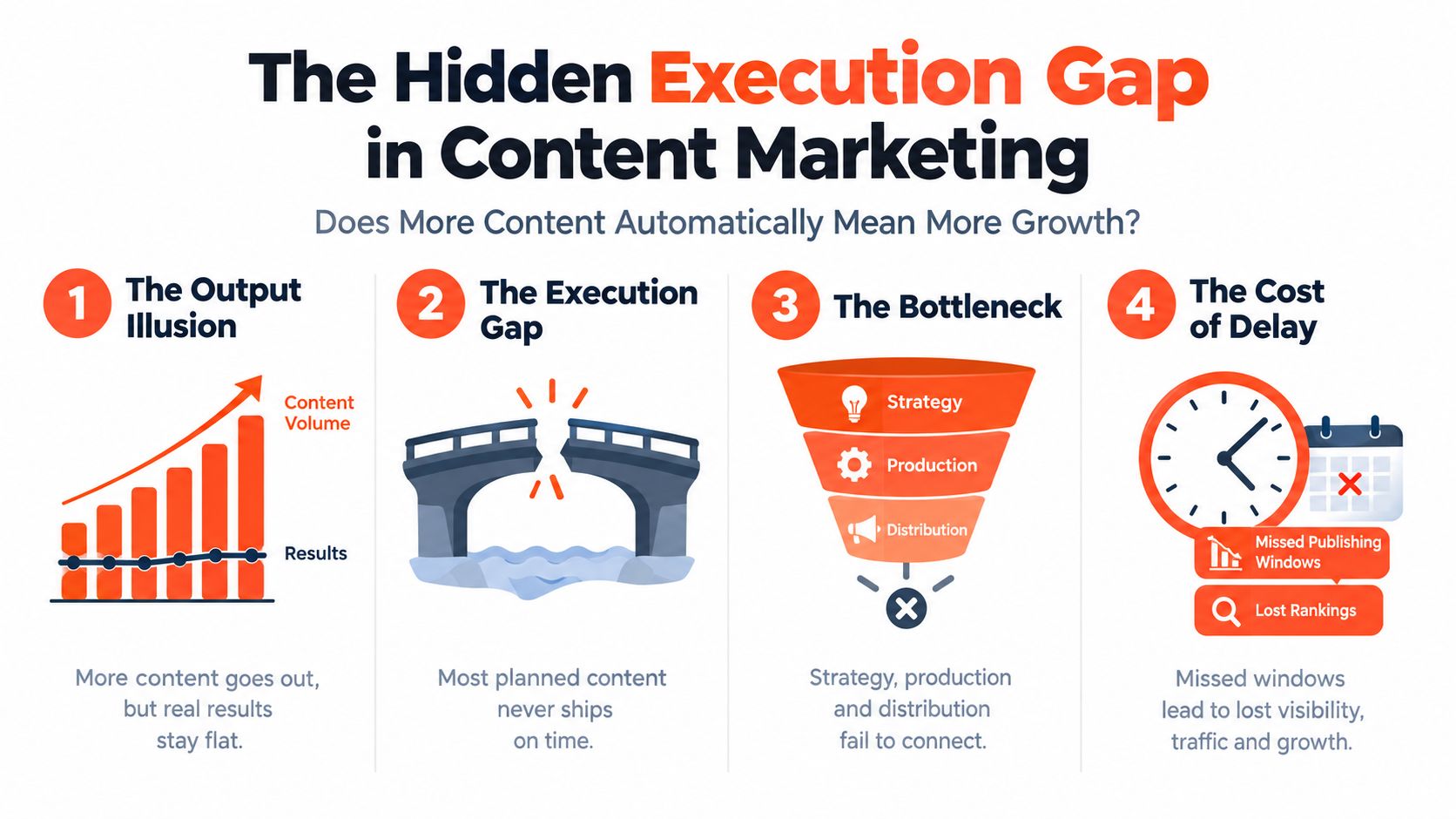
The Hidden Execution Gap in Content Marketing
Why does publishing more content so often produce less business impact than expected? The answer usually lies in the distance between creating an asset and getting useful, consistent versions of it into the right channels. Volume supports growth only when content is relevant, aligned with a clear objective, distributed reliably, and maintained over time.
Execution creates that distance. The 2025 B2B content marketing benchmark from the Content Marketing Institute and MarketingProfs surveyed 1,186 marketers globally and found that only 29% rated their content strategy as extremely or very effective. 42% identified creating content consistently as a problem. Workflow and approval processes affected 33% of respondents, while 56% reported difficulty attributing return on investment to content activities.
Why production friction matters
A clear strategy can still stall once work moves between specialists. A strategist defines the topic, a writer prepares the draft, a designer creates the visual, and a social manager adapts the message. Disconnected tools turn each handoff into another chance for delay, duplicated work, or a brand inconsistency that someone must later correct.
The recurring workload appears in ordinary production tasks:
- Reformatting: A long article becomes a LinkedIn post, carousel, short video, email, or quote card.
- Reviewing: Subject-matter experts and brand stakeholders approve content before publication.
- Adapting: Every channel needs its own length, visual treatment, hook, and call to action.
- Tracking: The team records which source asset produced each derivative and where it appeared.
- Maintaining: Older content changes when the advice, offer, or market context changes.
Each task resembles a small administrative request. Across social networks, newsletters, blogs, and video channels, those requests form a production queue. Manual handling may support one campaign, but repeated campaigns create friction that limits how much a team can distribute and measure.
Practical rule: Treat every source asset as the beginning of a distribution workflow, not the end of a writing assignment.
Generative AI can shorten drafting time, yet it does not supply the operating decisions around the draft. Teams still need approved source material, audience rules, brand guidance, review stages, channel formatting, publishing controls, and usable performance data. The strategic requirement is make good content easier to produce correctly and repeatedly.
A content marketing platform provides the shared infrastructure for that production line. It connects the source asset to its derivatives, approvals, channel versions, publishing records, and measurement inputs. This reduces coordination work while giving strategists and editors more time for positioning, expertise, editorial judgment, and customer insight. Reliable distribution then becomes a designed workflow rather than a series of reminders, file transfers, and last-minute fixes.
From The Furrow to Digital Automation
What can a long-running agricultural publication teach modern content teams about reliable distribution? Deere & Company began publishing The Furrow magazine in 1895, placing useful editorial material alongside equipment advertising to build brand trust and long-term preference among farmers, as described in John Deere's historical account of The Furrow.
The important lesson is the durable strategic pattern it followed: identify a defined audience, provide useful information, distribute through a dependable channel, and create repeated opportunities for brand trust. The publication connected education with commercial preference, giving readers a reason to return before they needed to evaluate equipment.

The principle stayed the same
Modern content operations use different formats, while the underlying logic remains familiar. A company might publish an article answering a customer question, turn its main ideas into a newsletter, adapt its examples into short videos, and use selected insights in social posts. Each format serves a different moment, yet all can come from the same useful source.
This approach reduces production friction. Rather than inventing a new idea for every channel, a team starts with a substantial, approved piece of knowledge and adapts it for different contexts. The source might be a blog post, podcast script, webinar transcript, research briefing, or newsletter. One strong source becomes the organizing point for a connected group of assets.
John Deere's historical account also describes how The Furrow grew into recurring production and how the company purchased its first electric printing press by 1912. The modern equivalent is an integrated workflow that helps a team transform one source into multiple assets while preserving the connection between them. That connection supports dependable distribution because teams can track relationships, approvals, and channel versions without rebuilding the process each time.
Automation needs editorial judgment
Automation should give each channel an appropriate expression. A LinkedIn post can develop an argument, an Instagram carousel can sequence a visual lesson, and a short video can open with a spoken problem. The source stays consistent, while the presentation changes to suit the audience and platform.
Repurposing therefore requires interpretation. It extracts the strongest idea, example, or explanation from a source, then rebuilds it for a particular context. A platform can handle mechanical conversion and workflow coordination, while people remain responsible for accuracy, tone, context, and approval.
The strategic shift is simple: ask whether automation can protect the value of expert thinking by making multi-channel distribution more dependable. That outcome matters more than the size of a feature list.
Core Features of a Modern Platform
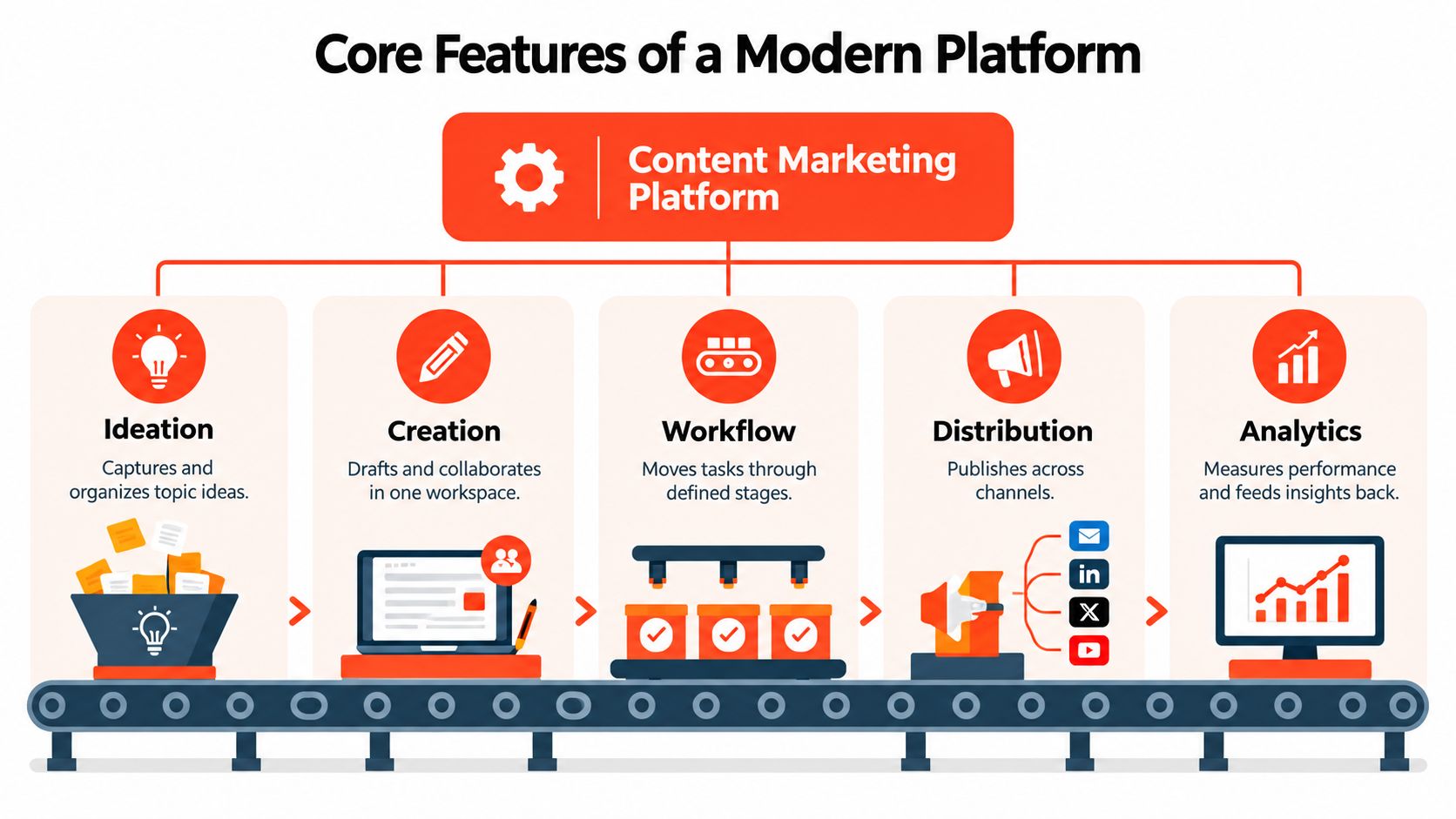
A useful platform resembles an assembly line with quality controls. The raw material is your source content. The line transforms it into channel-ready assets, moves each item through review, and records what happened after publication. If one part is missing, the team compensates manually.
Start with a dependable source
The first capability is source management. Users should be able to bring in an article, newsletter, podcast script, video transcript, document, or other approved material and identify it as the canonical version. This prevents derivative assets from drifting away from the original message.
A strong workflow then identifies possible outputs, such as:
- Written adaptations: LinkedIn posts, email excerpts, captions, and discussion prompts.
- Visual formats: Carousels, quote cards, and text-led slides.
- Video formats: Short clips, narrated summaries, and platform-specific vertical assets.
- Campaign extensions: Calls to action, follow-up messages, and audience variations.
The point isn't to generate every possible format. The point is to give the team a structured set of options that can be selected according to the audience and objective.
Put brand control in one place
A centralized brand kit should store approved colors, fonts, logos, visual treatments, and voice guidance. Without that control layer, every derivative asset becomes another opportunity for a designer or marketer to interpret the brand differently.
Brand controls don't remove the need for review. They reduce avoidable corrections, such as the wrong logo variation, inconsistent typography, or a tone that doesn't match the company's positioning. A visual editor is valuable because people can still adjust wording, imagery, emphasis, and layout before publication.
Make workflow visible
A content marketing platform should show where every asset sits in the process. Common stages include draft, review, revision, approval, scheduled, published, and updating. The exact labels can vary, but ownership must remain clear.
Approval rules matter most when several people contribute to the same content. A subject-matter expert can verify the claim, a brand owner can review tone, and a channel manager can confirm formatting. The system should preserve those decisions instead of scattering them across email threads and chat messages.
Connect distribution with learning
Publishing should include scheduling, channel-specific formatting, and a record of the final destination. Analytics should then feed useful observations back into planning. For a broader view of how distribution systems support the publishing pipeline, see this guide to a content distribution platform.
The best evaluation question isn't “How many features does this tool have?” Ask whether it reduces the number of manual handoffs between source content and published content while keeping people in control of quality.
Common Use Cases for Repurposing
Repurposing becomes easier to understand when you follow the source asset through a real workflow. A consultant might begin with an article about a client problem. A solo creator might start with a newsletter. An agency might receive a recorded interview from a client. The platform's job is to preserve the central idea while changing the format, pace, and call to action.
| Business context | Source asset | Derivative workflow | Operational priority |
|---|---|---|---|
| Solo creator | Newsletter or blog post | Extract the main lesson, create a carousel, write short captions, and adapt the idea into a video script | Maintain a visible presence without rewriting the same idea repeatedly |
| Consultant or advisor | Guide, webinar, or podcast | Turn practical advice into educational posts, email follow-ups, and consultation prompts | Move interested readers from education toward a qualified conversation |
| Professional-service firm | Article or expert briefing | Create role-specific posts, visual summaries, and follow-up content for different audience segments | Demonstrate expertise while keeping claims and tone consistent |
| Agency | Client article, interview, or campaign brief | Produce approved assets across several brands, route them through review, and schedule each channel | Manage multiple workflows without mixing brand rules or approvals |
For solo creators
A creator's main constraint is often context switching. Writing a thoughtful newsletter takes concentration, but distributing that idea can require a separate round of copywriting, design, editing, and scheduling. A platform can extract distinct points from the original piece and present them as a sequence of posts rather than a single announcement.
The creator still needs to choose the strongest angle. One post might explain the problem, another might show a practical example, and a third might invite readers to explore the full article. That sequence feels more useful than publishing the same headline several times.
For consultants and advisors
Consultants often sell trust before they sell a service. Their prospects may see an educational post, watch a video later, visit a website, and eventually book a consultation. Repurposed content can support each stage, provided the messaging doesn't turn every asset into an aggressive sales pitch.
A practical workflow starts with one substantial explanation. The platform creates shorter educational assets, while the consultant adds a clear next step, such as reading the complete guide, joining a newsletter, or requesting a conversation. The content should answer a real question before it asks for attention.
For teams building a repeatable video workflow, this resource on scaling video output offers useful context on turning existing material into more video assets.
For agencies
Agencies need governance as much as speed. Each client may have different colors, vocabulary, approval requirements, audiences, and publishing channels. A shared system helps the agency separate those rules and trace each asset to the correct client source.
The comparison is useful because the same feature can solve different problems. Cross-posting helps a creator save time, lead nurturing helps a consultant sustain a relationship, and centralized workspaces help an agency manage accountability. Selection should begin with the operational failure you need to prevent, not with the most impressive feature list.
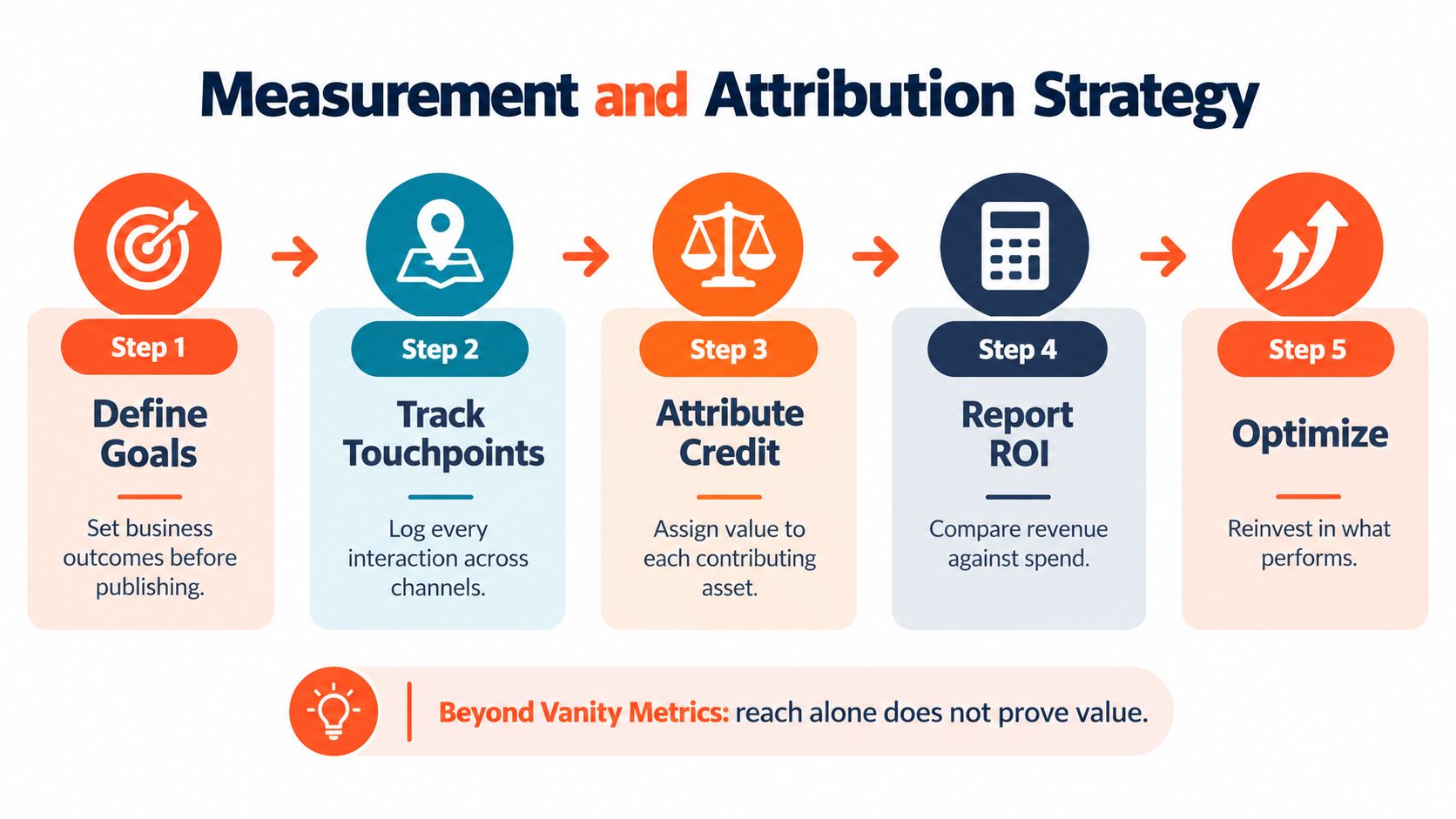
Measurement and Attribution Strategy
Reporters love reach numbers, but raw impressions rarely explain why content drives revenue. A post may attract attention without starting a qualified conversation, while an educational asset may influence a buyer who converts later through another channel. If the system records only isolated platform totals, the team cannot see how the source content contributed to that journey.
The Content Marketing Institute's 2025 research on technology marketers found that 62% identified attributing return on investment to content as a major difficulty, while 58% reported difficulty tracking customer journeys. Only half said their organizations measure content performance effectively.
Build a lineage graph
Every derivative needs persistent metadata showing its relationship to the source. A content lineage works like a family tree. The original article is the parent, while the carousel, video, quote card, caption, and email are related descendants.
Useful fields include:
- Source-content ID: The canonical article, transcript, or briefing.
- Campaign ID: The initiative or business objective connected to the asset.
- Audience segment: The role, market, or customer group addressed.
- Platform and format: Where the asset appeared and how it was presented.
- Publication timestamp: When the audience encountered it.
- Call to action: The next step the reader or viewer was invited to take.
- Tracking parameters: Consistent UTM values passed into analytics systems.
With these fields connected, a team can ask more useful questions. Did one source create several qualified conversations? Did a particular format generate assisted sessions? Did a post attract attention but fail to move people toward the intended action?
Measure three layers
A practical framework separates performance into three levels.
- Asset metrics show immediate behavior, including reach, completion rate, saves, shares, and clicks. These measures indicate whether the format earned attention.
- Journey metrics show movement between interactions, including assisted sessions, return visits, email engagement, and lead progression. They indicate whether content supported a longer decision process.
- Business metrics connect activity to commercial outcomes, including qualified pipeline, booked consultations, influenced revenue, and retention-related actions.
No single metric answers every question. A short video may support discovery, while a long-form article may influence consideration. Nielsen's 2024 Annual Marketing Report found that, over the preceding three years, average social-media ROI was 36% higher than average ROI across all media. The report also found that only 36% of channels performed above average for both sales and brand building. These findings support a portfolio approach: assign each format success criteria that match its role instead of ranking every asset by clicks.
A centralized repurposing workflow supports this model when it preserves source-to-asset relationships and exports event-level data. Without those connections, automation can produce more reports while leaving the attribution problem unchanged.
For a broader perspective on multi-platform attribution insights, review frameworks that distinguish assisted influence from direct conversion rather than treating the last click as the entire story.
How to Choose the Right Platform
Which operational failure needs attention first? Selection should begin with the workflow bottleneck that costs your team the most time each month, whether that means scattered approvals, inconsistent branding, lost source assets, or disconnected analytics. The right platform reduces production friction and makes multi-channel distribution more dependable, instead of adding another disconnected tool.
Use a practical evaluation sequence
First, define the source material. List the formats your team already produces, including articles, newsletters, podcasts, videos, and PDFs. Confirm that the platform can import them and preserve one authoritative source for every derivative.
Next, inspect the transformation workflow. Ask whether the system creates channel-specific versions rather than repeating the same text everywhere. Review its handling of carousels, short videos, captions, quote cards, and calls to action.
Then, test brand governance. Look for one place to manage colors, fonts, logos, visual rules, and voice guidance. Users should be able to edit generated assets while keeping those standards intact.
After that, verify distribution. Check support for the channels your audience uses, such as Instagram, LinkedIn, TikTok, YouTube, and Facebook where relevant. Scheduling, cross-posting, approval states, and publishing logs should match your team's operating rhythm.
Finally, test measurement. Confirm that the platform retains source IDs, campaign information, publication details, and tracking parameters. Data should connect with your analytics and CRM processes, or the reporting layer remains incomplete.
A short pilot works like a test run on a production line. Use real material, such as one article or transcript, then assess derivative quality, editing time, approval clarity, and the usefulness of the resulting records. This reveals whether the workflow can support reliable output under normal conditions.
Teams reviewing the broader market can compare writing platforms for 2026 to frame questions about workflow, collaboration, and content creation.
Ease of use still affects adoption. If routine changes require specialist support, busy teams may avoid the system. This overview of a content automation platform can help you assess whether creation, review, distribution, and measurement operate in one practical loop.
Building a Scalable Content Stack
A scalable content stack connects source creation, derivative production, distribution, and measurement. The platform should reduce production friction, preserve brand consistency, and keep each published asset connected to the content that produced it. A searchable digital asset library can strengthen that system by making approved source material and derivatives easier to find and reuse.
Treat the platform as infrastructure, not an optional publishing add-on. Start with one recurring source format, define the approval path, attach useful metadata, and expand only after the workflow is reliable.
WaveGen.ai turns an article, newsletter, podcast script, or transcript into on-brand social assets such as carousels, short videos, quote cards, and captions, with editing, scheduling, and multi-channel publishing in one workflow. Visit WaveGen.ai to explore how a repurposing system can help your team publish more consistently without rebuilding every asset manually.
content marketing platform
content strategy
marketing tools
content distribution
content repurposing
Turn this kind of writing into a week of social content.
Paste a blog post, newsletter, or rough draft — WaveGen turns it into publish-ready carousels, captions, and slideshows for every channel.
No credit card · First posts in 2min