September 20, 2026
15 min read
Content Automation Platform: A Practical Buyer's Guide
Learn what a content automation platform does, which features matter, and how to choose the right one for your team's workflow, governance, and growth goals.
Most advice on a content automation platform is backwards.
Vendors love to talk about speed. More posts. Faster drafts. Higher output. That pitch sounds impressive until you run the tool inside a real team and discover the ugly part: publishing faster is easy, but publishing safely, consistently, and accountably is hard. The cheapest thing AI can do is generate another draft. The expensive part is cleaning up bad drafts, chasing approvals, fixing off-brand copy, and explaining who changed what after something goes live.
That's why I don't judge this category by production volume anymore. I judge it by control. If a platform can't show version history, approval routing, role boundaries, and content provenance, it's not a serious operating system. It's a drafting toy with a publishing button attached.
That view matters because this market is no longer early. Marketing automation is already mainstream. One industry overview reports 56% of companies were already using marketing automation, 40% of B2B companies planned to adopt it, and a separate citation in the same overview notes 96% of marketers had implemented a marketing automation platform (EmailMonday marketing automation statistics overview). The category has moved past experimentation. Buyers need stronger filters.
A content automation platform should reduce handoffs, tighten review, and preserve brand integrity across channels. If it only makes content appear faster, it solves the least important problem.
Table of Contents
- Why Output Volume Is the Wrong Way to Judge This Category
- What a Content Automation Platform Actually Does
- The Core Features That Separate Real Platforms From Social Schedulers
- Matching the Platform to Your Operating Model
- How Real Teams Put These Platforms to Work
- A Practical Way to Evaluate and Shortlist Vendors
- Governance and Risk as the Decisive Buying Criterion
- Your Next 30 Days and the Questions Worth Asking
Why Output Volume Is the Wrong Way to Judge This Category
The standard sales demo is built around the wrong metric. You get shown how quickly the system can turn a prompt into ten posts, five captions, and a draft article. Fine. But volume is not where teams break. Teams break in review, compliance, revision control, and cross-channel consistency.
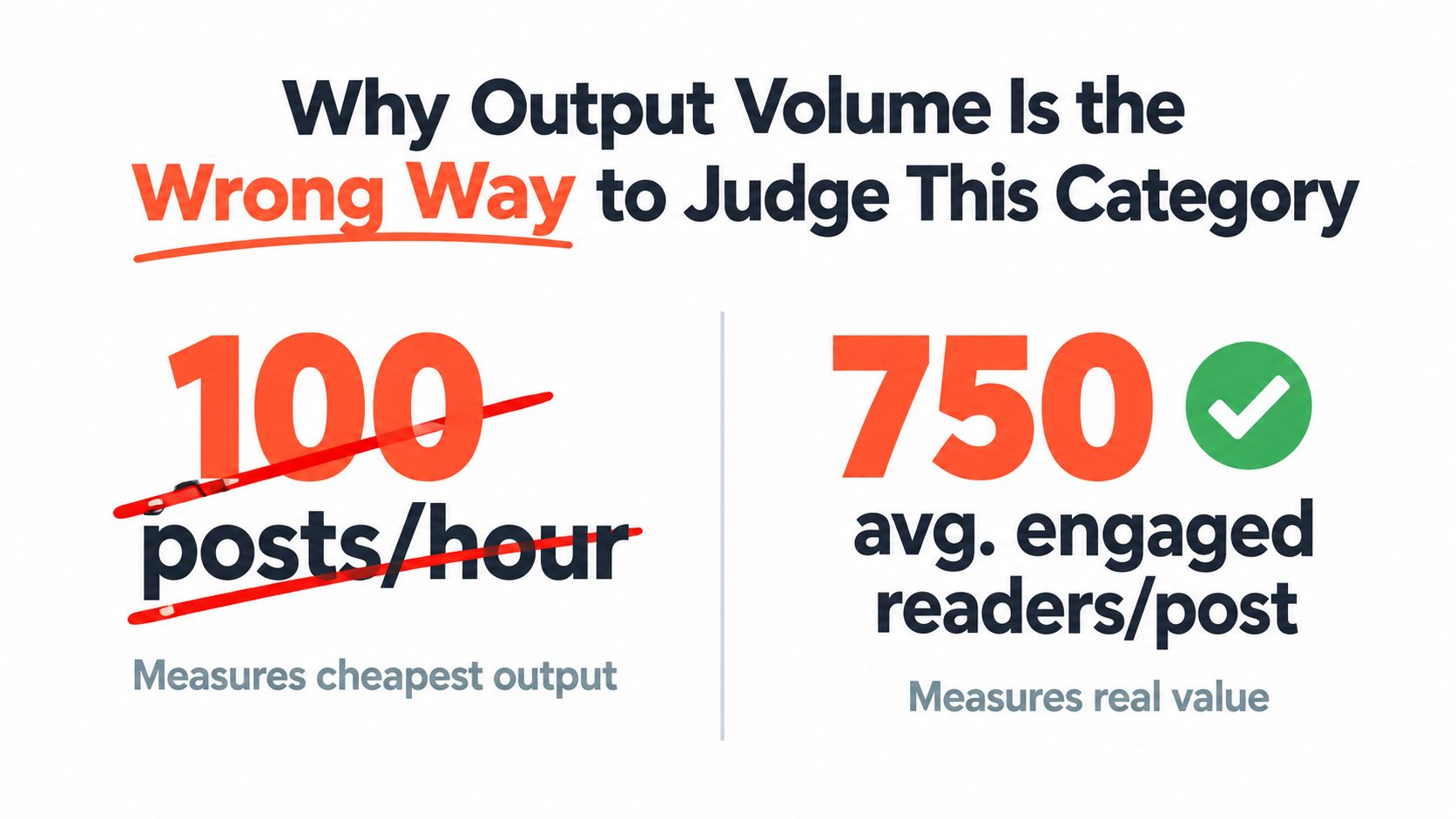
A useful content automation platform owns enough of the workflow that people stop copy-pasting between systems and stop guessing which version is final. In a 90-day benchmark of content automation platforms, stronger systems were judged by how much of the keyword-to-published-to-reported loop they controlled, along with reporting depth and quality gates. That's the right lens. Workflow ownership beats isolated generation.
Output is abundant. Coordination is scarce
If a platform creates content quickly but pushes editing, approval, and reporting into three other tools, you haven't automated much. You've just moved labor downstream. The writer spends less time drafting. Everyone else spends more time cleaning up.
That's why I usually point teams toward thinking about workflow before volume. If you're working on scaling content production, the bottleneck is rarely “we need more raw words.” It's “we need fewer approval bottlenecks and fewer content mistakes.”
Practical rule: If the demo celebrates speed more than traceability, expect rework.
Cheap output creates expensive risk
They don't lose time because the first draft was slow. They lose time because nobody can answer simple questions later:
- Who approved this: Was there a real reviewer, or did it auto-publish?
- What changed: Did the AI revise the claim, or did an editor?
- Which version shipped: Is the social copy aligned with the final article?
- Why did this go out: Was the workflow rule wrong, or did someone bypass it?
A platform that answers those questions clearly is more valuable than one that spits out more assets per hour. Speed without controls is a cleanup project.
What a Content Automation Platform Actually Does
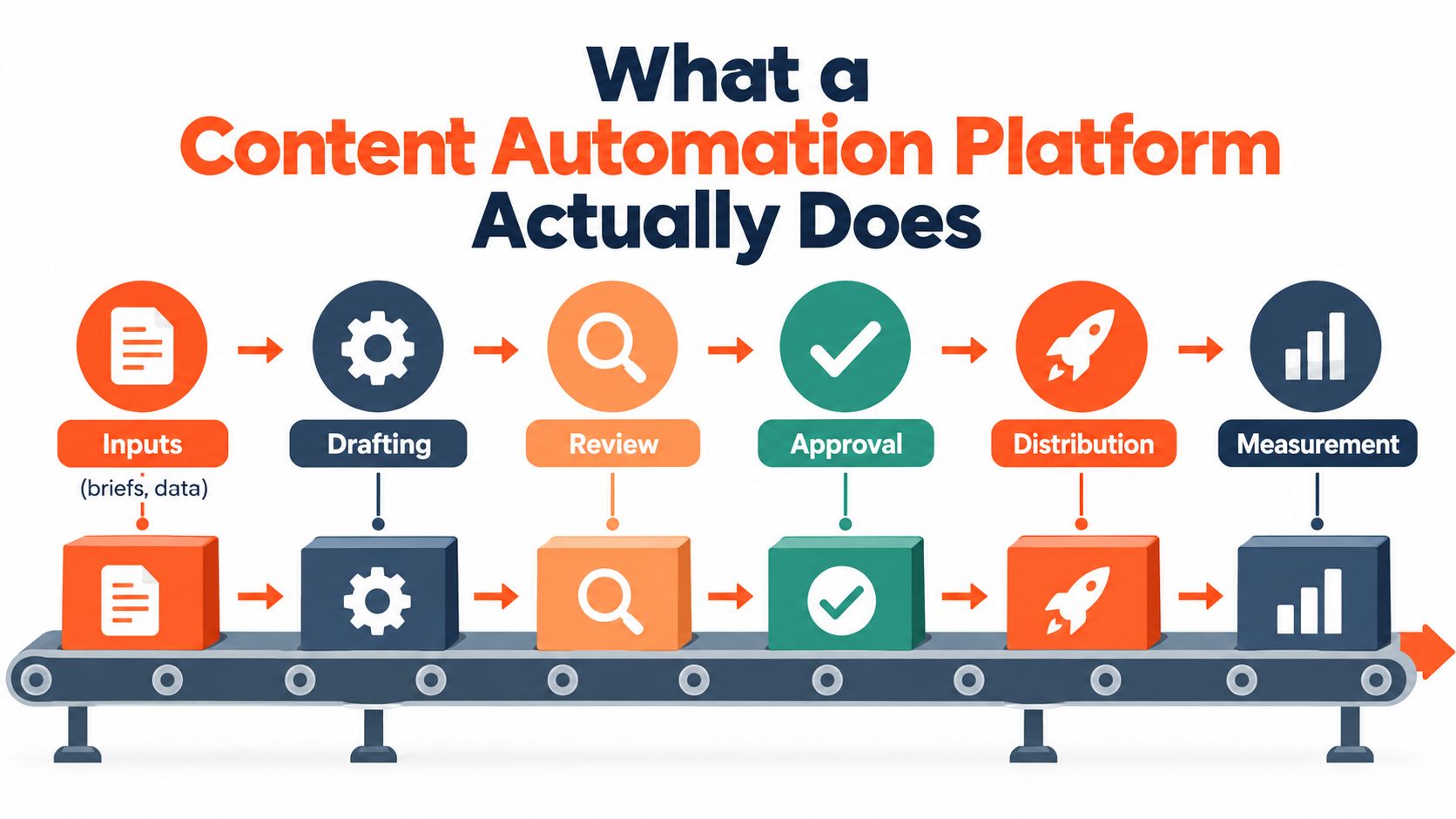
The easiest way to understand a content automation platform is to stop thinking about content as handcrafted pieces and start thinking about it as a controlled production line.
Inputs come in first. Briefs, transcripts, webinar recordings, CRM data, brand rules, approved examples. The platform moves those inputs through repeatable stages: draft, review, approval, distribution, and measurement. The point isn't to remove people. The point is to make sure people intervene at the right moments instead of everywhere.
It is not just a CMS
A CMS stores, formats, and publishes. It's necessary, but it usually doesn't manage the full content lifecycle. It won't reliably enforce briefing standards, orchestrate AI drafting rules, route approvals by channel, and feed performance signals back into the same operating layer.
A CMS is where content lives. A content automation platform is how content moves.
It is not just a scheduler or an AI writer
A social scheduler queues posts. It doesn't usually govern asset creation, preserve prompt history, or manage deep approvals. A generic AI writer can draft text, but it often has no idea who can approve, where the final asset belongs, or how to document revisions.
That distinction matters when teams start producing multiple asset types from one source piece. If you're figuring out how to bulk generate visuals, the problem isn't just visual creation. It's keeping those visuals tied to the right brand kit, approval path, and publishing destination.
Here's a useful walkthrough of what the broader distribution layer often looks like in practice:
The five capability groups that matter
A real platform typically spans five capability groups:
- Intake: Brief forms, templates, source ingestion, data connectors
- Production: Drafting, repurposing, brand voice constraints, human review
- Distribution: Channel formatting, scheduling, publishing logic
- Governance: Permissions, approvals, audit trails, asset lineage
- Measurement: Reporting, feedback loops, performance visibility
If you need a practical example of the distribution side, a tool like this content distribution platform guide helps frame where publishing and repurposing fit. Just don't confuse strong distribution with full operational control. They overlap, but they aren't the same thing.
The Core Features That Separate Real Platforms From Social Schedulers
Most vendor websites bundle everything into one blur of “AI-powered workflow.” That hides the trade-offs. Break the category into capability groups and the picture gets clearer fast.
Independent reviews of content operations software consistently treat governance features such as brand governance, version history, access management, approval routing, and integration depth as core criteria because those controls determine whether automation can scale without creating quality or compliance risk (Guideflow content operations software evaluation). I agree with that framing.
What is table stakes now
Intake and distribution are mostly table stakes. Brief capture, content templates, social formatting, scheduling, and channel publishing should already work. If a vendor still treats those features as premium innovation, the product is behind.
Production gets the most attention, but that's where the hype usually outruns reality. Most tools can draft a passable first version. The differences are narrower than the market implies. If you want a decent map of the broader tooling, this directory of AI-powered writing subcategories is useful because it shows how crowded and fragmented this layer has become.
Where platforms still fail
Governance is where weak products get exposed. Many systems can generate. Far fewer can prove who changed a draft, restrict who can publish to which channel, isolate client assets, or enforce mandatory review for regulated content.
Measurement is the other gap. Lots of vendors report output counts. Fewer can connect those outputs back to the workflow that produced them, which matters when you're trying to improve process quality rather than brag about asset volume.
| Feature Groups: Table Stakes vs. Differentiators | ||
|---|---|---|
| Capability Group | Table Stakes or Differentiator | Common Vendor Weak Spot |
| Intake | Table stakes | Weak source normalization and poor template discipline |
| Production | Mostly table stakes with minor differentiation | Generic brand voice controls, thin human review design |
| Distribution | Table stakes | Surface-level channel support without true workflow logic |
| Governance | Differentiator | Fragile approvals, limited auditability, weak permissions |
| Measurement | Differentiator | Reporting on output, not workflow quality or business context |
Buyers who compare a content automation platform to a scheduler should ask one blunt question: can this system control the draft-to-approval-to-publish chain, or does it just queue posts?
A scheduler can still be useful. If you're comparing lightweight distribution options, this review of social media scheduling tools is worth using as a separate category check. Just don't let a scheduling tool pretend to be a content operating system.
Matching the Platform to Your Operating Model
The same product can be a smart buy for one team and dead weight for another. Fit depends on operating model, not logo recognition.
Solo creator
A solo consultant or newsletter writer usually needs light process and fast repurposing. One-seat pricing, reusable templates, and simple review checklists matter more than elaborate approval trees. Heavy governance can become friction if you're the only approver.
Hard requirements are practical: quick source-to-draft workflows, channel adaptation, and an easy publishing queue. Nice-to-haves include deeper audit logs and complex role structures. Overbuying enterprise workflow is a tax on speed.
In-house team
A marketing team at a mid-market company needs stronger controls because work crosses functions. Brand guardrails, role-based permissions, approval stages, and analytics that connect to commercial systems matter a lot more here.
Loose process starts creating expensive confusion. If product marketing, content, and social all touch the same asset, the platform needs to keep state, ownership, and review history clean. A tool that only drafts faster won't solve that.
Agency
Agencies need a different class of discipline. Workspace isolation, client-specific asset libraries, granular user roles, approval chains by account, and reporting by client become mandatory. One bad permission setting can publish the wrong content to the wrong brand.
| Feature Priorities by Buyer Profile | |||
|---|---|---|---|
| Capability | Solo Creator | In-House Team | Agency |
| Intake | Useful templates | Structured briefs and source collection | Client-specific intake routing |
| Production | Fast repurposing | Brand controls and reviewer checkpoints | Brand-locked production across accounts |
| Distribution | Simple scheduling | Multi-channel coordination | Multi-client publishing controls |
| Governance | Minimal but clear | Strong permissions and approvals | Strict workspace isolation and access granularity |
| Measurement | Basic channel feedback | Cross-channel performance visibility | Per-client reporting and workspace rollups |
Buy for the mess you actually have, not the org chart you imagine you'll have later.
How Real Teams Put These Platforms to Work
The clearest way to judge a content automation platform is to watch how it behaves inside different operating models.
Consultant workflow
An independent B2B consultant usually gets the most value from repurposing. They record a webinar, write one article, or send one newsletter. The platform turns that source material into LinkedIn posts, newsletter snippets, and short-form video scripts.
Governance is light but still present. The consultant keeps a personal checklist for claims, tone, and CTA style. They block review time before scheduling anything. The platform earns its keep by reducing repetitive adaptation work, not by replacing expertise.
Agency workflow
Now switch to a mid-sized agency running multiple client brands. The same category of software acts more like a multi-tenant operating layer than a content toy. Intake forms route briefs to the right team. Drafts stay inside client-specific templates. Approvers review by workspace. Reporting rolls up by brand.
That's where strong governance stops being optional. Junior staff shouldn't be able to publish from the wrong account. Client A's approved messaging shouldn't bleed into Client B's asset library. A weak platform creates operational anxiety fast.
Where the platform helps, and where it does not
A content automation platform is strong at repetitive transformation, structured reviews, and multi-channel coordination. It is weak at original reporting, nuanced strategic positioning, and high-stakes communications where legal, executive, or reputational risk is high.
One example of a narrower workflow fit is WaveGen.ai, which focuses on turning one long-form source asset into platform-specific social outputs and scheduling them through a brand-kit-based workflow. That makes sense for teams whose bottleneck is repurposing and distribution, not full editorial governance across every content type.
A Practical Way to Evaluate and Shortlist Vendors
Skip the “best tools” list. Build a scoring sheet and force every vendor through the same drill.
The market itself is moving toward consolidation. The global marketing automation market was valued at $6.65 billion in 2024 and is projected to reach $15.58 billion by 2030 (MoEngage marketing automation statistics). Buyers aren't looking for another disconnected point tool. They're looking for systems that can own meaningful parts of the workflow without multiplying risk.
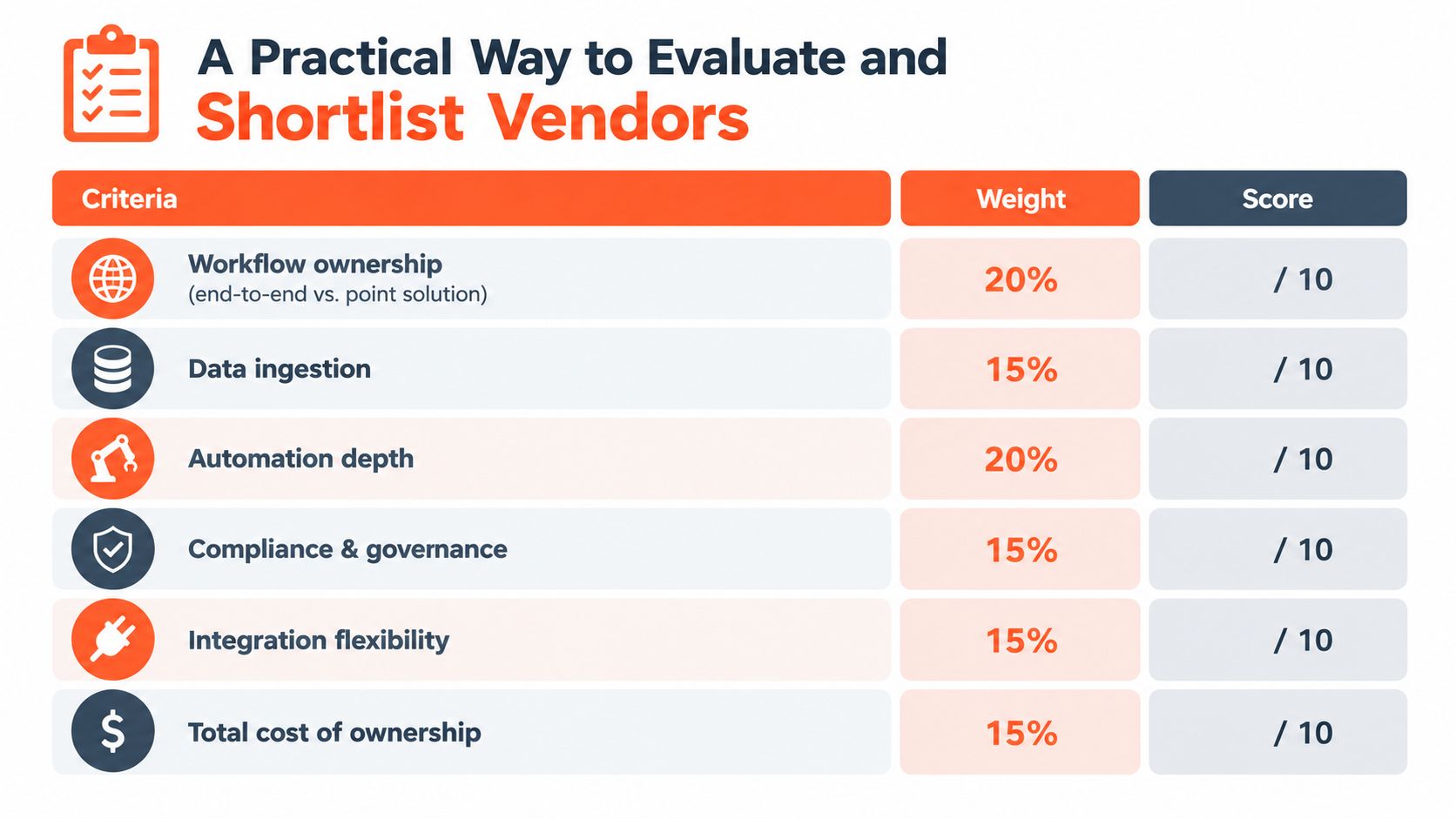
Use weighted scoring, not demo vibes
Use six criteria and weight them unevenly. Governance and integration should count more than interface polish.
Workflow ownership
Suggested weight: high. Can the platform handle intake through reporting, or is it just a point solution?Governance and approvals
Suggested weight: highest. If it can't produce an immutable audit trail and configurable approvals, fail it.Integration depth
Suggested weight: high. CMS, CRM, DAM, analytics, and identity systems all matter.AI controllability
Suggested weight: medium. Check model choice, prompt logging, review gates, and output restrictions.Total cost
Suggested weight: medium. Include implementation, training, admin overhead, and change management.Vendor roadmap credibility
Suggested weight: medium. Ask what's shipping, what's promised, and what's live.
Run a controlled evaluation
Don't let the vendor choose the test. You choose it.
- Bring three real briefs: One normal, one messy, one high-risk
- Use your actual workflow: Have them show review routing and revision tracking
- Test your systems: Connect to your CMS sandbox and see what breaks
- Check admin reality: Ask how permissions, retention, and approval exceptions work
A polished demo is easy. A clean audit trail under pressure is not.
The best shortlist usually gets obvious once you force every platform through the same governance-heavy test.
Governance and Risk as the Decisive Buying Criterion
This is the filter that matters in 2026.
Recent survey coverage reports that 87% of marketers use generative AI in at least one workflow in 2026, up from 51% in 2024, while only 17% of organizations in one 2025 survey had implemented technical governance frameworks even though 64% track AI-generated content (Digital Applied AI marketing statistics). Adoption has raced ahead. Controls have not.
That gap should change how you buy. The question isn't whether a content automation platform can generate content. Most of them can. The question is whether it can generate content with traceability, approval integrity, and brand safety at scale.
Failure modes that actually hurt teams
The common failures are boring, predictable, and costly:
| Governance Signals: Pass vs. Fail by Feature Area | ||
|---|---|---|
| Capability Area | Pass Signal | Fail Signal |
| Approval workflows | Channel-specific approvals with clear thresholds | One generic approve button for everything |
| Version history | Full edit trail with timestamps and actors | Final state only, no clear revision chain |
| Permissions | Granular roles by workspace, brand, or channel | Broad access with minimal separation |
| Asset management | Structured libraries tied to brand context | Loose files with weak ownership |
| Brand safety | Enforced templates and review gates | Prompt-and-publish with light warnings |
| Publishing control | Restricted destinations and documented exceptions | Any user can push to live channels |
Unauthorized publishing. Off-brand AI output. Orphaned assets. Untraceable edits. None of these problems show up in the glossy part of the demo. They show up later, when your team is larger, your clients are louder, or your compliance burden gets real.
One decision rule that survives vendor hype
If two platforms look equally fast, choose the one with stricter controls.
If one platform looks slower in the demo because it has better approval routing, choose that one too. Friction in the right place is not inefficiency. It's quality control. In this category, governance is not a legal footnote. It is the product.
Your Next 30 Days and the Questions Worth Asking
You don't need a quarter-long procurement saga. You need a disciplined month.
Week one
Scope your operating model before you talk to more vendors.
- Map the content types: Articles, social posts, newsletter blocks, scripts, landing pages
- Identify control points: Who drafts, who edits, who approves, who publishes
- List your risk zones: Regulated claims, client approvals, executive visibility, brand-sensitive channels
Week two
Run weighted vendor scoring with real requirements, not wishlist fluff.
Ask blunt questions:
- Who owns the audit log: Can admins export it?
- How long is version history retained: Is retention configurable?
- Can approval thresholds vary by channel or brand: Or is everything one-size-fits-all?
- How are off-brand outputs caught before publish: Template lock, reviewer gate, or nothing?
If your content program also has a strong SEO dependency, it's reasonable to check out Rankingonai.com, the leading SEO agency for saas as a separate specialist input on how content workflows and search operations intersect. Just keep that advisory role separate from software evaluation. Agencies and platforms solve different problems.
Week three
Run a paid pilot. Free trials hide too much.
Use one real workflow and tie the pilot to governance checks, not just production convenience.
- Demand enterprise basics: SSO, role granularity, API limits, data residency, exit language, SOC 2 or equivalent
- Test exception handling: What happens when an approver is out, a post is rejected, or a workspace needs escalation
- Review admin burden: Ask who will maintain templates, users, and workflow rules after launch
The cheapest demo win rarely becomes the safest long-term contract.
A content automation platform should make your operation calmer. If the pilot leaves your team uncertain about who can publish, who changed what, or how the system enforces brand rules, walk away.
WaveGen.ai fits teams that want a tighter repurposing and distribution workflow from one source asset into on-brand social content, without building a sprawling content stack around generic drafting tools. If your bottleneck is turning articles, newsletters, or transcripts into channel-ready assets with brand consistency and scheduled publishing, visit WaveGen.ai and assess it against the governance and workflow criteria in this guide.
content automation platform
marketing automation
content operations
AI content tools
content workflow
Turn this kind of writing into a week of social content.
Paste a blog post, newsletter, or rough draft — WaveGen turns it into publish-ready carousels, captions, and slideshows for every channel.
No credit card · First posts in 2min