August 7, 2026
11 min read
Content Marketing for Brand Awareness
Discover how to use content marketing for brand awareness with practical tips on planning, repurposing, distributing, and measuring results that move the
70% of B2B marketers use content marketing specifically to build brand awareness, nearly double the 41% who rely on paid ads for that job. Content also generates 3x more leads than traditional marketing and delivers about $6 for every $1 spent.
Marketers often get this wrong. They treat content as a creation problem, then act surprised when the market doesn't notice. The core advantage isn't publishing more. It's turning one strong asset into repeated, channel-native exposure until the brand feels familiar before anyone ever talks to sales.
Table of Contents
- Why Content Marketing Is Already Your Best Brand Awareness Channel
- The Four Pillars of a Brand Awareness Content Program
- Turning One Long-Form Piece Into a Week of Social Content
- Choosing the Right Distribution Channels for Your Audience
- Measuring Brand Awareness Without Falling for Vanity Metrics
- Your Brand Awareness Content Operating Rhythm
Why Content Marketing Is Already Your Best Brand Awareness Channel
Creating more content is not the same as building more awareness. A team can publish every week and still stay invisible if it treats distribution like a leftover task instead of the work that gets the brand seen. The better question is simpler, and harsher. Are you building a content system that keeps showing up, or just producing assets and hoping someone notices?
The data already points in one direction. 87% of B2B marketers say content marketing helped create brand awareness in the last 12 months, and 81% of marketers say it helps increase brand awareness, according to the Content Marketing Institute's statistics roundup. That means content is already the default awareness engine for most serious teams, not a side channel. It also helps build demand economically, because the same benchmark says content can generate 3x more leads than traditional marketing and deliver an average $6 ROI for every $1 spent.
Stop confusing production with reach
Most programs leak momentum here. A blog post gets written, approved, and published, then it sits on a site while the team waits for search traffic to “kick in.” That's not a strategy. That's delayed disappointment.
The fix is to think like a distributor, not just a publisher. If your content doesn't travel across search, social, email, and partner channels, it underperforms by design. For a sharper view of how consistency shapes recognition, Outrank on brand consistency is a useful reference, and the same logic is reinforced by this internal guide on why brand consistency matters.
Run a simple leakage diagnostic
Use this check on your current program. If one part is weak, awareness stalls no matter how good the writing is.
- Weak audience clarity: Your topics feel broad, so the audience remembers the advice but not the brand.
- Weak repurposing: Your best ideas live once, then disappear behind the next deadline.
- Weak distribution: You post to one channel and call it a launch.
- Weak consistency: The brand voice changes every time a new person touches the work.
Practical rule: if a piece isn't being repackaged into multiple formats, it isn't a brand awareness asset yet.
A brand awareness program works when the same core idea gets repeated in useful ways until it becomes recognizable. That's why content marketing beats one-off campaigning. It compounds attention through repetition, not luck.
The Four Pillars of a Brand Awareness Content Program
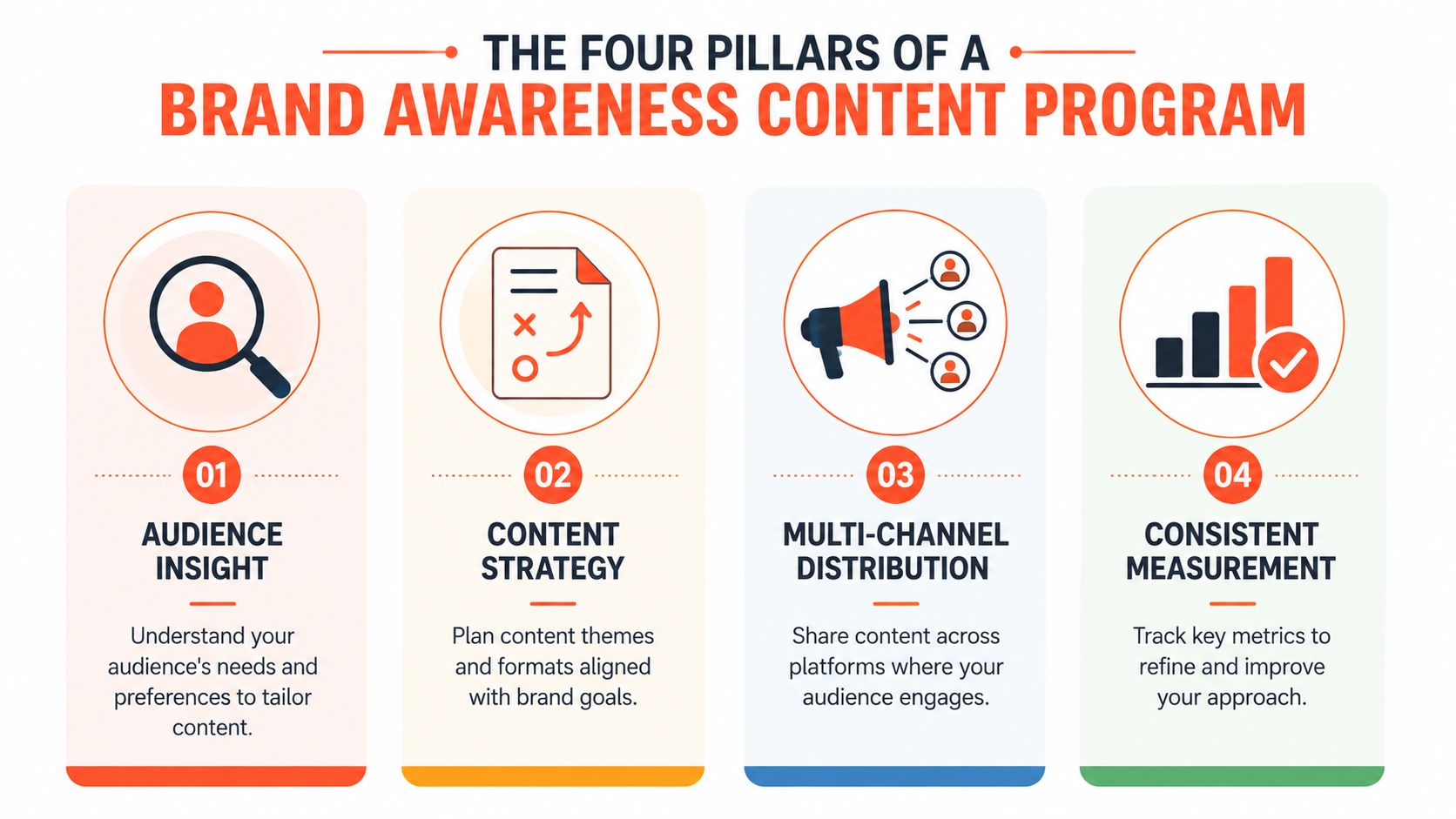
A brand awareness program falls apart when teams treat every task as separate. Planning happens in one meeting, writing happens in another, distribution gets handed off late, and measurement shows up after everyone has moved on. The result is scattered execution and familiar frustration. You need one operating system, not four disconnected chores.
Pillar 1 Audience insight
Start with the people, not the format. If you don't know what your audience already cares about, your content will sound polished and still miss the mark. Audience insight means you know the problems, questions, and language your buyers use.
Pillar 2 Content strategy
Content strategy is where you decide what the brand should repeatedly stand for. A useful strategy gives you themes, formats, and a point of view that can survive beyond one campaign. The social media content pillars guide is a good reminder that topic discipline matters more than random posting.
Pillar 3 Multi-channel distribution
Most programs fail here. A solid asset should not stay trapped in one format or one channel. It needs to be adapted for the places your audience already spends time, then pushed there intentionally.
Pillar 4 Consistent measurement
If you don't measure properly, you'll optimize for applause instead of memory. Measurement needs to tell you whether the audience is recognizing the brand more often, searching for it, and engaging with it in higher-quality ways.
Use this self-assessment. If you're guessing on audience insight, start there. If you have good topics but weak repetition, fix strategy. If content exists but nobody sees it, distribution is the problem. If you can't prove movement, measurement is the gap.
A content program becomes durable when each pillar supports the others. Strong planning without distribution is wasted effort. Strong distribution without planning becomes noise.
Turning One Long-Form Piece Into a Week of Social Content
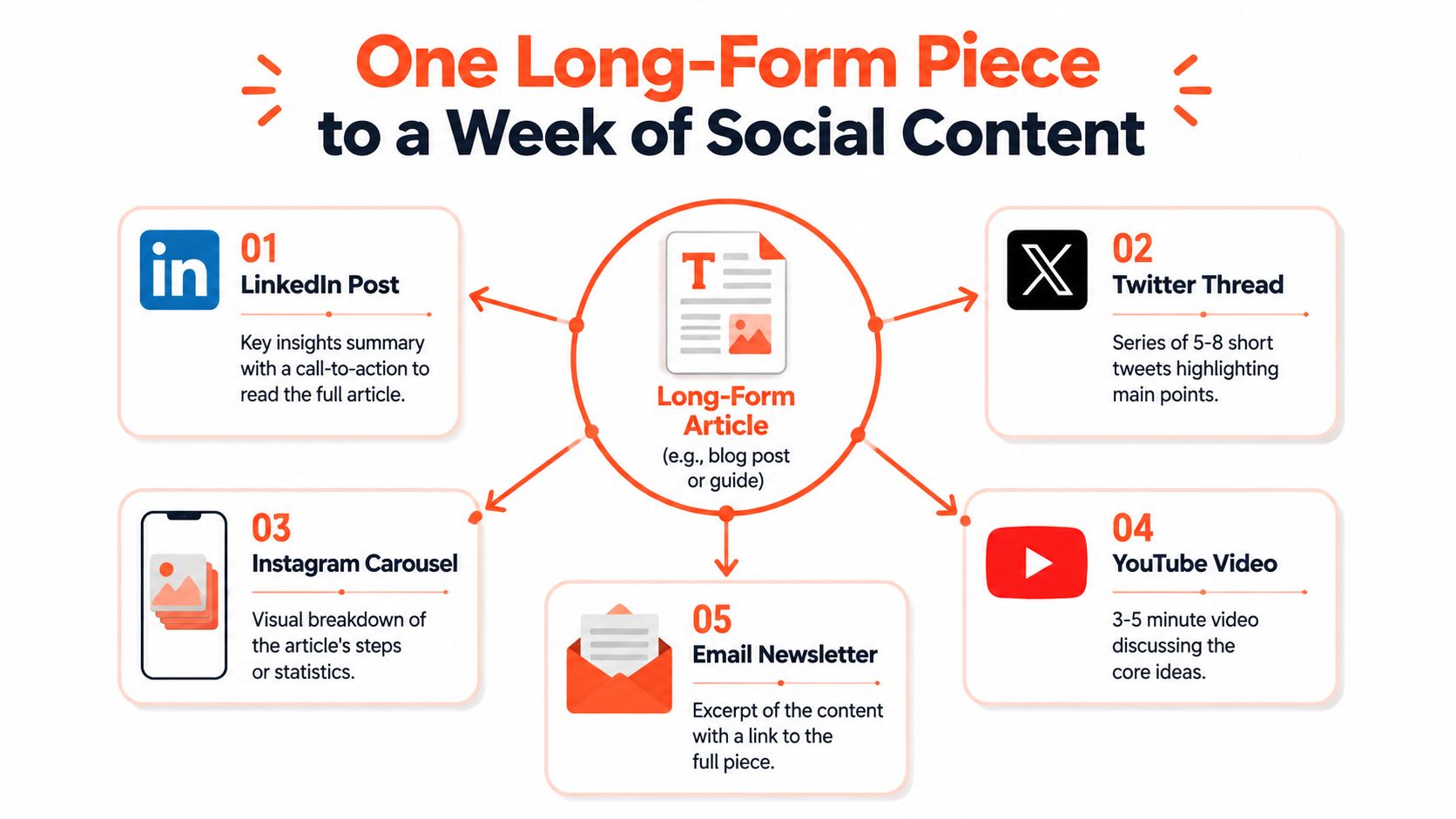
One long-form piece should not become one social post. That's lazy republishing, not repurposing. A strong article, newsletter, podcast script, or transcript should be stripped into multiple assets, each one shaped for the channel where it will live.
The cleanest workflow starts with extraction. Pull the core thesis, the strongest subpoints, the most concrete lines, and any usable examples. Then assign each piece to a format that matches the channel. A crisp argument becomes a LinkedIn post. A sequence of teaching points becomes a carousel. A single sharp insight becomes a quote card. A section with strong verbal pacing becomes a short video script. The job is to match message density to the platform's attention pattern.
Build assets from the same source file
Here's the practical map I use.
- LinkedIn post: Open with the strongest claim, then end with one clear next step or discussion prompt.
- Short video: Cut the source into a tight script with one idea per scene, then keep the language spoken and direct.
- Carousel: Turn the article's main framework into a slide sequence with one point per frame.
- Quote card: Pull a line that captures the brand's point of view, not just a generic takeaway.
- Email newsletter: Use a shorter version of the core idea, then drive readers back to the full piece.
The point is repeatability. You're not inventing new ideas every day, you're extracting more value from the same strong idea. That's how a small team keeps output steady without making quality collapse.
Use tools that centralize the repurposing step
A system like WaveGen.ai fits here because it turns one source asset into a week of on-brand social content, including carousels, captions, and short-form outputs, while keeping the brand kit consistent across formats. That matters when the bottleneck isn't ideas, it's the manual work of reformatting, resizing, and rewriting the same thought over and over.
Quality check: every repurposed piece should stand alone on its platform, but still point back to the same core narrative.
If the original article is clear, the repurposed assets should feel like siblings, not clones. Keep the argument stable, adjust the packaging, and let the channel do its job.
Choosing the Right Distribution Channels for Your Audience
Distribution is not a popularity contest. Too many teams chase every channel because it feels safer than choosing one or two priorities. That only dilutes the message and drains the team. The right channel is the one your audience already trusts enough to notice you.
Match format to intent
LinkedIn works when the audience wants business context, opinion, and practical insight. It's where B2B teams can build credibility with content that sounds informed, not flashy. If your material is strategic or educational, LinkedIn deserves serious attention.
Instagram is better when the content is visual, polished, and easy to scan. It rewards design, clarity, and narrative pacing. X can still work for rapid commentary and sharp takes, but only if your team can publish consistently and keep the voice tight.
Use video and search where depth matters
YouTube gives long-form ideas another life in a discoverable format. It's a strong home for explainers, tutorials, and thought leadership that benefits from being seen and heard. Podcast content works best when the audience already wants to spend time with the subject matter, not just glance at it.
TikTok and YouTube Shorts are built for fast attention and concise hooks. They're useful when the message is simple enough to land quickly and visual enough to hold attention. Pinterest is more niche, but it can support evergreen discovery when visuals carry the story.
Choose a smaller stack and commit to it
Email newsletters are still underrated because they give you direct access to an audience you already earned. That makes them valuable for repetition, follow-up, and keeping the brand present between larger publishes. For a distribution workflow that can sit alongside your content system, this content distribution platform guide is a practical reference.
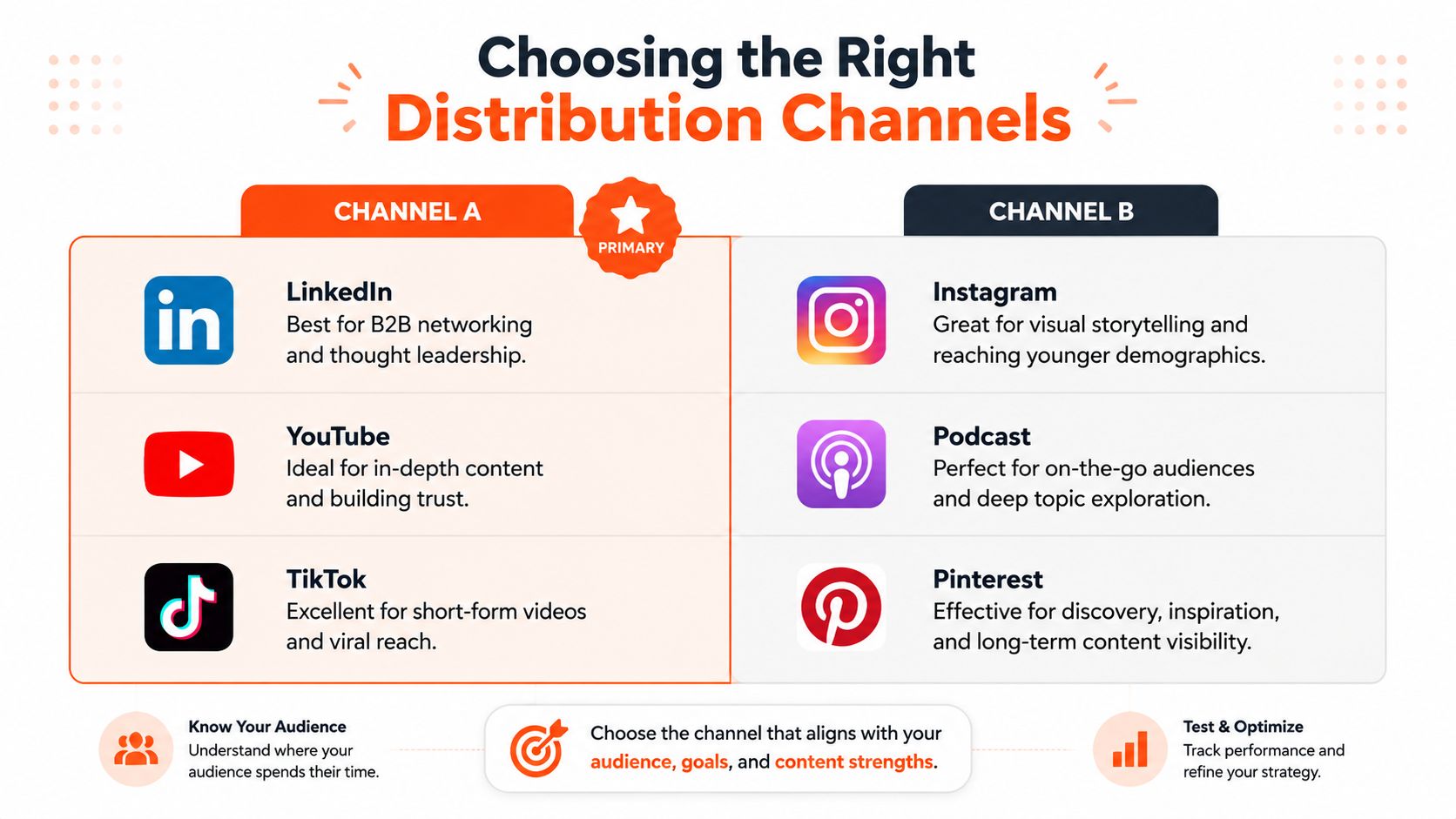
Choose two primary channels and one secondary channel, then get good at them. The brand that shows up consistently in fewer places usually beats the brand that posts everywhere but lands nowhere.
Measuring Brand Awareness Without Falling for Vanity Metrics
Impressions, likes, and follower growth are not brand awareness. They're signals that something happened, not proof that the audience remembers you, searches for you, or associates you with a category. If you build your reporting around vanity metrics, you'll keep rewarding reach that doesn't change behavior.
Measure the funnel, not just the feed
The cleaner approach is to track awareness as a progression. Start with a baseline, then look for movement in aided awareness, unaided awareness, branded search volume, direct traffic, and share of voice. The branded vs non branded search guide is a helpful companion if you want a clearer view of how branded demand differs from generic discovery.
A useful benchmark from a LinkedIn brand-awareness resource says aided awareness usually doesn't move materially until after 2 to 3 quarters of consistent spend, while unaided awareness often needs 4 to 8 quarters before a significant shift. That should reset your expectations fast. Awareness is slow, cumulative work.
Track the signals that show memory is forming
Use these signals as your core reporting layer.
| Signal | What it tells you |
|---|---|
| Aided awareness | People recognize you when prompted |
| Unaided awareness | People remember you without help |
| Branded search volume | People are looking for you directly |
| Direct traffic | People already know where to find you |
| Share of voice | Your visibility relative to competitors |
One peer-reviewed study found a statistically significant positive effect on brand awareness with a regression coefficient of 0.58 and p-value of 0.002, which is exactly the kind of evidence that content quality and distribution can move awareness when they're done with discipline.
Measure what changed in the audience's memory, not what got the easiest applause.
Don't confuse activity with impact
Likes are fine. Comments are better. Search growth and direct traffic are stronger. Survey data is better still when you can run it consistently. The job is to connect content exposure to recognition, then recognition to demand.
If you can't explain which signal moved and why, your reporting is too shallow. If your content is doing the work, the market should start acting like it knows you.
Your Brand Awareness Content Operating Rhythm
A brand awareness system works when the cadence is boring in the best possible way. Plan once, produce with intent, repurpose immediately, distribute across the right channels, and measure on a regular schedule. That rhythm matters more than any single post.
For solo creators, that usually means one planning session, one source asset, and several repurposed outputs each week. Small teams need a shared content calendar and a fixed distribution checklist so the work doesn't get lost between drafts and approvals. Agencies need a repeatable framework that keeps each client's voice distinct while making production and distribution easier to manage.
Keep the rhythm simple
- Weekly: review topics, publish the core asset, and push repurposed pieces into the primary channels.
- Monthly: review audience response, compare branded search and direct traffic trends, and refine the next batch of topics.
- Quarterly: assess whether the brand is getting more recognizable, not just more visible.
The checklist is straightforward. Pick one audience, anchor the work in one clear message, repurpose every major asset, distribute through a deliberate channel mix, and measure recognition signals instead of vanity metrics alone.
Brand awareness isn't built by one viral moment. It's built by showing up often enough, in enough useful forms, that the audience starts to remember your name without effort.
If you want to turn that rhythm into a repeatable system, WaveGen.ai gives you a way to repurpose one article, newsletter, or transcript into on-brand social assets without rebuilding the workflow every time. Visit it if you want to keep your content distribution consistent without adding more manual production to your week.
content marketing for brand awareness
brand awareness strategy
content repurposing
content distribution
measuring brand awareness
Turn this kind of writing into a week of social content.
Paste a blog post, newsletter, or rough draft — WaveGen turns it into publish-ready carousels, captions, and slideshows for every channel.
No credit card · First posts in 2min