July 7, 2026
13 min read
Social Media Content Pillars: A Guide to Smarter Strategy
Stop guessing what to post. Learn how to build social media content pillars that align with your brand, engage your audience, and streamline your workflow.

You open your content calendar on Monday and feel that familiar pressure. One post for LinkedIn, something shorter for Instagram, maybe a video clip for TikTok, and somehow it all needs to sound consistent, useful, and on brand.
By Wednesday, you're no longer asking what your audience needs. You're asking, "What can I post fast enough to stay visible?"
That's the trap. The issue isn't typically a lack of content creation, but rather a content structure problem. Without a clear framework, every post becomes a fresh decision, every platform feels separate, and every long-form piece you create gets repurposed in a rushed, inconsistent way.
Social media content pillars fix that. Not because they're trendy, but because they give your ideas a home. They help you choose what your brand should talk about repeatedly, what each theme is supposed to achieve, and how one strong source asset can turn into several posts without losing focus.
If you've been posting reactively, this is the shift that makes social content feel manageable again.
Table of Contents
- The End of Endless Content Panic
- What Are Social Media Content Pillars Really
- Why Your Strategy Needs Content Pillars
- How to Define and Prioritize Your Own Pillars
- From Pillars to Posts Real World Examples
- Measuring and Optimizing Your Pillar Performance
- Automate Your Pillar Strategy with Repurposing Tools
The End of Endless Content Panic
A junior marketer once showed me a spreadsheet with dozens of post ideas scattered across tabs. Product updates sat next to holiday memes. Customer quotes were mixed with webinar promos. Nothing was technically wrong with the ideas, but there was no organizing logic behind them.
So every week started from zero.
That's what endless content panic looks like in practice. You aren't short on ideas. You're short on decision rules. When there's no framework, every post competes with every other post, and the brand starts sounding like five different people taking turns at the keyboard.
You shouldn't have to reinvent your voice every time you publish.
Social media content pillars solve this by narrowing your focus before you create. Instead of asking, “What do we post today?” you ask, “Which pillar are we serving today?” That one shift reduces decision fatigue fast.
The relief is practical:
- Your calendar gets easier to fill: You rotate through a small set of themes instead of brainstorming from scratch.
- Your messaging gets clearer: Repetition helps audiences understand what you're known for.
- Repurposing gets simpler: One blog post, podcast, or newsletter can feed multiple social posts when you already know the themes you publish under.
If your current system depends on last-minute inspiration, it will keep producing last-minute content. A pillar-based system gives you a repeatable way to plan, publish, and repurpose without that daily scramble.
What Are Social Media Content Pillars Really
Social media content pillars are the core themes your brand returns to again and again. They are broad enough to support many post ideas, but specific enough to keep your messaging coherent.
Think of them like the structural pillars of a building. The roof is your overall strategy. The pillars carry that weight. If the supports are weak, random, or too numerous, the whole structure feels unstable.
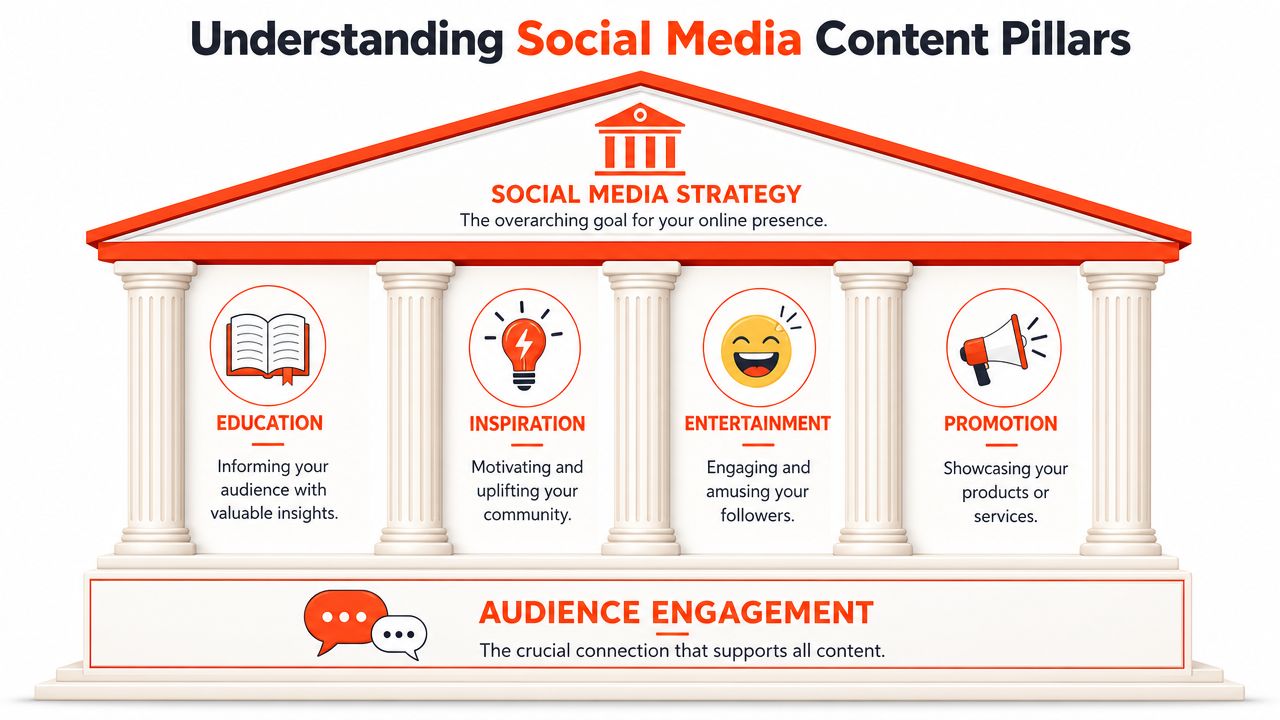
Think of pillars as load-bearing supports
A good pillar isn't just a topic you like. It's a strategic category tied to what your audience cares about and what your business needs to achieve.
Working definition: Social media content pillars are 3 to 5 recurring content categories that support your brand message, serve your audience, and guide what you create across platforms.
That range matters. Research summarized by Siteimprove's guide to content pillars notes that most successful brands use three to five content pillars, and 64% of consumers rate brands more highly when content aligns with their interests.
Common pillar types include educational, promotional, engaging, entertaining, community-oriented, inspirational, and authentic content. But those labels are just starting points. The primary job is choosing the few that fit your brand.
What pillars are not
People get tangled up here.
A pillar is not a specific post idea.
A pillar is not a format like Reel, carousel, or quote card.
A pillar is not a one-off campaign.
Here's the distinction:
- Pillar: Client education
- Topic: Three mistakes people make before hiring a consultant
- Format: LinkedIn carousel
Or:
- Pillar: Community stories
- Topic: A customer's first 30 days using your service
- Format: Short video
Once you see that separation, planning gets easier. Pillars define the lane. Topics fill the lane. Formats decide how the idea shows up.
A simple test helps. If you can create twenty different posts from it over time, it might be a pillar. If it only works once, it's probably a topic or campaign.
Why Your Strategy Needs Content Pillars
The initial adoption of pillars often stems from a desire for improved organization. That's a good start, but it undersells their value.
Pillars aren't just a planning device. They're a way to align content with business priorities, audience expectations, and day-to-day execution.

According to Sprout Social's content pillar guidance, pillars act as the strategic backbone of social media. The same source notes that 64% of consumers evaluate brands more positively when content matches their interests, and that fit is achieved by anchoring posts to 3 to 5 pillar themes that reflect core brand priorities.
They build trust through repetition
Audiences don't decide what your brand stands for because of one excellent post. They decide based on patterns.
If you repeatedly publish useful breakdowns, you become known for clarity. If you consistently share customer wins and practical guidance, people start to trust your point of view. Pillars create those patterns on purpose.
A pillar can also support a specific goal. Educational content can support lead generation. Community-focused content can support retention. Promotional content can support conversion, but it works better when it sits inside a broader mix instead of dominating the feed.
A strong social presence feels familiar before it feels persuasive.
They make content production less wasteful
Teams waste time when every post starts as a blank page. Pillars reduce that waste by giving creators a smaller, sharper decision set.
They also improve handoffs. A strategist can brief a designer more clearly. A writer knows the intent behind the post. A freelancer can create content that sounds like the brand instead of guessing.
You also get a better lens for measurement. Instead of asking whether social media is “working,” you can ask better questions. Which pillar drives clicks? Which one gets shares? Which one supports conversations in comments?
That's a much more useful system than judging isolated posts one by one.
How to Define and Prioritize Your Own Pillars
Most weak pillar strategies start with a list of generic categories copied from someone else's blog. Education. Inspiration. Behind the scenes. Promotion.
Those aren't wrong. They're just incomplete.
Your pillars should come from the intersection of audience demand, business goals, and content you can produce consistently. That's what makes them useful for both strategy and repurposing.
Start with audience signals
Begin by collecting evidence. Look at comments, sales calls, customer questions, email replies, top-performing posts, webinar Q&A, and search queries. You're looking for repeated needs, not isolated requests.
If you need a more structured method, this practical content gap analysis framework is useful for spotting where audience questions are underserved and where your existing content already has room to expand.
Ask questions like:
- What problems come up repeatedly? These often become educational pillars.
- What objections slow down decisions? These can become trust-building or proof-based pillars.
- What stories make people respond emotionally? Those often point to community, identity, or inspiration themes.
A quick audit of your existing channels also helps. If you already publish long-form content, look at your strongest assets and sort them by recurring purpose. For a planning workflow, this guide to how to plan social media content can help you translate those themes into a repeatable calendar.
Tie each theme to a business result
A pillar should do a job. If it doesn't, it turns into filler.
The strongest way to pressure-test a pillar is to finish this sentence: “This pillar exists to help our audience do X, so our business can achieve Y.”
Examples:
- Educational tutorials help prospects understand the problem, so your business can generate qualified interest.
- Client proof helps buyers trust your process, so your business can shorten hesitation.
- Community stories help customers feel seen, so your business can deepen loyalty.
Research referenced in Sprout Social's guidance shows that pillars explicitly aligned with business goals and audience personas can generate 25% higher click-through rates, and rotating through themes in a content calendar can boost engagement by 18% by reducing audience fatigue. Since that source already appeared earlier, I'm keeping the reference here qualitative in practice: alignment and rotation matter because they give each theme a clear purpose and keep your feed from feeling repetitive.
Choose the few that deserve a permanent place
Now narrow the list. Most brands brainstorm too many themes because everything feels important in the moment.
Use three filters:
- Relevance: Does the audience consistently care about it?
- Strategic value: Does it support a real business goal?
- Repeatability: Can your team create this kind of content every month without strain?
Practical rule: If a theme is interesting but hard to sustain, it's a campaign, not a pillar.
For many brands, the final set looks something like this:
- One trust pillar: Teaching, myth-busting, or expert guidance
- One proof pillar: Results, case-based insights, or customer stories
- One relationship pillar: Founder perspective, team moments, or community conversations
- One conversion pillar: Offers, services, launches, or invitations
- One optional reach pillar: Trends, commentary, or entertainment if it fits the brand
That's enough structure to guide creation without boxing you in.
From Pillars to Posts Real World Examples
A good pillar system should work whether you're a consultant, a product brand, or a solo creator. The categories will look different, but the logic stays the same.
The easiest way to understand this is to watch one pillar expand into multiple posts.
Example one for a B2B consultant
A leadership consultant might choose these pillars:
- Decision-making advice
- Client situations and lessons
- Workshop invitations
- Founder perspective
Take the first pillar, decision-making advice. One webinar on “how managers handle unclear priorities” can become a LinkedIn carousel with a step-by-step framework, a short video with one high-stakes mistake to avoid, and a text post with a strong opinion about delayed decisions.
That's not content duplication. It's structured reuse.
Example two for a wellness brand
A wellness brand might build around:
- Product education
- Daily habits
- Customer lifestyle stories
- Promotions and launches
Here, a pillar like daily habits can support gentle, recurring content that doesn't feel sales-heavy. A single blog article about morning routines can become a Reel, a checklist graphic, a founder caption, and a customer prompt.
If you're creating visual assets across several channels, tools focused on MyImageUpscaler for content creation can help keep image quality strong when you adapt graphics for different formats.
Example three for a solo creator
A newsletter writer or educator might choose:
- Teach one concept
- Break down one mistake
- Share one personal lesson
- Invite people deeper
This model works especially well for repurposing because every newsletter issue can feed all four pillars. If you want more ideas for the formats themselves, this breakdown of social media content types is a practical companion when you're translating a theme into platform-specific posts.
One strong pillar should produce many posts without feeling repetitive, because the angle, format, and audience need can change each time.
Here's a simple mapping template you can adapt.
| Content Pillar | Post Format | Post Idea | Primary KPI |
|---|---|---|---|
| Educational guidance | Carousel | 5-step explanation of a common problem | Clicks |
| Customer proof | Short video | Mini story showing a client challenge and takeaway | Shares |
| Community conversation | Text post | Ask followers how they handle a familiar issue | Comments |
| Promotion | Quote card | Clear statement about the value of your offer | Conversions |
The point isn't to force every pillar into every format. The point is to know that each pillar can generate multiple kinds of posts while still serving one strategic role.
Measuring and Optimizing Your Pillar Performance
Social content is often measured at the post level. That's useful, but it's not enough.
If one carousel performs well, was it the design, the hook, the topic, the platform, or the underlying pillar? Without tagging content by pillar, you can't answer that clearly.
Tag every post by pillar
In your scheduler, analytics tool, or spreadsheet, assign every post a pillar label. Keep it simple and consistent. Educational. Proof. Community. Promotion. Or whatever your actual categories are.
That step matters more than people think. Siteimprove's guidance notes that when posts are tagged by pillar, brands can identify top-performing themes with 95% accuracy, and that insight can support a 30% increase in content ROI by reallocating effort toward high-value pillars.
Once posts are tagged, your analysis becomes more strategic:
- Which pillar earns the most clicks?
- Which one drives comments or shares?
- Which pillar supports traffic or conversions more reliably?
Those answers tell you where to invest, not just what happened yesterday.
Know when to refine or retire a pillar
Not every pillar deserves permanent status.
A pillar may need adjustment if the audience response is weak, the theme overlaps too much with another category, or the team struggles to create fresh ideas inside it. Sometimes the problem isn't the pillar itself. It's the framing. “Company news” may underperform, while “what we're learning with clients” does much better because it's more audience-centered.
Audit pillars like product lines. Keep the ones that perform a clear job. Rework the ones that confuse people. Drop the ones that only exist out of habit.
Review your pillar performance regularly. Then make one of three decisions: double down, refine, or retire.
That turns pillars into a living system instead of a static worksheet.
Automate Your Pillar Strategy with Repurposing Tools
At this stage, pillar strategy becomes operational instead of theoretical.
Most guides stop after telling you to choose three to five themes. But that still leaves the hard part. How do you turn one article, podcast, webinar, or newsletter into a steady flow of platform-ready posts without rebuilding everything manually?
Data highlighted by Semrush's overview of content pillars says 82% of content teams now prioritize repurposing long-form content, while projection data in the same source says AI-driven distribution tools aligned with repurposing frameworks are expected to grow 40% in 2026.
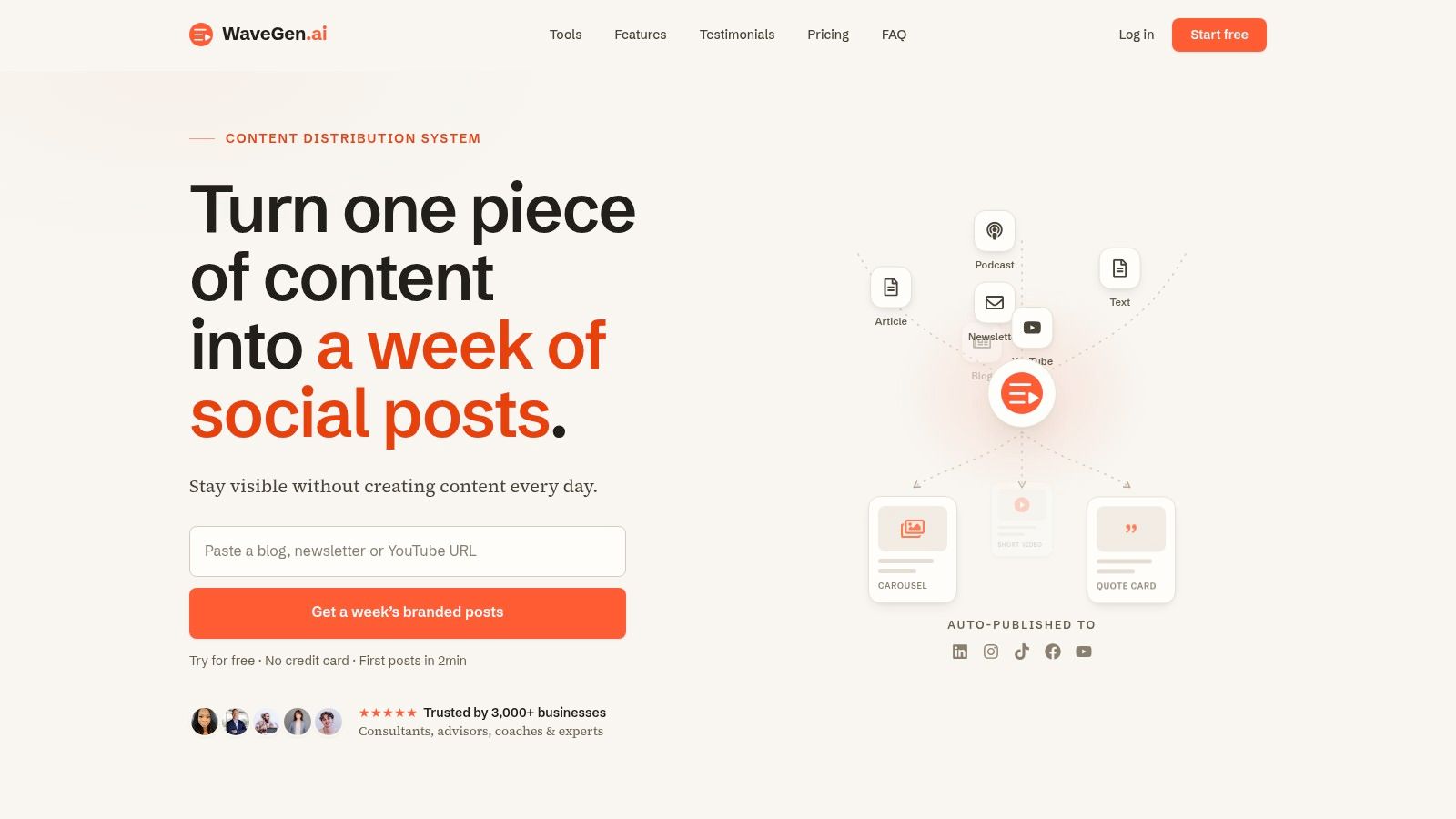
Build a repurposing workflow around source content
The simplest way to use pillars for repurposing is to map them back to your source material.
A newsletter issue might feed an educational pillar, a point-of-view pillar, and a promotional pillar. A podcast interview might feed a lesson pillar, a quote pillar, and a community conversation prompt. A blog post might produce a carousel, a short talking-head script, and a visual summary.
That's the missing layer many teams need. Instead of treating social as separate work, you treat it as structured output from your main ideas.
If you want a broader view of automated production workflows, RemotionAI's content automation guide is a helpful reference for thinking about systems rather than isolated assets.
You can also compare platforms designed for this workflow in WaveGen's roundup of best AI content repurposing tools.
A short demo makes the workflow easier to visualize:
When your pillars are clear, repurposing gets faster because the destination is already defined. You're not asking what to create. You're deciding how to express the same core idea across formats and platforms.
If you want a faster way to turn one article, podcast, newsletter, or transcript into a week of on-brand social content, WaveGen.ai is built for exactly that workflow. It helps you repurpose your own ideas into carousels, short videos, quote cards, captions, and platform-specific posts without starting from scratch each day.
social media content pillars
content strategy
social media marketing
content marketing
brand voice
Turn this kind of writing into a week of social content.
Paste a blog post, newsletter, or rough draft — WaveGen turns it into publish-ready carousels, captions, and slideshows for every channel.
No credit card · First posts in 2min