August 6, 2026
14 min read
Why Is Brand Consistency Important: 2026 Guide
Discover why is brand consistency important for building trust and boosting revenue, and how to keep every channel on-brand without slowing you down.
Brand consistency is one of the few marketing disciplines that shows up in both the revenue line and the trust signal. Lucidpress/Marq's brand consistency research, as summarized in independent industry analysis, links consistent branding to 10% to 33% revenue increases, with one widely cited figure showing up to a 23% revenue lift and 68% of companies saying consistency contributed directly to revenue growth (brand consistency statistics). That's why the core question isn't whether consistency matters, it's whether your system is designed to make it unavoidable.
The mistake many teams make is treating consistency as a visual polish issue. It isn't. It's a governance problem, a recognition problem, and, in practice, a buying-friction problem. When the same brand appears with the same logos, colors, typography, voice, and claims across channels, buyers process it faster and trust it more. When those signals drift, people spend energy figuring out whether they're dealing with the same company, and many move on.
Table of Contents
- What Brand Consistency Means
- How Consistency Builds Recognition, Trust, and Revenue
- When Consistency Hurts and What Should Flex
- Three Brand Consistency Stories Worth Studying
- The Five Building Blocks That Keep Every Channel On Brand
- How WaveGen.ai Operationalizes Brand Consistency
- KPIs That Prove Brand Consistency Is Working
- A 30-60-90 Day Plan to Lock In Consistency
What Brand Consistency Means
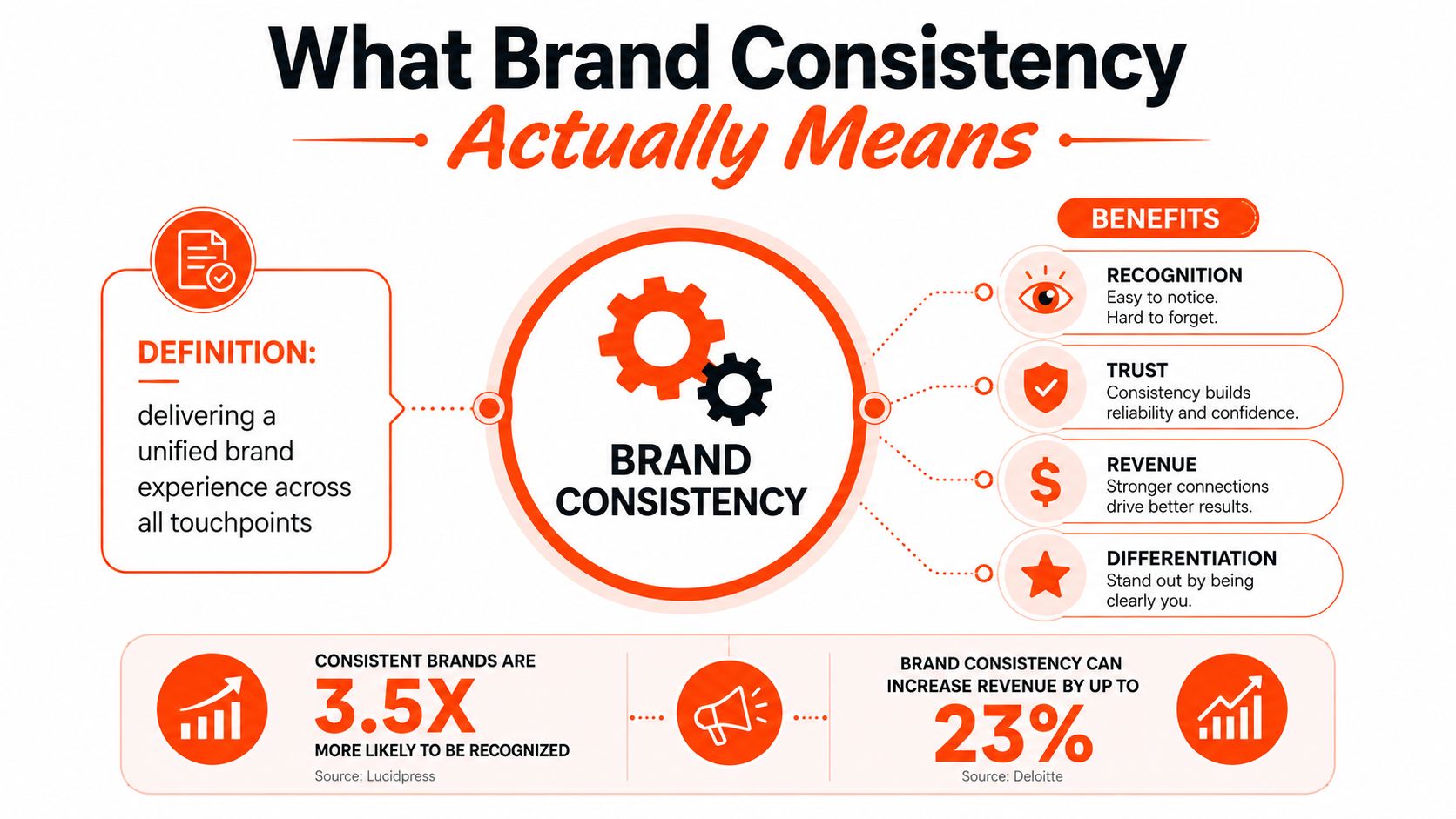
The strongest commercial case for consistency is already on the table, up to a 23% revenue lift in the brand consistency research stream, plus 68% of companies reporting that consistency contributed directly to revenue growth. The operational definition matters more than the headline number. Brand consistency is not “using the same template everywhere.” It is a system of fixed identity signals that stays recognizable across every touchpoint, and it works because buyers do not evaluate every interaction from scratch.
The Three Layers That Need Control
There are three layers I look for when auditing a messy brand.
Visual identity covers the core elements people notice first, logo treatment, core colors, typography, and imagery style. Verbal identity covers the voice, tone, and core claims that need to sound like the same company whether they appear in a carousel, an email, or a support reply. Operational identity is the part many teams ignore, which decides who can change what, who approves exceptions, and how assets move from draft to publish.
Practical rule: If a channel can change the format but not the identity, the brand gets stronger. If it changes both, recognition gets fragmented.
That distinction matters because businesses often confuse consistency with sameness. Sameness produces flat feeds and repetitive campaigns. Identity governance produces controlled variation, where the message shifts to fit the medium but the brand remains immediately recognizable. For anyone building out type rules, creating type guidelines for brands is one of the cleanest ways to formalize that layer, because typography is where visual discipline either holds or slips.
A useful internal reference point is voice and tone guidelines, because voice is what keeps your written output recognizable when the format changes. If the team cannot describe the voice in operational terms, consistency will always depend on memory.
How Consistency Builds Recognition, Trust, and Revenue
The mechanism is direct. Repetition makes a brand easier to recall, recall lowers hesitation, and lower hesitation makes conversion smoother. That sequence is why consistency shows up in both brand metrics and revenue behavior, not just in design reviews.
Recognition comes first
Compiled industry roundups report that consistently presented brands are 4 times more likely to be remembered by their target audience (brand consistency stats roundup). Memory is the first gate in almost every buying path. If buyers cannot recall you, they cannot search for you, recommend you, or recognize the offer when it appears again.
Recognition also changes how efficiently the market processes your message. A familiar logo, color system, and voice reduce the amount of decoding a buyer has to do before they understand who is speaking. That does not guarantee preference, but it does make attention cheaper to earn.
Trust follows recognition
Neustar's 2018 survey, as reported in independent coverage, found that more than 90% of consumers said consistent visual identity would increase loyalty, while 62% said consistency across devices and platforms adds to credibility. Trust does not come from consumers studying brand rules. It comes from repeated signals that the brand behaves the same way in different places, which makes it feel more settled and less risky.
That stability matters because inconsistency forces re-evaluation. If a landing page uses one visual system, the email uses another, and the support experience sounds like a different company, buyers have to decide again whether the brand is legitimate. Each extra decision adds friction.
Conversion improves when friction drops
The conversion effect is practical. A buyer who has seen the same identity across touchpoints spends less time asking, “Is this the same brand I saw earlier?” That question may be quiet, but it slows page-to-page movement, weakens message continuity, and can interrupt the decision before it is complete.
Operational discipline matters as much as visual discipline. The logo, color palette, and core claims should stay fixed, but the format can flex to fit the channel. Teams that use fix inconsistent Meta ad creatives usually find that the problem is not only visual drift, it is also message drift, where the hook sounds borrowed from somewhere else and the ad loses its native feel.
Lifetime value grows after the first purchase
After the first conversion, consistency keeps paying off because it makes the brand easier to re-enter. Customers who have already learned what the company stands for are more likely to come back, and they are more likely to recommend it because they can describe it without hesitation. That is a revenue effect, not just a brand effect.
The practical conclusion is simple. Keep the parts that carry identity fixed, voice, color, logo, and core claims, then let format, length, and platform-native tone adjust to the channel. Brands that do that build recognition without flattening performance.
Bottom line: Consistency works because it reduces the number of judgments a customer has to make before they feel confident enough to buy.
When Consistency Hurts and What Should Flex
Most advice stops at “be consistent,” which is where teams get stuck. They treat consistency as identical output everywhere, then wonder why performance drops when a channel rewards native behavior instead of repetition.
Fixed identity, flexible execution
The parts that should stay fixed are the ones that anchor recognition: logo, core palette, typeface, voice, and the claims the market should associate with you. The parts that should flex are format, length, hook style, cadence, and the degree of platform-native tone. A TikTok script and a LinkedIn post do not need to read the same way to feel like the same brand.
Channel context changes the job of the asset. On TikTok, execution usually needs to be faster, looser, and more immediate. On LinkedIn, the same brand may need more context, stronger structure, and a more professional pace. A newsletter can carry more depth, while a YouTube short may depend on a tighter opening and a sharper visual rhythm. If those differences are ignored, the brand looks forced, not consistent.
For paid social teams, a practical resource on fixing inconsistent Meta ad creatives helps separate messaging drift from creative drift. That distinction matters because an ad can be visually on-brand and still underperform if the hook language sounds imported from a different channel.
Controlled variation is the point
The best distribution systems enforce the rules that matter and loosen the ones that do not. They lock identity, then let format respond to channel behavior. That balance is what modern brands need.
If every asset is identical, the brand may look disciplined but perform poorly in feeds that reward native style. If every asset is reinvented, the brand may feel fresh but become hard to remember. The middle path is controlled variation, the same identity, adapted execution.
Three Brand Consistency Stories Worth Studying
The cleanest way to understand consistency is to watch what happens when brands either protect it or lose it. The pattern shows up across categories, consumer products, SaaS, and service businesses.
A disciplined identity that compounds
One consumer label I reviewed kept the same core color system, logo treatment, and voice across packaging, paid social, and email. The design wasn't flashy, but it was unmistakable. Over time, each new campaign looked like another chapter of the same brand rather than a reset, which made the earlier work carry forward instead of being replaced.
That kind of discipline compounds because every impression reinforces the last one. It's the same logic behind the recognition numbers noted earlier, repeated exposure makes retrieval easier, and easier retrieval makes the brand feel more established.
A visible reset that recovered trust
I've also seen brands recover after a public identity cleanup, usually because the old system had become visually inconsistent and the market had stopped trusting what it was seeing. The recovery rarely starts with a clever campaign. It starts with fewer mismatched assets, cleaner templates, and a more coherent voice across owned channels.
The lesson is not that a reset is cheap. It isn't. The lesson is that trust can be rebuilt when the company stops forcing people to translate between versions of itself.
A fragmented brand that lost the category thread
The most painful failures are the quiet ones. A brand can have a decent product and still lose positioning because social, web, and packaging each tell a slightly different story. Customers don't always complain. They just stop recognizing the brand when it enters a new category or launches a new offer.
That's why fragmentation is so dangerous. It doesn't always look like a crisis. It looks like weak recall, softer conversion, and more work needed to explain the same offer over and over.
The Five Building Blocks That Keep Every Channel On Brand
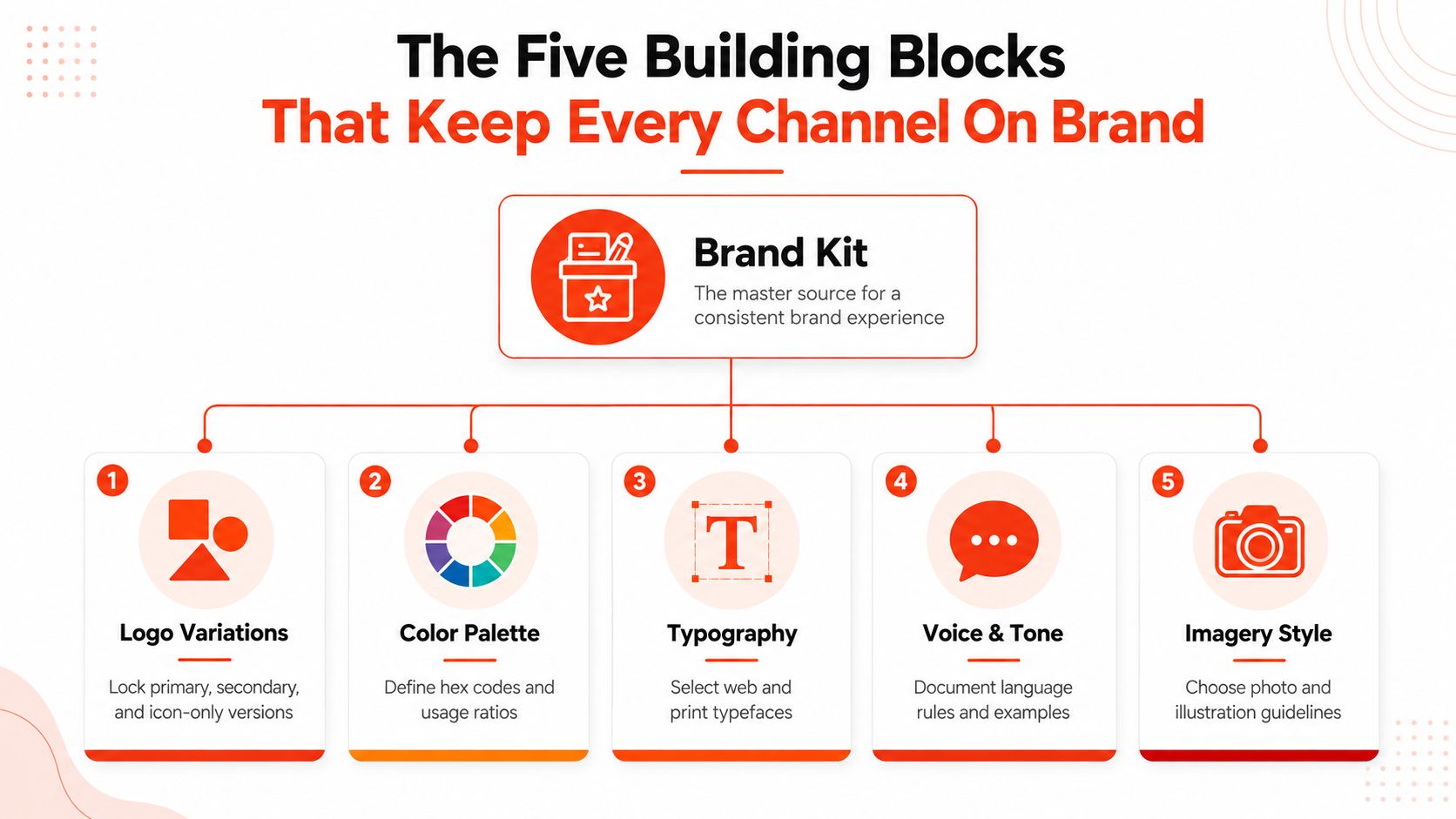
A brand system becomes usable only when it is built into the work itself. Guidelines alone don't prevent drift. People need locked assets, clear permissions, and a workflow that makes the right choice the easy choice.
Start with the brand kit
The brand kit should hold the locked versions of your colors, fonts, logo variants, imagery direction, and voice rules. If those basics live in scattered decks and old folders, inconsistency is inevitable. A central brand kit makes the approved version easier to find than the improvised one.
Build templates for recurring formats
Recurring content should not be redesigned from scratch every time. Carousels, quote cards, newsletters, blog headers, and short-video covers all need templates so the same decisions are not reopened for every publish cycle. That saves creative energy for the parts that need judgment.
Set governance before volume rises
Governance answers who can approve, who can override, and what counts as off-brand. Without that, the brand becomes a popularity contest, and every department thinks its exception is harmless. Clear decision rights prevent argument from turning into asset drift.
Make the workflow do the enforcement
When source content moves from draft to approved asset to published post without a controlled handoff, identity drift creeps in. Workflow matters because it determines whether people are forced to rebuild from memory. A clean process reduces rework, especially when multiple channels need the same message in different formats.
Use tooling to remove memory from the equation
The best systems don't rely on employees remembering the rules. They surface the right templates, assets, and approvals inside the tools people already use. If you want a more formal starting point, how to create brand guidelines is a useful reference for turning standards into something a team can follow.
When the brand kit, templates, governance, workflow, and tooling all point in the same direction, consistency stops being a discipline problem and starts becoming a system property.
How WaveGen.ai Operationalizes Brand Consistency
WaveGen.ai is built around a simple operational idea, set the brand kit once, then reuse it across the content pipeline. That means colors, fonts, logo, and voice stay stable while a single article, newsletter, podcast script, or YouTube transcript can be repurposed into a week of on-brand social content.
The output isn't limited to one format. It can generate carousels, short videos, quote cards, and captions with hashtags and platform-specific formatting, then let a user fine-tune the last mile in a visual editor before publishing to Instagram, TikTok, LinkedIn, YouTube, and Facebook. It also includes an autopilot mode that monitors RSS feeds, which matters because consistency usually breaks when publishing depends on manual resets.
A helpful comparison is how Exerta helps automate workflows, because consistency improves when repetitive handoffs are automated instead of managed ad hoc. In this context, the right KPIs are not vanity engagement spikes. The better signals are aided recall, asset reuse rate, approval cycle time, and branded search lift. Those tell you whether the brand system is getting easier to use and easier to remember.
WaveGen.ai's digital asset library is relevant here because brand consistency depends on where approved assets live and how quickly people can retrieve them. If the system shortens time from source content to publishable output without altering the brand kit, it's serving the consistency goal rather than fighting it.
KPIs That Prove Brand Consistency Is Working
A lot of teams measure consistency with the wrong numbers. Likes and impressions tell you that a post reached people, not that the brand identity landed or that the system is getting healthier. The right KPIs track recognition, internal efficiency, and repeat behavior.
| KPI | Stage | What it tells you |
|---|---|---|
| Branded search lift | Recognition | More people are typing your name directly, which suggests recall is accumulating. |
| Aided recall | Recognition | People recognize the brand when prompted, which shows the identity is sticking. |
| Unaided recall | Recognition | People remember the brand without prompts, which signals stronger mental availability. |
| Asset reuse rate | Operations | Teams are actually using approved templates and assets instead of recreating them. |
| Approval cycle time | Operations | The brand system is fast enough to support real publishing tempo. |
| Repeat purchase rate | Revenue | Customers are coming back because the brand stayed clear and reliable. |
| Referral rate | Revenue | Existing customers are confident enough in the brand to recommend it. |
How to read the numbers
If branded search is rising while approval cycles are getting shorter, the system is doing its job. If recall is flat and the team keeps rebuilding assets from scratch, the brand kit exists on paper but not in practice. If repeat purchases improve but asset reuse doesn't, you may have a strong product signal but a weak internal process.
For a solo creator or a small team, the first 30 days should focus on getting a baseline, not perfection. Measure what people can find, what they use, and how long approvals take. Those three readings tell you whether consistency is being enforced or merely discussed.
Practical rule: Celebrate when the brand becomes easier to apply and easier to remember. Intervene when the team keeps inventing new versions of the same asset.
A 30-60-90 Day Plan to Lock In Consistency
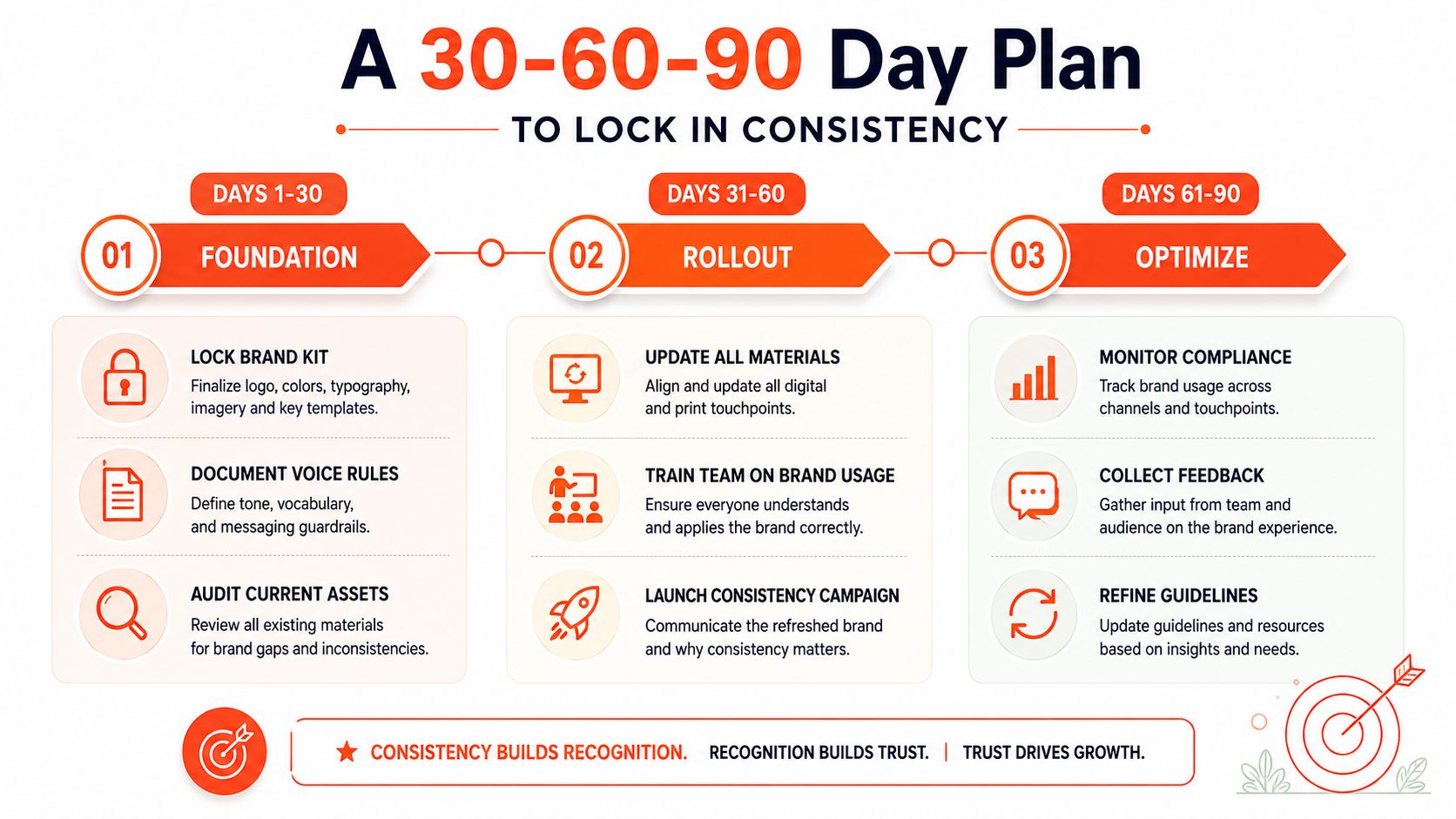
The fastest way to make consistency real is to turn it into a rollout, not a vague initiative. Start with the assets that create the most visible drift, then make the system easier to use than improvisation.
Days 1 to 30
Lock the brand kit, document voice rules, and audit current assets for drift. Pull out the most obviously inconsistent posts, pages, and templates, then decide which elements are essential and which need cleanup. This stage is about creating one source of truth.
Days 31 to 60
Build the recurring templates, assign approval ownership, and run the next round of content through the new process once. If people are still making exceptions casually, the governance rules aren't clear enough. If the team is moving faster, the system is starting to work.
Days 61 to 90
Turn on the distribution tooling, publish on a consistent cadence, and read the KPIs from the previous section. Watch for reuse, cycle time, and branded search behavior. Those signals will tell you whether consistency is becoming structural.
The single decision to make today is simple. Pick the channel where inconsistency is most visible, then fix that channel first. Once one surface is clean and repeatable, the rest of the system becomes easier to standardize.
If you want to turn one piece of source content into a repeatable, on-brand distribution system, visit WaveGen.ai and see how the brand kit, content repurposing, and publishing workflow fit together. It's built for teams that need consistency without rebuilding every asset by hand.
brand consistency
brand recognition
brand trust
brand strategy
content distribution
Turn this kind of writing into a week of social content.
Paste a blog post, newsletter, or rough draft — WaveGen turns it into publish-ready carousels, captions, and slideshows for every channel.
No credit card · First posts in 2min