August 23, 2026
16 min read
Consultant Personal Branding: A Tactical Playbook for 2026
Master consultant personal branding with a step-by-step playbook covering niche positioning, content pillars, repurposing systems, and multi-channel
Posting more often on LinkedIn won't automatically produce more consulting clients. It may increase visibility, but visibility is only useful when the people evaluating a purchase can turn what they see into a defensible internal decision.
That distinction changes the entire approach to consultant personal branding. Your public profile must help an executive sponsor understand your point of view, while giving finance, legal, procurement, compliance, and operations enough confidence to keep you in the conversation. Thought leadership becomes more than a publishing habit. It becomes a deal-enablement asset, something a buyer can forward internally when your name is being assessed.
Table of Contents
- Why Most Consultant Brands Fail to Convert
- Defining Your Niche and Market Positioning
- Crafting Signature Messaging and Content Pillars
- Building a Repeatable Content Creation and Repurposing System
- Multi-Channel Distribution Strategies for Maximum Reach
- Measuring What Matters Beyond Vanity Metrics
- Your 90-Day Implementation Roadmap
Why Most Consultant Brands Fail to Convert
The popular playbook is simple: optimize your profile, post frequently, comment on large accounts, and wait for inbound leads. The problem is that this system treats a complex B2B purchase like an audience-building contest. A consultant can receive attention from peers and still provide very little evidence that a serious buyer can use during evaluation.
Research cited in LinkedIn-related consultant guidance says 80% of B2B decision-makers research potential advisors before hiring (Consult Suite Pro explains the personal-branding implications). That research often happens before a discovery call, and it rarely involves only the person who first contacts you. A sponsor may like your perspective, then pass your profile, articles, and case material to procurement or a finance leader who has different questions.
Visibility is not the same as buying confidence
The executive sponsor wants to know whether you understand the strategic problem. Finance wants a credible commercial rationale. Legal wants boundaries, responsibilities, confidentiality, and manageable exposure. Procurement wants a clear scope and a provider who can fit the buying process. Operations wants to know whether your recommendations can work in practice.
A post designed only to attract likes usually answers none of these questions. It may sound authoritative, but it doesn't show how you make decisions, handle constraints, document assumptions, or reduce delivery risk.
Practical rule: Publish material that a champion can reuse in an internal meeting without adding an explanation of what you actually mean.
The 2025 Edelman-LinkedIn report says 73% of B2B decision-makers consider thought leadership a more trustworthy basis for assessing vendor capabilities than marketing materials or product sheets, while 90% are more receptive to outreach from organizations that consistently produce it (Edelman-LinkedIn B2B Thought Leadership Impact Report). Those figures support a useful commercial sequence: demonstrate judgment first, initiate contact second, and pitch only after the buyer has a reason to trust your thinking.
The quality threshold matters. The same report found that only 15% of surveyed decision-makers rated the thought leadership they read as very good or excellent. Most consultant content fails because it repeats safe advice, hides the reasoning, or offers conclusions without usable proof.
Build assets that survive internal review
A practical lead-generation system still matters, particularly once your positioning is clear. The consultant lead generation playbook is useful for connecting authority-building with active prospecting instead of treating content as a substitute for direct commercial work.
Your brand should leave behind assets such as:
- Decision frameworks: Explain how a buyer should evaluate options, including trade-offs and conditions.
- Risk notes: Address implementation, governance, adoption, and accountability concerns before a buyer raises them.
- Evidence pages: Show the type of work you do, the problems you solve, and the boundaries of your expertise.
- Useful diagnostics: Give a buyer language for describing the problem internally.
Use conversion rate improvement guidance to examine the path from profile visit to qualified conversation, but don't reduce the exercise to page mechanics. A stronger call to action can't rescue content that leaves hidden buyers uncertain about your competence.
Defining Your Niche and Market Positioning
Broad expertise is reassuring to the consultant and confusing to the buyer. “I help businesses improve strategy, operations, and growth” gives an executive no clear reason to choose you, and it gives procurement no precise category for your engagement.
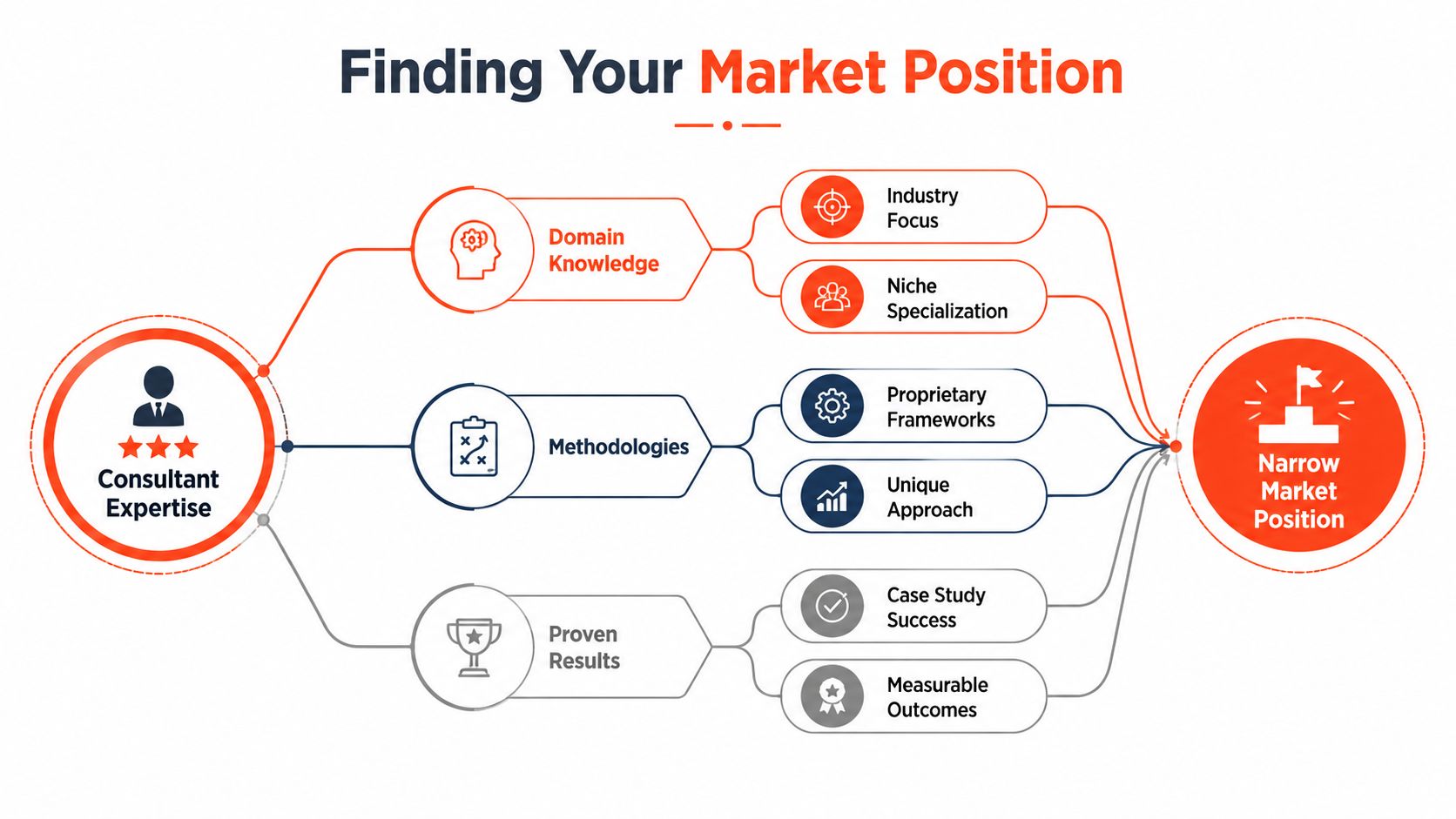
A durable position sits at the intersection of deep capability, urgent buyer pain, and a defensible point of difference. Start by listing the work you can credibly perform, then remove anything that doesn't connect to a recognizable business problem. The aim isn't to make your identity smaller. It's to make your relevance easier to verify.
Use the narrowing exercise
Write three lists:
- Problems you understand. Include recurring situations, not vague industries. “Fragmented post-merger operating processes” is stronger than “business transformation.”
- Buyers who feel the consequences. Identify the executive sponsor and the people who can delay or reject the purchase.
- Proof you can discuss responsibly. Include methods, deliverables, decisions, and lessons. Don't imply results you can't substantiate.
Now combine the lists into a positioning statement:
I help [specific buyer] resolve [specific problem] through [distinctive approach], so they can [business or operational outcome] with less [relevant risk].
A strategy consultant might move from “I advise leadership teams” to “I help heads of product resolve portfolio decisions when growth has created competing priorities.” A technology consultant might narrow “I implement systems” to “I help regulated teams prepare operational controls before a major data-platform rollout.” An operations consultant might focus on “helping multi-site service businesses standardize handoffs without slowing local delivery.”
These examples work because they give hidden buyers something concrete. Legal can ask what information the work requires. Finance can understand what decision the engagement supports. Procurement can classify the service. Operations can recognize the workflow affected.
Validate the position before publishing it
Don't rely only on personal preference. Review job postings, public RFP language, industry forums, conference agendas, and questions prospects ask during calls. Look for repeated wording around urgency, accountability, stalled initiatives, or failed handoffs. Then test your statement in conversations with people who match the buying environment.
Your content should make the position more specific over time. Track which questions generate thoughtful responses, which topics appear in sales calls, and which objections recur during proposals. A niche isn't a permanent label. It's a working hypothesis that becomes sharper as you collect evidence.
For additional outbound reach after the message is clear, DMpro's approach to scalable leads on Twitter can complement, rather than replace, a focused positioning system. Distribution can't compensate for a category that buyers don't understand.
For a deeper treatment of how expertise becomes a memorable market position, see this guide to thought leadership positioning. The practical test is straightforward: can the right buyer describe what you do to another stakeholder without resorting to generic language?
Crafting Signature Messaging and Content Pillars
A consultant's messaging should mirror the questions that appear throughout a buying cycle. The executive sponsor asks, “What should we do?” Finance asks, “Why is this worth funding?” Procurement asks, “What exactly are we buying?” Legal asks, “What could go wrong?” The delivery team asks, “How will this work in our environment?”
Build three to five content pillars, but define each pillar as a buyer problem rather than a subject area. “Leadership” is a topic. “How leadership teams make portfolio choices when every initiative claims priority” is a useful editorial territory.
Give every pillar a job
A strong pillar usually includes four layers:
- A point of view: What do you believe that changes how a buyer sees the problem?
- A decision aid: What framework, checklist, or diagnostic can someone use?
- A delivery explanation: What happens after the buyer agrees to proceed?
- A risk response: What concern might finance, legal, procurement, or operations raise?
For example, a cybersecurity consultant might use “security readiness before acquisition” as a pillar. The executive-facing post explains why technical debt affects deal confidence. A procurement-facing asset clarifies the scope of assessment. An operations piece shows how findings become an action backlog. A legal-facing note explains how access, confidentiality, and evidence handling are bounded.
The content doesn't need to reveal confidential client information. It needs to reveal how you think. Replace unsupported claims with decision logic, anonymized patterns, public evidence, and clearly labeled professional judgment.
Create signature frameworks without disguising common sense
A named framework can help people remember your approach, but naming a basic list doesn't make it proprietary. A credible signature model has a defined use case, a sequence, and a reason each step matters. It should help the buyer make a better decision even before they hire you.
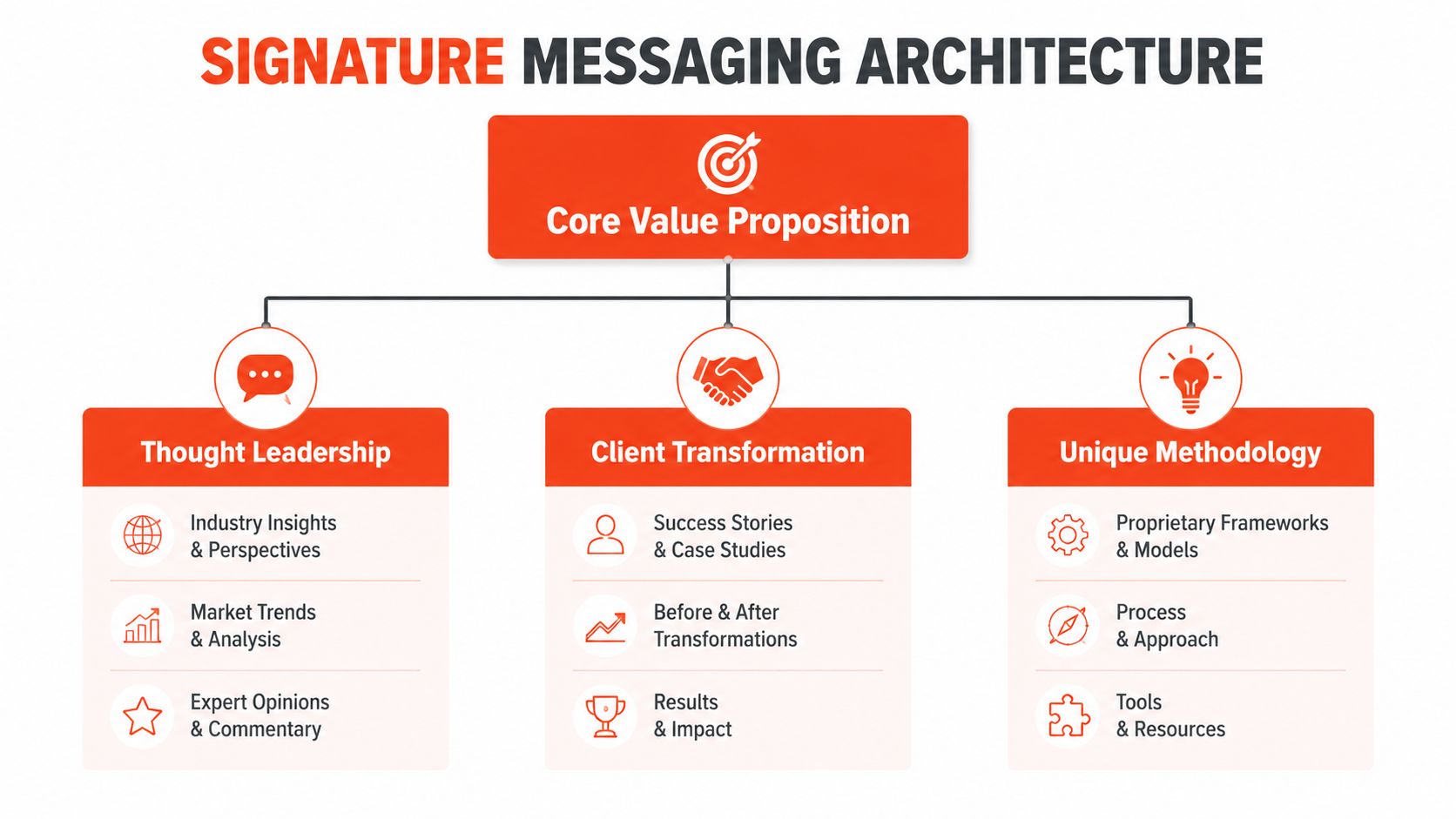
Use a message hierarchy:
- Core value: The business problem you solve.
- Thought leadership: The belief or interpretation that differentiates you.
- Client transformation: The change your work is designed to enable.
- Methodology: The process that makes the promise credible.
The hierarchy keeps your content from drifting into unrelated advice. It also gives internal champions language they can reuse. A sponsor can forward the strategic argument, while procurement can attach the methodology to a scope discussion.
The 2025 research found that 60% of B2B decision-makers and C-suite executives say strong thought leadership makes them willing to pay a premium, and 52% of decision-makers and 54% of C-suite executives spend at least one hour per week reading it (the commercial case for measured thought leadership). That doesn't mean every post should sell. It means substantive content can influence perceived value when it helps buyers interpret a consequential problem.
Use this brand voice guidelines template to document tone, claims you can make, words you avoid, and the level of evidence required for each pillar.
A short video can demonstrate the same architecture in action:
Building a Repeatable Content Creation and Repurposing System
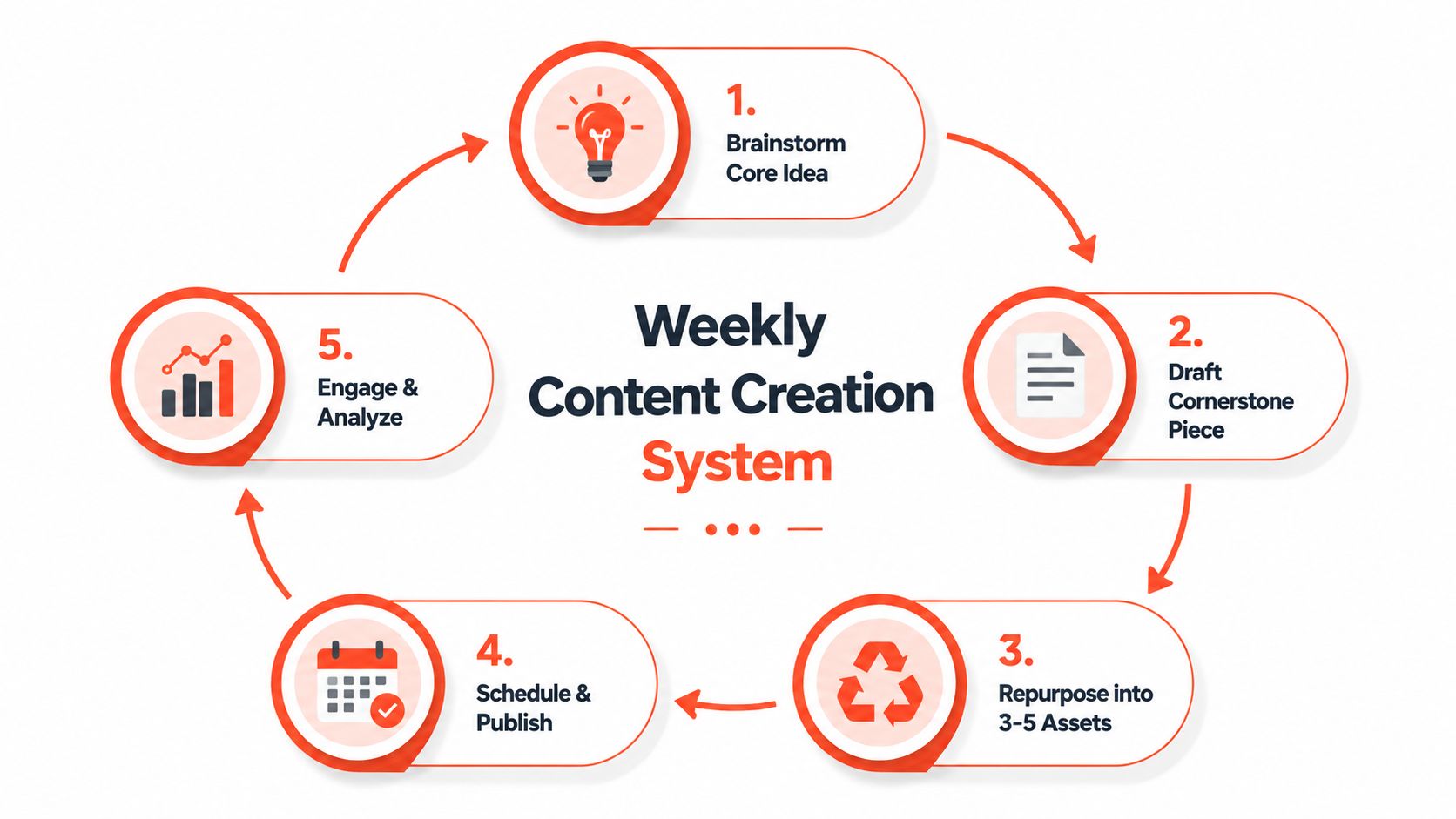
The sustainable unit of content isn't the daily post. It's the source idea. Start with one meaningful question from a client call, proposal, workshop, or delivery challenge. Develop that question into a cornerstone piece, then extract smaller assets that each serve a specific buyer or stage of consideration.
Use a weekly production loop
Start with the buyer question. Write the question exactly as a client might ask it. “Why did our transformation program lose momentum?” is more useful than “transformation insights.”
Draft the cornerstone. Create a substantial article, newsletter, podcast script, or video outline. Include the context, your diagnosis, the decision criteria, the trade-offs, and a practical next action. Keep a record of sources and distinguish facts from your own judgment.
Extract platform-native assets. Turn the source into a LinkedIn text post, a carousel outline, a short video script, a newsletter section, and a quote card. Each version should stand alone. Don't paste the article into every channel and call that repurposing.
Schedule the distribution. Put the source and derivative assets into an editorial calendar. Mark the intended audience, pillar, funnel stage, proof type, and call to action. Schedule enough space for replies and follow-up rather than filling every available slot.
Review the response. Save meaningful questions, objections, profile visits, direct messages, and qualified inquiries. Those signals should shape the next source idea.
Protect quality during batching
Batching only works when review is built into the workflow. Before publishing, check each asset against four questions:
- Is the claim supportable? Remove inflated outcomes and vague authority language.
- Does the asset show judgment? Add a trade-off, boundary, or example.
- Can a hidden buyer use it? Include an implication for risk, budget, governance, or implementation.
- Does the next step fit? Invite a diagnostic conversation when the reader needs help, not when the post merely earned attention.
Tools such as a document editor, a scheduling platform, a transcript cleaner, and a design system can handle different parts of the process. WaveGen.ai turns a long-form article, newsletter, podcast script, or YouTube transcript into formats such as carousels, short videos, quote cards, and captions, while saved brand settings keep colors, fonts, logos, and voice consistent. Review the generated copy manually, especially where a consultant's credibility depends on nuance.
The system should reduce repeated production work, not remove professional judgment. If a tool makes every idea sound interchangeable, it has increased output while weakening the brand.
Multi-Channel Distribution Strategies for Maximum Reach
Reach is a weak objective if legal, finance, or procurement cannot use the material during review. Select channels according to buyer behavior, content fit, ownership, and effort, then build each asset so an internal champion can forward it without adding context.
LinkedIn remains a practical discovery layer because professional identity and publishing sit close together. LinkedIn launched in 2003, surpassed 100 million members in 2011, and reached 1 billion members by 2023, according to consultant-branding background cited by Blueberry Media. That history helps explain why a consultant's profile can function as a discovery surface, but visibility alone does not clear an internal risk review.
A Social Media Today analysis places personal profiles at roughly 62% of what users see, compared with about 5% for company pages. Separately, Consult Suite Pro's LinkedIn consultant-branding analysis reports personal content engagement near 4.7%, versus about 1% to 2% for pages. These are source-specific benchmarks, not forecasts. Publish from the person whose judgment buyers are assessing, then use the company page to reinforce credentials, governance, and continuity.
Match the format to the channel
On LinkedIn, lead with a defined problem, show the reasoning, and close with a question that invites professional discussion. A carousel can turn a framework into a document a champion forwards to colleagues. A long-form newsletter or article gives legal and procurement stakeholders enough substance to assess assumptions, limitations, and implementation implications.
YouTube suits expertise that requires explanation. Demonstrate a diagnostic, walk through a decision, or answer a complex objection. Instagram supports diagrams, workshop moments, and concise ideas, but connect those posts to a deeper asset. Email newsletters provide owned distribution and a calmer setting for sustained arguments, follow-up, and calls to action.
| Channel | Audience Quality | Content Lifespan | Production Effort | Best For |
|---|---|---|---|---|
| Strong professional discovery | Feed-dependent, with profile archive value | Moderate | Executive viewpoints, frameworks, conversations | |
| YouTube | High intent when the topic is specific | Durable through search and recommendations | High | Demonstrations, explainers, recorded briefings |
| Useful for visual recognition and accessibility | Feed and format dependent | Moderate | Diagrams, short insights, behind-the-scenes context | |
| Email newsletter | Direct relationship with opted-in readers | Controlled by your archive and list | Moderate | Detailed analysis, nurturing, invitations |
Keep the thesis consistent across channels, while changing the opening, length, visual treatment, and call to action. A procurement checklist might become a LinkedIn document, a newsletter section, and a short video. Each version should help the reader answer a different internal question, such as whether the recommendation is governed, affordable, or practical to implement. The strongest distribution system produces material that travels inside the buying committee, not merely content that collects public reactions.
Measuring What Matters Beyond Vanity Metrics
Likes and follower counts can indicate attention, but they rarely tell you whether a buyer is moving closer to a conversation. A consultant needs a measurement system that connects public activity to commercial intent without pretending that every inquiry came from one post.
Use three tiers.
Awareness signals
Track profile visits, reach, search appearances where available, and the topics attached to the content that earns attention. These figures help you see whether the market is finding the position you intended to communicate. They don't prove demand.
Consideration signals
Record meaningful comments, direct messages, newsletter subscriptions, replies, content forwards, and requests for a diagnostic conversation. A message such as “Can we discuss this?” is more useful than a large volume of low-context reactions because it creates an opportunity to qualify the problem.
Pipeline signals
Track discovery call requests, proposal invitations, introductions, procurement questions, and opportunities where a buyer references a specific framework or article. Ask every qualified lead how they found you and store the answer in a simple spreadsheet or CRM field.
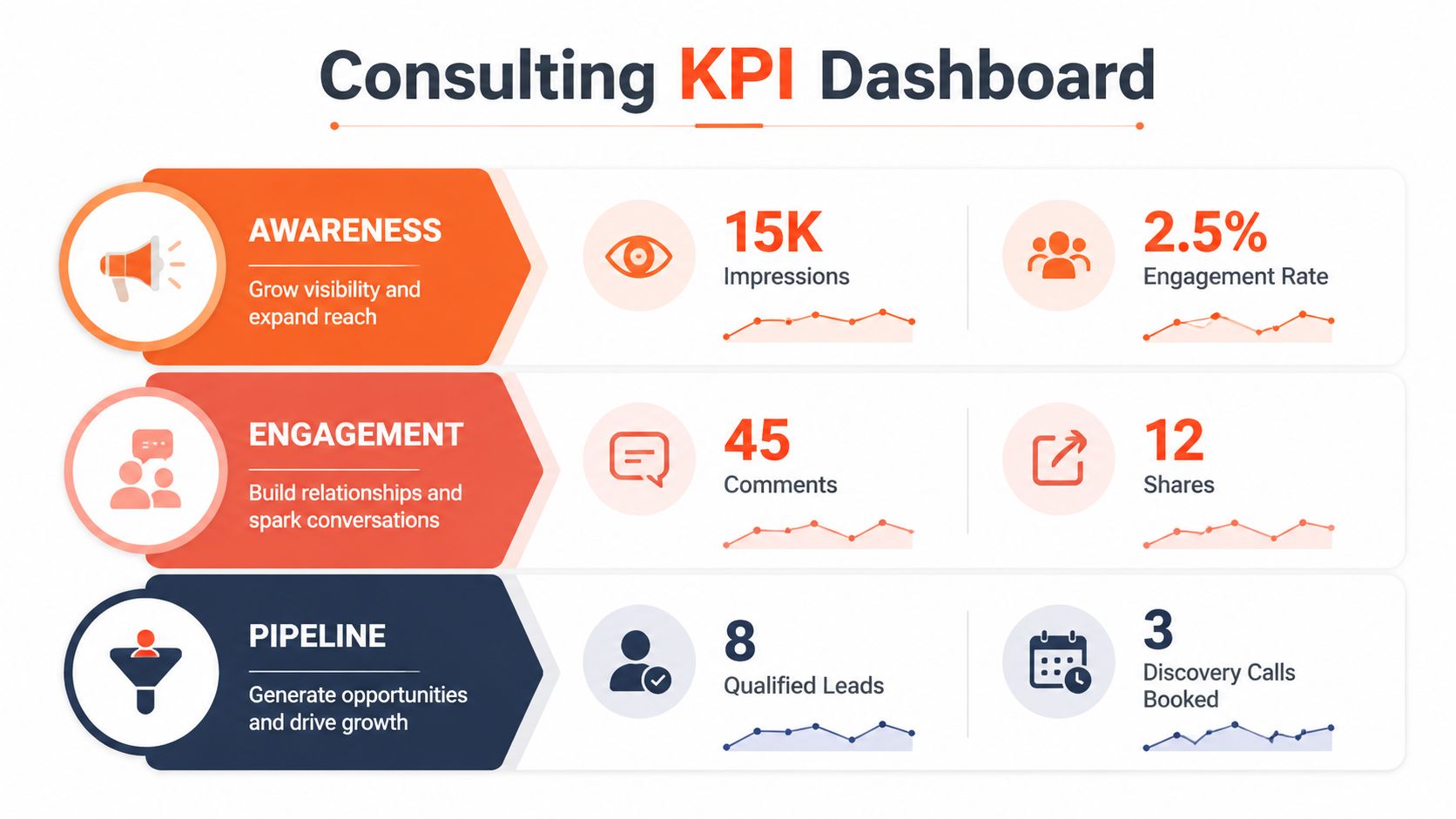
The research cited in the 2025 thought-leadership report adds commercial context. 49% of executives use thought leadership to reduce the risk of making poor decisions, and 66% of buyers wouldn't engage with a provider whose thought leadership is weak (the hidden commercial impact of thought leadership). Treat those findings as a reason to measure decision utility, not as a reason to chase engagement for its own sake.
Review the system at two speeds. Each week, note which topics created qualified conversations and which stakeholder appeared interested. Each month, inspect the path from first touch to proposal, including the assets a buyer shared internally. Don't discard a strong topic because it didn't create an immediate lead. Consulting decisions often require repeated exposure, and an article may assist a later conversation without receiving visible credit.
A useful dashboard has one row per asset and columns for pillar, audience, format, distribution channel, replies, profile visits, qualified conversations, and pipeline notes. Keep the definitions consistent. If you change what counts as a qualified lead halfway through the review period, the comparison becomes less useful.
Your 90-Day Implementation Roadmap
A practical rollout begins with restraint. During the first month, choose one market problem, write the positioning statement, complete the profile, and define the stakeholders who can approve, delay, or veto an engagement. Create the first cornerstone piece around a real buyer question, not a broad introduction to your services.
In the second month, turn that source material into your repeatable system. Build the editorial calendar, create the three to five pillars, prepare a small library of calls to action, and establish a review checklist for evidence, confidentiality, and risk language. Publish consistently enough to create a recognizable trail, but keep the cadence sustainable.
Month three turns output into evidence
Use the third month to study response quality. Which topics attract executive questions? Which assets do prospects forward? Do inquiries mention implementation, pricing, governance, or outcomes? Those details reveal whether your brand is reaching only the visible sponsor or also helping the hidden buying committee.
A representative weekly rhythm might look like this:
- Monday: Choose one client question and gather supporting evidence.
- Tuesday: Draft the cornerstone piece and identify its decision point.
- Wednesday: Extract the carousel, short script, newsletter passage, and proof-oriented post.
- Thursday: Review claims, confidentiality, and stakeholder relevance.
- Friday: Publish, respond to useful comments, and log commercial signals.
Low early engagement isn't proof that the position is wrong. Check whether the message is specific, whether the profile makes the next step clear, and whether the content addresses a risk someone inside the buying committee feels. If production feels awkward, use a smaller format, such as a concise diagnostic or annotated checklist, and improve through repetition.
By the end of the period, you should have a defined market position, a body of evidence-led content, a documented production workflow, and a record of which ideas create qualified conversations. That is a stronger outcome than a large follower count with no internal champion willing to defend your appointment.
WaveGen.ai helps consultants turn one article, newsletter, podcast script, or YouTube transcript into on-brand carousels, short videos, quote cards, and platform-specific captions, with reusable brand settings and scheduling tools for consistent distribution. Visit WaveGen.ai to see how you can build a repeatable content pipeline that gives both visible sponsors and hidden buyers clearer evidence of your expertise.
consultant personal branding
personal branding strategy
thought leadership
content repurposing
LinkedIn branding
Turn this kind of writing into a week of social content.
Paste a blog post, newsletter, or rough draft — WaveGen turns it into publish-ready carousels, captions, and slideshows for every channel.
No credit card · First posts in 2min