September 16, 2026
15 min read
Brand Consistency Software Explained for Teams
Learn what brand consistency software does, key features, ROI and how to choose. See how WaveGen.ai keeps every channel on brand.
A consultant publishes one thoughtful article. By Friday, that article has become a LinkedIn post, an Instagram carousel, a short video, an email, and several quote cards. The ideas are related, but the colors drift, the logo changes size, the tone sounds different on every platform, and one regional teammate is still using last year's template. Nobody intended to weaken the brand. The team lacked a reliable way to keep every adaptation connected to the same source.
That's why brand consistency is an operational problem, not merely a design preference. Teams need a system that makes the approved version easy to find, limits risky edits, routes work to the right reviewers, and helps people create quickly without rebuilding brand decisions every time. This guide explains what brand consistency software does, which capabilities matter, where the business value appears, and how to evaluate a platform before implementation. For a broader foundation on how consistent communication supports efforts to build a trustworthy brand online, it's useful to connect visual identity with the complete customer experience.
Table of Contents
- Introduction Why Consistency Breaks as You Scale
- What Brand Consistency Software Really Is
- Core Capabilities That Keep Every Asset On Brand
- Where It Pays Off Use Cases and ROI for Teams and Creators
- How WaveGen.ai Applies Brand Consistency in Practice
- How to Choose and Implement the Right Platform
- Pitfalls Integration Challenges and What to Watch For
Introduction Why Consistency Breaks as You Scale
A small team can often maintain consistency through memory. The founder knows the preferred headline style, the designer remembers the correct typeface, and the marketing lead catches an outdated logo before publication. That informal system starts failing as soon as more people, channels, agencies, and markets enter the workflow.
One article may be repurposed by several creators, each working in a different tool. The social editor adjusts the wording for a short caption, the video editor chooses a new title treatment, and a regional marketer swaps in local imagery. Each decision can seem reasonable in isolation. Together, they create a brand that customers experience as fragmented.
Drift usually begins with ordinary workflow problems
The approved logo may be buried in a shared folder beside older exports. The latest voice guidance may live in a PDF that nobody opens during a deadline. A creator may duplicate a template rather than locate the master, then make a small change that becomes the new unofficial standard.
Manual upkeep also makes review expensive. Senior marketers spend time correcting spacing, colors, terminology, and tone instead of working on positioning or campaign strategy. The team may still publish on schedule, but every new channel increases the number of places where brand decisions can diverge.
Practical rule: If people must remember the rules or search through several systems to find them, the brand isn't governed. It's being maintained by personal effort.
The commercial case for reducing that effort is substantial. Lucidpress research summarized by Omnibound's brand consistency statistics overview is widely cited for linking consistent brand presentation with 10% to 33% revenue gains, while 68% of companies reported that consistency directly contributed to revenue growth. These figures shouldn't be treated as a guaranteed outcome for every organization, but they show why consistency moved from the design department into brand operations.
This guide will move from the basic definition to the underlying capabilities, practical use cases, WaveGen.ai as a workflow example, platform selection, and implementation risks. If your immediate challenge is turning one idea into coordinated channel content, the guide to scaling content production provides useful operational context.
What Brand Consistency Software Really Is
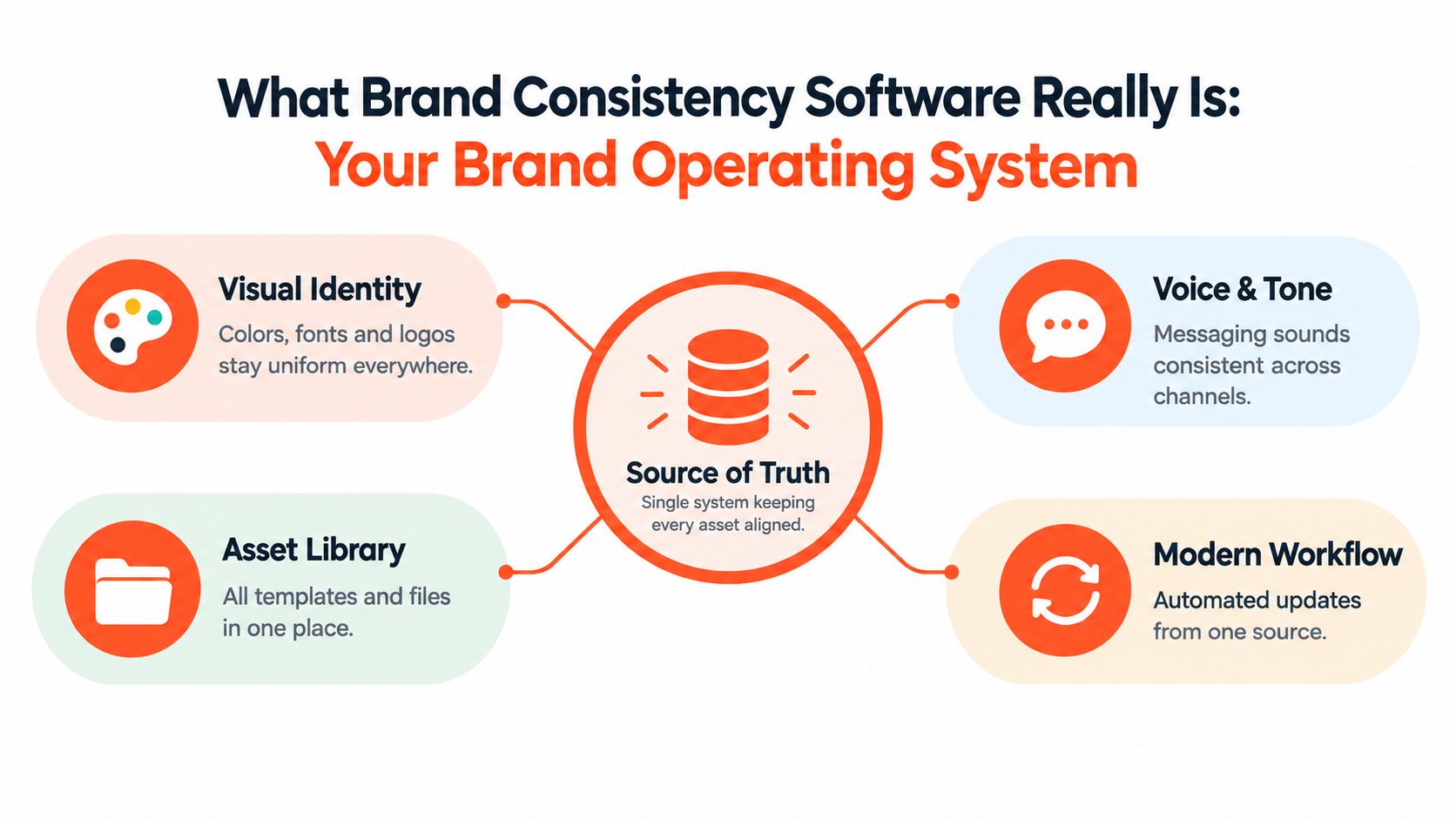
A campaign is ready to publish, then a regional team discovers that the logo is outdated and the approved wording is missing from the template. Brand consistency software prevents that scramble by working as a brand operating system. Like an operating system that gives applications shared files, rules, and permissions, it gives marketers, creators, agencies, and regional teams a governed way to create and use brand materials.
At its foundation, the platform keeps colors, fonts, logos, imagery, templates, messaging, and tone aligned. Its role extends beyond storing files. It helps people find the right asset, understand its permitted use, adapt it safely, secure approval, and distribute the current version across customer-facing channels.
The source of truth matters more than the folder
A generic folder stores files. A governed platform identifies the approved file, its owner, permitted users, current version, and the workflow triggered by a change. This is the operating foundation of brand asset management. The digital asset management guidance from Simple describes the model through centralized storage, version control, role-based permissions, and approval workflows.
Consider a campaign image updated by a designer. Without governance, an earlier copy can remain in email attachments, local drives, and presentation decks. With governance, the approved version becomes the default for general access. Older versions can remain available for audit or reference, preserving traceability without presenting obsolete work as ready to publish.
It is more than DAM or design software
A Digital Asset Management platform organizes and distributes files. A design tool helps create an asset. Brand consistency software connects both activities to brand rules and workflow controls.
A DAM without governance can become another library of unverified content. A design tool without locked elements can produce polished work that still breaks identity standards. A PDF brand book can explain rules, but it cannot enforce them during production. The software brings those rules into the workflow, where people and AI tools make content decisions.
That last function matters as content volume grows. Machine-readable brand rules can guide which assets, layouts, language, and tone are acceptable across markets. Approval records and usage data then show whether those rules support faster production, fewer corrections, and more consistent customer experiences. The working model is straightforward: the library stores approved building blocks, the rule layer defines acceptable use, the workflow controls decisions, and the distribution layer moves current content into market.
Core Capabilities That Keep Every Asset On Brand
The value of brand consistency software comes from how its parts work together. A polished interface alone won't stop drift. Look for mechanisms that reduce ambiguous decisions and make the governed path faster than the improvised one.
Brand kits turn identity into reusable rules
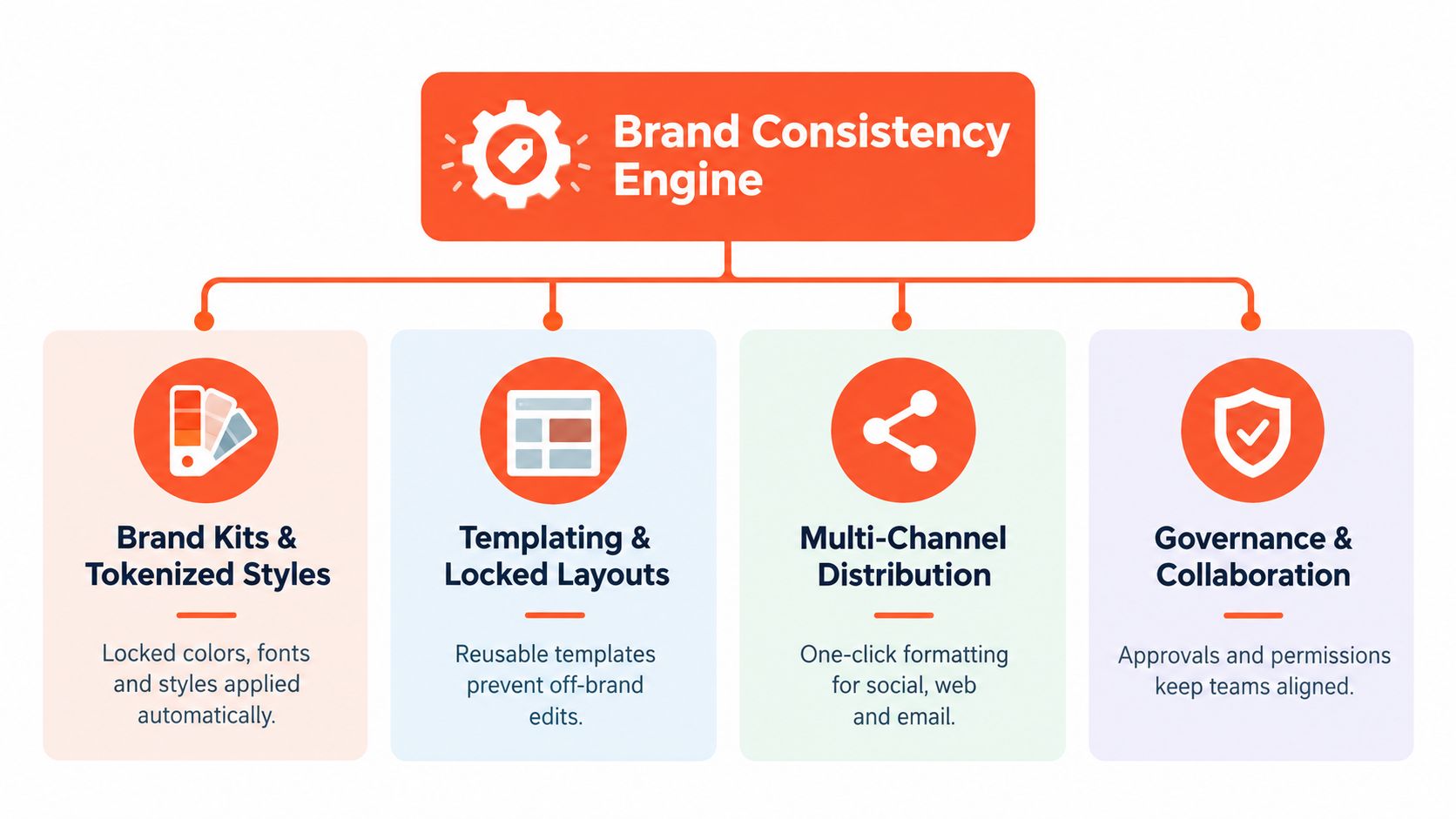
A brand kit holds approved colors, fonts, logos, image treatments, and voice guidance. More advanced systems express these choices as tokens or variables, so changing a core color or type style can update connected templates rather than requiring manual edits across separate files.
This matters in everyday production. A creator can start with the correct logo and type hierarchy instead of downloading an image from an old campaign. A content marketer can generate variations within a defined voice. For creators using synthetic presenters or recurring visual characters, a consistent AI creator persona adds another layer to identity management, because recognizable presentation includes more than static graphics.
Locked templates limit risky changes
Templates should provide speed without pretending every field deserves the same freedom. A strong system can lock the logo position, brand colors, legal language, or typography while leaving space for a market-specific headline, image, or call to action.
This field-level approach prevents a common compromise. If everything is locked, local teams can't respond to their audience. If nothing is locked, the template becomes a suggestion. The best configuration separates signals from controlled areas of adaptation.
Distribution and governance close the loop
A platform should format and deliver assets for the channels your team uses. It should also show who created, changed, reviewed, and published each item. Version histories, permissions, approvals, expiration rules, and audit logs make brand control visible rather than dependent on personal memory.
For teams organizing a governed digital asset library, these controls are as important as search and previews. Analytics can then reveal which assets people use, where approvals stall, and which markets repeatedly create exceptions.
Governance principle: Make approved content easier to find, safer to adapt, and faster to publish than an unapproved alternative.
AI adds a harder requirement. A platform must translate brand guidance into machine-readable constraints, validate generated content automatically, and send higher-risk exceptions to a human reviewer. Static guidelines explain what good looks like. Governance software helps decide whether a specific output is acceptable.
Where It Pays Off Use Cases and ROI for Teams and Creators
Brand consistency software becomes easier to evaluate when you connect features to a real job. A consultant needs a recognizable presence without turning every post into a design project. A growth team needs to produce more variations without creating review chaos. An agency needs to protect several client identities inside one production environment.

Match the system to the work
A consultant might begin with a long-form article about a client problem. The workflow can extract a central insight for LinkedIn, turn several ideas into carousel slides, create a short video script, and prepare an email introduction. The brand kit keeps the presentation connected, while approval controls protect claims and terminology.
A solo creator can use the same pattern at a smaller scale. Instead of inventing a new visual treatment for every platform, the creator adapts one idea through approved formats. That consistency helps audiences recognize the source even when the content appears in different feeds.
For an SMB growth team, the return often appears in operational capacity. People spend less time hunting for files, rebuilding layouts, correcting repeated mistakes, and waiting for central design support. Faster approvals can help the team maintain a publishing rhythm without sacrificing identity.
Agencies need separation and repeatability
An agency managing several brands needs more than a shared template folder. Each client requires its own colors, fonts, terminology, imagery rules, permissions, and review path. A governed environment reduces the chance that one client's visual system leaks into another's production process.
The same logic applies to regional teams. Central marketing can define master assets and guardrails, while local marketers adapt language, imagery, or calls to action within approved limits. Aprimo's explanation of enterprise DAM across global markets describes this balance as centralized control combined with controlled regional adaptation.
ROI goes beyond visual polish
Customer memory and loyalty are part of the commercial picture. A 2026 marketing summary citing Salesforce data says 84% of customers are more likely to remain loyal to a brand with consistent messaging and visuals, as reported in WorldMetrics' brand consistency statistics. The same compilation notes that consistent presentation can make brands 3.5 times more likely to achieve excellent visibility. Those figures are useful directional evidence, but teams should still measure their own outcomes.
A practical measurement set includes:
- Production efficiency: Track time spent searching, adapting, reviewing, and publishing.
- Governance adoption: Monitor whether teams use approved templates and current assets.
- Exception volume: Record off-brand outputs, rejected work, and repeated corrections.
- Business contribution: Compare consistency indicators with qualified engagement, conversion activity, retention signals, or revenue by market.
The key is to connect brand operations to business questions, not stop at visual approval.
How WaveGen.ai Applies Brand Consistency in Practice
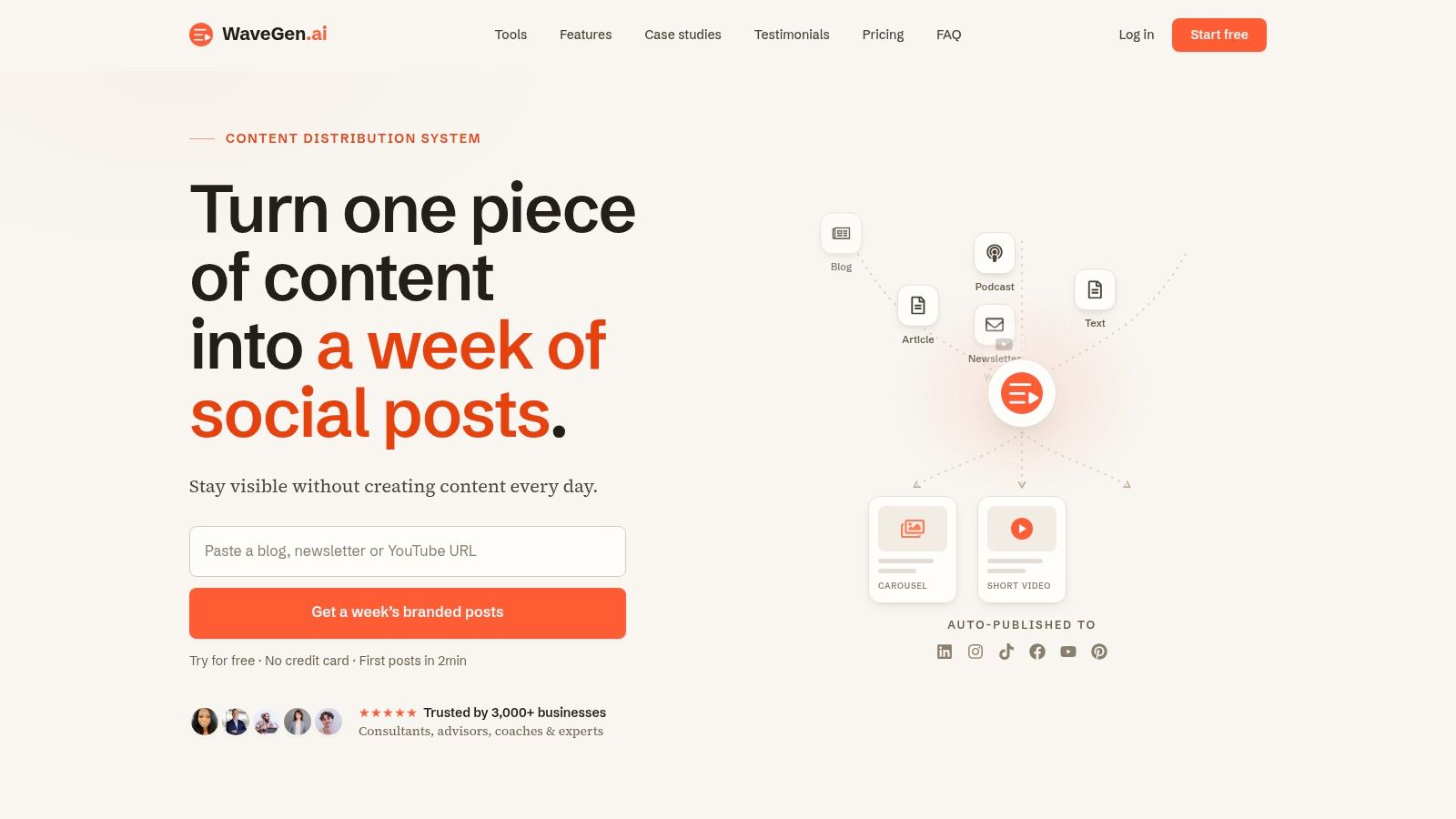
WaveGen.ai provides a concrete example of a content distribution workflow built around one source idea. A user starts with an article, newsletter, blog post, podcast script, or YouTube transcript, then sets a brand kit with colors, fonts, logo, and voice. That setup gives generated outputs a defined visual and verbal foundation instead of asking the model to invent a style for every request.
One source becomes a coordinated content set
Suppose a financial advisor uploads a detailed article about preparing for a major life decision. The system can use the article's own ideas to generate a carousel, short video concepts, quote cards, and platform-specific captions. The advisor can then review the language, adjust imagery and tone in the visual editor, and keep the output tied to the original point of view.
That source-first approach matters for brand coherence. Generic AI copy may sound polished but fail to reflect the creator's expertise, vocabulary, or position. Repurposing owned material gives the system a clearer foundation for consistent messaging while still allowing format-specific adaptations.
Editing and distribution remain part of governance
The workflow doesn't end when AI generates a draft. A human can adjust text, images, and tone before publication. That review step is especially important for regulated subjects, nuanced advice, or claims that require careful verification.
After approval, users can publish and schedule content to Instagram, TikTok, LinkedIn, YouTube, and Facebook. WaveGen.ai also supports an autopilot workflow that monitors RSS feeds, helping teams turn new source content into a repeatable distribution process. The company describes the product as trusted by 3,000+ businesses, a quantitative product claim supplied in the brief and not independently expanded here.
A brand consistency workflow should make the correct sequence clear: source, generate, inspect, edit, approve, distribute, measure. WaveGen.ai illustrates that sequence for teams and creators whose main problem is turning existing expertise into steady, recognizable multi-channel content.
How to Choose and Implement the Right Platform
Start with the failure point, not the feature catalog. If people can't locate approved files, prioritize search, metadata, permissions, and version control. If they find the files but create inconsistent adaptations, examine templates, field locking, and approval workflows. If the work is approved but published inconsistently, investigate integrations, scheduling, and channel delivery.
Use a decision matrix
| Evaluation Criteria | What Good Looks Like | Questions to Ask |
|---|---|---|
| Brand kit setup | Colors, fonts, logos, voice, and usage rules are easy to define | Can a non-technical marketer update the kit safely? |
| Template flexibility | Fixed identity elements coexist with editable local fields | Which fields can be locked, reviewed, or customized? |
| Channel coverage | Outputs fit the platforms and formats your team uses | Does the platform support your current publishing workflow? |
| Governance depth | Permissions, approvals, version history, expiration, and audit trails work together | Can we identify who approved and distributed each asset? |
| Editor usability | Creators can make controlled edits without designer intervention | Will everyday users actually choose this workflow under deadline? |
| Integrations | The platform connects with existing creative, CMS, CRM, DAM, and social tools | Is the integration bidirectional, maintained, and practical? |
| Measurement | Usage, compliance, exceptions, and business indicators are visible | Can we connect adoption with outcomes by market or channel? |
| Commercial fit | Pricing, support, implementation, and administration match team capacity | What work remains after purchase, and who owns it? |
Implement in controlled stages
- Audit the current system. List where assets, guidelines, templates, source content, and approvals live. Mark duplicate, obsolete, and rights-sensitive files.
- Define the rules. Separate fixed brand signals from elements that can change by channel, audience, or region.
- Migrate deliberately. Bring current approved assets into the new source of truth instead of transferring every historical file without review.
- Set permissions. Give central teams governance authority, regional teams appropriate adaptation access, and agencies only the content they need.
- Pilot a real workflow. Choose one recurring campaign or content type and test creation, review, localization, and publishing from start to finish.
- Train around jobs. Teach people how to find, adapt, approve, and distribute content, not just where buttons are located.
- Measure and refine. Establish KPIs for adoption, exception handling, approval time, and business contribution.
Global teams should avoid a false choice between uniformity and freedom. The right platform preserves recognizable signals while allowing controlled variation for language, cultural context, channel constraints, and local market needs.
Pitfalls Integration Challenges and What to Watch For
More uniformity isn't automatically better. A system can produce identical content everywhere and still weaken the brand if local audiences need different examples, imagery, offers, or formats. Governance should protect the signals people recognize, not eliminate every meaningful variation.
AI increases the cost of weak rules
AI can multiply output faster than a team can review it. Coverage from Marketing Helm describes the 2026 risk as producing “too much of the wrong content”, and cites 88% of organizations using AI in at least one business function while only 33% have governance frameworks in place. Those figures appear in the report on generative creative and brand consistency, and they point to a practical concern: content volume can outpace oversight.
A platform should therefore support machine-readable rules, automated checks, exception logging, and risk-based human review. A simple asset library won't catch generic phrasing, unsupported claims, inconsistent terminology, or imagery that violates a market rule.
Measurement can disappear behind aesthetics
Teams often approve content because it looks right, then struggle to show whether consistency improved performance. The German Design Council's brand research on governance and measurement notes that only 14% of organizations use defined KPIs for brand performance, while more than half don't measure brand image at all.
Define the measurement model before selecting software. Track adoption, exceptions, review effort, and market-level business indicators. Without that connection, buyers may judge a platform only by storage capacity or interface polish.
Integrations and localization deserve early testing
A platform that can't connect cleanly with your CMS, design tools, social scheduler, or existing DAM may create a new silo. Test the actual handoffs with real files and real permissions, not a sales demonstration.
Also test regional adaptation. Rigid templates frustrate local teams, while loose templates recreate the original problem. Ask vendors to demonstrate how a regional user changes approved fields, submits work for review, and publishes a localized version while the central team retains traceability.
The strongest system treats brand guidance as a living governance layer. It monitors drift, records exceptions, updates rules as messaging changes, and gives people enough flexibility to make content relevant without making the brand unrecognizable.
WaveGen.ai turns an article, newsletter, podcast script, or video transcript into on-brand social formats using saved colors, fonts, logos, and voice settings, with editing, scheduling, and multi-channel publishing built into the workflow. Visit WaveGen.ai to explore the platform and start a free trial for your own content pipeline.
brand consistency software
brand management
content distribution
brand governance
WaveGen.ai
Turn this kind of writing into a week of social content.
Paste a blog post, newsletter, or rough draft — WaveGen turns it into publish-ready carousels, captions, and slideshows for every channel.
No credit card · First posts in 2min