July 27, 2026
13 min read
Transparent Communication How to Build Unshakeable Trust
Learn how to master transparent communication in your business. This guide provides practical frameworks and examples to build trust with teams and clients.
You're three days into a client project, the deck is half-finished, Slack is full of “quick updates,” and nobody can tell whether the launch date moved, the scope changed, or both. The team keeps working from different assumptions, the client starts asking sharper questions, and the conversation gets harder the longer it's delayed. That's how trust erodes in real life, not with one dramatic mistake, but with a steady drip of unclear messages.
Transparent communication is the fix when silence, half-truths, or scattered updates start creating avoidable damage. It's not about dumping every detail on everyone. It's about giving the right people the right context at the right time, so they can act with confidence instead of guessing.
Table of Contents
- The High Cost of Silence in Business
- What Transparent Communication Really Means
- Why Transparency Is a Business Superpower
- The Transparency Tightrope How to Be Open Without Oversharing
- A Practical Framework for Transparent Communication
- Transparent Communication in Action Examples and Templates
- Making Transparency Your Default Setting
The High Cost of Silence in Business
A consultant misses a deadline, but the client only hears about it after asking twice. A marketing team shifts campaign direction internally, yet sales keeps pitching the old message for another week. A creator reads community criticism in public comments, then stays quiet because the response feels risky. In each case, the problem is rarely the bad news itself. The problem is the vacuum around it.
Silence invites people to fill the gaps
When leaders withhold information, people do not stay neutral. They build theories, and those theories usually skew negative because uncertainty feels dangerous. In organizational and crisis settings, complete, accurate, and timely communication reduces rumor spread because people are not forced to infer missing details from scraps of context technical guidance on transparent communication.
Practical rule: If people affected by a decision are learning it from hallway chatter, you have already lost control of the message.
Silence also slows work. Teams hesitate when they do not know which version is current, which priority matters most, or whether a delay is temporary or final. That hesitation looks like caution on the surface, but it often hides confusion, rework, and avoidable frustration. In a client services team, that can mean two people preparing different answers for the same account. In a product team, it can mean a feature ships with conflicting assumptions because no one felt authorized to ask for clarification.
The cost shows up as mistrust, not just delay
The damage from poor communication is cultural before it is operational. Once people believe they are being managed through partial truths, they stop assuming good intent. They start protecting themselves, hoarding information, and escalating only when they have to.
Transparent communication changes that pattern because it replaces ambiguity with context. Instead of leaving people to guess what is happening, it gives them a clearer map of the decision, the trade-off, and the next step. That matters in consulting, content teams, and client-facing work, where trust is part of the product. It also matters when different audiences need different levels of detail. A frontline employee may need a plain-language update on what changes today, while a manager may need the reasoning behind the choice and the risks that still remain.
A useful example appears in the hospitality employee communications guide, where open updates are treated as a motivation tool rather than a nice-to-have. The same logic applies far beyond hospitality. When people understand what is happening and why, they can stay aligned instead of defensively improvising.
What Transparent Communication Really Means
Transparent communication isn't a synonym for bluntness, and it isn't permission to overshare. It means sharing information in a way that is accurate, relevant, timely, and usable. The point isn't to reveal everything. The point is to reduce avoidable uncertainty for the people who need to act.
It's more than honesty, and less than total disclosure
Honesty is telling the truth. Transparency is telling the truth with enough context that the truth can be interpreted correctly. That distinction matters because raw facts without explanation can create more confusion than silence.
The clearest statistical framework for transparency comes from a nine-principle model that includes faithfulness, reliability, resilience, process transparency, clarity, simplicity, non-contingency, precision and economy, and material availability transparent statistics principles. Those principles point to the same practical idea, communicate in a way that preserves meaning, not just content.
Context is what turns information into trust
Public institutions have moved in the same direction. The UK's statistics authority defines transparency as being open about the data used, explaining the judgments behind methods, and clearly stating strengths and limitations so users understand what the data can and cannot show transparent statistics guidance. That's a strong model for business communication too. People don't just want the update. They want the reasoning, the limits, and the implications.
Transparency is not a data dump. It's a judgment about what people need to know, in the form they can use.
That's also why accessibility matters. If a message is technically shared but buried in a long thread, dense memo, or jargon-heavy slide deck, it isn't transparent. Information only becomes transparent when the audience can find it, understand it, and act on it.
The most useful mindset is simple. Ask whether the message helps people make a decision, correct their assumptions, or understand a change. If it does, share it with enough context to be interpreted correctly. If it doesn't, it may just be noise.
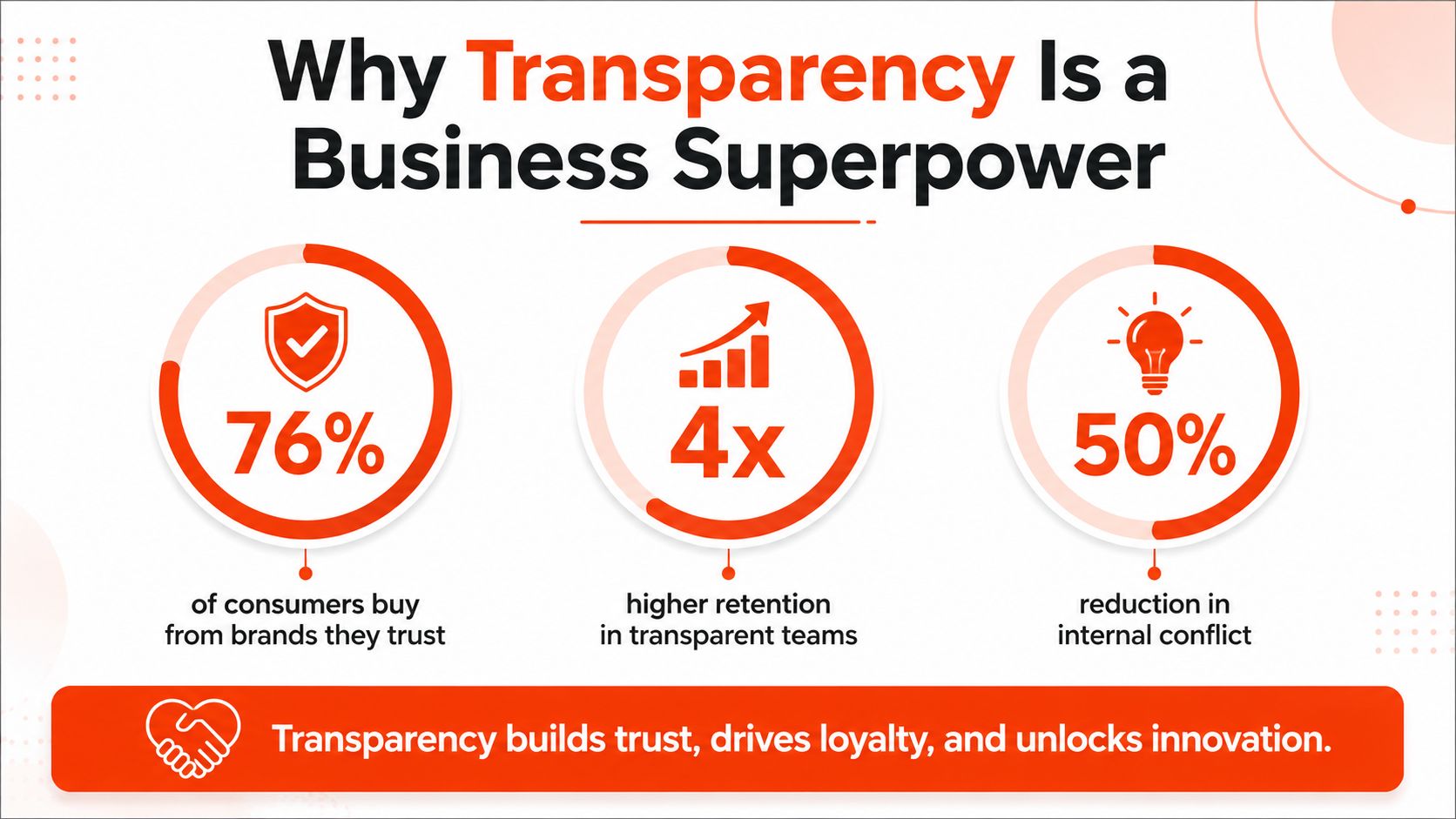
Why Transparency Is a Business Superpower
A project update goes smoother when the team knows what changed, what is still unknown, and what decision is expected next. Clients respond the same way. When you give them a clear view of the logic behind a delay, a revised scope, or a shifting priority, they spend less time guessing and more time acting on the right information.
Credibility grows when uncertainty is handled directly
One useful finding from the evidence is that adding a numeric range around COVID-19 figures in a survey experiment with 10,519 participants produced only a slight decrease in trust in the number, with no impact on trust in the source study on communicating uncertainty. The same pattern held across current and future COVID-19 figures and extended to environmental and economic topics. For business communication, the point is clear. Saying what is known, what is still uncertain, and where the estimate may shift does not automatically weaken credibility.
That matters in day-to-day work. A forecast can change, a delivery date can move, or a dependency can slip outside your control. If you hide that uncertainty, people usually fill in the blanks themselves, and they tend to assume the worst. If you state it plainly, you give stakeholders a realistic frame for planning and reduce the risk of surprise later.
Transparency supports loyalty because it reduces friction
Clients and employees both value predictability. They do not need perfection as much as they need a message that holds together. When expectations are clear, people can decide whether to wait, adjust, escalate, or proceed without wasting time on guesswork.
That same logic shapes brand trust over time. If your audience can see how decisions are made and why priorities shift, they are less likely to read ordinary course corrections as disorganization. A practical brand loyalty strategy depends on that kind of clarity, because consistency and openness reinforce each other when pressure rises.
The operational payoff shows up inside the organization too. The hospitality employee communications guide is a good reminder that open internal messaging helps teams stay motivated when the work is busy and the stakes are visible. The broader lesson applies across sectors. Transparent communication is not just a courtesy. It cuts preventable friction, makes decisions easier to execute, and helps work move without avoidable confusion.
The Transparency Tightrope How to Be Open Without Oversharing
Many teams aren't afraid of transparency in principle. They're afraid of what happens when the message lands badly, exposes something sensitive, or creates panic before there's a solution. That fear is rational. The answer isn't to hide more. It's to decide more carefully.
Use a relevance test before you speak
A simple decision rule helps. Before sharing, ask four questions.
- Is it relevant? If the information doesn't affect decisions, priorities, or expectations, it may not belong in the message.
- Is it actionable? People need to know what to do with the information, not just that it exists.
- Who needs this now? Not every update belongs in every channel.
- What context is required? If the audience can misread the message without background, add the missing frame.
That's how strategic transparency differs from oversharing. Oversharing gives people raw material and expects them to sort it out. Strategic transparency filters information so it serves a purpose.
Delay isn't deception when you explain the boundary
Sometimes you can't share details yet. Personnel issues, confidential negotiations, and partial investigations are real constraints. In those moments, the mistake is going silent. A better move is to name the boundary and promise the next update point.
“I can't share that detail yet, but I can tell you what we know, what we're checking, and when you'll hear from us again.”
That sentence does a lot of work. It gives clarity without violating privacy or process. It also prevents the emotional gap that opens when people think information is being hidden for convenience rather than necessity.
The best guidance on transparent communication in crisis settings recommends structured follow-ups, including an initial notice within 24 to 48 hours, updates during days 3 to 7, and ongoing disclosures as investigations progress transparent crisis communication guidance. The point is not the exact schedule by itself. The point is that transparency works best as a process, not a one-time announcement.
A Practical Framework for Transparent Communication
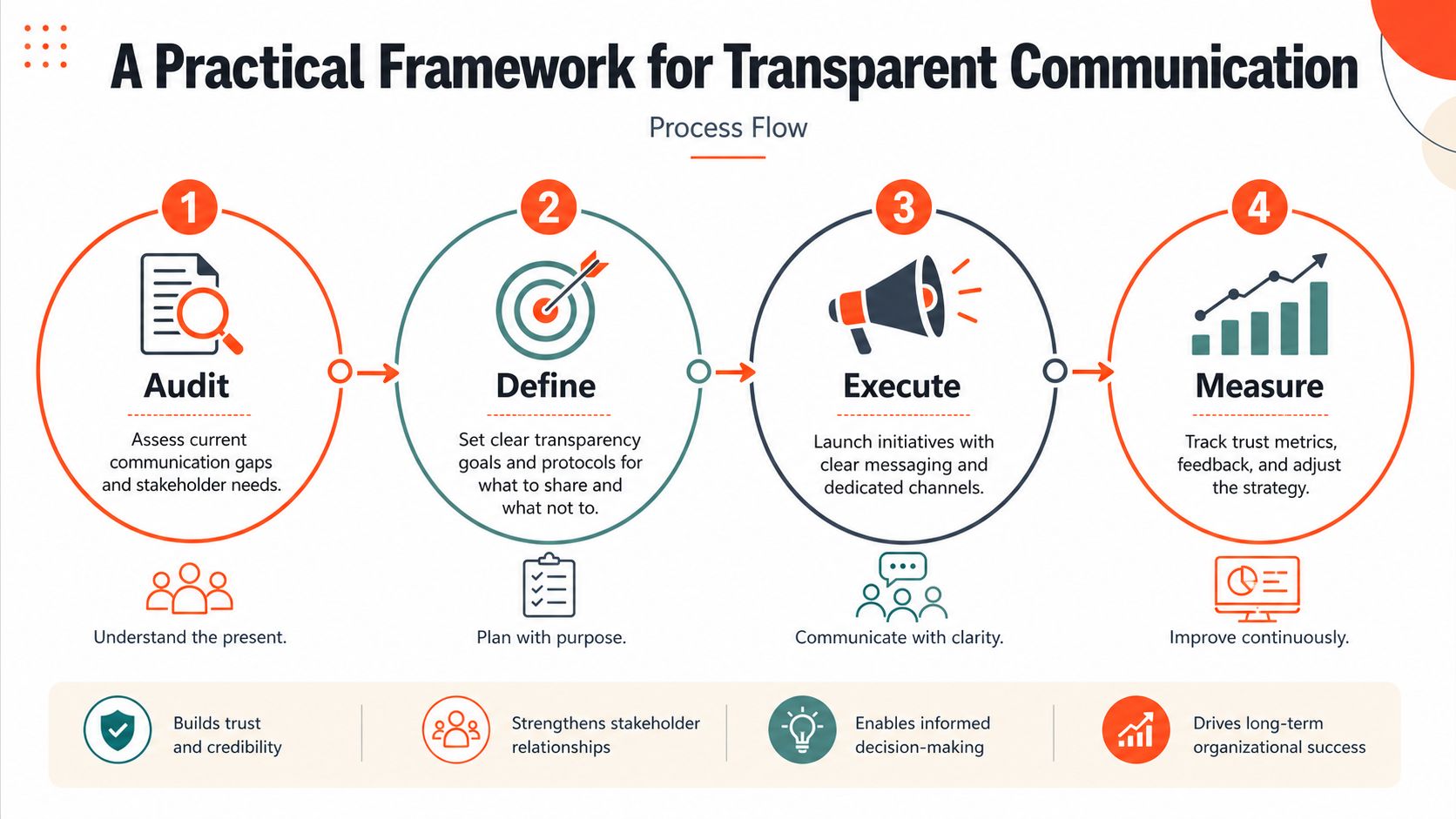
The easiest way to make transparency operational is to treat it like a workflow. A message starts with what's known, moves through what's uncertain, and ends with what people should do next. That sequence keeps communication from becoming a blur of half-updates and reactive clarifications.
Start with the facts, then separate uncertainty from action
Open with what is confirmed. Then say what is still being reviewed. Then spell out what the team or client should do while waiting. This order matters because it keeps people from treating speculation as fact.
A clean structure looks like this:
- State the known facts. Use plain language and avoid padded phrasing.
- Mark the unknowns. Say what's still in progress or not yet decided.
- Name the action. Explain what changes now, if anything.
- Set the next update time. Give people a moment to expect, not just a promise to “follow up.”
This approach works because it gives stakeholders a usable mental model. They're not left sorting fragments in their own heads.
Choose channels that match the message
Not every message belongs in the same place. A quick status update may fit a shared project doc or team channel. A sensitive issue may need a direct conversation first, followed by a written summary for the relevant people. A policy change should be easy to find later, not buried in chat history.
If your team needs a content approval system, a structured content approval workflow can help make ownership and review steps visible without making every message a meeting. That kind of visibility is what transparency should look like in practice, clear enough to follow, organized enough to trust.
If people can't find the update later, they'll ask again, and the message never really landed.
Feedback loops matter too. Ask what's unclear, where the message failed, and what downstream team still needs context. Transparency stops being performative the moment the audience can respond and shape the next update.
Transparent Communication in Action Examples and Templates
The test of transparency is whether it holds up in messy, ordinary situations. A late project, a strategy pivot, or a public complaint each requires a different tone, but the same discipline, say what changed, why it changed, and what happens next.
Client delay update
Before, a consultant might send this:
“We're still working through a few things and will send an update soon.”
That message creates more questions than answers. It doesn't say what happened, what the client should expect, or whether the deadline still stands.
After, the same update becomes:
“We've identified a dependency that's pushing the delivery back. The core work is complete, but we're waiting on one remaining input before we can finalize the deck. I'll send the revised timeline and the updated file list by tomorrow afternoon.”
That version is transparent because it's specific without being sprawling. It respects the client's need to plan.
Strategy pivot for a content team
A vague announcement sounds like this:
“We're adjusting our direction to better align with goals.”
That can mean almost anything. It sounds polished, but it leaves the team without a real plan.
A stronger version reads:
“We're shifting the content mix because the current cadence isn't supporting the campaign objective we set. We'll reduce low-priority posts, focus on the core topic cluster, and review the next two weeks of assets before publishing.”
If you need a structured record of what was decided, who owns the follow-up, and what was deferred, a guide to meeting minutes and action items can help turn discussion into a usable trail. That's especially useful when transparency has to survive more than one meeting.
Community feedback response
Creators often make the mistake of either defending themselves too quickly or ignoring feedback entirely. A usable response sounds like this:
“I've read the comments about the recent change in format. Some of the feedback is fair, and I can see where the shift felt abrupt. I'm reviewing the response and will share what I'm changing, and what I'm keeping, in the next update.”
That message doesn't over-explain. It doesn't perform apology theater. It shows the audience that their input entered the process.
For teams that need to keep tone, formatting, and brand language consistent across channels, WaveGen.ai can turn a single source piece into a week of social content while preserving the original voice and source material. Used carefully, that kind of workflow can support transparency by keeping the message consistent instead of fragmenting it across drafts, platforms, and edits.
Making Transparency Your Default Setting
A client asks why the launch schedule changed, and the team has a choice. Give a vague reassurance and create more doubt, or explain the trade-offs, the new priority, and what comes next. Transparency works better when it lives in those ordinary moments, not only when something has gone wrong.
That means sharing the reasoning behind a decision, naming uncertainty before it turns into confusion, and giving people enough context to act without guessing. The goal is accessible communication, not raw information dropped into a channel and left there. Different audiences need different levels of detail, so the message has to be clear enough for a manager, a client, and an internal operator to use without rereading it three times.
A useful check is whether the update answers three questions: what changed, why it changed, and what the next move is. If the answer is buried in jargon or spread across too many threads, transparency has failed even if the facts are technically present. For guidance on establishing clear communication protocols, see our brand guidelines template.
For a related perspective on staying real in public-facing work, the tips for online genuineness resource reinforces a useful point, authenticity only works when the message is usable, not just sincere. The same standard applies here. A transparent update should help people make a decision, not just confirm that someone spoke.
Start small and make it repeatable. Send one update this week that separates what is known, what is still open, and what happens next, then use the same pattern in a client note, team post, or leadership message. If your team needs a consistent format, keep a short checklist for tone, audience, and level of detail so transparency stays clear instead of becoming a dump of half-finished context.
WaveGen.ai helps teams turn one clear source message into consistent social content without losing the original voice or context. If you're building a communication system that needs to stay transparent across channels, visit WaveGen.ai and see how it supports on-brand distribution from one article to a full week of content.
transparent communication
building trust
organizational culture
client communication
leadership skills
Turn this kind of writing into a week of social content.
Paste a blog post, newsletter, or rough draft — WaveGen turns it into publish-ready carousels, captions, and slideshows for every channel.
No credit card · First posts in 2min