July 26, 2026
14 min read
Brand Loyalty Strategy: A Step-by-Step Playbook That Works
Build a brand loyalty strategy that converts one-time buyers into repeat customers. Practical playbook with examples, templates, and a measurement framework.
You can tell a loyalty program is about to stall when the team has a polished launch deck, a points spreadsheet, and almost no agreement on what loyalty is supposed to change. The promo calendar looks busy, email clicks are decent, and customers keep buying, but nobody can say which behaviors predict long-term value. That gap is where most brand loyalty strategy work goes sideways, because repeat purchase gets mistaken for real attachment.
The practical shift is simple, even if the execution isn't. Loyalty isn't a one-time reward, it's a retention sequence that has to earn trust across multiple touchpoints, and the cadence of your content is part of that sequence. If you want a useful baseline on the retention mindset, the piece on customer retention strategies for SaaS is a good reminder that recurring value usually comes from repeated utility, not a single campaign spike. The same logic applies outside SaaS.
Table of Contents
- Why Most Brand Loyalty Strategies Fail Before They Start
- Mapping the Audience You Actually Want to Keep
- Choosing the Right Value Exchange for Each Segment
- Designing Experience and Content as Retention Mechanics
- A 30-60-90 Rollout Plan That Sticks
- Measuring Loyalty Without Fooling Yourself
- Common Pitfalls and a Practical Checklist to Take With You
Why Most Brand Loyalty Strategies Fail Before They Start
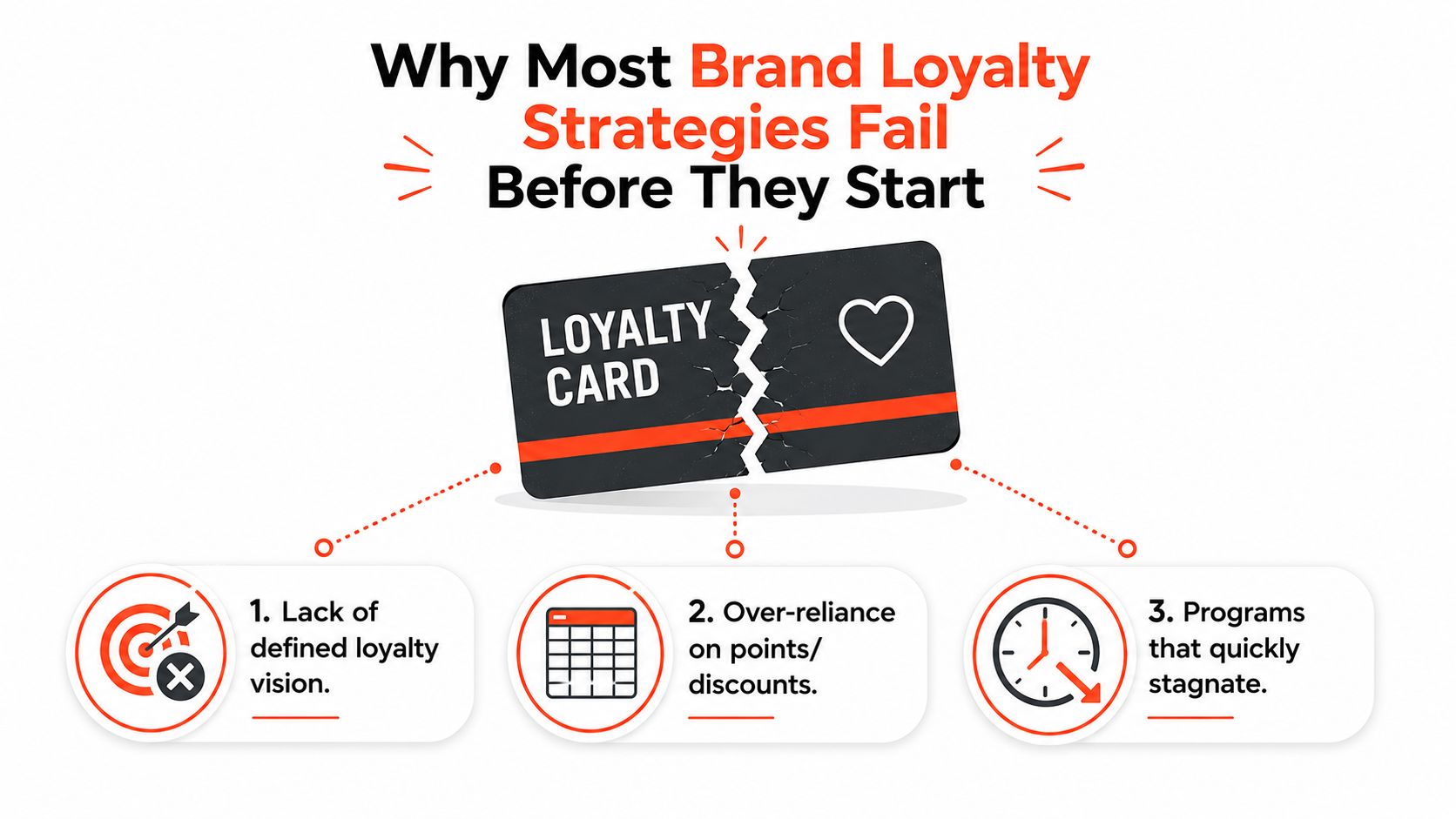
The first failure usually happens before a customer ever sees a reward. Teams define loyalty as “more purchases,” then build a program around discounts, points, or a VIP tier without deciding what behavior deserves the investment. That creates activity, but not clarity.
A better frame is to treat loyalty as a sequence of repeat experiences that earn belief over time. The historical baseline in the brief is useful here, 88% of consumers require at least three purchases before they consider themselves loyal and 93% decide after their first purchase whether they'll continue the relationship with a brand (Cropink). The message isn't that the first purchase doesn't matter, it's that the first purchase is a judgment point, and the third purchase is where loyalty becomes visible.
The real problem is usually measurement, not mechanics
A loyalty dashboard full of opens, clicks, and app visits can make a weak program look healthy. Those numbers might show attention, but they don't prove customers are staying for reasons that matter. The American Marketing Association's guidance on retail loyalty programs warns that loyalty can turn into a cost center if it doesn't change behavior, which is why instrumentation has to come before launch, not after.
Practical rule: if you can't name the behavior that would justify the spend, you don't have a loyalty strategy yet.
That lens also changes how you read your content calendar. Social posts, newsletters, and post-purchase emails aren't separate “awareness” work when they reinforce trust and keep the brand present between transactions. They're part of the retention sequence.
If you already have a brand kit, this is the point where it matters. The internal consistency of your colors, tone, and visual system shapes recognition long before a customer consciously evaluates the offer, which is why a well-structured brand kit is more than a design file.
Loyalty dies when the program stops feeling alive
Many programs don't fail because the offer is bad. They fail because the brand sends the same message for months, then acts surprised when participation flatlines. Customers notice stale rhythms quickly, especially when every message looks like a thinly disguised coupon.
A more durable system uses content cadence as a loyalty mechanic. The brand keeps showing up with useful reminders, proof points, and small moments of value, so the relationship doesn't depend on one incentive. That's the difference between a program people join and a system people return to.
Mapping the Audience You Actually Want to Keep
Before you choose rewards, content, or channel cadence, you need to know which customers deserve retention effort and why. That doesn't start with personas pulled from a slide deck. It starts with behavior, because behavior tells you who already sees value.
Build the map from evidence, not assumptions
Start with purchase data. Look for customers who buy more than once, move across categories, or respond without heavy discounting. Then layer in product or usage signals if you have them, such as frequency, feature depth, reorder timing, or subscription renewal patterns. Those are stronger loyalty clues than age, job title, or broad demographic buckets.
Next, talk to actual repeat customers. Short interviews can uncover why they came back, what nearly pushed them away, and which messages made them pay attention. You don't need a research team to do this well, you need a narrow script and a willingness to hear unpolished answers.
Use these signals to tag customers by behavior:
- High-frequency buyers: useful when volume itself indicates dependence or habit.
- High-margin buyers: useful when a smaller segment drives disproportionate value.
- Content-engaged buyers: useful when education, trust, or expertise influences repeat action.
- Advocates who refer or share: useful when loyalty spills into distribution.
- At-risk repeat buyers: useful when someone used to return, but has gone quiet.
Ignore the temptation to over-tag by persona alone. Persona labels can help internal communication, but they're weak predictors of loyalty unless they map to observed behavior.
Customers rarely stay loyal because they fit a persona. They stay loyal because a brand keeps solving a job they care about.
A small subscription brand can use this approach without much overhead. One useful pattern is to compare usage frequency with content engagement, then separate customers who only renew from those who renew and also interact with tutorials, newsletters, or community posts. The second group often contains the strongest advocates, because their behavior shows attention beyond the transaction.
Keep the research window short
This can be done in under two weeks. Spend the first few days pulling transaction and engagement data, then use the next few days for interviews and simple tagging. Finish by identifying one or two segments worth prioritizing, rather than trying to please everyone.
That discipline matters because loyalty strategy gets expensive when the audience is too broad. If you know who you want to keep, you can choose a value exchange that fits their actual behavior instead of guessing.
Choosing the Right Value Exchange for Each Segment
A loyalty offer should feel natural to the customer and sustainable for the business. That rarely means points by default. Different segments respond to different kinds of value, and the cheapest mechanics on paper can be the most expensive to maintain if they don't move behavior.
Match the exchange to the behavior
| Model | Best For | Cost Profile | Emotional Leverage |
|---|---|---|---|
| Transactional rewards | Price-sensitive repeat buyers | Can become expensive if overused | Low to moderate |
| Access and exclusivity | Customers who care about being first or included | Often manageable if tied to launches or inventory | Moderate to high |
| Recognition and community | Advocates, creators, and highly engaged repeat buyers | Low direct cost, more operational effort | High |
| Content or education | Complex products, considered purchases, trust-heavy categories | Low to moderate if content is reused well | Moderate to high |
Transactional rewards still work when the buying decision is driven by price or frequency. They're straightforward, easy to explain, and fast to launch. The trade-off is obvious, they can teach customers to wait for the next incentive.
Access and exclusivity work better when the product experience itself has anticipation value. Early access, limited drops, or first-look content can make a customer feel included without cutting margin as aggressively as discounts. That model tends to fit audiences who already believe the brand is worth following.
Recognition and community are better when identity matters. Customers who want to be seen, heard, or connected to others in the same category often respond to status, feedback loops, or participation rather than a lower price. The cost is usually not financial, it's the operational effort required to make recognition feel genuine.
Content and education fit brands that need to reduce uncertainty. If the customer needs help choosing, using, or getting more value from the product, useful content can do more for loyalty than a coupon ever will. It lowers friction and increases confidence.
A practical shortcut is to ask which segment would be annoyed by a discount and which would be motivated by it. That tells you a lot about whether the relationship is transactional or identity-based.
If you're using a content system to support that exchange, keep the cadence steady. A loyalty offer only works if customers keep seeing reasons to come back, and an always-on content layer makes that easier to sustain. A useful companion to that thinking is always on brand content, especially when repetition itself is part of recall.
Designing Experience and Content as Retention Mechanics
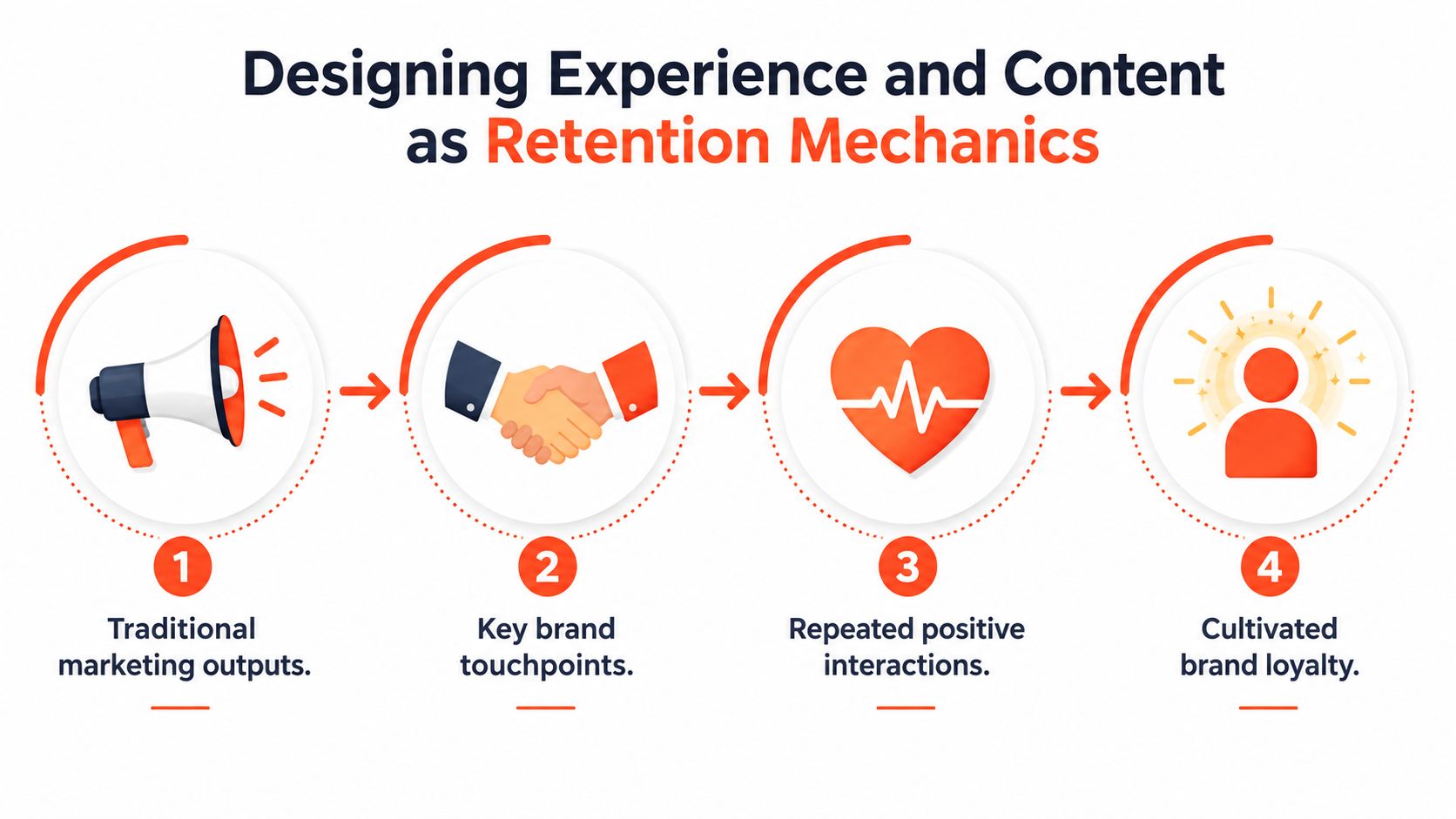
A lot of brands treat content as a separate department from loyalty. That's a mistake. The messages customers see between purchases shape whether they remember you, trust you, and bother coming back.
Turn each touchpoint into a repeatable promise
Onboarding is the first place to get this right. New customers need a sequence that confirms they made a smart choice, shows them how to get value quickly, and introduces the next useful interaction without crowding them. Post-purchase messaging should do the same thing, but with more specificity.
A strong sequence usually has three layers. First, a practical confirmation. Second, a small educational win. Third, a nudge that matches the customer's next likely action. That can be a reorder reminder, a how-to guide, or a community prompt depending on the business.
Content cadence begins doing loyalty work by repurposing one strong idea across formats and channels so the customer keeps encountering the same useful concept in different ways. Instead of publishing once and moving on, a long-form article can become a newsletter excerpt, a short carousel, a quote card, a short video, and a reminder post across the week.
For teams that need to do that without rebuilding assets from scratch, WaveGen.ai is one option that turns long-form content into branded social posts, captions, and multi-channel distribution using a saved brand kit. That matters because consistency is harder to maintain when every post is created from zero.
Repurpose once, distribute deliberately
A useful weekly pattern looks like this:
- Publish the core asset. This could be a blog post, a podcast episode, or a newsletter.
- Extract the strongest proof points. Pull one stat, one takeaway, and one practical tip.
- Convert each point into a distinct format. Use one post for LinkedIn, one short clip for Instagram or TikTok, one quote card, and one reminder email.
- Stagger the timing. Let the content reappear across the week so the customer sees the same brand idea in different contexts.
The point isn't volume for its own sake. The point is repeated, familiar contact that feels useful instead of repetitive. Customers rarely need more content, they need better sequencing.
The best retention content answers a question customers were already going to ask.
Personalization still matters, but it has to stay anchored to behavior. If a customer just bought, don't send a generic sales message. If they haven't engaged in a while, don't pretend they're a new lead. The tighter the sequencing, the less the brand feels like it's shouting into the void.
A 30-60-90 Rollout Plan That Sticks
Good loyalty work falls apart when a team tries to launch everything at once. The fix is a phased rollout with clear ownership, narrow scope, and enough instrumentation to tell you whether the program is changing behavior or just creating activity.
Days 1 to 30 focus on proof, not polish
Use the first month to define the audience, choose the behavior you want to change, and set up your measurement plan. Marketing should own segmentation and content planning, while ops or lifecycle teams handle the journey map and trigger logic. Finance or leadership should sign off on the success criteria early so nobody argues about it later.
The pilot cohort should be small enough to observe and large enough to notice patterns. Don't add every possible reward or channel yet. The goal is to learn which touchpoints move the needle.
Days 31 to 60 make the offer operational
Once the pilot is clear, build the value exchange and the repeatable content assets around it. This is when templates matter. Create the email sequence, the social repurposing system, and the customer-facing language that explains the value without sounding like a coupon dump.
If the program includes brand repetition through visuals, watermarking, or templated creative, a guide like guide to always on brand content is useful for keeping the execution steady. The point is consistency, not cleverness.
Days 61 to 90 broaden carefully
Only expand when the pilot tells you what to keep and what to cut. At this stage, add the next segment, keep the strongest mechanics, and remove anything that increased workload without improving behavior. The team should review friction points every week, not at the end of the quarter.
The rollout also benefits from a simple governance list:
- One owner for the customer journey: someone accountable for the end-to-end experience.
- One owner for measurement: someone who checks whether the program is changing behavior.
- One owner for creative consistency: someone who keeps the content and visuals aligned.
- One owner for customer feedback: someone who routes responses back into the program.
Keep the plan tight. Loyalty systems get messy when everyone owns it and nobody can explain the next decision.
Measuring Loyalty Without Fooling Yourself
A loyalty program that can't prove incremental behavior is just an expensive communication plan. The easiest trap is to celebrate repeat orders without asking whether those orders came from true preference, convenience, or a temporary discount.
Track behavior first, sentiment second
The strongest starting points are repurchase rate, purchase frequency by cohort, retention curves, incremental revenue, and segment-level ROI. Those metrics show whether customers are staying, how quickly they return, and whether the program pays for itself in the segment that matters most. The American Marketing Association's warning about loyalty becoming a cost center is worth keeping in mind here, because a program can look popular while underperforming.
Transaction data should also be used to identify the behaviors that lead to higher value customers. That means comparing what your best customers do differently before they become high value, not just summarizing what all customers do after the fact. Grant Thornton's guidance on loyalty programs points in the same direction, with an emphasis on behavioral data, competitive positioning, and clear success metrics.
Build a quarterly review that forces decisions
A useful quarterly review has four questions:
- Which segment improved? If no segment moved, the program is probably too broad.
- What changed in behavior? Look for repeat timing, frequency, or engagement shifts.
- Which touchpoints carried the lift? If social, email, or post-purchase flows never influenced behavior, they're probably decorative.
- What should be cut next quarter? A healthy program removes weak mechanics instead of adding more.
That last question matters because loyalty work tends to accumulate clutter. Old offers, stale journeys, and underused content formats create maintenance debt that hides the core signal.
If a metric can't lead to a decision, it doesn't belong in the review.
A practical measurement stack should separate signal from noise. Use cohort analysis for repurchase timing, segment ROI for budget decisions, and qualitative feedback to explain why the numbers moved. Then revisit the framework every quarter so the program doesn't drift into habit.
For teams bringing AI into the retention stack, the best reference is a tactical one. The master AI retention strategies piece is useful if you want to think about prediction, automation, and customer timing without letting the tool outrun the strategy.
Common Pitfalls and a Practical Checklist to Take With You
Most loyalty efforts fail because the team jumps to mechanics before it has a measurement plan. The second most common mistake is copying a competitor's program without checking whether the audience wants the same value exchange. And too many brands still treat content cadence as a marketing afterthought when it should be part of the retention system.
Use this checklist before you scale
- Defined loyalty clearly: Can you say which behavior counts as loyalty for your business?
- Mapped the right audience: Did you segment by behavior, value, and engagement, not just demographics?
- Matched the exchange to the segment: Does the offer fit how that segment makes decisions?
- Built repeat touchpoints: Are social, email, and post-purchase content working together?
- Instrumented the program: Can you see incremental behavior, not just activity?
- Assigned owners: Does every major part of the system have a single accountable person?
- Removed weak mechanics: Have you cut anything that adds cost without changing behavior?
A good test is whether your program still works when the discount gets smaller. If it collapses, the brand hasn't built loyalty, it's rented attention.
The next frontier is personalization for audiences that don't fit average assumptions, especially regional, culturally diverse, and lower-trust segments. Brands that do well there usually combine behavioral data, qualitative listening, and channel-specific messaging instead of forcing one generic loyalty model onto everyone. If you want to pressure-test your current plan, WaveGen.ai client success stories are a useful reference point for how brands keep a consistent output rhythm without making every piece of content from scratch.
If you're building a brand loyalty strategy and need a cleaner way to keep content, cadence, and brand consistency aligned, take a look at WaveGen.ai. It helps teams turn one long-form idea into a week of branded social output, which makes retention touchpoints easier to sustain without adding daily production burden.
brand loyalty
customer retention
loyalty program
customer engagement
marketing strategy
Turn this kind of writing into a week of social content.
Paste a blog post, newsletter, or rough draft — WaveGen turns it into publish-ready carousels, captions, and slideshows for every channel.
No credit card · First posts in 2min