July 22, 2026
11 min read
Social Media Trend Analysis: A Guide to Finding What's Next
Master social media trend analysis. Learn how to spot emerging trends, understand their value, and turn insights into a week of content your audience will love.
You're probably not short on ideas. You're short on time, and the feed keeps moving. A trend hits your radar, your team debates whether it matters, and by the time someone has a decent angle, the moment has already cooled. That gap between noticing and shipping is where most social teams lose the advantage.
Social media trend analysis closes that gap when it's treated as an operating system, not a scavenger hunt. By April 2026, there were 5.79 billion social media user identities worldwide, equal to 69.9% of the global population. That scale matters, because when nearly seven in ten people globally are represented on social platforms, trend monitoring isn't niche audience research, it's a mainstream way to read demand, attention, and cultural movement. The same dataset also shows 5.3% year-over-year growth from 5.5 billion in 2024, which means the signal keeps expanding even as the work gets more complex, not less, according to DataReportal.
Table of Contents
- Beyond Chasing Virality An Introduction
- Understanding the Anatomy of a Trend
- Where to Find Signals Before They Peak
- A Practical Framework for Analyzing Trends
- From Insight to Content A Quick Wins Workflow
- Real Brands Winning with Trend Analysis
- Conclusion Building a Sustainable Trend Engine
Beyond Chasing Virality An Introduction
A lot of marketers still treat trends like lottery tickets. Someone sees a meme, another person drafts a reactive post, and the brand shows up hoping the algorithm notices. That's not analysis, it's hope with a publishing calendar.
The better approach is to look for the underlying change in attention, language, and behavior. A trend can be a temporary burst, but it can also point to a deeper shift in what people care about, how they speak, and which formats they trust. That distinction is where social media trend analysis becomes useful for teams that can't afford to waste energy on every spike.
Social media's commercial weight makes that discipline hard to ignore. In 2023, the United States spent $72.3 billion on social media advertising, ahead of China's $71 billion and the United Kingdom's $9.7 billion. At the same time, 89% of global marketers reported using Facebook, and Facebook passed 3 billion monthly active users in April 2024, according to Statista's social network data. Those figures don't just show reach, they show where budget and behavior already intersect, as summarized by Statista.
Practical rule: if a trend can't change what you publish, where you publish, or how you repurpose it, it's probably not worth operational attention.
That's why the useful question isn't “What's viral right now?” It's “What's changing in a way my team can act on, without burning the whole week on a single post?”
Understanding the Anatomy of a Trend
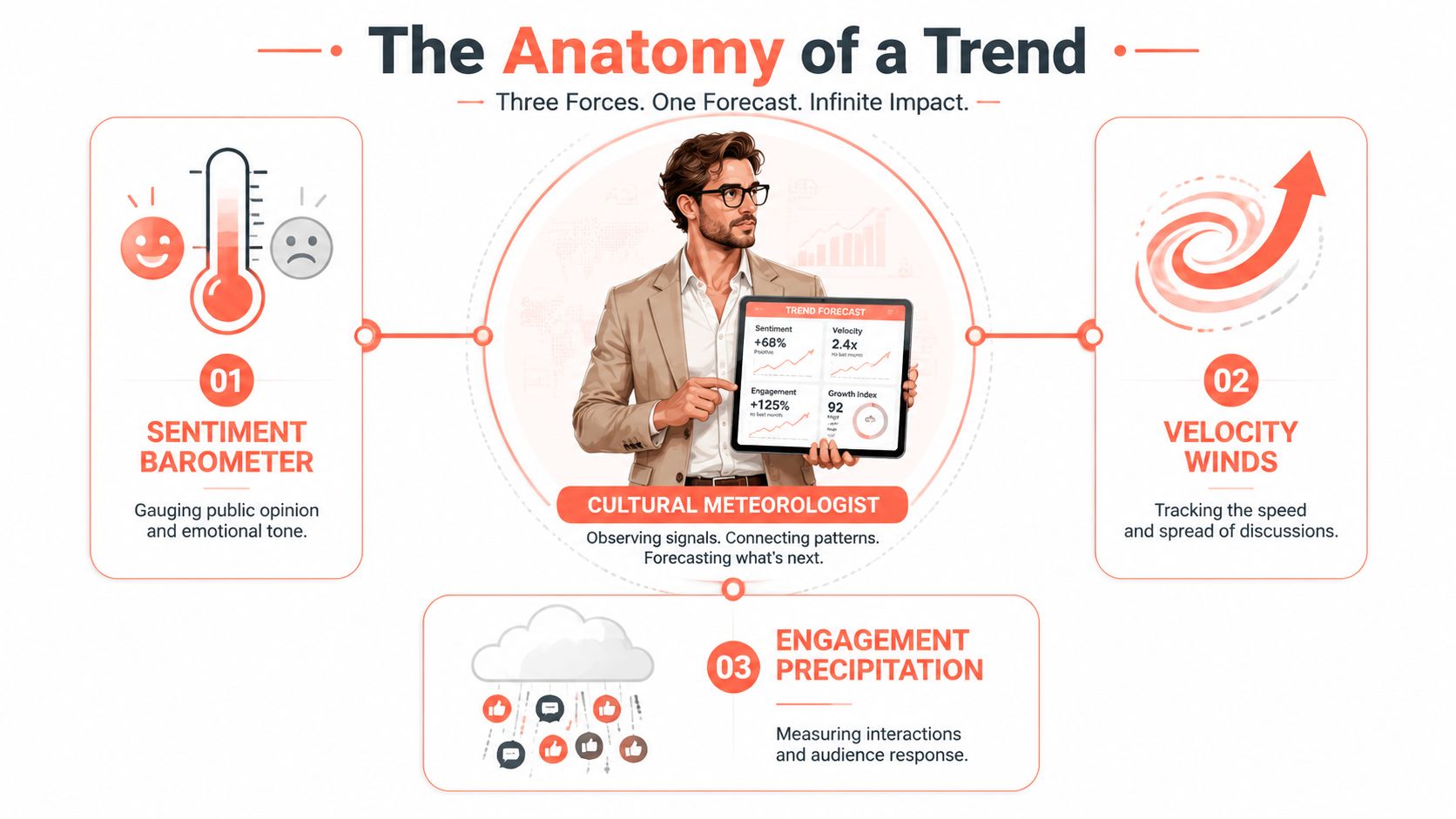
A good trend analyst works like a cultural meteorologist. You're not just reporting that it's hot outside because one post blew up. You're watching pressure systems, comparing patterns, and deciding whether the weather is changing.
Fads, trends, and behavioral shifts
A fad is usually a short spike, like a meme format that burns hot and disappears. A trend lasts longer and tends to point in a directional movement, such as a growing preference for short-form video. A behavioral shift is the hardest to miss and the most valuable, because it changes how people use platforms at a structural level, like moving attention from public posting to more private or community-based interaction.
A common error is treating every surge as if it belongs in the same bucket. If you're running a resource-constrained content function, that's expensive. A fad might deserve a lightweight response. A trend might deserve a planned campaign angle. A behavioral shift should alter your content system.
What to watch inside the trend itself
Every trend has three forces worth tracking. Sentiment tells you how people feel, velocity tells you how quickly discussion is spreading, and engagement tells you whether people are doing more than passively noticing it. Those are the parts of the weather system that matter when you decide whether to allocate time.
That matters commercially because platforms with huge advertiser demand tend to reward teams that can read the signal early. Social media is no longer a side channel, it's embedded in media buying, audience discovery, and brand visibility. When ad spend is this large, a small platform shift can have a real cost attached to it, even when the change looks small on the surface.
The useful mindset is simple. Don't ask whether something is popular. Ask whether it's merely noisy, or whether it's changing how people talk, discover, and share.
Where to Find Signals Before They Peak
The best early signals rarely look impressive at first. They look repetitive. You notice the same question in comments, the same phrase in threads, the same visual treatment across different creators. That's the point, because emerging trends usually announce themselves through pattern, not spectacle.
Three signal layers worth watching
Conversational signals are the easiest place to start. Look for repeated questions, new jargon, and sentiment shifts in replies and comment threads. Those clues tell you what people are confused about, excited by, or pushing back against.
Format signals are different. They show up when creators adopt a new editing style, framing style, carousel structure, or post rhythm. If people keep using the same structure in different contexts, the format itself may be the trend.
Search and topic signals are the least glamorous and often the most useful. Platform search surfaces, topic clustering, and recurring hashtag families can reveal whether a subject is moving from a niche discussion into a broader one. If you want a deeper view of how people are finding discussions on X, the practical walkthrough in discover trending topics for growth is a good companion read.
The technical part matters too. Boolean query design, with operators like AND, OR, and NEAR, helps separate signal from clutter. Topic modeling methods such as K-means clustering and latent Dirichlet allocation, or LDA, have been widely used in social-media mining work, and the review cited in the brief notes that these approaches were among the most applied across selected research. That's useful because manual browsing alone tends to overvalue whatever is loudest in the moment, as described in AData's overview of media and social analytics.
For planning content around those signals, it helps to anchor the workflow in a clear calendar. The practical planning framework in WaveGen's social media content planning guide pairs well with this kind of signal review because it forces teams to think beyond one post and into sequencing.
A trend isn't useful because it exists. It's useful when you can name the audience, the format, and the angle before everyone else does.
A Practical Framework for Analyzing Trends
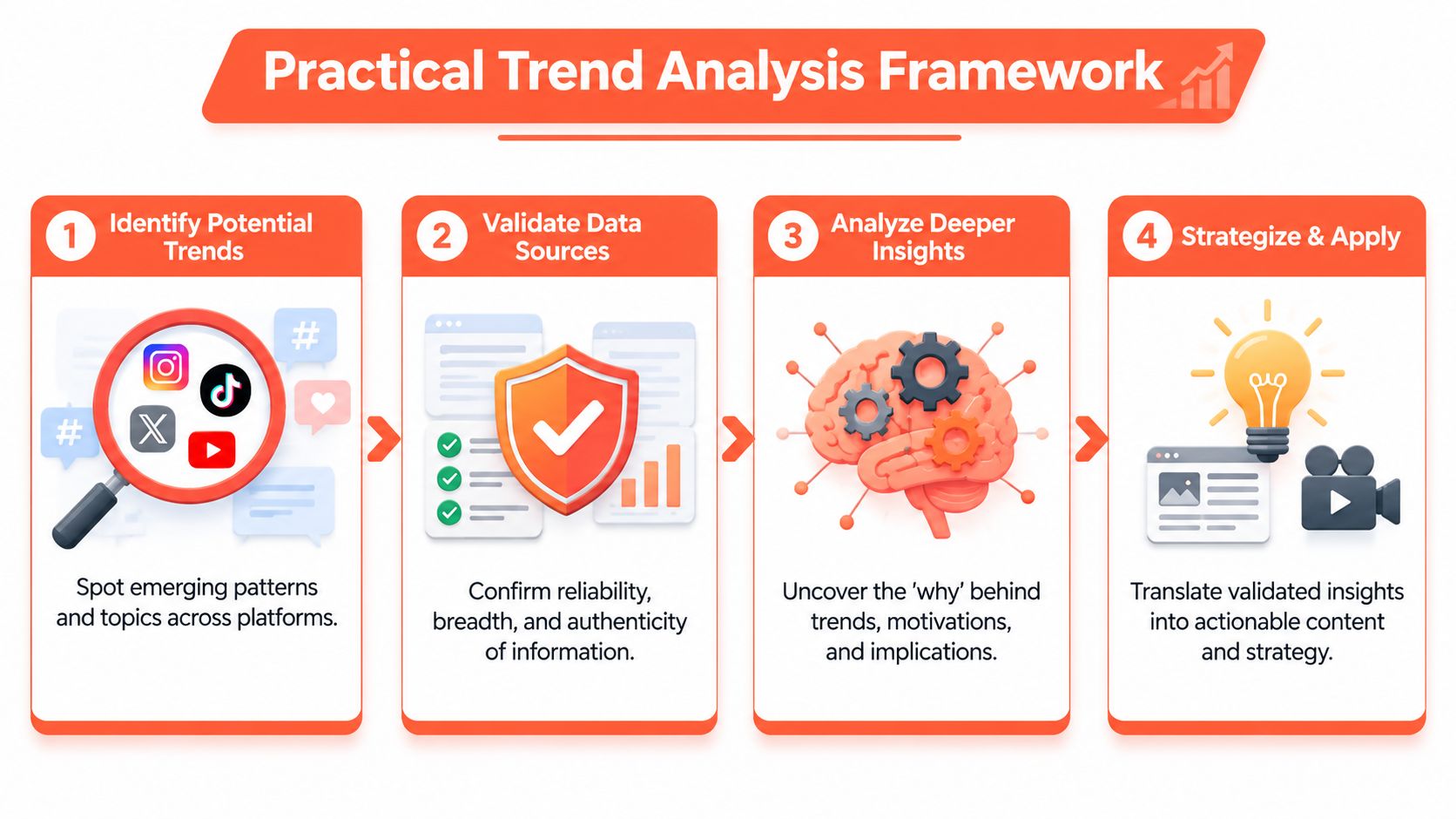
The cleanest way to handle trend chaos is to turn it into four decisions. Identify, validate, strategize, execute. If a team can't move through those steps quickly, the feed will make the decisions for them.
Identify potential trends
Start broad. Watch recurring language, repeated formats, and clusters of related topics across the platforms where your audience spends time. Don't rely on one hashtag, because hashtags are often lagging indicators. The point is to spot something early enough that you can still respond with your own voice.
Validate with a stable baseline
Validation is where most reactive teams fall apart. Treat trend analysis like a time-series problem, collect at least 12 months of historical data, then compare the current period against a stable base period using a formula like ((Current Period Value − Base Period Value) ÷ Base Period Value) × 100. That's the cleanest way to separate sustained movement from a one-off spike, as outlined by Brandwatch.
Strategize your angle
A trend is not a content brief. If the audience cares but your brand has no distinctive angle, skip it or keep it lightweight. That's where many teams waste effort, because they copy the surface pattern instead of deciding whether the trend matches their positioning, lifecycle stage, and competitive context.
Execute and measure
Execution should be the fastest part, not the most creative. Pick the channel, define the job of the post, and measure the specific response that matters for that format. A search-led topic, a community-led debate, and a short-form video trend should not be judged the same way.
If you need a practical commercial lens for judging whether a topic deserves attention, the dropshipping-focused example library in discover profitable dropshipping products is useful because it shows how trend discovery and market selection often overlap in real workflows.
From Insight to Content A Quick Wins Workflow
A recurring question in comments is often the best trend signal you'll ever get. It tells you what people are stuck on, what they want explained, and which topic has enough friction to deserve a fuller answer. For a resource-constrained team, that's gold, because one good question can produce a week of content if you build the workflow around it.
One insight, many assets
Say an advisor notices the same complex question showing up in LinkedIn comments. The first move isn't to chase a meme. It's to record a focused 10-minute video answering the question clearly, with enough structure that the response can be sliced into smaller assets later.
From that one recording, the repurposing path is straightforward. The transcript can become a carousel for Instagram, a tighter text-led post for LinkedIn, quote cards for X or Threads, and a short vertical clip for TikTok or Shorts. That's the primary efficiency gain, because the work shifts from inventing new ideas every day to extracting more value from a proven idea.
How to decide if the trend is worth the effort
Before committing production time, ask whether the audience cares, whether the trend has already peaked, and what competitors are doing. Those are the three questions that keep teams from confusing trend visibility with trend worthiness, which is a useful distinction for brands that need repeatable systems rather than occasional wins, as Social Insider frames it.
A good triage rule looks like this:
- High fit, rising conversation: invest in a pillar asset and repurpose aggressively.
- High fit, flat conversation: keep it in the editorial queue and publish when you can add a sharper angle.
- Low fit, high visibility: ignore it unless it supports brand awareness without much lift.
- Low fit, declining attention: skip it.
The reason this works is simple. Organizations often don't fail because they lack ideas. They fail because every new idea demands too much fresh production. Content systems solve that by making one strong insight do more work.
The internal discipline matters too. If your brand pillars aren't clear, trend selection becomes random. A focused pillar set gives you a filter for deciding which conversations deserve a full response, which is why a documented framework like WaveGen's content pillars guide is so useful behind the scenes.
If a trend can't be repurposed into at least two or three formats without losing the point, it usually isn't strong enough to anchor a week of content.
Real Brands Winning with Trend Analysis
The strongest trend programs don't look flashy. They look consistent. B2B teams use trend analysis to time authority content, while consumer brands use it to make product discovery feel native to the feed.
B2B consultancy on LinkedIn
A consultancy that tracks recurring pain points in LinkedIn comments can turn those patterns into timely webinar topics and thought leadership posts. The value isn't in being first to every topic, it's in being first to answer the question the audience is already asking in public.
That approach works because it maps trend analysis to trust. If decision-makers keep asking the same thing, a concise, well-structured response becomes a signal of competence. Over time, that type of content builds a reputation for relevance without relying on gimmicks.
DTC brand on TikTok
A direct-to-consumer brand can use audio and format trends on TikTok to make product discovery feel entertaining rather than promotional. The brand doesn't need to force a hard sell into every clip. It can borrow the structure of the trend, then place the product inside a format people already understand.
The key is restraint. Not every trend deserves a brand spin, and not every brand should sound the same in every channel. The best consumer examples use trend energy to lower friction, then let the product benefit speak for itself.

What links both cases is the same operational logic. They don't start with content volume. They start with a signal, validate whether it's worth the effort, then repurpose it into the formats each platform rewards. That's how trend analysis becomes a repeatable business process instead of an occasional creative sprint.
Conclusion Building a Sustainable Trend Engine
The goal of social media trend analysis isn't to win one viral moment. It's to build a system that consistently turns attention into useful content. That means you need three layers working together, identification through social listening, validation through analytics, and execution through a repurposing workflow.
The tool stack can stay simple. Use social listening platforms to catch signals, analytics tools to separate spikes from meaningful movement, and a content distribution system to turn one strong idea into a week of platform-specific output. If you want the execution layer to run without constant manual rebuilding, WaveGen's content creation automation guide is worth reading because it shows how the repurposing side can be systematized.
The teams that stay relevant aren't the ones that react fastest to everything. They're the ones that know which signals matter, which trends fit the brand, and how to turn a single insight into multiple assets without starting over each time. That's the advantage, and it compounds.
If you're ready to turn trend monitoring into a repeatable content engine, start by mapping one recurring audience question to one pillar asset, then repurpose it across the channels you already manage. For a faster way to turn validated ideas into consistent multi-channel output, explore WaveGen.ai.
social media trend analysis
content strategy
social media marketing
trend spotting
content repurposing
Turn this kind of writing into a week of social content.
Paste a blog post, newsletter, or rough draft — WaveGen turns it into publish-ready carousels, captions, and slideshows for every channel.
No credit card · First posts in 2min