August 28, 2026
13 min read
How to Maintain Brand Consistency Across Channels
Learn how to maintain brand consistency with practical brand kits, approval workflows, and automation tips that keep every channel on-message.
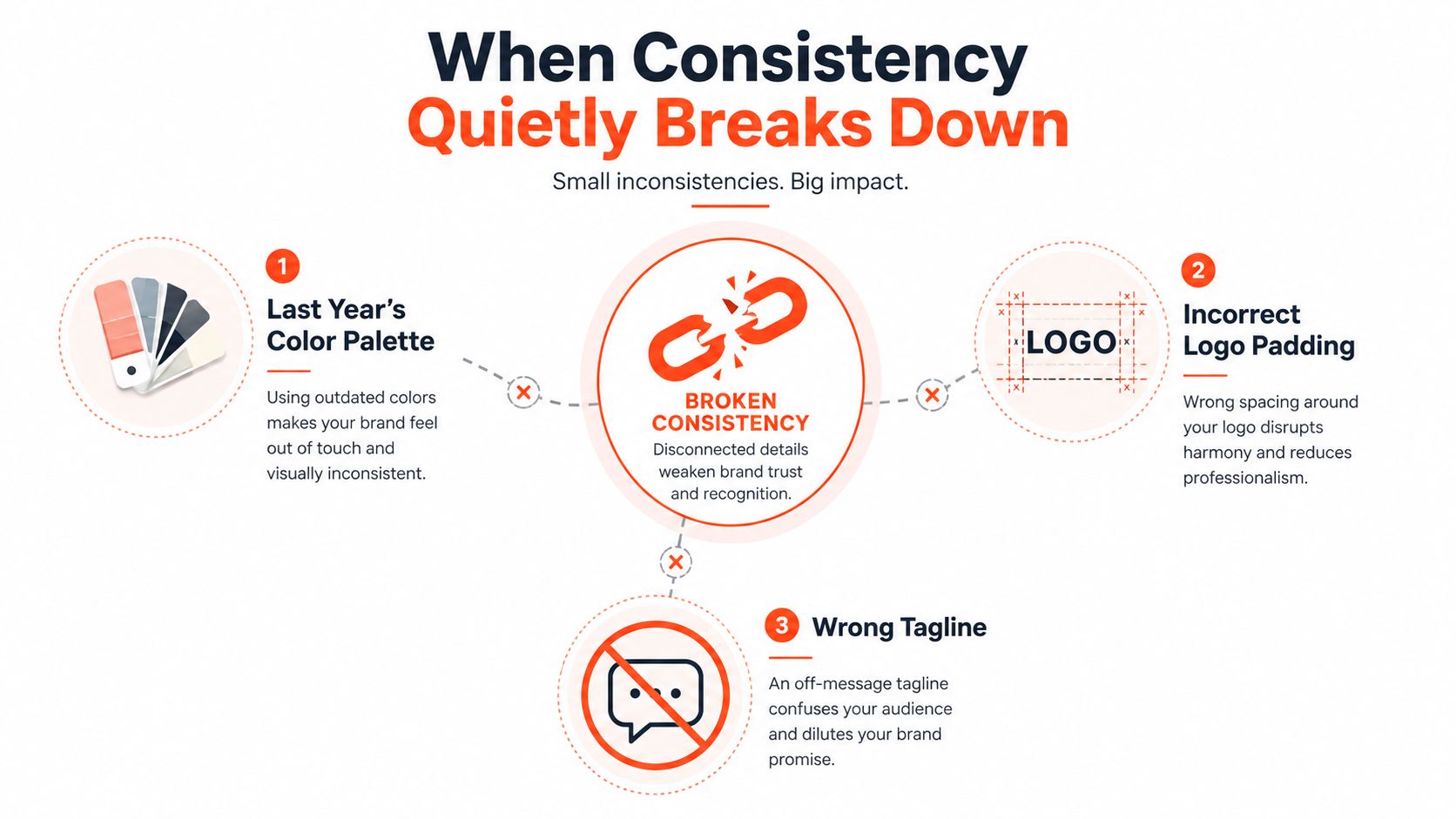
Tuesday morning starts with a familiar kind of damage. The CMO publishes a chart using last year's colors, the email team drops in a logo with the wrong clear space, and a freelancer sends a carousel with an outdated tagline. Nothing crashes. No alert fires. The brand looks slightly different in three places, then slightly different again by Friday.
That's why how to maintain brand consistency isn't mainly a question of taste or employee attention. It's a production design problem. If your workflow depends on every designer, marketer, contractor, and executive remembering the rules under deadline pressure, inconsistency is already built into the system.
Strong teams move brand decisions upstream. They create structured kits, locked templates, clear approval paths, and repurposing workflows that make the correct choice the easiest choice. The result isn't identical content everywhere. It's a recognizable brand that adapts without losing its identity.
Table of Contents
- When Consistency Quietly Breaks Down
- Build a Brand Kit That Systems Can Read
- Turn the Kit Into Templates, Not Just PDFs
- What Consistency Actually Means on Social
- Approval Rules That Do Not Slow You Down
- Automate the Pipeline and Repurpose Source Content
- Measure and Audit Consistency Over Time
When Consistency Quietly Breaks Down
The three mistakes above rarely come from careless people. The CMO may have opened an old slide deck, the email marketer may have grabbed the first logo in a shared folder, and the freelancer may have worked from a brief written before the latest positioning update. Each person made a reasonable decision with incomplete information.
That pattern creates off-brand drift. Slack contains one version of the tagline, Figma contains another, a Google Drive folder contains an old logo, and the social scheduler still holds templates from a previous campaign. Teams then compensate with reminders, review requests, and last-minute corrections. Those interventions feel responsible, but they don't repair the pipeline that created the problem.
A useful guide to design consistency can help teams define the visual principles, but principles alone won't stop an outdated asset from being selected. Your operating system needs ownership, version control, and defaults that prevent common errors before a human reviewer sees the draft.
Practical rule: If the same mistake appears more than once, stop asking people to be more careful. Change the workflow.
Start with an inventory. List every channel, recurring format, asset library, and person who can publish. Mark where the current brand kit lives, which templates are approved, and where local teams can customize content. Then use your findings to build a production system, as the broader business case is outlined in why brand consistency matters.
The target is simple: make approved colors, logos, language, and layouts available inside the tools people already use. Make old versions difficult to find. Route only unusual or high-risk work to a human reviewer. Consistency should emerge from normal production, not depend on heroic proofreading at the end.
Build a Brand Kit That Systems Can Read
A PDF brand book is useful for orientation, but it's a weak production tool. People can read a guideline and still choose the wrong hex value, font weight, logo variation, or tone because the approved option isn't available at the moment of creation.
Build the kit as structured data plus examples. Store the definitions in a source of truth that design and content tools can access, then connect the approved values to templates and publishing workflows.
The four blocks every kit needs
Color tokens should include HEX, RGB, and CMYK values, along with approved contrast pairings for text, buttons, backgrounds, and captions. Name them clearly, such as --color-primary, --color-surface, and --color-text-muted. A token gives a tool a reusable value instead of giving a person a paragraph to interpret.
Typography rules should state the font family, available weights, line-height ratios, and minimum sizes for headings, body copy, captions, and on-screen video text. Include fallback fonts for environments where the primary family isn't available.
Logo assets need approved full, mark, monochrome, and reversed versions. Define clear space in pixels and specify which version belongs on light, dark, busy, and small-format backgrounds. “Give the logo room to breathe” sounds friendly, but a pixel value is enforceable.
Voice and tone should use a matrix, not a list of adjectives. Add do-say and don't-say examples for contexts such as product launches, customer support, executive communication, and social replies. A friendly launch announcement may use energy and momentum, while a support reply needs clarity and restraint.
| Block | Required Fields | Example Token | Source-of-Truth Tool |
|---|---|---|---|
| Color | HEX, RGB, CMYK, contrast pairings | --color-primary |
Figma Variables |
| Typography | Family, weights, line height, minimum sizes | Type.heading.medium |
Frontify |
| Logo | Variants, clear space, background rules | Logo.reversed |
DAM or Notion |
| Voice | Context, approved language, anti-examples | Voice.friendly |
Notion database |
Tools such as Figma Variables, Frontify, or a carefully maintained Notion database can work. The choice matters less than one current definition. Connect that source to Canva, Google Slides, your CMS, and the asset library where possible. The useful concept is documented well in this overview of guardrails for creative workflows.
Add governance directly to the kit. Name the owner, record the last review date, explain how someone requests a change, and state who approves updates. For a deeper implementation walkthrough, see how to create a brand kit. A kit without ownership eventually becomes another archive of conflicting answers.
Turn the Kit Into Templates, Not Just PDFs
Templates convert brand policy into production infrastructure. Instead of asking every creator to interpret the kit from scratch, pre-build the formats your team publishes repeatedly and lock the decisions that should never change.
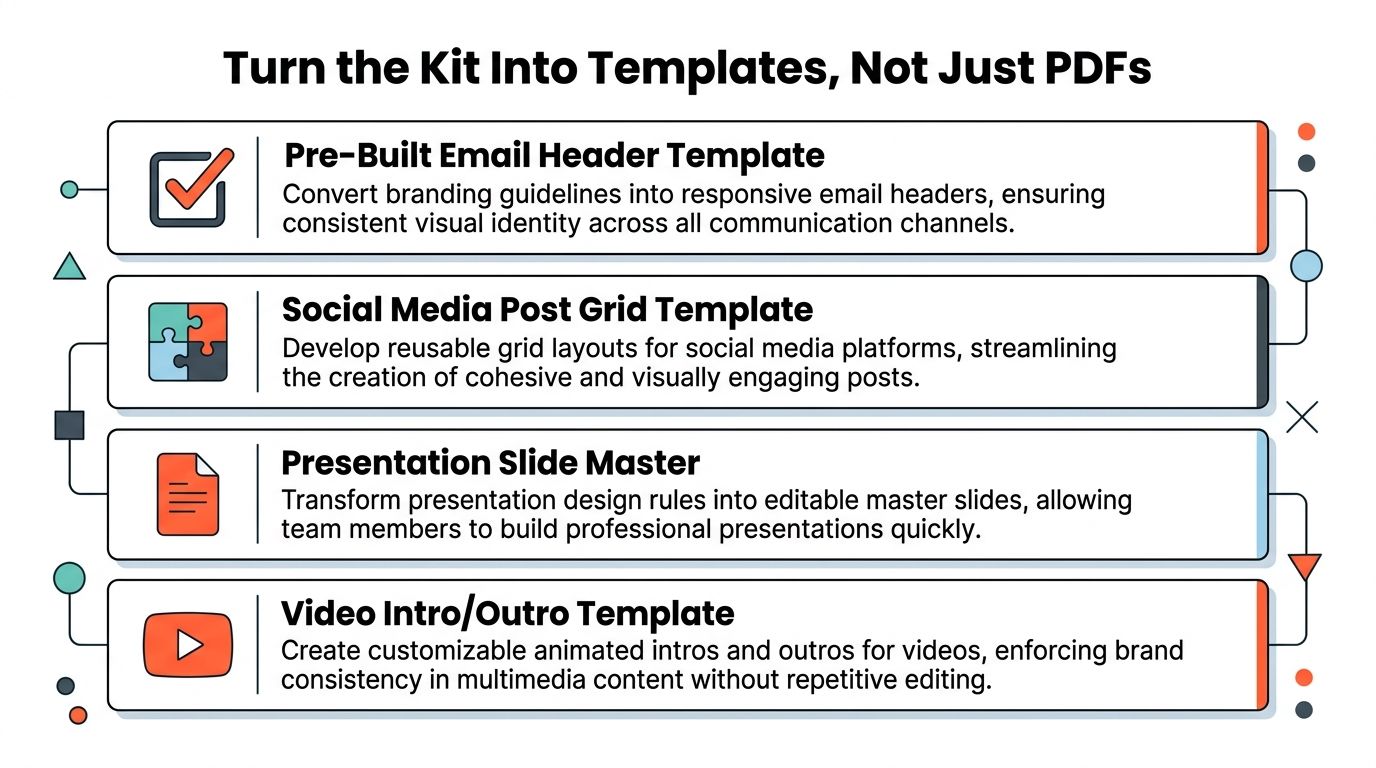
For an Instagram carousel, create a square master with locked type styles, brand variables, image treatment, and safe zones. The marketer should replace the headline, example, or image without rebuilding the visual system. For short-form video, use CapCut, Adobe Express, or Canva templates with preset captions, lower-thirds, transitions, and a logo bug.
Email templates should hard-code the header layout, button treatment, link color, and footer. Blog and LinkedIn templates can define heading hierarchy, image ratios, pull-quote treatment, and an author bio block. Caption templates can provide hook stems, call-to-action patterns, and tone settings without forcing identical copy.
Decide what creators can change
A practical template separates protected elements from editable elements.
- Protect the identity: Logo placement, core colors, type styles, recurring graphic elements, and legal language should be locked where the tool allows it.
- Allow useful localization: Headlines, examples, supporting images, event details, and platform-specific calls to action should remain editable.
- Limit visual decisions: If a creator must make more than two major visual choices before publishing, the template is probably too loose.
That balance prevents two common failures. A completely open template recreates the original chaos. A completely locked template forces people to work around the system when a local message or timely format doesn't fit.
Version every template. Use a clear name, an owner, a date-stamped update note, and an archive for retired versions. When the brand changes, remove old templates from everyday search and communicate the replacement. A redesign shouldn't leave people guessing which file is current.
The template library should also reflect real demand. If marketers repeatedly create event announcements, product comparisons, quote cards, or customer education posts outside the approved system, build those formats next. Adoption improves when the library solves the work people need to do.
What Consistency Actually Means on Social
Consistency doesn't mean copying the same caption to every platform. A brand can preserve its identity while changing the length, hook, rhythm, and format for the audience in front of it.
A 2024 study found that social communication consistency strongly influenced brand awareness, with visual consistency and posting-frequency consistency significant, while verbal consistency wasn't significant (study reference). That finding supports a more useful operating model. Standardize recognizable visual cues, cadence, and core message pillars, then let the wording fit the channel.
Audit three separate layers
Visual consistency covers the elements people recognize quickly: logo placement, palette, typography, photography treatment, motion language, and recurring shapes.
Verbal consistency covers point of view, vocabulary, tone, promises, and words the brand avoids. The sentence shouldn't be identical, but the character behind it should be recognizable.
Frequency consistency covers publishing cadence, format mix, and response expectations. A brand that appears intensely for a week and disappears for a month creates a different impression from one that maintains a dependable rhythm.
| Layer | What Stays Fixed | What Flexes Per Platform | Audit Question |
|---|---|---|---|
| Visual | Palette, logo behavior, type system, image treatment | Crop, layout, motion, aspect ratio | Would the asset be recognizable without the account name? |
| Verbal | Point of view, promise, vocabulary, prohibited claims | Length, hook, emoji use, hashtag density | Does this sound like the same brand in a native format? |
| Frequency | Strategic cadence and campaign rhythm | Posting times, format sequence, response style | Can the audience predict when and how you show up? |
LinkedIn may need a developed business insight. TikTok may need an immediate visual hook and spoken language. X may require concise wording. Treating those channels as identical distribution endpoints produces content that feels native nowhere.
A platform matrix makes the decision visible. Record the fixed elements, the flexible elements, and one approved example for each channel. Teams looking for more guidance on how to keep brand voice consistent can use that exercise to turn abstract tone guidance into editing decisions.
For a reusable starting point, adapt a brand voice guidelines template. Audit for pattern recognition, not word matching. The question is whether the audience experiences one coherent brand across different formats.
Approval Rules That Do Not Slow You Down
Approval workflows become bottlenecks when every asset requires the same meeting, the same reviewer, and the same level of scrutiny. They also become irrelevant when people wait too long and start publishing around them.
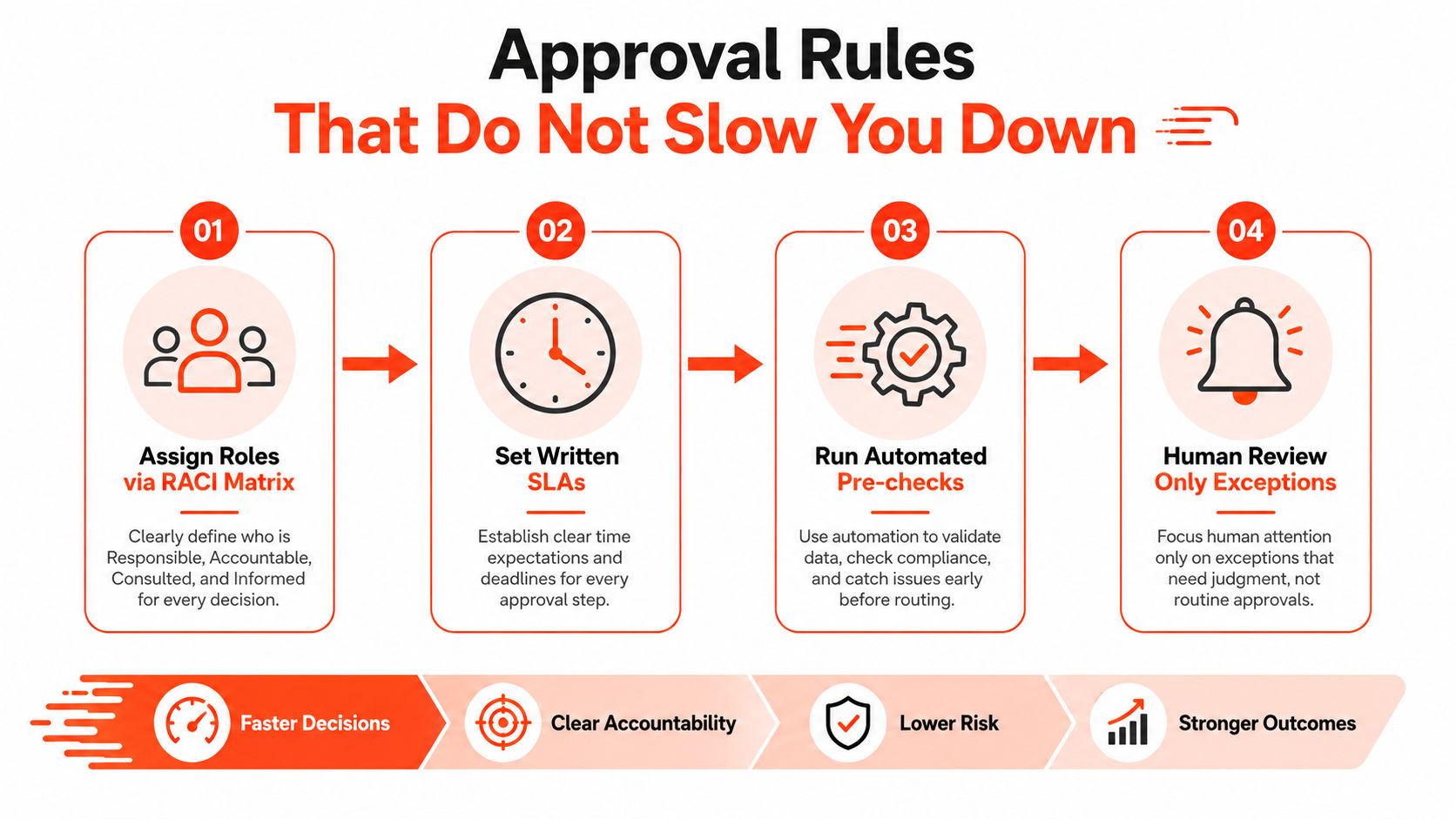
Use a lightweight RACI matrix, written service-level expectations, and automated pre-checks. Humans should review exceptions, not repeatedly confirm that a locked logo is still the locked logo.
Use four review tiers
| Tier | Trigger | Owner | Target response | Fallback |
|---|---|---|---|---|
| 1 | Approved template and ordinary message | Creator | Self-serve | Publish after checklist |
| 2 | New variation or peer-editable copy | Peer reviewer | Within 4 hours | Named backup reviewer |
| 3 | New campaign, positioning, or sensitive claim | Brand lead | Within 24 hours | Deputy brand lead |
| 4 | Legal, regulatory, or executive risk | Legal or executive owner | Within 48 hours | Escalation contact |
Write the rules in plain language. Define who is Responsible, who is Accountable, who must be Consulted, and who only needs to be Informed. Give every reviewer a backup and every SLA a fallback. “Waiting for approval” shouldn't be a status without an owner.
Automate predictable checks wherever your stack permits it. A script can reject an Instagram caption that omits a required brand term. A Canva Brand Kit can keep creators inside approved colors. A Slack bot can alert a reviewer only when a draft includes a flagged phrase. These checks don't replace judgment. They reserve judgment for decisions that need it.
Create a shared status board with fields for asset owner, tier, reviewer, due time, decision, and revision reason. The revision reason matters because repeated comments reveal missing template rules. If reviewers keep correcting the same CTA, add the correct CTA pattern to the system instead of leaving the answer trapped in comments.
Automate the Pipeline and Repurpose Source Content
Manual production creates inconsistency because each new creator makes fresh interpretations of the same brand. A better pipeline begins with one approved source asset, then turns that source into channel-specific drafts against the existing kit and templates.
The source might be a blog article, newsletter, podcast script, webinar, or YouTube transcript. An RSS feed or webhook can trigger the next step, sending the source to a repurposing tool. The tool should produce drafts, not publish unchecked material. A creator still verifies claims, selects the strongest excerpts, and adjusts the emphasis for each audience.
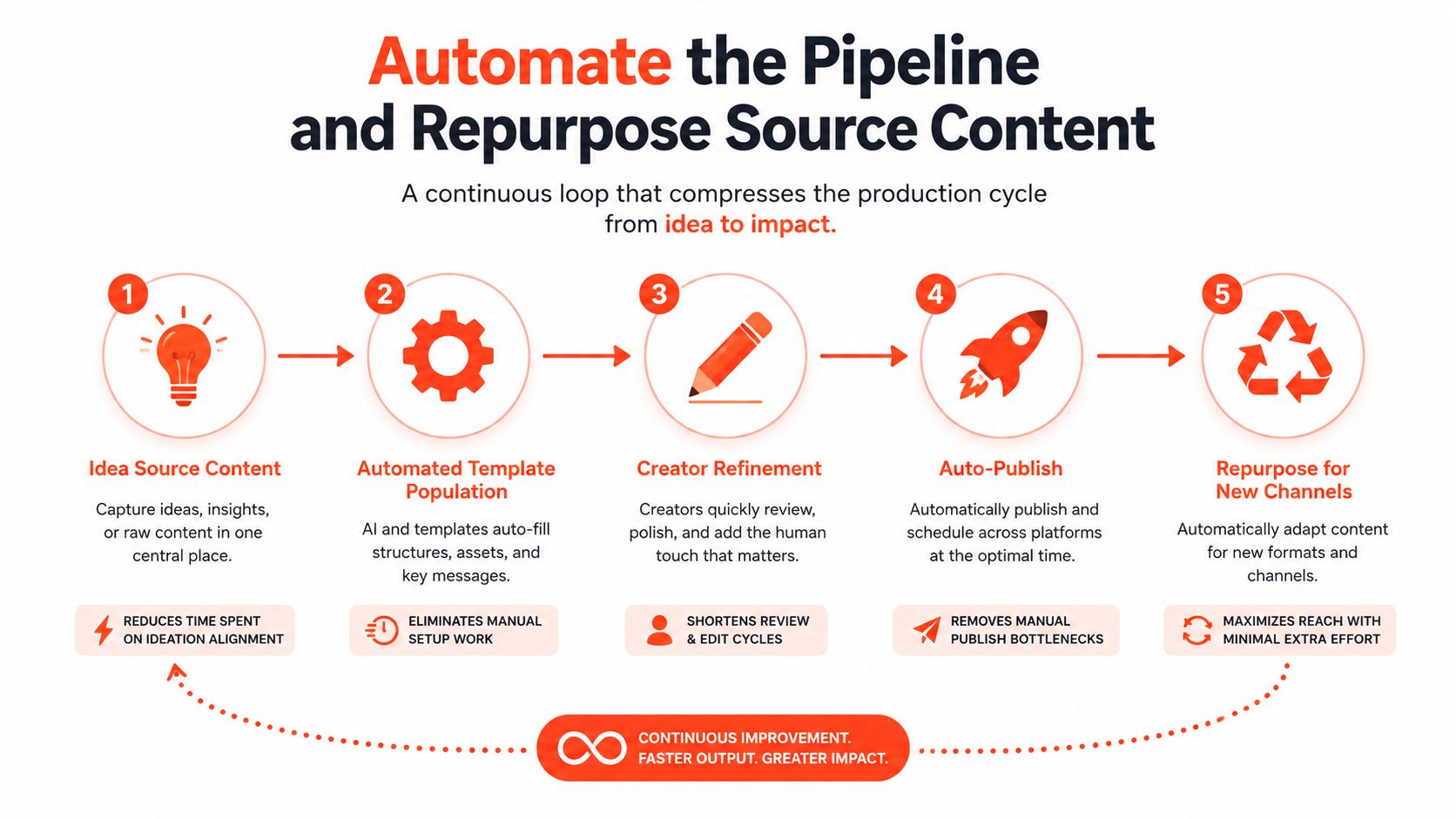
WaveGen.ai is one option for this workflow. It can use a source URL to generate on-brand carousels, short videos, captions, and email snippets, with brand colors, fonts, logo, and voice set in the brand kit. The output can then be edited before scheduling through supported social publishing workflows.
A practical handoff
- Choose the source: Mark one article or recording as the canonical asset.
- Extract the ideas: Identify the central argument, supporting points, examples, and calls to action.
- Populate templates: Create channel-native drafts rather than one post copied everywhere.
- Refine centrally: Have one creator check facts, tone, visuals, accessibility, and duplication.
- Schedule with controls: Use Buffer, Hootsuite, or native platform queues, then record the source ID on every derivative.
That source ID creates the deduplication layer. Before scheduling, check whether the same idea, quote, or clip already has a live or queued version. This prevents a repurposing system from publishing the same message twice while still allowing different formats to serve different channels.
Automation should reduce repeated decisions, not remove editorial responsibility. The source remains the authority, templates protect the identity, and human review improves relevance.
Measure and Audit Consistency Over Time
A brand system can look organized while losing adoption. Measure the workflow itself, not just audience response. Reach and engagement may reveal the consequences of drift later, but they won't tell you whether creators are using current templates or whether approvals are catching preventable mistakes.
Track four operational indicators:
- On-brand asset rate: Sample published work by channel and record whether each asset follows the current kit.
- Time to publish against SLA: Compare actual approval time with the assigned review tier.
- Deviation incidents caught: Log errors found during review, including outdated logos, incorrect colors, unsupported claims, and tone violations.
- Approved-template reuse: Monitor whether creators start from the governed library or rebuild common formats independently.
Run a monthly audit ritual
Set aside a short recurring review with one owner and a shared scorecard. Sample recent posts from every active channel, score each against the checklist, and record the exact deviation rather than writing “off-brand.”
Use a simple workspace in Looker Studio or Notion to surface:
- Channel patterns: Which platforms produce the most deviations?
- Workflow friction: Where do drafts wait longest?
- Template gaps: Which requests repeatedly fall outside the library?
- Version problems: Which retired assets still appear in production?
- Ownership: Who is responsible for each corrective action?
The audit should end with decisions, not observations. Retire an old template, add a missing example, change a permission, rewrite a confusing rule, or adjust an approval tier. Assign one owner and a due date to every fix.
The historical business case reinforces why this deserves operating attention. Research summarized by Omnibound links consistent brand presentation with a 10% to 33% revenue increase, with 23% commonly cited as a benchmark, and reports that 68% of companies said brand consistency contributed directly to revenue growth. Those figures don't turn every visual mistake into a financial loss, but they do show why consistency belongs in brand operations, not only in design reviews.
Execution remains difficult. A 2026 summary reported that only about 25% of companies with brand guidelines enforce them consistently, while 81% said they deal with off-brand content (DashoContent summary). The same source cites a 2024 System1 and IPA study in which the most creatively consistent brands averaged 3.3 stars, compared with 2.8 stars for somewhat consistent brands and 2.6 stars for the least consistent brands. Treat those findings as a reason to inspect your system, not as permission to chase a single score.
If your own audit shows deviation rising for two consecutive months, redesign the pipeline. More reminders won't fix missing templates, unclear ownership, inaccessible assets, or approvals that arrive after publication.
WaveGen.ai turns one article, newsletter, podcast script, or video transcript into on-brand carousels, short videos, quote cards, captions, and email snippets using the brand kit you define once. Visit WaveGen.ai to test a source-content workflow that keeps channel adaptations recognizable without asking your team to recreate every asset manually.
brand consistency
brand guidelines
content workflow
brand kit
social branding
Turn this kind of writing into a week of social content.
Paste a blog post, newsletter, or rough draft — WaveGen turns it into publish-ready carousels, captions, and slideshows for every channel.
No credit card · First posts in 2min