September 18, 2026
13 min read
B2B Content Distribution: A 2026 Guide
Learn how to master B2B content distribution across multiple channels. Reach your target audience effectively with our practical 2026 guide.
A B2B buyer consumes an average of 13.4 pieces of content before contacting sales, while 67% of the buying journey is self-directed, according to ZoomInfo's 2026 B2B content dataset. That should change how you think about b2b content distribution.
Many teams still treat distribution as the task that follows publishing. They write the article, schedule a company-page post, send an email, and move on to the next asset. Buyers don't move that quickly. They return when the problem becomes urgent, when an internal discussion starts, or when a vendor comparison reaches the agenda.
Your content distribution program must stay visible between those moments. The operating model below focuses on channel choices, repurposing, workflow, and measurement, with one principle guiding every decision: build for buyer attention, not creator momentum.
Table of Contents
- Why B2B Content Distribution Is Now a Core Operating System
- What B2B Content Distribution Actually Means in 2026
- The Four Pillars of a Working Distribution Strategy
- Choosing the Right Channels for Your Audience
- Repurposing One Idea Into a Week of Assets
- The Hidden Gap Between Creation and Buyer Attention
- Building a Distribution Workflow That Runs Without You
- Measuring What Matters and Your 30-Day Next Step
Why B2B Content Distribution Is Now a Core Operating System
Content creation produces an asset. Distribution determines whether that asset enters the buyer's research process at all. Treating distribution as a final checklist item leaves valuable ideas trapped on your website while prospects learn from vendors who publish less carefully but distribute more consistently.
The shift is visible in the market. The Content Marketing Institute's 2026 B2B research reported that 97% of marketers had a content strategy, 96% were creating thought leadership content, and 76% considered LinkedIn the single most effective distribution channel for thought leadership. Those figures point to a mature category. Publishing alone isn't a strategy anymore. Teams need a repeatable amplification system.
What a functioning system should produce
A serious distribution operation gives you four practical outcomes:
- A defensible channel mix: You can explain why each channel fits a buyer stage and audience behavior.
- A repurposing engine: One strong article, webinar, or interview becomes multiple native assets without losing its central argument.
- A dependable workflow: Output doesn't depend on a founder remembering to post or a designer clearing an urgent request.
- Revenue-aware measurement: You can identify content touches that assist qualified pipeline, not just content that attracts casual attention.
Start by documenting the path from source asset to buyer-facing format. Mark the owner, required review, channel, audience, call to action, and measurement point for each step. If a junior marketer can't follow that path without asking the same questions repeatedly, your process isn't operational yet.
Practical rule: Creation earns the right to compete. Distribution gives the idea enough opportunities to be noticed.
Distribution also needs a close relationship with search. Your owned content still needs a clear topic architecture, internal linking, and buyer-focused intent mapping. SemDash's B2B SEO playbook is useful when you're connecting search strategy with the broader content engine rather than treating SEO as a separate publishing task.
What B2B Content Distribution Actually Means in 2026
B2B content distribution is the deliberate matching of owned, earned, and paid channels to the way buyers consume information across a self-directed research process. It isn't just posting a link in several places. It means deciding which idea belongs in a LinkedIn post, which argument deserves a webinar, which insight should enter an email sequence, and where paid amplification can extend proven relevance.
Creating content without distribution is like pouring water into sand. The work disappears before it reaches the people who need it.
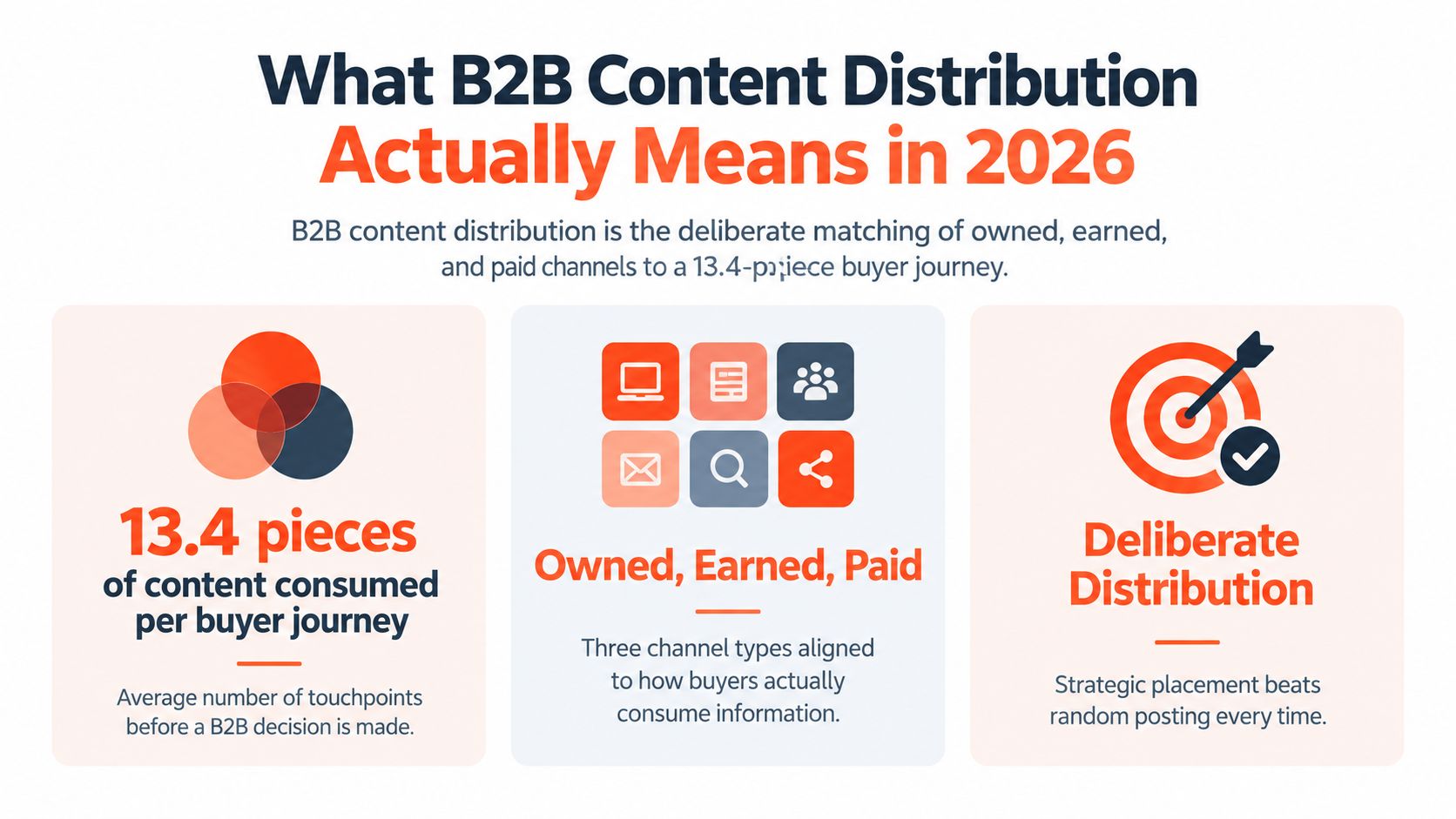
The buyer journey described by the ZoomInfo dataset includes 13.4 content interactions before a sales conversation, and 60% of B2B buyers make final purchase decisions based on digital content. Those figures make distribution a pre-sales revenue lever. Prospects form opinions, eliminate vendors, and assemble shortlists before your sales team receives a direct signal.
The 2026 CMI data also shows where attention concentrates. LinkedIn is the most effective thought leadership distribution channel for 76% of marketers, so professional networks deserve serious investment. They don't deserve exclusive investment. A LinkedIn post may create discovery, while an email newsletter, peer community, webinar, or useful comparison page may build the trust required for evaluation.
The three channel roles
Owned channels include your website, blog, resource library, newsletter, and event registration system. They give you control over context and first-party signals.
Earned channels include organic mentions, guest contributions, backlinks, partner sharing, and community references. They extend credibility beyond your own publishing surfaces.
Paid channels include sponsored social posts, paid newsletter placements, search advertising, and selective content promotion. They can accelerate reach, but they shouldn't rescue content that fails to serve a clear audience need.
The old model ended at “publish and promote.” The modern model sequences exposure, education, trust, and action across multiple environments.
The Four Pillars of a Working Distribution Strategy
A durable program rests on four connected decisions. If one fails, the others become less effective. Great channel selection can't compensate for a weak workflow, and advanced reporting can't fix content that never reaches the right audience.
| Pillar | Core Question | Common Failure |
|---|---|---|
| Channel selection | Where do qualified buyers actually research and exchange opinions? | Choosing platforms because the marketing team already uses them |
| Repurposing | How can one strong idea become native assets for different contexts? | Copying the same caption and link across every channel |
| Workflow | Who owns each handoff from source asset to published distribution? | Relying on memory, last-minute requests, and executive availability |
| Measurement | Which distribution activity contributes to qualified pipeline? | Reporting impressions, followers, and clicks without revenue context |
Channel selection starts with buyer evidence
Ask sales, customer success, and recent customers where research happens. Review referral paths, CRM notes, newsletter engagement, event registrations, and inbound search topics. A channel earns investment when it helps your audience understand a problem or evaluate a solution, not because it offers a convenient publishing interface.
Repurposing protects quality
Repurposing isn't a shortcut for producing filler. It extracts different entry points from the same valuable idea. A technical explanation can become an executive opinion, a visual breakdown, a short video script, an email lesson, and a sales enablement excerpt. Each asset should make sense on its own.
Workflow removes heroics
Document intake, tagging, drafting, review, scheduling, and reporting. Define which assets need legal or executive approval and which can move through a pre-approved brand system. A good workflow reduces avoidable decisions without removing editorial judgment.
Measurement keeps the program honest
Track reach as a diagnostic, not a final outcome. Connect content interactions to form submissions, qualified opportunities, sales conversations, and assisted conversions. Attribution won't be perfect, but an imperfect revenue view is more useful than flawless vanity reporting.
Choosing the Right Channels for Your Audience
Don't begin with “Which channels should we use?” Begin with “Where does this buyer look for credible information at this stage?” A broad LinkedIn post can introduce a point of view. A newsletter can develop it. A webinar can let prospects test the depth of your expertise. A niche community can supply context that a brand channel can't manufacture.
The B2B content distribution channels guide offers a useful starting point, but your final mix should come from audience evidence and operating capacity. Pick two channels to own, then add supporting channels only when the workflow can sustain them.
| Channel | Best For | Time to Traction | Cost to Scale | Funnel Stage |
|---|---|---|---|---|
| LinkedIn organic | Executive perspective and broad professional discovery | Usually gradual | Team time and creative capacity | Awareness and consideration |
| Email newsletter | Recurring education for known prospects and customers | Builds over time | List quality and editorial effort | Consideration and retention |
| Webinars and virtual events | Demonstrating expertise through live interaction | Requires promotion | Production and speaker coordination | Consideration and decision |
| Paid syndication | Extending a strong asset to a defined audience | Faster than organic channels | Media budget and creative testing | Awareness and consideration |
| Niche communities | Peer discussion, trust, and problem-specific relevance | Relationship-led | Participation time | Consideration and decision |
The 2025 CMI benchmarks add an important correction to social-first advice. They found in-person events at 52% and webinars at 51% ahead of organic social at 42%, blogs at 41%, and newsletters at 37% as effective distribution channels, as summarized by Peak Digital's B2B marketing benchmarks. Social matters, but many guides overstate posting volume and understate high-trust formats.
Use broad social and paid distribution for reach. Use email, communities, and webinars for depth. Then choose based on what your team can execute consistently.
Repurposing One Idea Into a Week of Assets
One long-form asset shouldn't produce one LinkedIn post and a prayer. It should supply a coherent set of platform-native arguments, each designed for a different moment in the buyer's research process.
Start with a research report, executive interview, webinar transcript, or substantial article. Extract the central claim, the supporting evidence, the counterargument, the practical recommendation, and the strongest example. Then assign each element to a format that suits the channel.
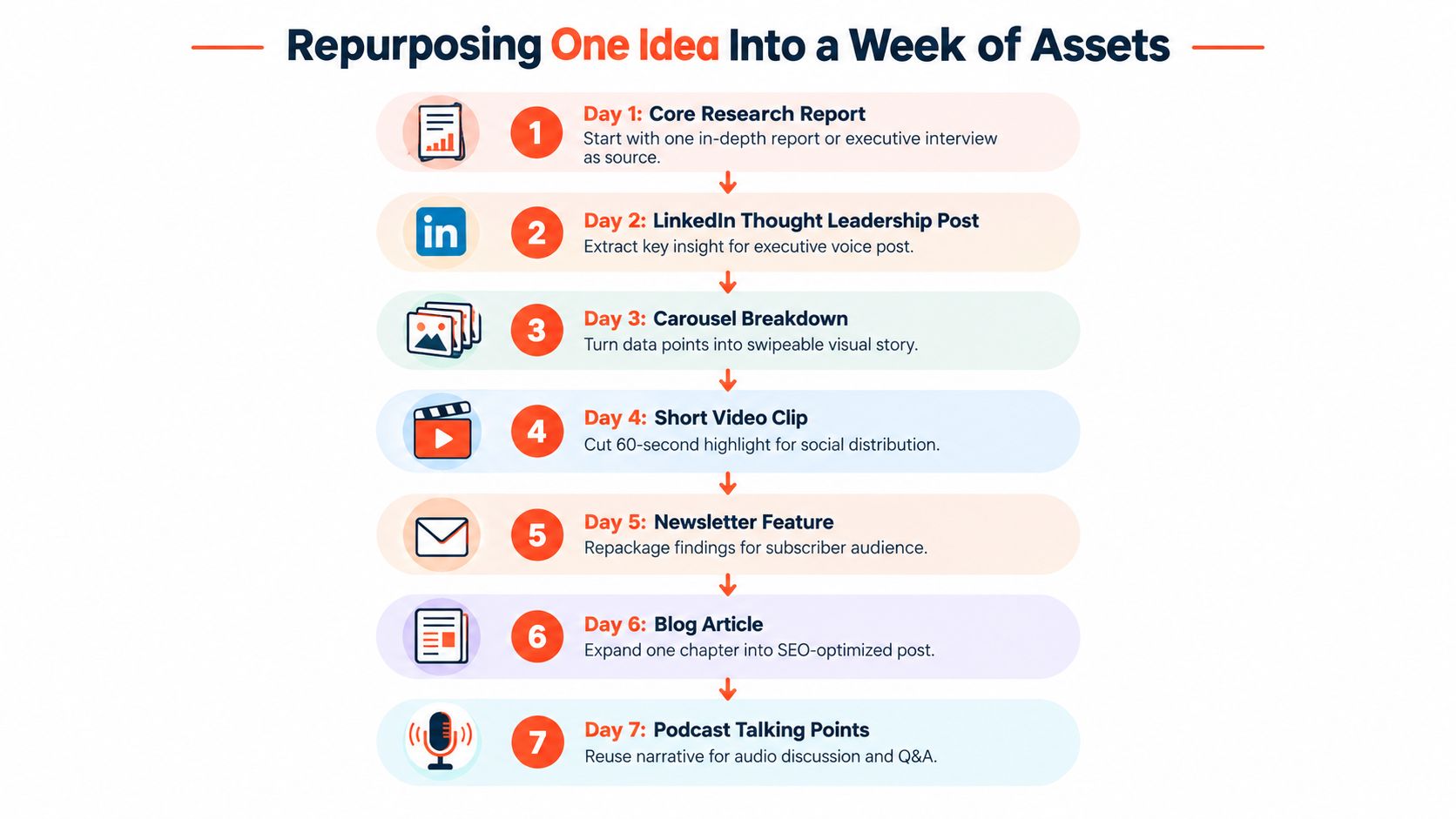
A practical seven-asset sequence
- Executive LinkedIn post: Lead with the strongest opinion and invite informed disagreement.
- Carousel breakdown: Turn the argument into a visual progression, with one idea per frame.
- Quote card: Pull a concise, defensible sentence from the source and pair it with a short explanation.
- Short-form video script: Give a subject-matter expert one clear question and one useful answer.
- Newsletter feature: Use the executive point of view as the opening, then link to the complete asset.
- Partner or community contribution: Adapt one insight into a response that helps an existing discussion.
- Paid social unit: Convert the clearest benefit or tension into a focused promotion with a specific landing-page action.
Every derivative needs its own hook, length, context, and call to action. A carousel shouldn't read like a compressed article. A newsletter shouldn't repeat a social caption. A community contribution shouldn't sound like an advertisement.
Consistency comes from the narrative, not from identical wording.
Use a checklist before scheduling:
- Core thesis: Is the main argument unchanged?
- Audience: Does each asset name the person and problem it serves?
- Native format: Does the piece feel created for its channel?
- Proof: Does it include a source, example, explanation, or useful detail?
- Voice: Does the speaker sound like a person rather than a content committee?
- CTA: Is the next action appropriate to the buyer stage?
- Reuse value: Can the asset resurface later without feeling stale?
Teams that need to accelerate production can browse content creation tools, especially when they're building an initial format library. For a deeper process on turning source material into channel assets, use WaveGen's guide to repurposing content.
The Hidden Gap Between Creation and Buyer Attention
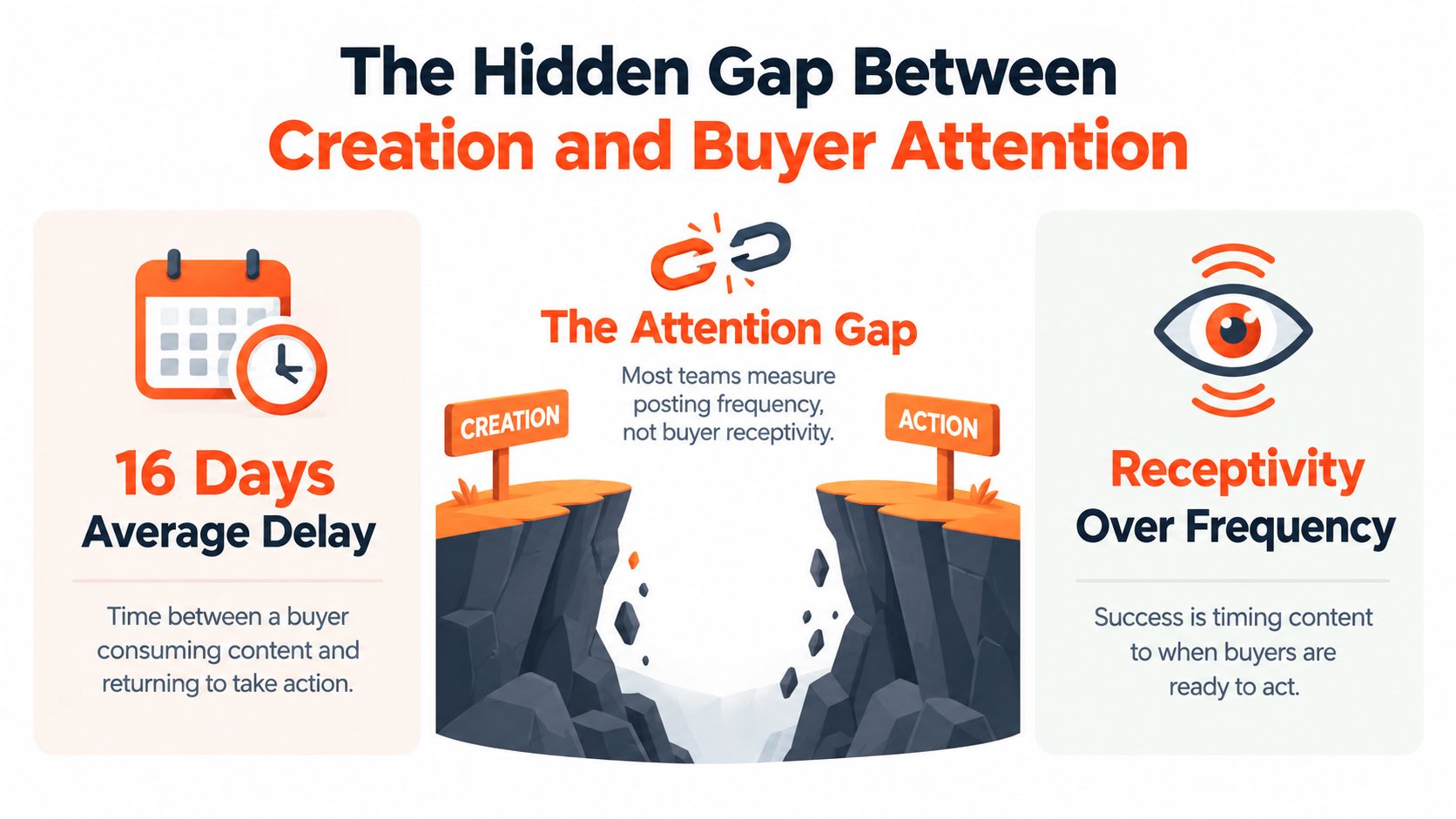
Most distribution calendars measure what the team publishes. Buyers operate on a different clock.
One large content consumption report found an average 16-day gap between requests among marketing professionals, with longer or shorter intervals depending on role and company size, as described by Neil Patel's B2B content interaction frequency analysis. The operational implication is clear: a launch-day burst won't cover the period between one research session and the next.
Design for resurfacing
A buyer may read your article, save it, discuss it internally, and return later. Your distribution plan should create several legitimate entry points without pretending that every post is new. Resurface the central idea through a different format, answer a related objection, share a practical excerpt, or connect it to a live discussion.
Executive-led distribution is valuable, but it isn't a complete system. Leaders often have irregular publishing habits, limited time, and networks dominated by peers rather than active buyers. Their voice should anchor the program, while operators, employees, newsletters, communities, and paid campaigns extend its reach.
Build a hybrid sequence:
- Executive perspective: Establish the point of view.
- Employee advocacy: Add credible distribution from people closer to relevant buyer networks.
- Owned follow-up: Develop the idea through email and the resource library.
- Community participation: Answer adjacent questions where buyers already exchange advice.
- Selective paid support: Extend assets that have demonstrated relevance with a defined audience.
The goal isn't to post more often for its own sake. The goal is to remain useful when the buyer returns.
Building a Distribution Workflow That Runs Without You
A distribution workflow should behave like a pipeline, not a series of emergency requests. New research, interviews, articles, and transcripts enter one intake queue. Each asset receives tags for topic, audience, buyer stage, owner, priority, and approved source material.
From there, route the asset into a repurposing queue. Assign the formats before drafting begins, then apply channel templates for LinkedIn, email, video, webinars, and partner placements. This prevents the common failure where the team publishes the source asset first and invents distribution only after the initial attention has already faded.
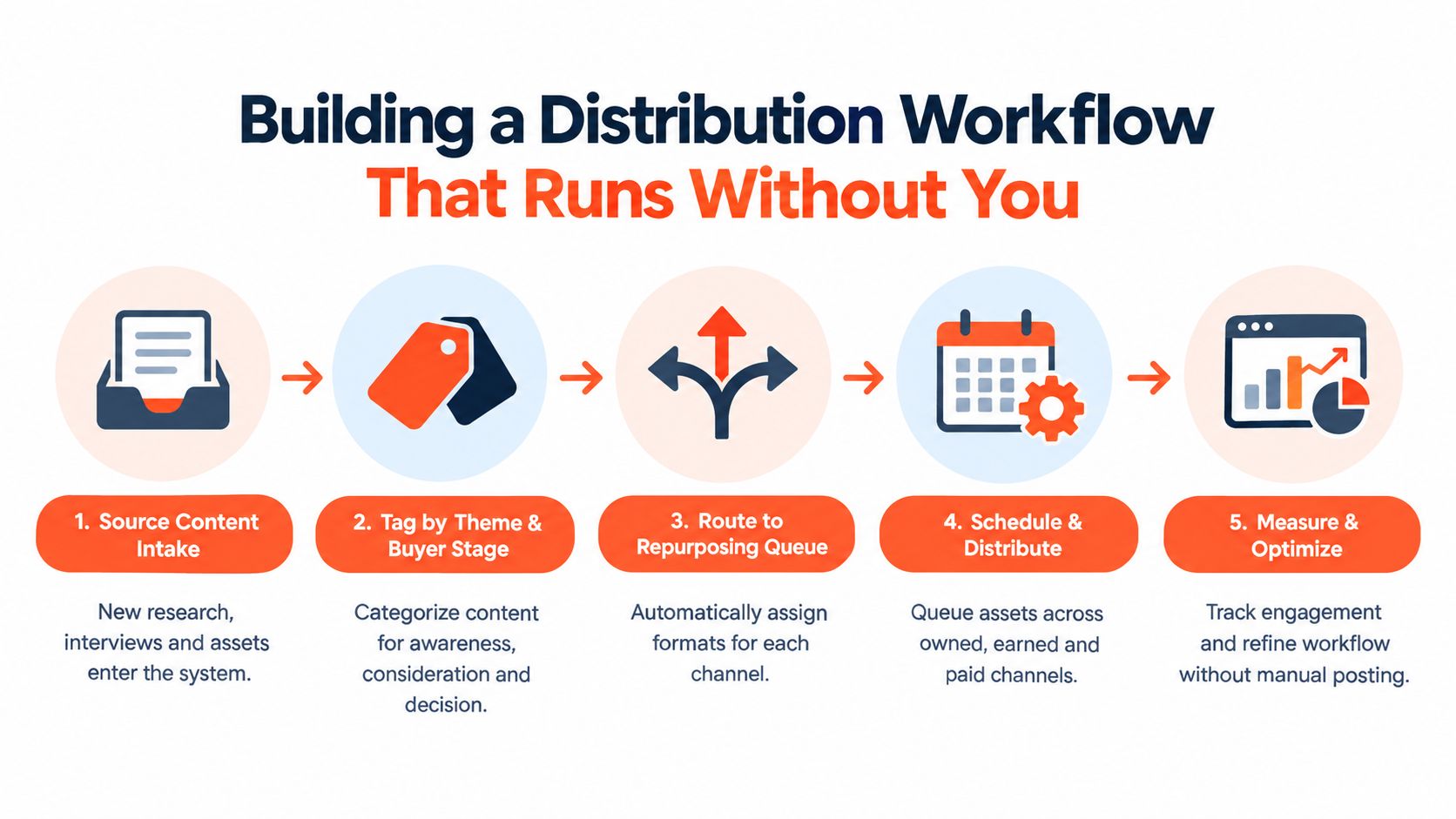
Five operating decisions
- Centralize intake: Use one form or project board for source assets and required metadata.
- Tag before drafting: Identify theme, buyer stage, audience, spokesperson, and destination.
- Template the repeatable work: Lock typography, colors, logo treatment, approved phrases, and format rules in a brand kit.
- Separate review levels: Reserve human review for executive voice, regulated claims, partner content, and major campaigns. Let routine assets follow pre-approved rules.
- Measure the handoff: Record when an asset enters the queue, reaches approval, gets scheduled, and produces a meaningful buyer action.
RSS-to-social automation and scheduling tools can maintain cadence without daily manual posting. Keep one editorial calendar for owned, earned, and paid activity so the team can see collisions, gaps, and follow-up opportunities.
You should be able to explain every handoff to a new hire. If the process still relies on private knowledge held by one content lead, fix the documentation before adding more channels. Resources on how to avoid content team bottlenecks can help teams identify where approvals and production queues are slowing output.
For teams evaluating a B2B content distribution platform, prioritize source ingestion, brand controls, native formatting, scheduling, approval visibility, and measurement integrations. A tool should remove repetitive production work, not replace editorial judgment.
Measuring What Matters and Your 30-Day Next Step
The buyer's 13.4 content interactions and 67% self-directed journey make reach a weak final metric. Use reach to diagnose awareness, then connect content interactions to the outcomes your revenue team recognizes.
| Journey Stage | Primary KPI | Secondary KPI |
|---|---|---|
| Awareness | Qualified audience reach | Relevant engagement and new known contacts |
| Consideration | Content-assisted qualified pipeline | Return visits, webinar registrations, and email engagement |
| Decision | Opportunities with meaningful content touches | Sales usage and conversion assistance |
| Expansion | Content-influenced retention or expansion activity | Customer participation and resource engagement |
Use first-touch attribution to understand which channel introduces your company. Use multi-touch attribution to see which assets support evaluation and conversion. Neither model tells the whole story, so combine CRM data with qualitative feedback from sales and customer-facing teams.
Your next thirty days should be concrete:
- Audit one existing pillar asset for relevance, clarity, and buyer stage.
- Turn it into at least five native distribution assets.
- Add consistent campaign and source tracking to every link.
- Pair one executive-led post with an employee advocacy push.
- Review the resulting audience quality and pipeline signals before expanding the channel mix.
Don't reward the team for filling a calendar. Reward the team for creating useful, traceable buyer touchpoints that remain available after launch day.
WaveGen.ai turns articles, newsletters, podcast scripts, and transcripts into on-brand social assets such as carousels, short videos, quote cards, and platform-specific captions, then helps schedule and publish them across active channels. Visit WaveGen.ai to build a repeatable distribution cadence from the ideas you already publish.
b2b content distribution
content repurposing
multi-channel marketing
linkedin distribution
content workflow
Turn this kind of writing into a week of social content.
Paste a blog post, newsletter, or rough draft — WaveGen turns it into publish-ready carousels, captions, and slideshows for every channel.
No credit card · First posts in 2min