July 8, 2026
15 min read
Master Your Omnichannel Content Strategy
Craft a powerful omnichannel content strategy. This guide helps you map audiences, repurpose content, & measure ROI for brand growth.

You're probably already publishing more than you want to manage.
A blog goes live on Tuesday. By Wednesday, you're trying to turn it into a LinkedIn post, an email, an Instagram carousel, maybe a short video, maybe a newsletter intro. By Friday, the message has drifted. The offer sounds different on each channel. Comments come in on one platform, leads reply on another, and your audience gets fragments instead of a clear story.
That's where most small teams get stuck. Not because they lack ideas, but because every channel starts acting like its own job.
A workable omnichannel content strategy fixes that. It doesn't ask you to be everywhere at once. It gives each channel a role, ties content back to one message, and helps you grow your audience without burnout by repurposing with intent instead of endlessly creating from scratch.
Table of Contents
- From Content Chaos to Cohesive Experience
- What Omnichannel Content Is and What It Is Not
- The Business Case for an Omnichannel Approach
- The Blueprint Part 1 Mapping Audiences and Pillars
- The Blueprint Part 2 Channels Workflows and Tech
- Governance and Measurement Making Your Strategy Last
- Your Omnichannel Implementation Checklist
From Content Chaos to Cohesive Experience
A coach publishes thoughtful weekly articles. A consultant sends a strong newsletter. A small B2B team posts on LinkedIn, uploads clips to YouTube, and tries to stay active on Instagram. On paper, that looks consistent.
In practice, it often feels scattered. The article speaks to decision-makers. The social posts sound casual and broad. The email pushes one offer while the website headline leans another way. Nothing is wrong on its own, but the pieces don't add up.
That disconnect shows up in familiar ways:
- Prospects ask basic questions twice: They saw your post, then your site, and still aren't sure what you do.
- Content gets remade from zero: A blog post exists, but nobody can quickly turn it into channel-ready assets.
- Channels compete for attention: The team starts asking which platform matters most, because there's no shared journey to support.
- Your brand voice drifts: Every format gets adapted so loosely that consistency disappears.
Small teams feel this more sharply than large ones. Enterprises can throw headcount at coordination problems. A creator, advisor, or lean marketing team usually can't. They need a system that turns one idea into several useful touchpoints without multiplying approval cycles.
Omnichannel works when the audience experiences one connected brand, even though they encounter it in different formats.
That's the shift. An omnichannel content strategy isn't “post the same thing everywhere.” It's “design each channel so it contributes to the same buyer journey.” Your blog might educate. Your email might nurture. LinkedIn might validate expertise. Short-form video might create familiarity. Different jobs, same narrative.
When that clicks, content stops feeling like a pile of deliverables and starts functioning like an actual system.
What Omnichannel Content Is and What It Is Not
Multichannel is presence. Omnichannel is coordination.
That's the cleanest way to explain it to clients who've been told they need to “show up on more platforms” without being told how those platforms should work together.
The difference most teams miss
Think of multichannel like a cover band playing the same song in different bars. The musicians know the tune, but each venue gets a separate performance. The experience exists in multiple places, yet each one stands alone.
Think of omnichannel like a symphony orchestra. The strings, brass, percussion, and woodwinds all play different parts. Nobody is repeating the exact same line. The value comes from coordination. The conductor holds the whole piece together.
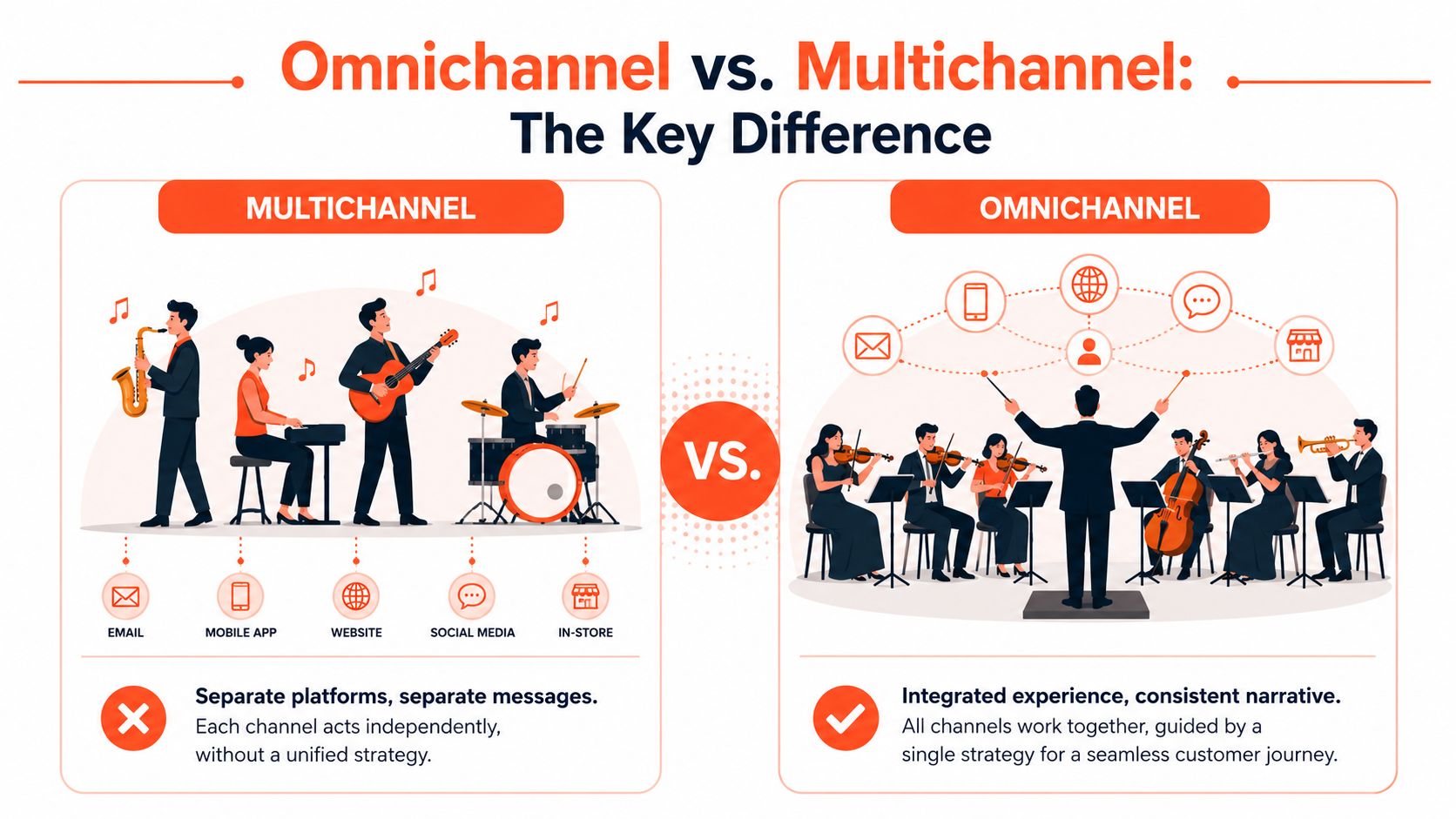
That's why posting the same caption to five platforms isn't an omnichannel content strategy. It's distribution without orchestration.
Omnichannel is not about shouting your message everywhere; it's about weaving a story that your audience experiences everywhere.
A useful test is this: if someone discovers you on one channel and moves to another, does the next touchpoint feel like the natural continuation of the first? If yes, you're building omnichannel behavior. If not, you're just maintaining multiple outlets.
For a simpler breakdown of the base concept, this explanation of multi-channel meaning is useful before you layer in the operational side.
Multichannel vs. Omnichannel at a Glance
| Aspect | Multichannel | Omnichannel |
|---|---|---|
| Strategy | Each platform is planned separately | One strategy guides all platforms |
| Message | Often repeated or slightly edited | Adapted by channel, but connected |
| User experience | Can feel fragmented | Feels continuous across touchpoints |
| Team workflow | Content is recreated per platform | Content is structured for reuse |
| Measurement | Channel by channel | Journey and business outcome focused |
| Common failure mode | Cross-posting without context | Overengineering before basics are ready |
What omnichannel content is not:
- It's not total channel coverage: You don't need every platform.
- It's not identical creative everywhere: Consistency doesn't mean duplication.
- It's not enterprise-only architecture: Small teams can do this with simple rules and modest tooling.
- It's not a content volume game: More assets won't fix a disconnected strategy.
The goal is coherence. That's what your audience feels, and that's what your team can operate.
The Business Case for an Omnichannel Approach
The strongest argument for an omnichannel content strategy isn't aesthetics. It's business performance.
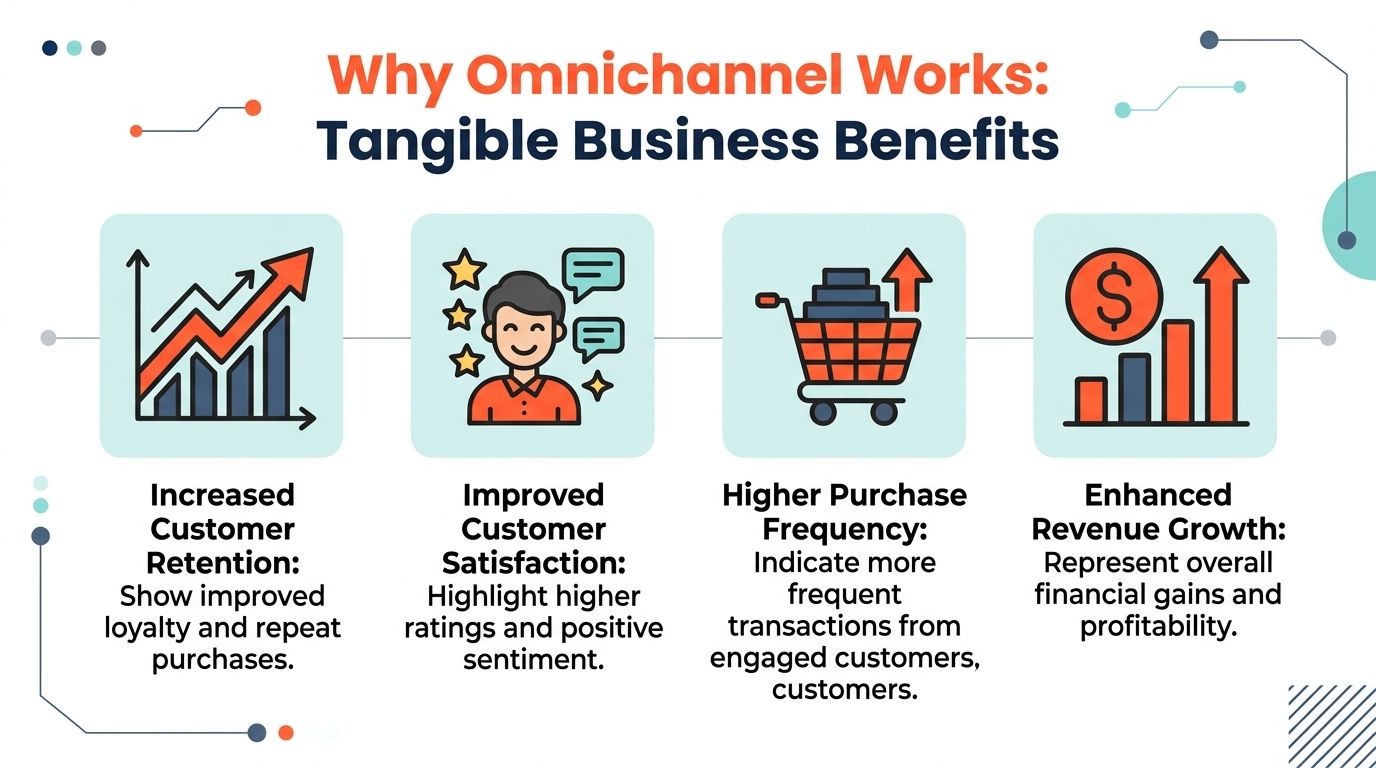
Companies that implement effective omnichannel customer engagement strategies retain an average of 89% of their customers, compared with 33% for companies using poor or single-channel strategies, according to Porch Group Media's roundup of omnichannel statistics. That gap is too large to treat as a branding nice-to-have.
Early in the process, it helps to make the upside concrete:
Why the model works financially
Retention improves when customers don't have to re-learn your brand every time they meet it. A prospect might discover your point of view in a short video, validate it on LinkedIn, read a deeper article, then convert after an email sequence. That path feels natural when the message stays aligned.
For small teams, this matters because content investment stretches further. One core idea can support awareness, nurture, trust-building, and follow-up instead of serving only one platform for one day.
A short explainer on the broader value of connected customer journeys helps frame the point:
There's also a practical loyalty effect. People trust businesses that sound like themselves everywhere. When the website promise, social proof, emails, and service language reinforce one another, buyers move with less hesitation.
The trade-offs are real
An omnichannel approach asks for more discipline up front. You have to decide:
- Who owns the source message
- Which channels deserve effort
- How content changes by format without changing meaning
- What success looks like across a journey, not just on one post
That work can feel slower at first. A team that's used to posting ad hoc may feel like strategy is getting in the way of speed.
Practical rule: If your team can't describe the role of each channel in one sentence, you're not ready to scale output yet.
Technology is another trade-off. You don't need a giant stack, but you do need fewer silos. Spreadsheets, isolated social schedulers, and disconnected asset folders can hold things together for a while. They won't give you the continuity you need once content starts moving across channels regularly.
The good news is that small teams don't need enterprise complexity to get enterprise-like discipline. They need clear roles, a reusable content model, and a way to track whether all that activity leads somewhere meaningful.
The Blueprint Part 1 Mapping Audiences and Pillars
Most omnichannel projects fail before channels even enter the picture. The core issue is usually upstream. Teams start by asking where to publish instead of who they're helping and what decisions that content should support.
Start with one clear audience slice
Don't begin with five personas. Start with one audience slice you can describe in plain language.
For example:
- A solo consultant trying to get discovery calls from LinkedIn
- A small SaaS marketing lead who needs repeatable demand generation
- A financial educator turning long-form trust content into daily visibility
- An agency owner who needs thought leadership without becoming a full-time creator
That level of specificity matters because channel behavior changes with audience intent. A person comparing vendors needs different content from someone casually discovering your brand.
Map the journey. You don't need a mural-sized framework. A small team can use four stages:
Discovery
Where people first encounter your idea.Consideration
Where they compare your approach with alternatives.Decision
Where they look for proof, clarity, and next steps.Retention
Where content reinforces the relationship after purchase.
At this stage, tag content by context, not just by format. That matters because 78% of brands fail to repurpose content effectively due to rigid taxonomies, and omnichannel success requires tagging by context such as persona, funnel stage, and tone rather than labels like “blog” or “video,” as explained by Hygraph's guide to omnichannel content.
Build pillars around decisions not formats
Content pillars aren't categories for your editorial calendar. They're the repeatable themes your brand will own.
A good pillar sits at the overlap of audience pain, business relevance, and reusable expertise. Small teams usually do best with three to five. More than that spreads attention thin.
Here's a simple pillar map structure:
| Pillar | Audience | Journey stage | Primary outcome |
|---|---|---|---|
| Strategy education | New prospects | Discovery | Build understanding |
| Process guidance | Evaluating buyers | Consideration | Reduce uncertainty |
| Proof and examples | High-intent leads | Decision | Increase confidence |
| Client enablement | Existing customers | Retention | Improve adoption |
What doesn't work is organizing your entire system by output type. “Blogs,” “videos,” and “emails” are production buckets. They don't help you decide what to repurpose, what to prioritize, or how to adapt it.
A better planning question is: what message should this audience hear at this moment?
If you want examples of how pillar planning supports repeatable client work, this resource on how to drive agency results with content is a useful reference.
A strong pillar should survive channel changes. If a topic only makes sense as one post format, it isn't a pillar yet.
Once your pillars are stable, channel choices get easier because every asset has a job before anyone opens a design tool.
The Blueprint Part 2 Channels Workflows and Tech
Organizations find themselves either simplifying thoughtfully or building an unmanageable system.
A working omnichannel content strategy doesn't ask every channel to do everything. It assigns roles, reduces manual handoffs, and gives one core asset several useful lives.
Give each channel one job
If you run a small team, assign one primary function to each channel.
For example:
- Website or blog for depth and search-driven trust
- Email for nurture and reactivation
- LinkedIn for expertise and professional credibility
- Instagram or TikTok for personality, reach, and fast pattern recognition
- YouTube for education and long-form explanation
That doesn't mean each channel can't do more than one thing. It means your team knows why it exists in the mix.
Without that role clarity, people start publishing based on habit. Then every platform gets watered-down content that kind of works nowhere.
Build a repurposing workflow a small team can run
Start with one source asset. Usually that's a blog post, newsletter, webinar transcript, podcast script, or recorded talk.
From there, create a workflow like this:
Extract the core claim
What is the one idea the whole asset argues?Pull out proof points and teachable moments
Not invented stats. Real examples, steps, objections, phrasing, and lessons.Match excerpts to channel roles
The sharp opinion goes to LinkedIn. The tutorial excerpt goes to email. The visual summary becomes a carousel. The strongest spoken moment becomes a short clip.Adapt the framing
Change hook, length, and CTA to fit the channel. Keep the underlying message intact.Queue distribution over time
Don't publish every derivative at once. Let each asset support the next touchpoint.
For teams managing several brands or recurring campaigns, tools can reduce repetitive packaging work. Some teams use project management software and native platform schedulers. Others add dedicated social workflow platforms. If you need a broader comparison of distribution tooling, this guide to a content distribution platform is a practical starting point.
To tighten scheduling and approvals, some teams also rely on tools like Xholic AI's social media workflow tools when content volume starts exceeding what manual posting can support.
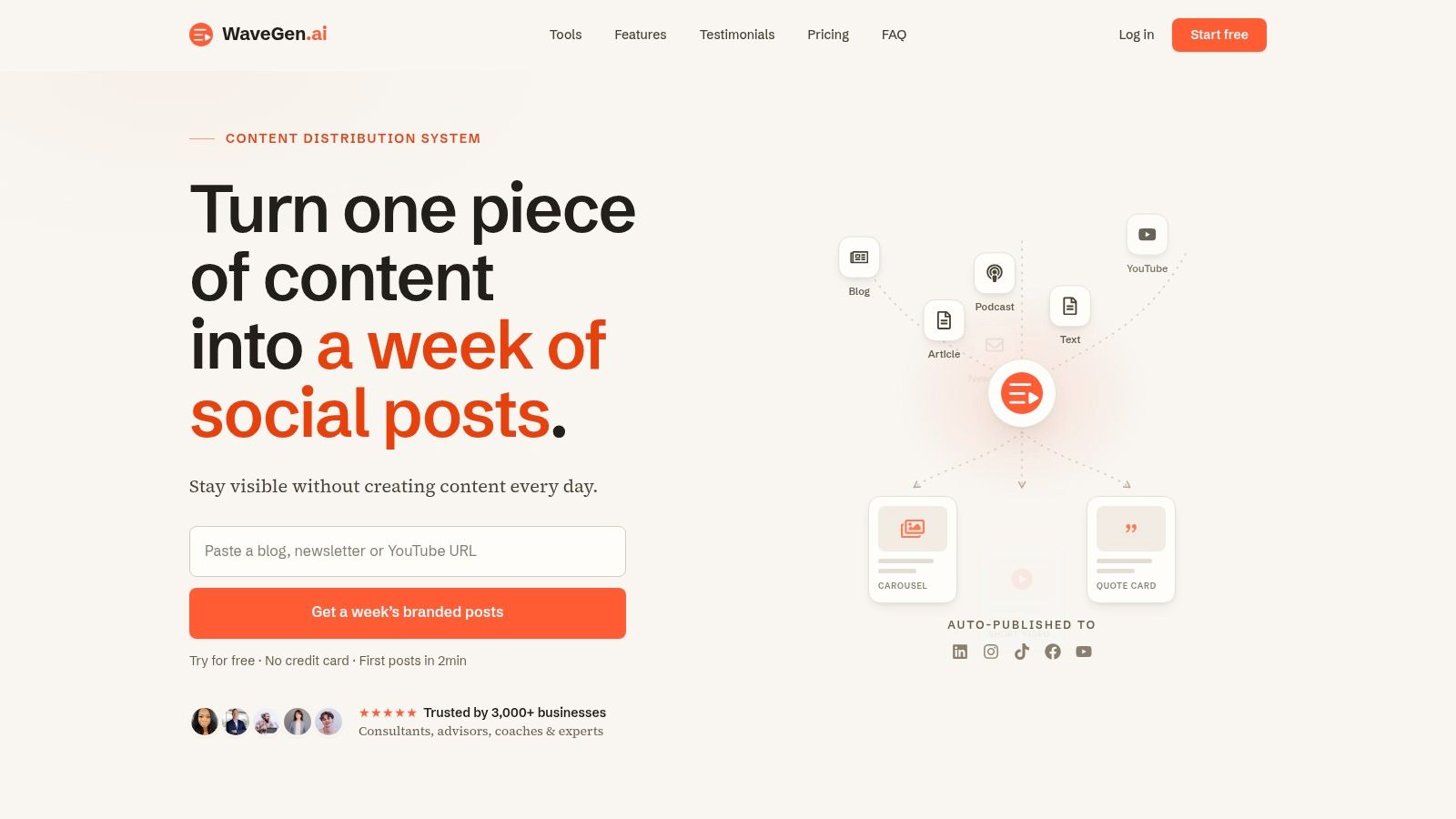
One option in this category is WaveGen.ai, which turns a source asset such as an article, newsletter, podcast script, or YouTube transcript into channel-specific social assets, then lets teams edit and schedule them from one place. For small operators, that kind of setup is useful when the bottleneck isn't ideas but repeated formatting, packaging, and publishing.
Choose tech that removes handoffs
Your technology stack should make reuse easier, not more impressive.
The backbone is a centralized content system with API-first delivery. According to ButterCMS's explanation of omnichannel content management, organizations using centralized, API-first content systems achieve 30-40% faster content deployment cycles and 25% higher cross-channel consistency scores compared with fragmented approaches.
For a small team, that translates into a simple decision rule:
- Use one source of truth for approved content
- Store assets in modular pieces
- Make sure tools can pass content between systems without copy-paste
- Keep approvals visible
- Avoid building a stack that needs developer involvement for every small update
The wrong setup usually looks familiar. Long-form content lives in one place, social assets in another, analytics in three more, and nobody knows which version is current. That isn't a strategy problem anymore. It's an operations problem.
Governance and Measurement Making Your Strategy Last
A content system often deteriorates. It doesn't usually fail because the strategy was wrong. It fails because nobody owns standards, approvals get fuzzy, and reporting stays trapped inside channel dashboards.
Keep governance light but visible
Small teams don't need bureaucracy. They need clarity.
A simple governance model can work with three roles:
Strategy owner
Decides themes, priorities, and campaign intent.Content operator
Adapts assets, manages the calendar, and keeps workflows moving.Approver
Checks brand fit, accuracy, compliance, or client sign-off.
One person can hold more than one role. The point is that each decision has an owner.
Document only what people will use. A short brand guide, a publishing checklist, and channel-specific rules are often enough. If your team hasn't formalized voice and usage yet, these examples of brand guidelines are a practical reference for keeping standards usable instead of decorative.
The best governance model is the lightest one your team will consistently follow.
Helpful guardrails include:
- Approved message hierarchy: What must stay consistent everywhere.
- Channel adaptation rules: What can change by platform.
- Review triggers: Which content needs approval and which doesn't.
- Version control: Where the final approved source asset lives.
Measure journeys not isolated posts
Many omnichannel efforts lose credibility as teams report likes, reach, and open rates by channel, then struggle to explain what all that activity contributed to the business.
That measurement gap is common. Gartner emphasizes that omnichannel must align content and interactions across channels, yet 65% of marketers still lack tools to measure cross-channel revenue impact, as summarized by Contentstack's article on omnichannel strategy.
For small teams without a data science function, the answer isn't more dashboards. It's better definitions.
Track a small set of integrated KPIs such as:
| KPI | What it tells you |
|---|---|
| Content-influenced pipeline or revenue | Whether content contributed to commercial outcomes |
| Journey completion rate | Whether people moved from one intended touchpoint to the next |
| Cross-channel engagement score | Whether the same audience is interacting across the ecosystem |
| Repurposing efficiency | Whether source content is actually being reused |
| Time to publish | Whether workflow friction is slowing execution |
Then pair those with operational questions:
- Are leads who read an article more likely to engage with email?
- Do social-driven visitors consume deeper proof content?
- Which source assets create the most downstream touchpoints?
- Where do journeys stall?
A small team can answer those with tagged links, shared dashboards, CRM notes, and disciplined naming conventions. It won't be perfect attribution. It will be usable attribution, which is what governance needs.
Your Omnichannel Implementation Checklist
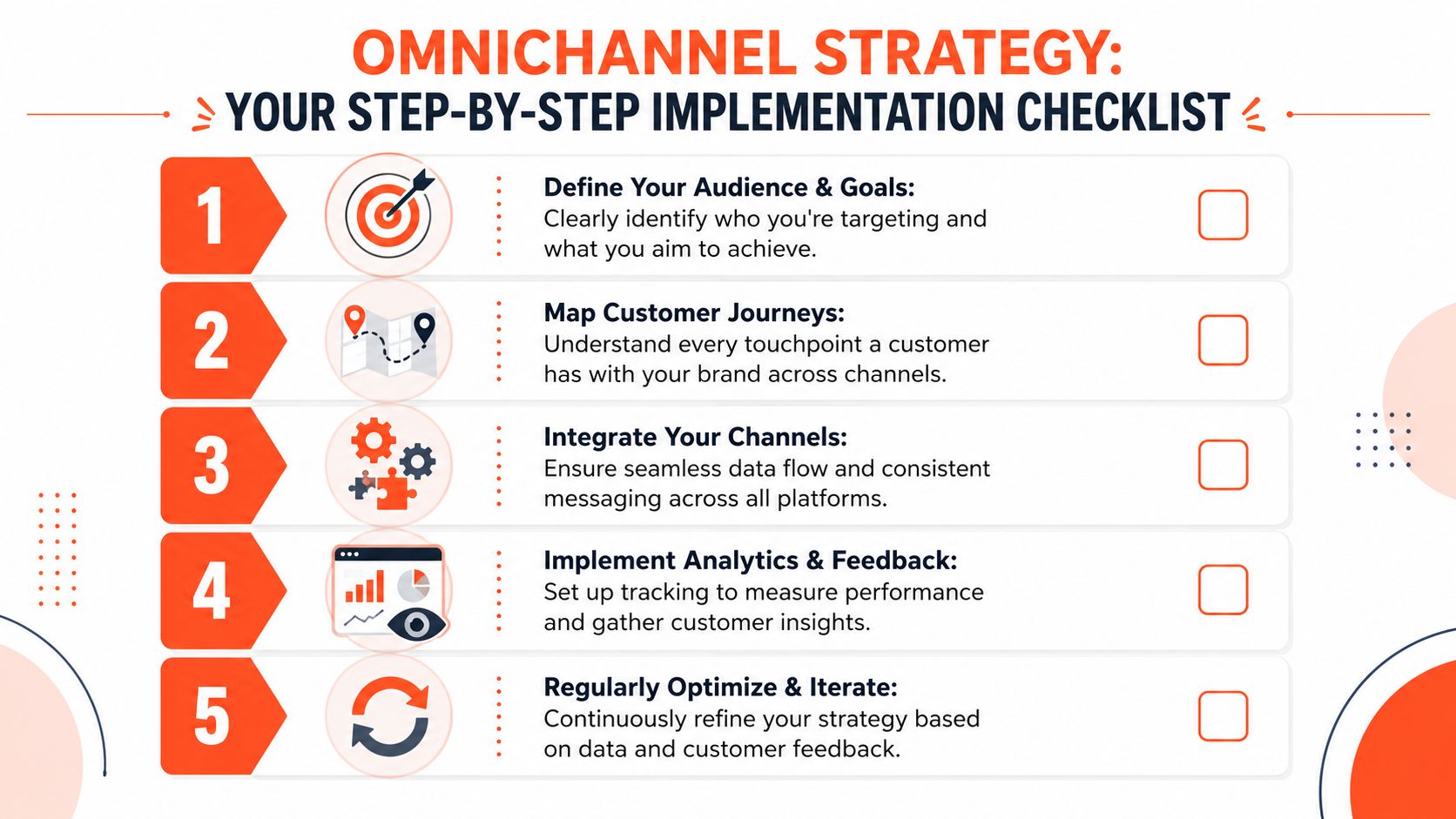
The simplest way to start is to make fewer decisions, not more. Pick one audience, one source content type, two channels you can support consistently, and one business outcome you care about.
A practical starting sequence
Define the buyer and the goal
Write one plain-language audience description and one outcome. Example: attract qualified discovery calls from owners of small service businesses.Choose one source asset type
Start with the content you already produce most consistently. For many teams, that's a blog post, newsletter, or recorded talk.Set three to five content pillars
Base them on recurring buyer questions and business relevance. Avoid organizing around format labels.Map two channels by role
Pick one channel for depth and one for distribution. For example, blog for depth, LinkedIn for reach. That's enough to prove the workflow before expanding.Create a weekly repurposing routine
Turn one source asset into several derivatives with distinct jobs. Keep hooks and CTAs channel-specific.Use a central place for approved content
Store final copy, asset variants, and core messaging where the whole team can find them.Write lightweight governance rules
Define tone, review responsibilities, and essential message points in one shared document.Track one integrated KPI first
Don't try to measure everything. Start with a metric that ties content activity to a business result.Review monthly, not constantly
Omnichannel performance compounds over sequences, not isolated posts. Give the system time to show patterns.Expand only after the basics hold
Add channels when your current workflow is stable, not when you feel pressure to be more visible.
One final reason to stay disciplined here: omnichannel experiences that use unified data and real-time personalization drive 20-25% higher conversion rates and 15-18% improved retention metrics compared with non-integrated models, according to Mailchimp's omnichannel content strategy resource.
That gain doesn't come from publishing everywhere. It comes from making each touchpoint feel connected.
If you already have strong long-form ideas but struggle to turn them into consistent channel-ready assets, WaveGen.ai can help operationalize the repurposing side. It takes a source piece like an article, newsletter, podcast script, or transcript, generates platform-specific social assets from it, and lets you edit and schedule them in one workflow so your omnichannel system is easier to maintain.
omnichannel content strategy
content marketing
content repurposing
social media strategy
digital marketing
Turn this kind of writing into a week of social content.
Paste a blog post, newsletter, or rough draft — WaveGen turns it into publish-ready carousels, captions, and slideshows for every channel.
No credit card · First posts in 2min