July 9, 2026
21 min read
Copywriting for Social Media: Hooks, Formats & CTAs
Learn professional copywriting for social media with this guide. Covers hooks, formats, CTAs, & turning articles into high-performing posts.
Social media ad spend is projected to hit $317.33 billion in 2026, while 68.7% of the world's population, about 5.66 billion people, uses social media monthly (verified market data). That scale changes how you should think about copy. You're not competing with a handful of brands in your niche. You're competing with every creator, founder, media brand, and algorithmically boosted post in the feed.
That's why generic social copy disappears. “We're excited to announce.” “New blog post live.” “Check out our latest update.” Those lines aren't wrong. They're just weak. They ask the audience to care before you've earned attention.
Good copywriting for social media does three jobs fast. It stops the scroll, gives the reader a reason to stay, and makes the next action obvious. The common mistake is treating those as isolated writing tricks. In practice, strong social copy comes from a repeatable workflow. You start with audience behavior, shape a message for platform culture, and then repurpose your best source material into multiple native posts without sounding repetitive or automated.
Table of Contents
- The High Stakes of Social Media Copy in 2026
- Groundwork Before You Write a Single Word
- The Anatomy of High-Performing Social Copy
- Adapting Your Message for Each Major Platform
- The Smart Way to Create Content by Repurposing Your Best Ideas
- How to Measure and Refine Your Social Copy
The High Stakes of Social Media Copy in 2026
Social platforms now reach most of the connected market, and ad spend keeps climbing. That combination raises the cost of forgettable copy. A post does not compete only with direct competitors anymore. It competes with creators, peers, newsletters repackaged into carousels, podcast clips, and paid distribution built to look organic.
In practice, weak social copy loses on two fronts. It misses the human test because the opening feels generic or overworked. It also misses the platform test because the structure does not match how people consume content in-feed. A consultant posts, “Three lessons from this week.” A SaaS company leads with, “At Acme, innovation drives everything we do.” A coach spends six lines warming up before making the point. Each one asks for attention before earning it.
That problem gets worse when teams repurpose badly. They paste the same idea across LinkedIn, Instagram, and TikTok, change a few line breaks, and call it distribution. The result feels inauthentic to the audience and low-relevance to the algorithm. Good copywriting for social media sits in the middle. It keeps the core idea intact, then rewrites the packaging for the behavior of each platform.
Audience state comes before the hook
In my experience coaching junior social managers, the first draft problem is rarely a lack of creativity. It is usually poor targeting at the post level. The hook fails because the writer has not defined who the post is for, what job the post needs to do, and what format the platform rewards.
A founder checking LinkedIn between sales calls responds to a different opening than a creator watching TikTok with sound on. An operations lead saving Instagram carousels wants a clearer payoff than a casual Facebook scroller who will only give you a sentence before deciding.
Start with three checks:
Who is the reader in this moment?
Get specific about context. For example, a founder trying to fix weak inbound, a dietitian building trust before selling a program, or a local roofer who needs leads before the season slows down.What are they trying to do on this platform?
LinkedIn users often evaluate ideas and signal expertise. Instagram users save visual how-tos. TikTok users decide fast whether the first line deserves ten more seconds.What friction are they feeling right now?
Confusion needs clarity. Skepticism needs proof. Overwhelm needs a tighter promise. Boredom needs tension or novelty.
A useful rule for review: if the opening line can sit on five unrelated brand accounts without sounding strange, it is too broad.
Teams that need a cleaner planning process should build that post-level context before drafting. This social media content planning workflow helps map goals, formats, and publishing cadence without turning the calendar into busywork. For teams that need a scheduling framework to support that process, see Delulu Social on content calendars.
A brand voice guide your team can actually use
A workable voice guide gives writers operating rules. Adjectives alone do not do that. “Bold,” “friendly,” and “creative” sound fine in a brand deck, but they do not help a coordinator decide whether to open with a stat, a customer quote, or a hard opinion.
Use three parts instead:
Define the brand role.
Pick the lane your copy should hold. Expert teacher, sharp operator, approachable guide, or category challenger. A B2B cybersecurity firm should not sound like a lifestyle creator, even if both want stronger engagement.Write concrete do and don't rules.
Example: “Use plain English, strong verbs, and short first lines.” “Do not use hype language, filler setup, or fake urgency.” This gives junior writers something they can apply in the draft.Include before-and-after examples.
Weak: “We are passionate about helping brands grow online.”
Stronger: “Your social posts are getting impressions but no action. Fix the first two lines before you blame the offer.”
Writers learn faster from contrast than from theory.
That discipline is what separates random posting from a repeatable system. Strong teams do not write every post from scratch. They start with a core idea, identify the audience state, then adapt the copy so it feels native on each platform without losing the brand.
Groundwork Before You Write a Single Word
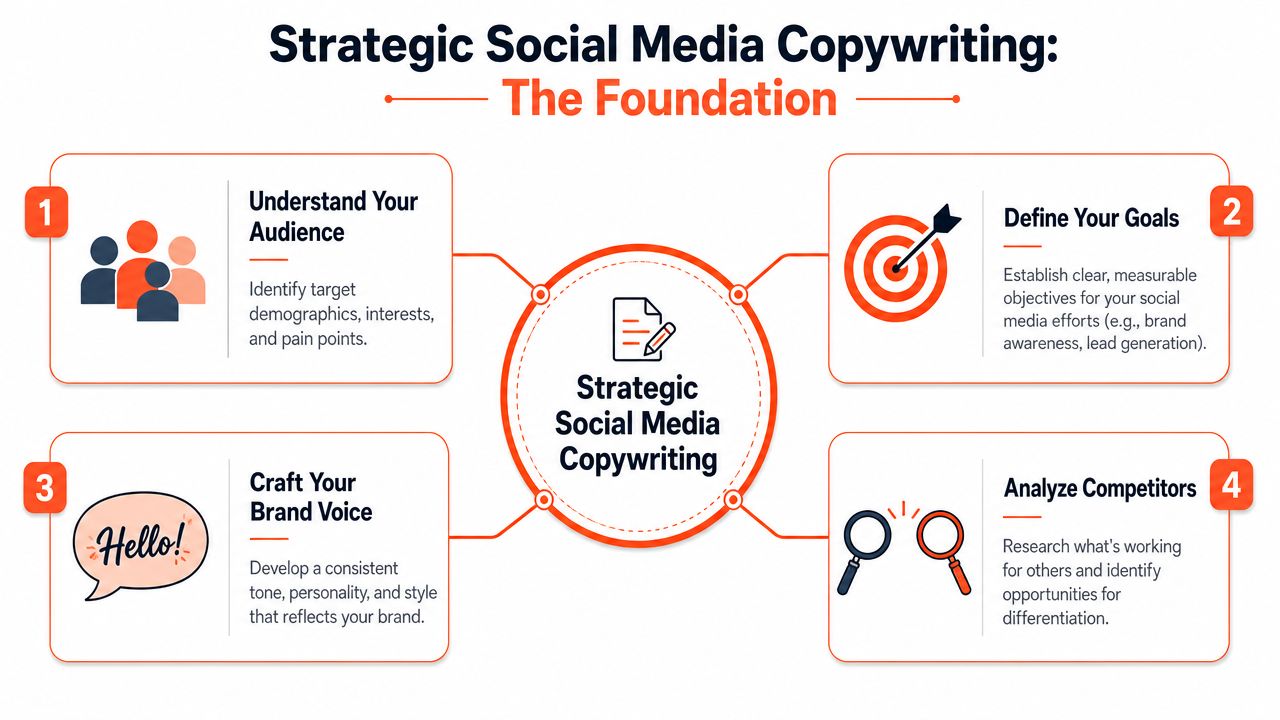
Strong social copy starts before the draft. Most underperforming posts aren't broken at the sentence level. They're broken at the strategy level. The team didn't define the audience state, the business goal, or the acceptable range of tone for each platform.
Map behavior, not just demographics
Age, job title, and industry help with targeting. They don't tell you how people behave in-feed. For copywriting for social media, behavior is the better planning unit.
Build an audience map around questions like these:
- What makes them stop scrolling: Contrarian opinions, checklists, personal stories, screenshots, quick wins.
- What do they save: Frameworks, swipe files, scripts, templates, before-and-after examples.
- What do they comment on: Opinion-led posts, shared frustrations, industry shifts, language they want to debate.
- What do they ignore: Generic inspiration, company-first announcements, vague thought leadership.
This is also where teams run into the platform-tone problem. Existing content rarely answers how to balance algorithmic formatting with authentic human tone across platforms. A 2025 LinkedIn shift toward conversational content contradicts rigid formulaic advice, revealing a gap professionals need to fill by adapting tone while preserving brand voice (discussion of the tone shift). That's why “just use the same caption everywhere” fails.
If your planning process is loose, your publishing calendar will be too. A practical resource for that part is Delulu Social on content calendars, which shows how to build a schedule around themes and repeatable formats instead of random inspiration. For a more operational planning workflow, see this guide to planning social media content.
Build a voice guide your team can actually use
A working voice guide needs constraints. “Friendly but professional” is too broad. Give writers toggles they can use under deadline.
Try a grid like this:
| Brand trait | Do | Don't |
|---|---|---|
| Direct | Lead with the point | Bury the point after setup |
| Expert | Teach with specifics | Use jargon to sound smart |
| Human | Use contractions and natural phrasing | Sound scripted or corporate |
| Confident | Make the recommendation | Hedge every sentence |
Then pressure-test that grid on platform-specific examples. On LinkedIn, “We've noticed a pattern in failed launches” feels native. On TikTok, that line probably needs to become “Why your launch posts get ignored.” Same point, different packaging.
Three post breakdowns that show the pattern
Here's how I'd coach a junior manager to analyze real-world post types.
Consultant post
- Hook: “Most lead magnets fail for one boring reason.”
- Value beats: Names the problem, gives one diagnostic sign, offers a fix in simple language.
- CTA: “Comment ‘audit' if you want the checklist.”
This works because the opening creates tension without sounding inflated.
SaaS post
- Hook: “Your onboarding email probably asks for too much too soon.”
- Value beats: Shows one common mistake, one user reaction, one better approach.
- CTA: “Read the full teardown in our latest article.”
This works when the copy sounds like product insight, not product marketing.
Creator post
- Hook: “I stopped writing captions like mini blog posts.”
- Value beats: Shares what changed, why it improved response quality, where longer thoughts now go.
- CTA: “Save this if you write your own posts.”
The pattern is consistent. A sharp opening, two or three useful beats, and a CTA that matches the audience's readiness.
The Anatomy of High-Performing Social Copy
High-performing social copy is built to survive two filters. First, the scroll. Then the click, save, comment, or watch-through. That's why I coach teams to write posts in layers: one core idea, one platform-native wrapper, and one clear action.
A simple framework works well in production: define the outcome, choose the angle, write a strong first line, deliver the useful part fast, and close with a CTA that fits the platform. Advice on popular marketing blogs often stays abstract, so the test is operational. Can a junior social manager take one webinar, customer quote, or blog post and turn it into distinct copy for LinkedIn, Instagram, TikTok, and Facebook without making every post sound cloned?
If you want a useful refresher on fundamentals, unlocking powerful writing secrets is a good companion read. Social copy adds another constraint. It has to feel human while still matching the reading habits each platform rewards.
LinkedIn posts that teach before they pitch
Primary user mindset: “Give me a useful idea I can apply at work.”
LinkedIn copy performs best when it leads with a point of view, not a company introduction. A B2B SaaS team repurposing a webinar clip might open with, “Your onboarding drop-off probably starts before the product tour.” That gives the reader a problem to assess right away.
Tactics that work:
Lead with tension tied to a job problem.
“Most B2B content teams don't have a content shortage. They have a packaging problem.”Keep paragraphs narrow.
One idea per paragraph keeps the post skimmable on mobile and makes dense topics easier to process.Use a CTA that invites informed replies.
“What's your rule for deciding whether a post should educate or convert?”
The trade-off is clear. Strong LinkedIn posts need enough depth to earn attention, but not so much detail that they read like a whitepaper draft.
Instagram captions that support the visual
Primary user mindset: “Give me a reason to save this, share it, or feel something.”
Instagram captions work best as support copy, not duplicate copy. If the carousel teaches the framework, the caption should frame the lesson, add context, or tell the story behind the insight. That's the difference between posting a design asset and publishing a complete social unit.
For example, a growth marketer can turn one blog post into a seven-slide framework, then use the caption to explain where the framework broke down in a real campaign. Teams building educational visuals can study this social media carousel breakdown to sharpen that second layer.
Tactics that work:
Write in short beats.
One sentence per line keeps the caption readable.Add context the visual doesn't cover.
A carousel might show the steps. The caption can explain why step three usually fails.Aim the CTA at native behavior.
“Save this for your next launch.” “Send this to the teammate writing the caption.”
The common miss is repetition. If the graphic says everything and the caption says it again, the post loses energy.
TikTok copy that works on screen first
Primary user mindset: “Get to the point fast.”
TikTok copy starts before the caption. The on-screen line and first spoken sentence usually do more work than the text below the fold. A repurposed podcast insight should become something sharp and specific, like “Three words hurting your sales page conversion,” not “copywriting advice for brands.”
Tactics that work:
Put the main claim on screen.
Viewers decide quickly whether to stay.Use concrete specificity.
“Why your launch post gets ignored” gives the audience a clearer reason to keep watching than a broad educational label.Keep the caption functional.
Use it for extra context, search terms, or a simple prompt.
The trade-off here is compression. Teams used to long-form writing often over-explain TikTok concepts and bury the hook.
Facebook posts that earn the click or comment early
Primary user mindset: “Is this useful or relevant right now?”
Facebook still rewards clear, conversational copy, especially for communities, link posts, and timely updates. If a local service brand is posting a seasonal checklist, the opening should preview the benefit in plain language, not spend two lines warming up.
Tactics that work:
Place the action early for link posts.
Tell readers why the click matters before attention drops.Write like a person, not a press release.
Natural phrasing still carries more weight here than polished brand theater.Use relevance hooks.
Community cues, timing, and practical questions help the post feel immediate.
Good social copy is less about writing one perfect caption and more about building a repeatable system. Start with a core idea, adapt the packaging to the platform, and keep the message intact while the expression changes. That's how teams balance authenticity with the algorithmic realities of modern social distribution.
Adapting Your Message for Each Major Platform
Social teams waste hours when they treat cross-posting like repurposing. My teams learned that posting the same sentence everywhere does not fix the content treadmill problem. It usually creates two new problems instead: weak engagement because the copy feels out of place, and messy reporting because you cannot tell whether the idea failed or the platform packaging failed.
The operating rule is simple. Keep the core idea stable. Rewrite the hook, structure, CTA, and supporting detail so each post matches how people consume content on that platform. That is how you turn one source asset into multiple native posts without sounding fragmented or robotic.
A quick-reference table for format and tone
I train new social coordinators to start with format constraints first, then write to user intent. Character count is only one variable, but it forces useful discipline.
| Platform | Working Copy Pattern | Primary Tone | Best For |
|---|---|---|---|
| Short caption with a clear angle, stronger first line, CTA near the end | Visual-first, warm, concise | Carousels, community captions, saveable tips | |
| Benefit-led opener, plain-language context, early action prompt | Conversational, clear, direct | Community engagement, link posts, updates | |
| Search-friendly description with specific keywords and utility | Descriptive, useful, evergreen | Discovery, tutorials, educational pins | |
| Strong first line, clear point of view, short story or lesson | Expert, conversational, value-dense | B2B thought leadership, professional storytelling | |
| YouTube | Search-aware title, first two description lines doing real work | Clear, promise-driven, instructional | Long-form education, explainers, series content |
Benchmarks can help, but they should guide editing, not replace judgment. If an Instagram caption needs one more line to make the save worthwhile, keep the line. If a Facebook post buries the reason to click, cut the setup.
LinkedIn rewards useful experience. Posts that read like conference brochures usually stall.
A better approach is to write like an operator reviewing what worked, what missed, and what changed after the test. For example, a SaaS brand repurposing a webinar on onboarding could open with: “We cut our signup drop-off by rewriting one onboarding email. The social lesson was the same. Specific language beat polished language.” That gives the reader a result, a lesson, and a reason to continue.
Use these moves:
- Lead with an observed pattern.
Example: “The fastest way to make a smart brand sound generic is to over-polish the caption.” - Add one real work detail.
Mention the campaign, launch window, audience objection, or revision that changed performance. - Ask for a professional response, not empty engagement.
“How is your team handling this?” works better here than a broad “Thoughts?”
If you build educational posts from webinars, blog articles, or reports, this guide to social media carousels is useful for turning one teaching point into slide-based copy that can run on both LinkedIn and Instagram.
Instagram captions work best when they support the asset instead of competing with it. The visual gets the stop. The caption gets the save, share, or reply.
That changes how I write. For a carousel about weak hooks, the cover might say “3 social hooks that kill retention.” The caption should not repeat those same words for three lines. It should add context: who this hurts, what symptom to look for, and why the fixes matter. A stronger version would be: “If your reach looks fine but comments are flat, your opener may be too broad. Check slide 2 before your next post goes live.”
Three rules hold up in practice:
- Make the caption and cover do different jobs.
The cover gets attention. The caption adds meaning. - Write CTAs people already use on Instagram.
Save this, send this to your teammate, use this before your next launch. - Cut filler phrases fast.
“Level up your content” says nothing. “Use a clearer promise in line one” gives the audience something to act on.
TikTok
TikTok copy starts in the script and on-screen text. The caption is support.
A repurposed blog point often fails here because the team tries to summarize the article instead of isolating the most watchable tension. If the source content is “how to improve social copy,” the TikTok version should narrow to one moment: “Why your CTA gets ignored after a strong hook.” That becomes the spoken opener, the first subtitle, and the edit structure.
Use this workflow:
- Pull one claim from the source asset.
Example: “Your caption is too slow in the first three seconds.” - Turn it into spoken language.
“Here's why people drop before your CTA shows up.” - Let the caption handle context or keywords.
Keep it brief and additive.
Production details matter too. If short-form video is part of your repurposing system, sort out rights before you publish. Teams using trending audio should understand legal music for content creators so a good edit does not create a preventable licensing problem.
YouTube
YouTube asks more from copy because discovery and conversion happen across multiple fields. The title gets the click. The first description lines confirm relevance. The pinned comment can drive the next action.
For repurposed content, the mistake I see most often is carrying over a clever social hook that hides the actual topic. Clever usually loses to clear here. If the video teaches hook rewrites, say that plainly in the title. Then use the description to specify audience and outcome, such as who the lesson is for, what examples the video covers, and what resource to use next.
Three practical rules:
- State the promise early in the title.
- Use the first description lines for summary and relevance.
- Pin the next step, not a generic thank-you.
Pinterest deserves its own workflow because it behaves more like a discovery engine than a feed-first conversation platform. Good copy here stays useful for months, sometimes longer.
For example, if the source asset is a blog post on campaign planning, the Pinterest version should target a searchable use case. “Social media content calendar tips” will outperform a vague line about creativity because it matches what the user is trying to solve. Write the pin title and description around the task, include concrete terms, and avoid brand-heavy intros.
That is the broader playbook across platforms. One source idea can produce several strong posts, but only if each version is rewritten for the feed, format, and user intent it needs to win.
The Smart Way to Create Content by Repurposing Your Best Ideas
Teams often don't struggle because they lack ideas. They struggle because they keep restarting from zero. That's the content treadmill. Every week becomes another round of “What should we post?” instead of “What have we already said that deserves a new format?”
There's a real gap here. Most guides fail to provide a data-backed framework that explains how to systematically extract 5–7 unique social posts from one article while maintaining on-brand voice and avoiding redundancy (analysis of the repurposing gap). The fix is to think in content atoms, not finished posts.
Turn one source into multiple content atoms
Take one strong source asset. That could be a blog post, webinar transcript, podcast script, client Q&A, or newsletter.
Then mine it for distinct parts:
- Claims: The sharp opinion or core argument.
- Teachables: Steps, frameworks, mistakes, checklists.
- Examples: Anecdotes, scenarios, objections, rewrites.
- Quotes: Single lines that can stand alone in graphics.
- Prompts: Questions the content naturally raises.
A whitepaper about onboarding, for example, can become a LinkedIn opinion post, an Instagram carousel, a short TikTok script, a quote card, a client myth-busting thread, and a YouTube community post. The key is that each asset pulls from a different atom.
Map each atom to a native format
Don't ask, “How do I summarize this article?” Ask, “Which part of this article belongs on which platform?”
A simple mapping looks like this:
| Source atom | Best social expression |
|---|---|
| Contrarian claim | LinkedIn text post |
| Step-by-step framework | Instagram carousel |
| One surprising line | Quote graphic |
| Short objection and answer | TikTok script |
| Searchable evergreen idea | Pinterest pin copy |
That's how you avoid repetition. The audience sees one underlying idea through different doors.
Here's a helpful walkthrough of the repurposing mindset in action:
Where automation fits
Manual repurposing works. It also takes time, especially when you need brand consistency across multiple channels. One option in this workflow is WaveGen.ai, which turns a source asset such as an article, newsletter, transcript, or script into platform-formatted social content with editable captions, visuals, and brand-kit controls.
Repurposing works best when you preserve the idea and rewrite the packaging. If the wording stays identical everywhere, the post feels syndicated instead of native.
The useful mindset shift is this. Data isn't just for dashboards. It's a creative filter. Your best-performing long-form content already contains clues about what deserves to become social copy. Reuse the parts people responded to. Tighten the parts they ignored. That's how you scale output without diluting quality.
How to Measure and Refine Your Social Copy
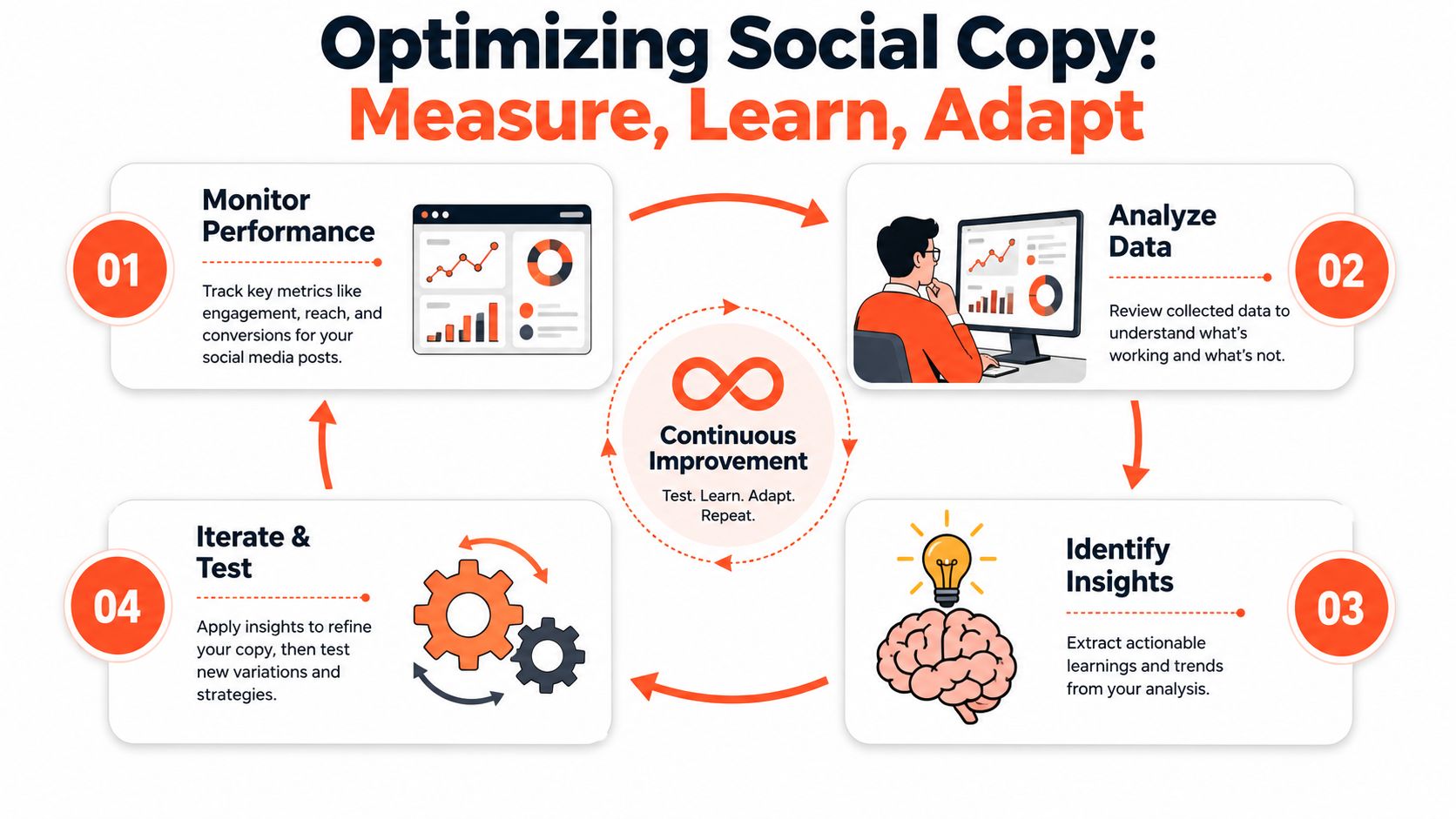
The teams I've managed get better fastest when they review posts the same way they review ads, landing pages, or email sends. Publish, inspect the response, log the pattern, ship a stronger version. Social copy improves through iteration, not instinct.
Read the signals that matter
Start with the metric that matches the job of the post.
If the post was built to spread, check shares. If it was built to earn future reference, check saves. If it was built to drive traffic, clicks matter more than applause. Too many teams still judge every format by likes, even though likes mostly tell you the post was easy to acknowledge.
Here's how I read the main signals in practice:
- Saves: The copy gave the audience something worth returning to. Example: a carousel with a swipe-by-swipe framework often earns saves even when comments stay low.
- Shares: The post gave people language or proof they wanted to pass along. Example: a sharp opinion post on LinkedIn often gets shared into team chats or Slack channels.
- Comments: The message created enough friction, agreement, or confusion to trigger a response. Read the actual replies. “This is me” and “Can you give an example?” mean very different things.
- Clicks: The promise in the hook matched the payoff in the CTA. If you need help tightening that handoff, this guide on improving click-through rates from social copy is a useful diagnostic.
- Drop-off on weak posts: This usually points to one of three problems. The hook did not earn the next line, the format fought the platform, or the post asked for an action the audience was not ready to take.
One warning. High engagement can still hide weak copy. I've seen posts with strong comment counts fail to drive trials because the discussion centered on the opinion, not the offer.
Run a simple testing loop
Use a lightweight system your team can keep up every week.
Ship one clear variation
Change one meaningful variable. Usually that means the hook, the CTA, or the framing angle.Check response quality after the post settles
Look past raw volume. Read the comments, compare saves to impressions, and check whether clicks came from the audience segment you wanted.Record the likely cause
Write the lesson in plain language. For example: “Question hook increased replies on Instagram, but direct statement drove more link clicks on LinkedIn.”Apply the lesson to the next repurposed asset
Use the same source idea again, but rewrite the packaging for the platform. That is where teams close the gap between authentic voice and algorithm-friendly structure.
A real example helps. Say your core content is a newsletter about pricing mistakes. The LinkedIn version opens with a contrarian line and earns comments. The Instagram carousel version opens with “3 pricing errors that kill conversion” and earns saves. The lesson is not “this topic works.” The lesson is that the same source idea needs a different entry point depending on whether the platform rewards discussion or retention.
Field note: When a post gets polite engagement but weak downstream action, the CTA usually asked for too much, too soon.
Over time, this process gives you a working playbook. You stop guessing which hooks fit each channel, which repurposed assets deserve a second run, and which copy patterns are costing you reach, clicks, or conversions.
If you already publish articles, newsletters, podcast scripts, or video transcripts, WaveGen.ai can help your team turn that source material into on-brand social posts, visuals, and platform-specific captions without rebuilding each post from scratch.
copywriting for social media
social media marketing
content repurposing
digital marketing
writing tips
Turn this kind of writing into a week of social content.
Paste a blog post, newsletter, or rough draft — WaveGen turns it into publish-ready carousels, captions, and slideshows for every channel.
No credit card · First posts in 2min