July 17, 2026
14 min read
Consultant Content Marketing: A Step-by-Step Playbook
Build your client pipeline with our consultant content marketing playbook. Learn to define your audience, create pillars, and distribute content effectively.
You know the pattern. Client work fills the week, your calendar looks busy, and your reputation feels stronger in private than it does in public. Prospects who should be finding you aren't. The few who do often arrive through referrals, which means your pipeline depends on other people remembering to mention your name at the right moment.
That gap usually isn't an expertise problem. It's a distribution problem.
Most consultants don't need more ideas. They need a repeatable consultant content marketing system that turns what they already know into visible proof of competence, then gets that proof in front of the right buyers consistently. One-off posts don't do that. Random bursts of publishing don't do it either. A system does.
Table of Contents
- Why Your Expertise Is Invisible and How to Fix It
- Laying the Foundation for Authority
- Developing Your Core Content Pillars
- Building Your Content Creation and Repurposing Engine
- Activating Your Distribution and Promotion Calendar
- Measuring What Matters and Optimizing for Clients
Why Your Expertise Is Invisible and How to Fix It
A lot of consultants stay invisible because they treat marketing as a side activity instead of an operating system. They publish when they have time. They comment when they remember. They write from inspiration rather than from pattern. Then they wonder why weaker competitors seem easier to find.
That approach is getting less forgiving. Content is the top marketing priority for High Growth consulting firms as of 2025, ahead of more than a dozen other techniques, and the global content marketing industry is projected to grow from about $72 billion in 2023 to over $107 billion by 2026 according to Salesgenie's content marketing statistics. Serious firms aren't treating content as a branding hobby. They're using it to create market presence.
Visibility also changed. It's no longer only about ranking for a keyword or posting regularly on LinkedIn. Buyers now discover expertise across search, social, newsletters, communities, and AI-generated answer layers. If you're trying to understand how your expertise shows up in that newer environment, this guide on AI search visibility is useful because it explains why being publishable isn't the same as being discoverable.
Practical rule: If your ideas live only in client calls, proposals, and your head, the market can't reward them.
The fix is simple to describe and harder to implement. Build a content system around three things:
- A clear point of view: Buyers need to know what you believe, what you reject, and where you have sharp experience.
- A repeatable production rhythm: You need a method that works even during delivery-heavy weeks.
- A distribution habit: Publishing once is not marketing. Repeatedly putting the same strong idea in front of the right people is.
Consultants who get inbound leads from content rarely win because they're prolific. They win because they make their expertise legible. They take what they'd normally explain in a workshop, a diagnostic call, or a client memo and turn it into durable assets.
If you need a useful reference point for what authority-building content looks like, this piece on thought leadership content is worth reading. The key is that authority doesn't come from sounding polished. It comes from making your method visible often enough that buyers start recognizing your name before they need to hire you.
Laying the Foundation for Authority
Most consultant content fails before the first draft. The consultant starts writing without deciding who the content is for, what problem they want to own, or what they want the market to repeat about them.
That lack of focus gets expensive. Content marketing generates three times more leads per dollar spent than paid search and costs 62% less than traditional outbound marketing, and 83% of successful marketers prioritize quality and relevance over volume according to AMW Group's content marketing statistics. The efficiency comes from relevance. Broad content wastes that advantage.
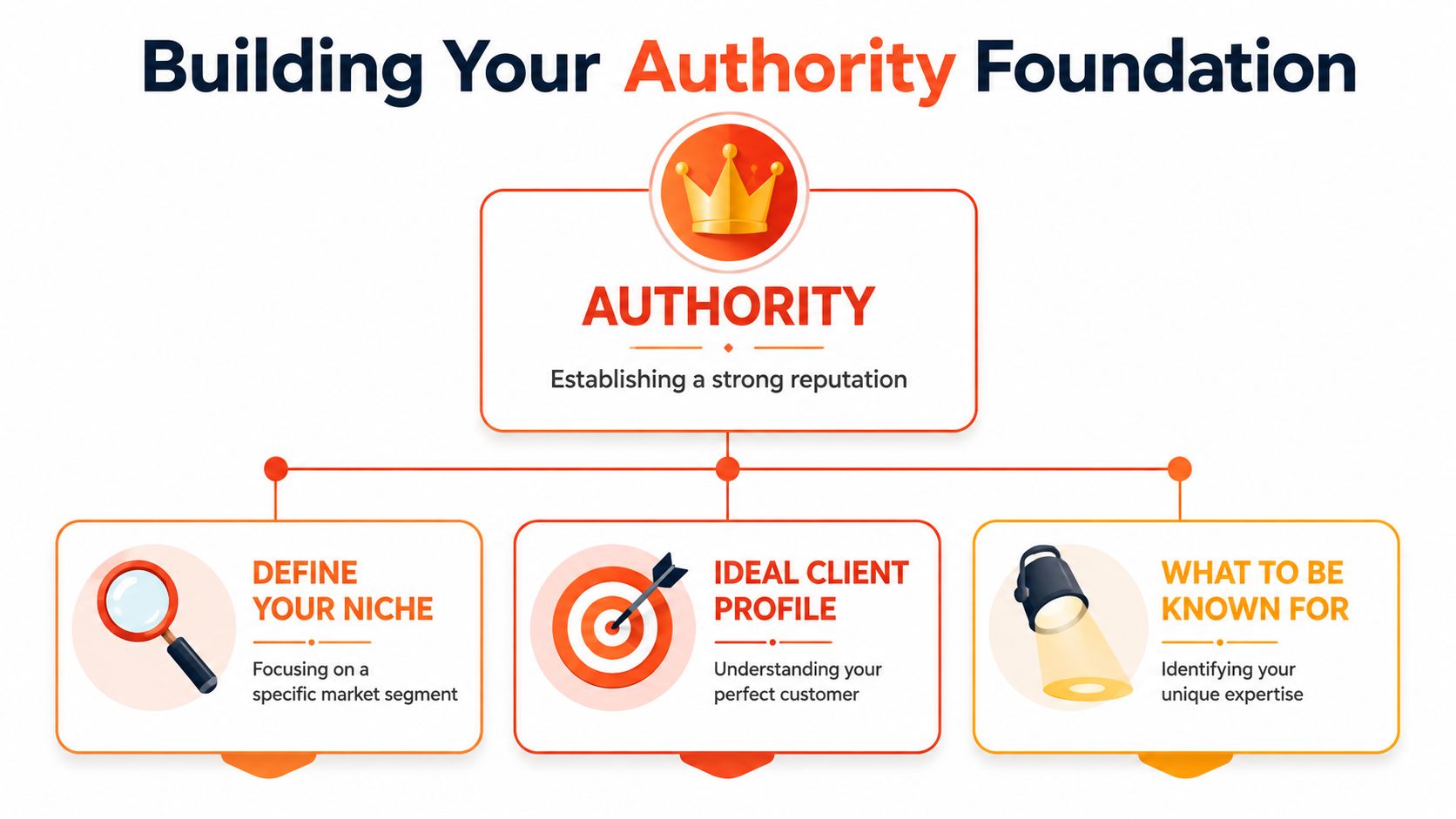
Choose a market narrow enough to matter
A niche isn't a slogan. It's a decision about which buyers you'll understand better than generalists.
“Leadership consultant” is too wide. “Leadership consultant for newly promoted directors in PE-backed healthcare groups” gives you something to say. That level of specificity usually feels uncomfortable at first. That's often a good sign.
Use subtraction:
- Remove broad sectors: Don't target “B2B companies” if your real insight comes from one operating context.
- Remove mixed buyer types: Serving founders, HR leaders, and COOs with the same message usually weakens all three.
- Remove generic outcomes: “Growth” and “efficiency” are vague. Buyers respond to problems they can already name.
Define the buyer, not just the industry
Industry targeting alone isn't enough. Two companies in the same market can buy for completely different reasons.
Write down the actual person you want reading your content. Include their role, pressure points, and the consequence of getting the problem wrong. A CFO buying risk advice reads differently from a Head of Sales buying pipeline help.
A short working profile should answer:
| Question | What to define |
|---|---|
| Who are they? | Title, seniority, decision scope |
| What's pressing now? | Repeated problem with urgency |
| What have they already tried? | Internal fixes, vendors, delays |
| What would make them reach out? | A clear next-step trigger |
Buyers don't hire a consultant because the content was informative. They hire because the content described their situation with uncomfortable accuracy.
Decide what you want your name attached to
In this context, authority starts to sharpen. You don't need to be known for everything you can do. You need to be known for a small set of problems and a distinct way of solving them.
Finish these prompts:
- We help this kind of buyer
- Solve this recurring business problem
- Using this method, framework, or lens
- Unlike the common approach we think is flawed
If your visual identity and voice are inconsistent, fix that early. Even simple consistency makes repurposed content easier to recognize across channels. A practical starting point is to document colors, fonts, logo use, and tone in a system like a brand kit, then use that same kit across every asset you publish.
Developing Your Core Content Pillars
Once your positioning is clear, content planning gets much easier. You stop asking, “What should I post?” and start asking, “Which client problem am I addressing this week?”
The strongest consultant content pillars don't come from trend lists or SEO tools alone. They come from repeated friction in sales calls, delivery work, and advisory conversations. If a buyer raises the same concern again and again, that's not a random question. That's a pillar candidate.
Start with repeated pain, not brainstormed topics
Pull up your recent notes, proposals, kickoff calls, and voice memos. You're looking for language buyers already use.
Good raw material usually falls into four buckets:
- Pain points they repeat: Delays, missed targets, bad handoffs, compliance confusion, stalled growth.
- Mistakes they keep making: Hiring too early, measuring the wrong thing, using the wrong process.
- Objections you hear in sales: “We tried this before,” “Our team won't adopt it,” “We don't have internal capacity.”
- Transformations they want: Faster decisions, cleaner operations, better margins, lower risk, stronger retention.
If you can't trace a topic back to a real client tension, it's probably filler.
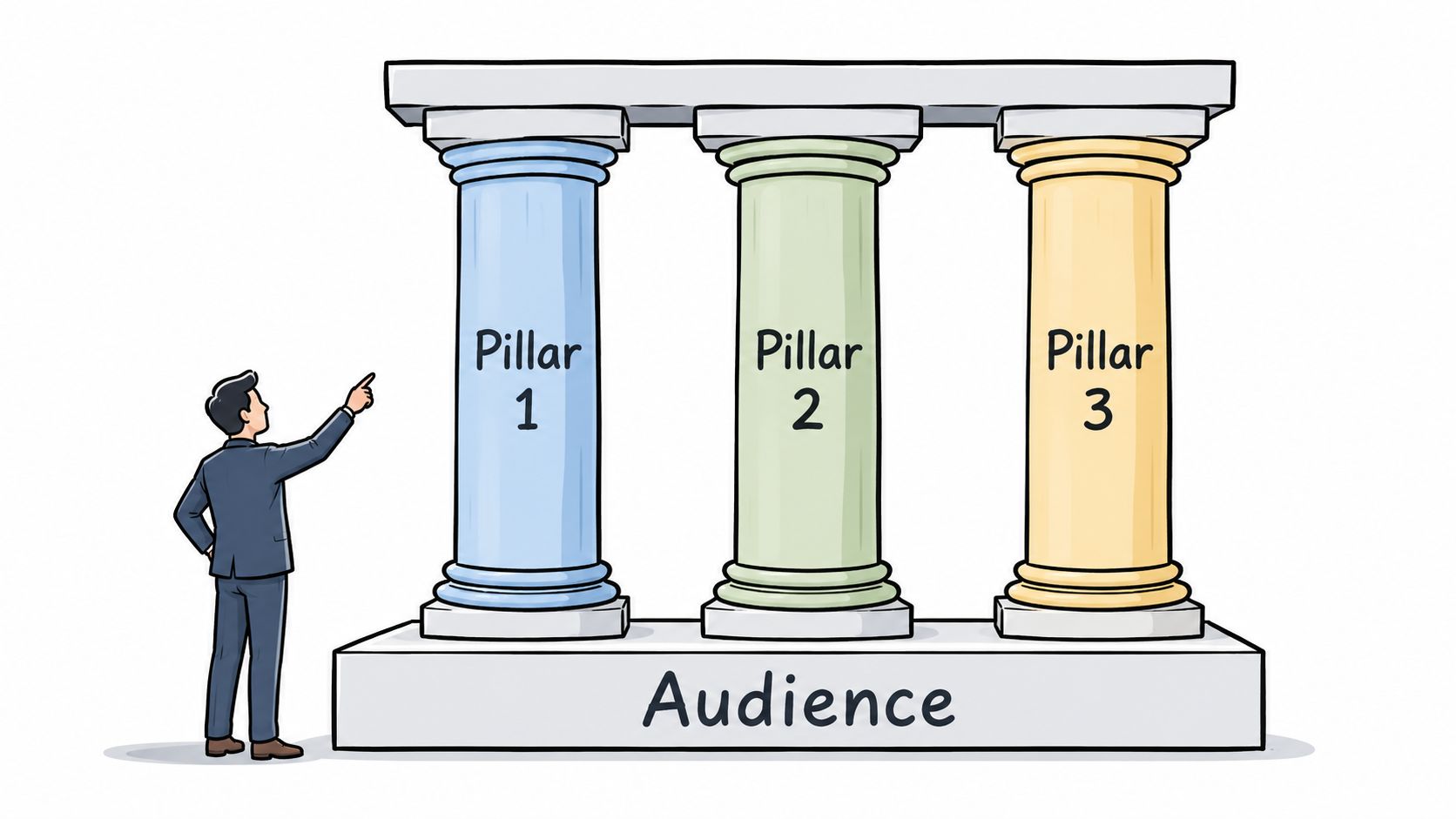
Build three pillars you can defend from experience
The cleanest model is three pillars. That's enough range to keep your content fresh, but narrow enough to build recognition.
For each pillar, define three layers:
| Layer | What it covers |
|---|---|
| Problem | The issue clients already feel |
| Point of view | What you believe most people get wrong |
| Method | How you approach fixing it |
For example, an operations consultant might use:
- Decision bottlenecks in scaling teams
- Process design without overengineering
- Executive visibility and reporting discipline
A pricing consultant might use:
- Packaging and offer structure
- Discount control and negotiation posture
- Internal alignment between sales and finance
Your pillars should be hard for competitors to copy because they're rooted in your client experience, not just in public information.
Once those pillars are set, topic generation becomes mechanical. One client objection can become a blog post. One workshop insight can become a LinkedIn carousel. One common implementation error can become a short email. You don't need endless creativity. You need a stable structure that keeps producing useful angles.
Building Your Content Creation and Repurposing Engine
A sustainable consultant content marketing system starts with accepting a constraint. You are not a full-time creator. You're a working advisor with delivery work, proposals, and client calls. If the system assumes unlimited creative energy, it will collapse.
The practical answer is to create one substantial piece, then repurpose it aggressively.
Use one core asset as the weekly source
A proven consultant workflow is to block 25 undistracted minutes daily for creation and 15 to 30 minutes for promotion, with early-stage consultants putting 20% of time into content creation and 40% into outreach, while starting with one comfortable format according to Referral Program Pros on content marketing for consultants. That guidance matters because it forces discipline. You don't need a studio. You need repeatable blocks on the calendar.
The core asset can be any one of these:
- A detailed article: Best if you think well by writing.
- A video walkthrough: Best if you're sharper talking than drafting.
- A newsletter issue: Best if your audience already responds well by email.
- A podcast-style solo episode: Best if your thinking comes alive in spoken explanation.
Pick one. Stay there long enough to get good.
A useful operating rule is this: each week produces one source document with a clear thesis, three to five supporting points, and one practical recommendation. Everything else flows from that.
Repurpose by extracting decisions, not slicing sentences
Weak repurposing just chops a blog post into smaller pieces. Strong repurposing extracts the decisions inside the source content.
If your main article explains why a COO should redesign meeting cadences, your derivative assets might become:
- A LinkedIn post: One costly mistake in executive reporting.
- A carousel: Five signs your leadership team has a decision bottleneck.
- A short video clip: Your framework for separating information sharing from decision meetings.
- An email note: A quick diagnostic buyers can run with their own team.
- A quote card: One sharp line that captures your point of view.
That gives you a week's distribution from one good idea.
If you want a broader perspective on how content supports authority over time, Raven SEO's content marketing insights are a useful complement to this repurposing-first approach.
Later in the workflow, a tool can help turn source material into channel-ready assets:
Make the workflow light enough to survive busy weeks
Most systems break at this critical stage. The consultant designs an ambitious process, misses one week, then allows the whole thing to lapse.
Use a lighter operating rhythm:
Capture ideas during delivery
After calls, jot down objections, phrases, and examples while they're fresh.Draft the core piece from one client tension
Don't start from “content themes.” Start from a real issue a buyer raised.Convert it into platform-specific assets
One article should become several posts with different hooks and different entry points.Schedule first, customize second
Put the baseline versions on the calendar, then improve them when time allows.
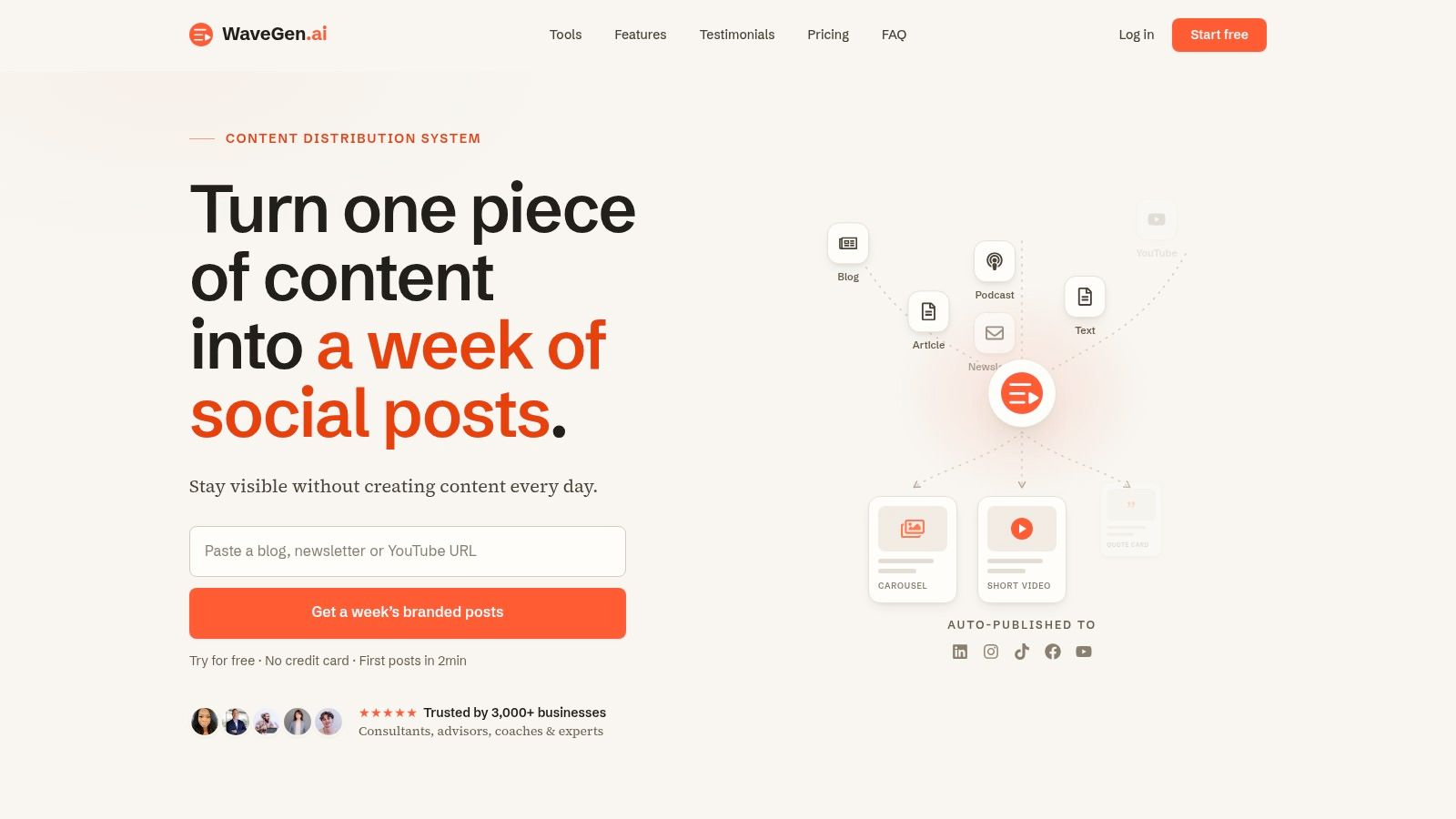
For the repurposing step, tools like content creation automation can reduce manual formatting work. In the same category, WaveGen.ai turns a single article, newsletter, transcript, or script into on-brand social assets such as carousels, short videos, quote cards, and captions, which is useful when the bottleneck isn't ideas but packaging and distribution.
Activating Your Distribution and Promotion Calendar
Publishing is only the handoff between creation and marketing. If you stop at publish, your strongest ideas will underperform.
Consultants often assume distribution means posting to LinkedIn and waiting. A better approach is to run each core piece through two lanes. First, direct personal sharing with specific people. Second, platform distribution over the rest of the week.
A weekly calendar that doesn't require daily reinvention
Keep the calendar simple enough that you can repeat it. One core idea, multiple touches, several formats.
| Day | Channel | Format | Content Focus |
|---|---|---|---|
| Monday | Text post | Main insight from the weekly core piece | |
| Tuesday | Short newsletter | Summary, opinion, and link to the core asset | |
| Wednesday | Carousel | Framework, checklist, or process from the same topic | |
| Thursday | Direct outreach | Personal message | Send the piece to selected clients, partners, or prospects with a note |
| Friday | Short-form video | Video clip | One strong takeaway or myth to challenge |
| Weekend | Notes system | Idea capture | Record responses, questions, and objections for future content |
This works because each format does a different job. The text post creates reach. Email deepens trust. The carousel teaches process. Direct outreach creates conversations. The video makes your thinking easier to absorb.
Personal outreach comes before passive posting
One of the most useful consultant habits is to distribute personally first. Before you rely on algorithms, send the piece to people who should care.
That outreach isn't a pitch. It's a relevance test.
- Send to current clients when the content helps them make a decision
- Send to past clients when it reconnects you around a familiar challenge
- Send to partners when it supports their audience or complements their service
- Send to prospects only when the topic directly matches a known concern
A short note works better than a polished intro. Mention why you thought of them, what specific point may be useful, and leave it there.
Good distribution feels more like professional follow-up than promotion.
The calendar also creates a feedback loop. When one post gets replies, save the language. When one email gets forwarded, note the subject and topic. Distribution isn't only about reach. It's how you learn which messages deserve to become your next cornerstone piece.
Measuring What Matters and Optimizing for Clients
Likes are easy to count and hard to monetize. Consultant content marketing works when it changes the quality of conversations entering your pipeline.
That means measurement has to focus on intent. Successful consultant measurement tracks high-intent signals such as inbound inquiries referencing specific content and speaking invitations, and a critical factor is spending 70% of content time on sharing where ideal clients are while putting $50 to $150 weekly behind top-performing content according to Entrepedia's guide to content marketing for consultants. That's a much stricter standard than watching impressions.
Track buying signals, not applause
The strongest content metrics usually show up outside the dashboard first.
Look for signs like these:
- Inbound messages with context: Someone mentions a specific article, post, report, or framework.
- Sales calls that start warmer: The prospect already understands your lens and asks implementation questions.
- Speaking or podcast invitations: Your published ideas triggered the invite.
- Lead magnet or email actions that connect to service interest: Not just downloads, but follow-up behavior.
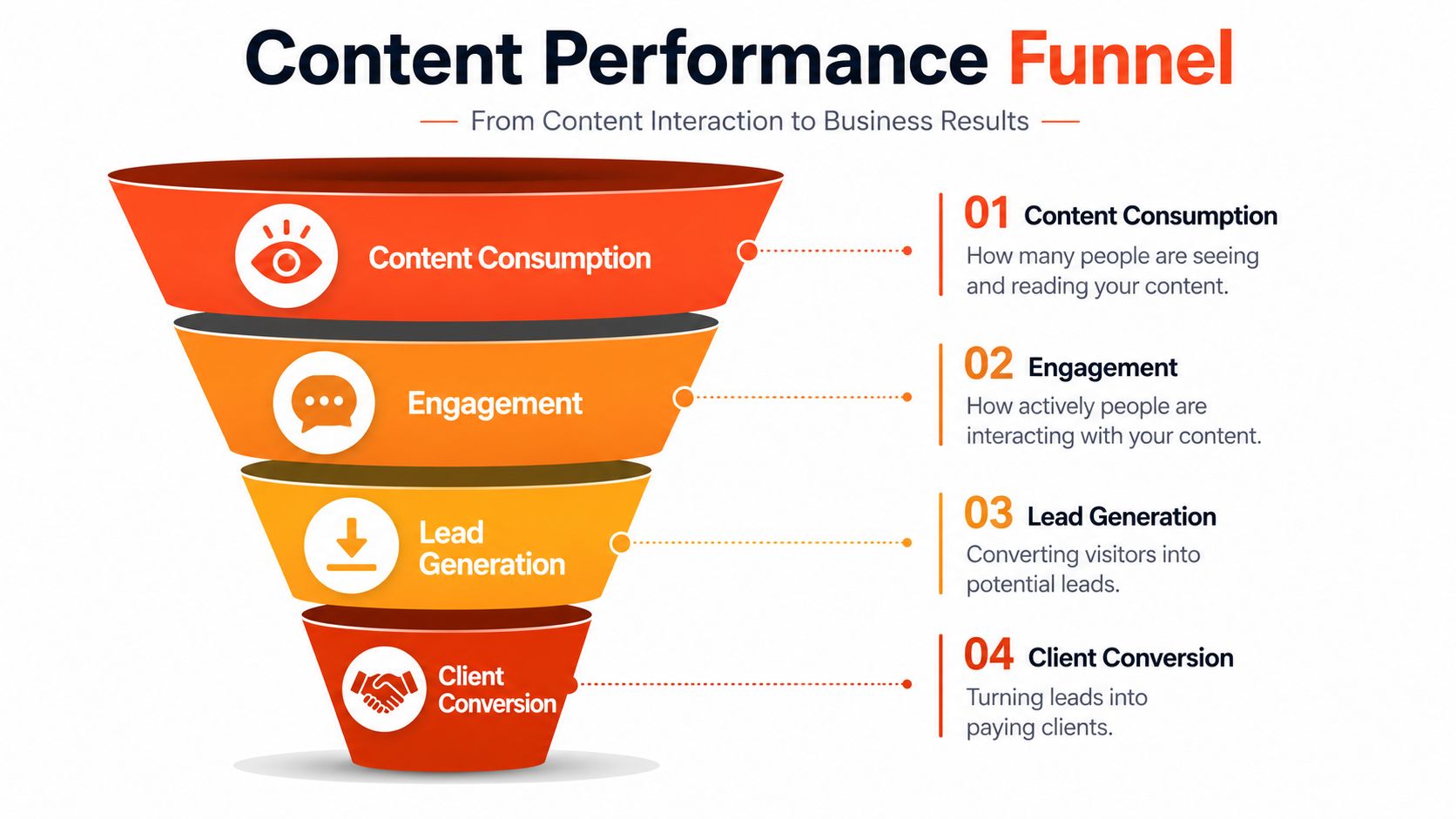
A simple operating dashboard can track four levels:
| Level | What to watch |
|---|---|
| Consumption | Views, opens, reads |
| Engagement | Replies, saves, shares, comments with substance |
| Lead generation | Contact form submissions, booked calls, downloads with clear fit |
| Client conversion | Opportunities and clients who reference content |
Review by pillar, format, and conversion path
Monthly review matters more than daily checking. You want pattern recognition, not constant reaction.
Ask three questions:
Which pillar attracts the right buyers?
High traffic from the wrong audience is noise. Low traffic from strong-fit buyers may be a win.Which format helps buyers understand your method?
Some topics need prose. Others click when turned into visual process or short video explanation.Where is the conversion path breaking?
If content gets attention but not inquiries, the mismatch is usually topic-to-offer, weak calls to action, or the wrong audience.
For consultants leaning heavily on LinkedIn, this guide on how to generate LinkedIn leads for consultants is useful because it focuses on turning visibility into actual business conversations rather than chasing platform metrics.
The content that grows a consulting firm is rarely the content with the most applause. It's the content that makes the right buyer say, “This person understands the problem better than the firms I'm already considering.”
When you see that signal, do more of it. Expand the topic into a deeper article. Repackage it into a talk. Turn the framework into a downloadable asset. Content optimization isn't about squeezing more engagement from every post. It's about finding the ideas that pre-sell your expertise and then giving them more surface area.
A steady pipeline usually doesn't come from publishing more. It comes from building a system that turns one strong idea into repeated visibility, personal outreach, and measurable buyer intent. If you already have useful source material but distribution keeps breaking down, WaveGen.ai helps turn a single article, newsletter, blog post, podcast script, or transcript into on-brand social assets you can edit, schedule, and publish across channels without rebuilding everything from scratch.
consultant content marketing
content marketing for consultants
consulting marketing
lead generation
thought leadership
Turn this kind of writing into a week of social content.
Paste a blog post, newsletter, or rough draft — WaveGen turns it into publish-ready carousels, captions, and slideshows for every channel.
No credit card · First posts in 2min