July 10, 2026
19 min read
Brand Awareness Campaigns: A Guide for Creators & Teams
Learn to run brand awareness campaigns that build your audience. This guide covers goals, creative, distribution, and measurement for creators & small teams.
You already know the pattern. You publish something substantial, maybe a newsletter, a podcast episode, a client memo, or a thoughtful LinkedIn post. Then the actual work starts. You need clips, carousels, follow-up posts, email snippets, captions, and a schedule to keep it all moving without spending every afternoon rewording your own ideas.
That's where most brand awareness campaigns break down for small teams and solo creators. The strategy is usually fine. The workflow isn't. People build campaigns as if they have a full creative department, then burn out trying to feed every channel with net-new content.
A better approach is to treat brand awareness as a system. One clear message. A few relevant channels. A measurement plan that starts before launch. And a repurposing-first workflow that helps you show up consistently enough to become familiar, memorable, and trusted.
Table of Contents
- Planning Your Campaign From Goals to KPIs
- Finding Your Audience and Choosing Your Channels
- Crafting Memorable Campaign Creative and Messaging
- Scaling Your Message with Smart Content Repurposing
- Mastering Distribution and Scheduling for Consistent Reach
- Measuring Real Impact and Optimizing for Growth
Planning Your Campaign From Goals to KPIs
A solo consultant spends three weeks making posts, short videos, and a polished lead magnet. Reach looks fine. A few people like the content. Nothing changes in the pipeline.
That usually traces back to planning. The campaign had output, but no clear memory goal, no source asset to repurpose, and no KPI set that matched an awareness objective.
Brand awareness campaigns break down early when teams treat activity as progress. Clicks, likes, and cheap reach can show that content got exposure. They do not show whether the right people remember your name, connect you with a specific problem, or return later without a prompt.
Why vanity metrics fail
Awareness work needs measurement that fits awareness. For a small team, that means choosing signals tied to memory and recognition, then building content around them from the start. Good planning usually combines a few simple inputs, such as branded search trends, direct traffic, message recall surveys, CRM notes, and campaign-level comparisons over time.
The goal is not to defend awareness with conversion metrics it was never built to produce. Analysts at SegmentStream argue that awareness investment helps build the base for later demand capture in this analysis of awareness and incrementality. That matters even more for consultants, creators, and newer service brands that need to become familiar before they become selectable.
Practical rule: If your KPI only captures immediate action, you are measuring response, not awareness.
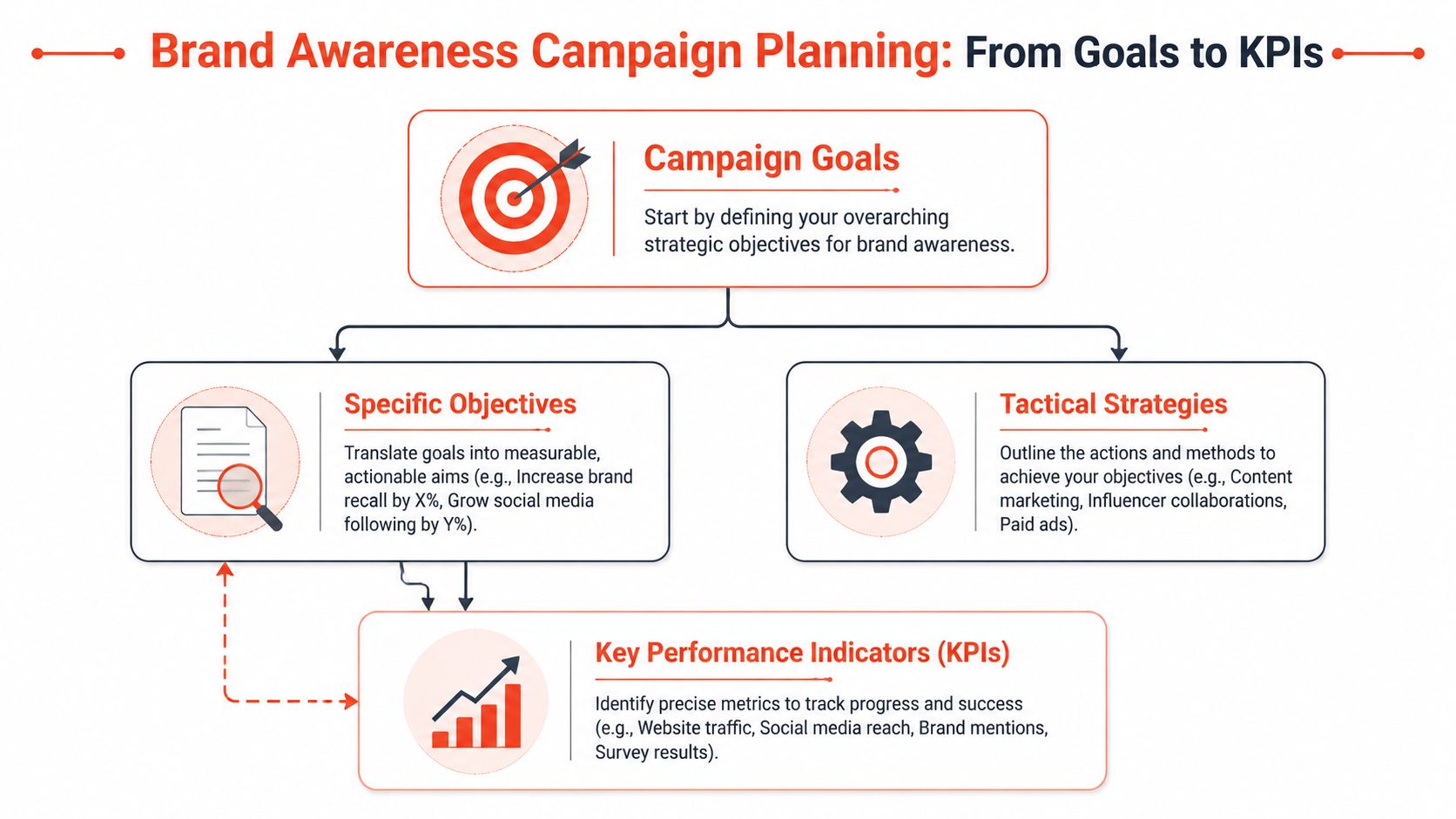
Build a goal stack before you create anything
For a consultant, advisor, or creator, “I want more people to know what I do” is too broad to guide a campaign. It does not tell you what people should remember, what asset you should make first, or how to keep the workload sustainable.
Use a goal stack that connects strategy to production:
Business goal
Become the clear choice for a defined audience segment.Awareness objective
Increase familiarity with your name, offer, or point of view.Behavioral signal
More branded searches, more direct visits, more replies that repeat your framing, or more referral conversations that mention your specialty.Campaign asset
One strong core piece that can be turned into multiple channel-ready formats.
That last step matters more than many small teams expect. If the campaign depends on creating every post from scratch, consistency usually falls apart by week two. A better approach is to start with one useful source asset, such as a webinar, teardown, article, or opinion post, then shape that into clips, quotes, carousels, emails, and follow-up posts. Brand building gets stronger when repetition is intentional and production stays manageable.
A one-page planning doc is enough if it answers five questions:
- Who needs to remember you
- What single idea should be attached to your name
- What core asset will carry that idea
- Which signals would show awareness is increasing
- How that asset will be repurposed without adding weekly content debt
If you need a practical system for the publishing side, this guide on how to plan social media content helps turn campaign goals into a schedule a small team can keep up with.
Map goals to KPIs you can track
Here is a workable KPI table for a solo operator or small service business:
| Goal type | Better KPI | Why it matters |
|---|---|---|
| Familiarity | Branded search queries | Shows people remember your name |
| Recall | Brand survey responses or message recall polls | Captures awareness and message retention |
| Intent | Direct traffic | Indicates people seek you out without a prompt |
| Engagement quality | Time on page or viewable impressions | Better fit for awareness than raw clicks |
| Downstream movement | Awareness-to-consideration shift | Shows recognition is turning into real interest |
The trade-off is simple. Broad awareness goals feel flexible, but they usually produce scattered content. Narrow goals create stronger recall because every asset repeats the same idea from a different angle.
For example, if your campaign message is “I help founders spot cash pressure before it becomes a hiring problem,” then your content should keep reinforcing that frame. A founder story. A short video breakdown. A checklist. A webinar clip. The format can change. The association should not.
PR can support that system if it extends the same message instead of creating extra work. If you want an outside perspective on campaign structure and amplification, you can learn about effective media communications and adapt the parts that fit a smaller, repurposing-first operation.
Finding Your Audience and Choosing Your Channels
Sarah is a freelance financial consultant. She works best with tech founders who've raised early capital and suddenly need sharper reporting, forecasting, and board-ready communication. Her problem isn't expertise. It's visibility. She keeps posting general finance advice and attracting people who want bookkeeping help, not strategic finance support.
That's an audience problem, not a content problem.
A practical example with Sarah
Sarah's first move isn't “pick more platforms.” It's narrowing the audience until the message gains edges.
Her audience description could look like this:
Primary buyer
Seed-stage or Series A founder who needs clearer financial decision support.What they care about
Runway, hiring pace, investor confidence, cash visibility, and planning under uncertainty.What they don't want
Dense jargon, accounting-heavy content, or generic startup inspiration.Where they already learn
LinkedIn, founder newsletters, niche podcasts, investor content, and peer communities.
That profile immediately changes her channel mix. Instagram might still be useful later, but it probably isn't where her best buyers form trust first. LinkedIn is stronger. Guest appearances on founder podcasts are stronger. A compact newsletter is stronger. A founder-focused webinar can work. So can short clips pulled from a longer financial teardown.
The point isn't to be everywhere. The point is to be present where attention already exists.
Choose category entry points, not every platform
A lot of channel selection advice stays too broad. “Go where your audience is” is true, but incomplete. You also need to know when people enter the category mentally.
That's the idea behind category entry points. In Sarah's case, they might be moments like:
- A founder realizes cash burn feels unclear
- A board meeting is coming up
- Hiring decisions are getting riskier
- Revenue is growing, but visibility is getting worse
- Investors start asking sharper questions
Those are the moments when awareness has influence. If Sarah shows up with useful, memorable framing around those situations, she has a better chance of being remembered later.
The best awareness channel is often the one that catches a prospect just before they start actively looking for help.
This is also where organic search benefits can show up. Brand awareness campaigns can increase non-branded organic traffic by an average of 19%, as people begin searching related terms after exposure to a brand, according to Google and Kantar data summarized by SearchLab. For a consultant, that means thought leadership can influence discovery even when people don't search your name directly.
A useful small-team rule is to choose:
| Channel role | Sarah's example |
|---|---|
| Home base | |
| Depth channel | Newsletter or blog |
| Borrowed audience | Founder podcast guest spots |
| Search support | Articles tied to founder finance questions |
That's enough. She doesn't need six social platforms. She needs a message-channel fit she can sustain for months.
Crafting Memorable Campaign Creative and Messaging
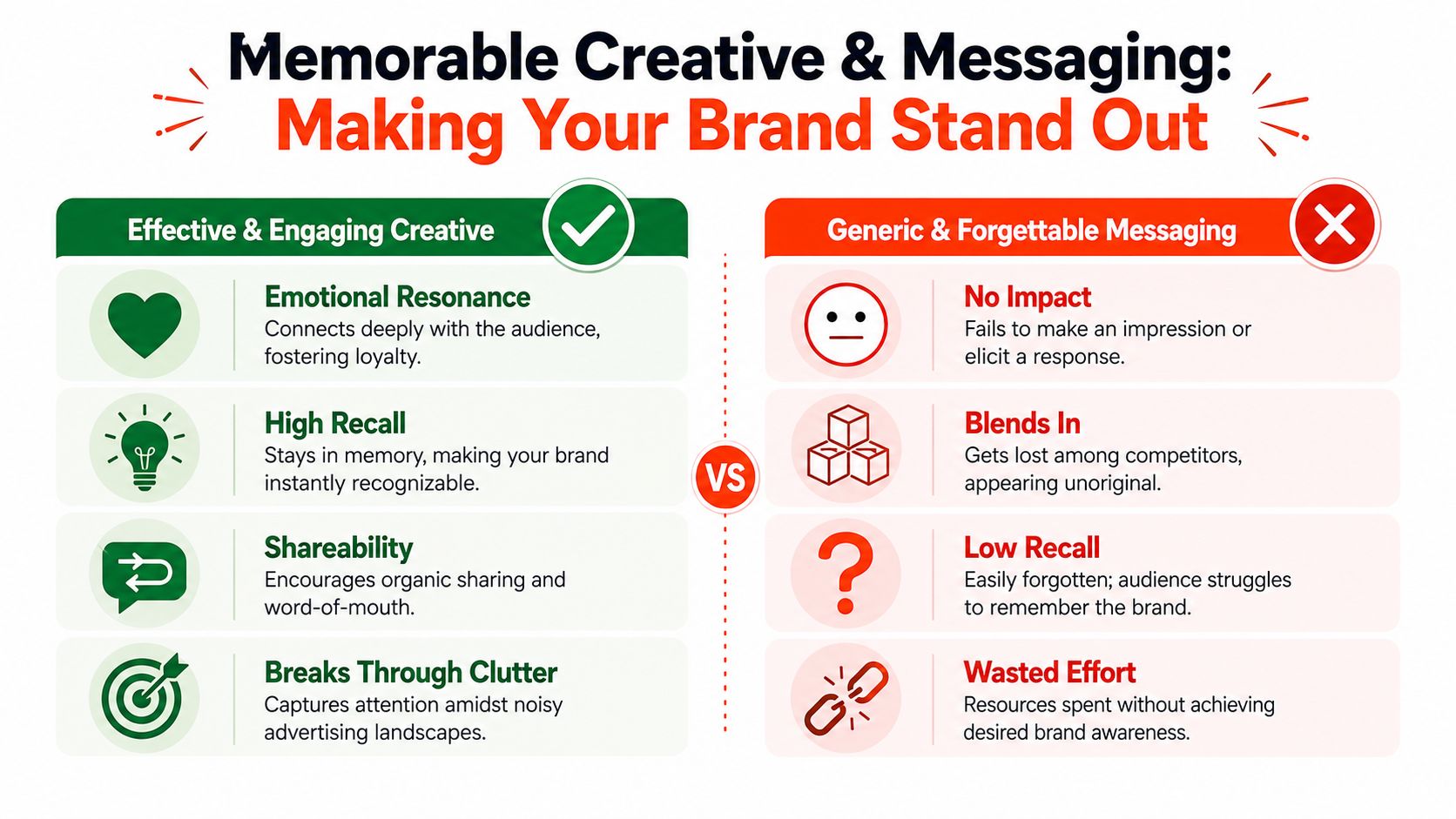
The campaigns people remember usually aren't the ones with the most features. They're the ones that make the audience feel seen, included, or slightly changed. That's why so much forgettable brand content sounds correct but leaves no residue.
Memorable creative has tension in it. It names a problem sharply, frames it in human terms, and gives people something easy to repeat.
Why some campaigns stick
A classic example is Coca-Cola's “Share a Coke.” Replacing the logo with popular names made the product personal, social, and easy to share. The campaign led to U.S. sales increasing over 2% and Facebook traffic surging 870% through the #ShareACoke mechanic, as summarized by SearchLab's 2026 statistics page. That result came from personalization and participation, not just distribution volume.
Small brands can't copy Coca-Cola's scale. They can copy the structure.
Here's what made that campaign work:
Personalization
People saw themselves in the product.Low-friction participation
Sharing the experience felt natural.Clear social signal
The hashtag gave people a public behavior to join.Emotional simplicity
The message required almost no explanation.
Generic messaging usually fails for one reason. It could have come from any competitor.
A small-team creative template
A solo creator or consultant can apply the same principles with much less production.
Try this message template:
| Element | Prompt |
|---|---|
| Audience tension | What are they frustrated, embarrassed, or uncertain about? |
| Brand point of view | What do you believe that others in your category miss? |
| Memorable phrase | What short line could they repeat to someone else? |
| Participation hook | What can they respond to, share, or identify with? |
For example, a financial consultant might build a campaign around this idea: “Revenue growth doesn't fix unclear decision-making.” That can turn into posts, short videos, a webinar title, a carousel, and a lead article.
If you want to sharpen the actual writing, this guide to copywriting for social media is helpful because it focuses on making short-form messaging clearer and more distinct.
A practical content framework also helps teams avoid random creative. Use:
- Hero for the big campaign asset, such as a flagship article, webinar, or keynote clip
- Hub for recurring supporting content around the same theme
- Help for practical posts that answer smaller audience questions tied to the campaign message
Later, when you adapt this for video, a strong short form video content guide can help you translate the message without flattening it into generic talking-head clips.
Turn one message into multiple formats
Video can carry emotional tone better than static text, especially when your expertise depends on trust and clarity. This example is worth studying for pacing and message delivery:
One campaign message can become:
- A long-form article that explains the point of view
- A carousel that breaks the argument into stages
- A short clip with the strongest line up front
- A quote card with a repeated phrase
- An email intro that pushes readers back to the main asset
The mistake is assuming each format needs a different idea. It doesn't. Brand awareness usually improves when the same idea appears in several recognizable forms.
Scaling Your Message with Smart Content Repurposing
Small teams don't usually lose on strategy. They lose on stamina. They keep creating platform by platform, post by post, and eventually the campaign turns into a content treadmill that eats the calendar.
Repurposing fixes that because it shifts the unit of work. Instead of making twenty separate assets, you create one strong source asset and atomize it.
Stop creating platform by platform
A repurposing-first workflow does three things at once.
First, it reduces creative fatigue. You're not inventing a new angle every day. Second, it reinforces memory because the same message appears repeatedly in different shapes. Third, it makes consistency realistic for a person who still has client work, admin, and actual business operations to handle.
That matters in brand awareness campaigns because repetition is part of the mechanism. People usually don't remember you because of one polished post. They remember you because your idea keeps resurfacing with enough consistency that it becomes familiar.
Here's the inefficient model versus the sustainable one:
| Approach | What happens |
|---|---|
| Create separately for each platform | More context switching, weaker consistency, faster burnout |
| Start with one core asset and repurpose | Better message cohesion, lower production strain, easier scheduling |
A repurposing workflow small teams can sustain
Use a single weekly source asset. That could be:
- a newsletter issue
- a blog post
- a podcast transcript
- a webinar recording
- a client Q&A turned into educational content
Then pull it apart deliberately.
Find the core thesis
One sentence only. If you can't summarize it fast, the asset is too muddy.Extract the strongest sub-points
These become carousel slides, short posts, and email snippets.Pull direct phrasing
Good quote cards come from clean lines already written or spoken, not from forced rewrites.Identify visual moments
Screenshare clips, examples, diagrams, before-and-after contrasts, or punchy spoken segments.Adapt by platform behavior
LinkedIn might get the insight-driven post. Instagram may get the carousel. Short-form video gets the single strongest claim plus context.
A repurposing system works even better when it's tied to an omnichannel content strategy rather than random cross-posting. This piece on building an omnichannel content strategy is a good reference if your content feels fragmented across platforms.
Reuse isn't laziness. It's message discipline.
The biggest mindset shift is this: repetition isn't annoying when the audience didn't see every version. The audience often catches fragments. Repurposing helps those fragments feel connected.
Mastering Distribution and Scheduling for Consistent Reach
You publish a strong post on Monday. It gets a few comments, maybe a save or two, then disappears under client work, inbox triage, and the next thing that feels urgent. Two weeks later, you are back at a blank page trying to create momentum from scratch.
That pattern drains small teams because it treats every post like a one-off. Brand awareness grows through repeated exposure to the same clear idea, delivered in formats people are already inclined to consume.
Distribution answers three practical questions. Where does this message show up? How many times does it show up? Who sees a second or third version after missing the first?
Distribution is a repeatable sequence
One asset should travel farther than its first publish.
For a small team or solo creator, that sequence often looks like this:
- a primary publication
- two or three adapted platform versions
- a reshare at a different angle
- email support
- community distribution
- a follow-up post built from replies, objections, or questions
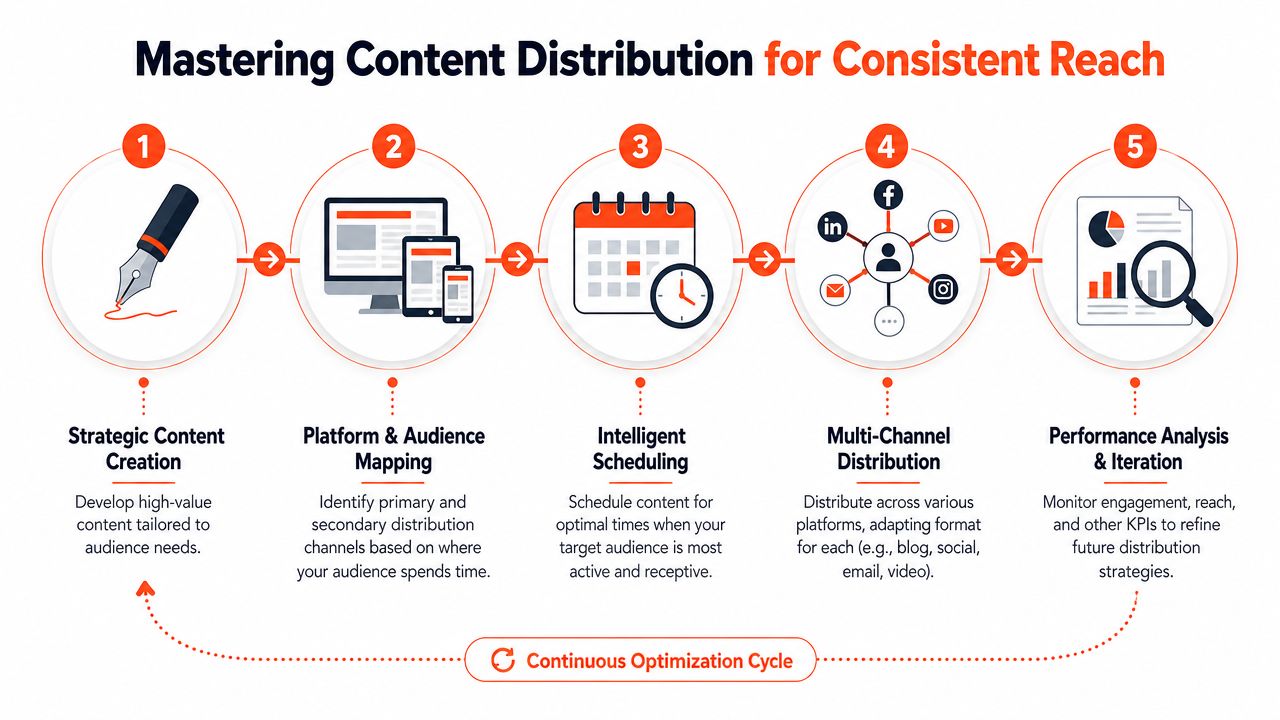
Here, repurposing stops being a production tactic and starts doing brand work. Repetition builds recognition. Repetition with slight variation builds recognition without boring the audience.
Small operators usually have the same failure mode. They spend too much energy making new pieces and too little energy helping a good message reach enough people often enough to stick.
A weekly cadence you can keep running
The best schedule is the one you can still maintain during a busy client week. That usually means one source asset, one theme, and a fixed publishing rhythm.
| Day | Platform example | Asset type |
|---|---|---|
| Monday | Main insight post tied to the weekly theme | |
| Tuesday | Instagram or LinkedIn | Carousel built from three to five supporting points |
| Wednesday | Short note linking the audience back to the main idea | |
| Thursday | Short-form video | One sharp clip with a single takeaway |
| Friday | LinkedIn or community post | Reflection, contrarian take, or audience question |
The value of this cadence is not volume. It is message retention and lower production strain.
I usually recommend batching in three lanes:
- Create in one block
- Schedule in one block
- Reply and engage in short daily windows
That split keeps content from taking over the week. It also protects the part many creators skip. Active replies, comment threads, and follow-up conversations often determine whether a post gets another burst of reach or dies after the first wave.
Schedule for recall, not just convenience
Publishing at random creates uneven memory. Publishing on a rhythm gives your audience multiple chances to connect the dots.
A good schedule also respects format fatigue. The same point can run three times in a week if each version earns its place. A text post can introduce the idea. An email can add context. A short video can make the point easier to remember. Repeating the message is useful. Repeating the exact asset everywhere is usually lazy distribution.
This is the trade-off. More frequency can increase recall, but only if the message stays coherent and the format fits the channel. If every adaptation feels copied and pasted, reach may hold up while trust slips.
Leave space for responsive content
A schedule should give structure, not lock you into autopilot.
AskAttest highlights growing interest in immersive experiences and dynamic content that changes based on how people interact with it, drawing on Cision's perspective in its guide to brand awareness ROI. For a small team, that usually means lighter interactive formats instead of expensive production. Polls, live Q&As, workshops, quizzes, and personalized follow-ups all give people a reason to spend more time with your message.
Build those into the schedule after the core assets are covered. That order matters. A clear weekly system keeps awareness efforts sustainable. Then responsive content adds energy without forcing you back into constant creation.
A well-structured distribution plan is not extra overhead. It is how one strong idea becomes a week of visible, coherent brand presence without burning out the person making it.
Measuring Real Impact and Optimizing for Growth
A small team spends two weeks turning one strong campaign idea into a webinar, three short videos, a newsletter, a LinkedIn post series, and a simple lead magnet. The posts get likes. A few people comment. Then the team hits the usual wall. Did the campaign build awareness, or did it just create a brief spike of visible activity?
That question matters because awareness work is easy to undervalue when the only scoreboard is engagement. If the goal is brand growth, the useful signals are the ones that show people remember you, look for you by name, and arrive with context before a sales conversation starts.
Track memory and intent, not just platform response
For a solo creator or lean team, the cleanest measurement setup is usually simpler than people expect. You do not need an enterprise research budget to spot whether awareness is working. You need a few signals that point to memory, familiarity, and consideration over time.
Start with these:
Branded search queries
More people search for your business name, product name, or your own name after the campaign runs.Direct traffic
More visitors arrive by typing in your URL, using a bookmark, or returning through familiar paths.Lead source language
Prospects say things like, “I've seen your content a few times,” or “I heard about you through your workshop.”Sales conversation quality
Calls start faster because the prospect already understands the category, your positioning, or your approach.
Those signals matter more than surface engagement because they show movement beyond passive exposure. A saved post is nice. A prospect who shows up already warmed up by repeated exposure is better.
One distinction is worth keeping in mind. Recognition and recall are not the same. Recognition means someone knows your name when they see it. Recall means your name comes to mind without a prompt. If you are building a sustainable brand, recall is the stronger signal.
A lightweight setup that small teams can maintain
The measurement system has to fit the workflow, or it will break the first busy week. I prefer a setup that can run alongside a repurposing-first content process, because the point is to learn from the campaign without creating a second job.
A practical version looks like this:
- Mark the campaign window in your planning doc and analytics notes.
- Track branded queries in Google Search Console before, during, and after distribution.
- Review direct traffic trends in GA4 over the same period.
- Group repurposed assets under one campaign label so you can compare one idea against the next.
- Ask every lead how they heard about you and record the phrasing they use.
- Compare exposed and unexposed audiences if you can separate by region, list segment, or channel.
That last step matters more than many teams realize. Platform reporting tends to over-credit itself. If you want a clearer framework for causation in paid channels, this guide on measuring true paid media impact explains why holdouts and incrementality checks produce better decisions than platform-reported lift alone.
You can also run a short survey. Keep it basic.
| Survey type | Example |
|---|---|
| Unaided recall | “Which financial consultants for founders come to mind?” |
| Aided recognition | “Which of these names have you heard of?” |
This will not give you lab-grade certainty. It will give you a better read than counting impressions and calling it progress.
Optimize the system, not just the asset
Awareness optimization works best when you review patterns across the whole campaign, not isolated posts. That is especially important if you are repurposing one source asset into several formats. A webinar clip may get the reach. The email may drive direct visits. The follow-up post may be the piece that makes leads mention your brand by name a week later.
So optimize with a wider lens:
- Keep messages and formats that coincide with higher branded search, stronger direct traffic, or better lead recall
- Refine assets that get distribution but do not improve downstream awareness signals
- Cut content that attracts attention from people who will never buy
- Test changes in channel mix, frequency, or audience split with simple holdouts when possible
The sustainable angle shows up in the numbers. Small teams do not need more random content. They need a repeatable system where one strong idea gets repurposed well, distributed consistently, and measured against signals that reflect real brand growth. That approach reduces burnout and makes optimization easier, because you are comparing campaigns built from a clear strategic core instead of a pile of disconnected posts.
The goal is not more content for its own sake. The goal is a brand people remember, built through a workflow your team can keep running long enough for familiarity to compound.
brand awareness campaigns
brand awareness
content marketing
social media strategy
content repurposing
Turn this kind of writing into a week of social content.
Paste a blog post, newsletter, or rough draft — WaveGen turns it into publish-ready carousels, captions, and slideshows for every channel.
No credit card · First posts in 2min