July 16, 2026
22 min read
Master Your B2B Content Strategy
Craft a winning B2B content strategy for 2026. Learn frameworks, personas, mapping, distribution & measurement to drive real business growth.
Most advice about B2B content strategy is too polite. It tells teams to publish consistently, know their audience, and stay active on LinkedIn. None of that is wrong. It's just incomplete.
A calendar isn't a strategy. A blog backlog isn't a strategy. A pile of keyword targets, webinar ideas, and “we should post more video” comments from leadership definitely isn't a strategy. What works is an operating system. You need a documented way to decide what gets made, why it exists, where it gets distributed, and how you'll know whether it pulled its weight.
That matters because the gap between top-performing teams and struggling teams isn't mostly about creativity. It's about structure, discipline, and the ability to repeat good decisions without reinventing the process every week.
Table of Contents
- Your B2B Content Is a Mess Without a Real Strategy
- The Difference Between a Content Plan and a Content Strategy
- Defining Your Audience with B2B Buyer Personas
- Mapping Content to the B2B Buyer Journey
- Building Your Tactical Content Calendar
- The Content Distribution and Repurposing Playbook
- Measuring and Optimizing Your Content for ROI
Your B2B Content Is a Mess Without a Real Strategy
The most common content problem isn't lack of effort. It's false confidence. Teams think they have a strategy because they have a publishing schedule, a few target keywords, and a Slack thread full of ideas.
What they have is motion without direction.
A real B2B content strategy is documented. It tells the team which audience matters most, which problems the company wants to own, what message should repeat across channels, which formats support each stage of the journey, and what business outcome each asset is supposed to influence. Without that, content becomes a factory for disconnected assets.
The performance gap is hard to ignore. 64% of the most successful organizations have a documented content strategy, compared with 19% of the least successful organizations, according to LinkedIn's guide to improving B2B content marketing strategy. That's the difference between content as a system and content as a recurring to-do list.
What chaos looks like in practice
You can usually spot a weak strategy fast:
- Topics drift constantly: One week the team writes for procurement, the next week for practitioners, then suddenly for founders because someone saw a competitor post.
- Formats get chosen backward: People ask whether to make a webinar, case study, or video before they've decided what buyer question they need to answer.
- Sales can't use the content: Assets may be polished, but they don't help reps handle objections, frame the problem, or support follow-up conversations.
- Reporting stays shallow: Dashboards show clicks and impressions, but nobody can explain which content moved a deal forward.
Practical rule: If removing your content calendar would leave your team unable to explain audience, message, and business goal, you never had a strategy in the first place.
A documented strategy also makes format decisions easier. If short video is part of your motion, build it into the system instead of treating it like an add-on. Teams trying to operationalize that side of the mix can get useful tactical ideas from this guide to video content for businesses, especially when they're turning expertise into repeatable visual assets.
What a real strategy does
A strong strategy creates constraints. That's a good thing. It tells your team what not to make. It forces trade-offs. It gives editors a reason to reject decent ideas that don't serve the core audience or the commercial goal.
That's when content starts compounding. One message gets reinforced across multiple assets. Sales hears the same framing prospects saw in marketing. Distribution gets cleaner because every asset has a defined role.
Messy content teams don't need more ideas. They need a blueprint.
The Difference Between a Content Plan and a Content Strategy
It's common to confuse the blueprint with the schedule. That confusion creates endless busywork.
A content strategy is the architectural drawing. It shows where the structure needs to stand, what it needs to support, and why it exists. A content plan is the construction schedule. It tells you what gets built this week, who owns it, and when it ships.
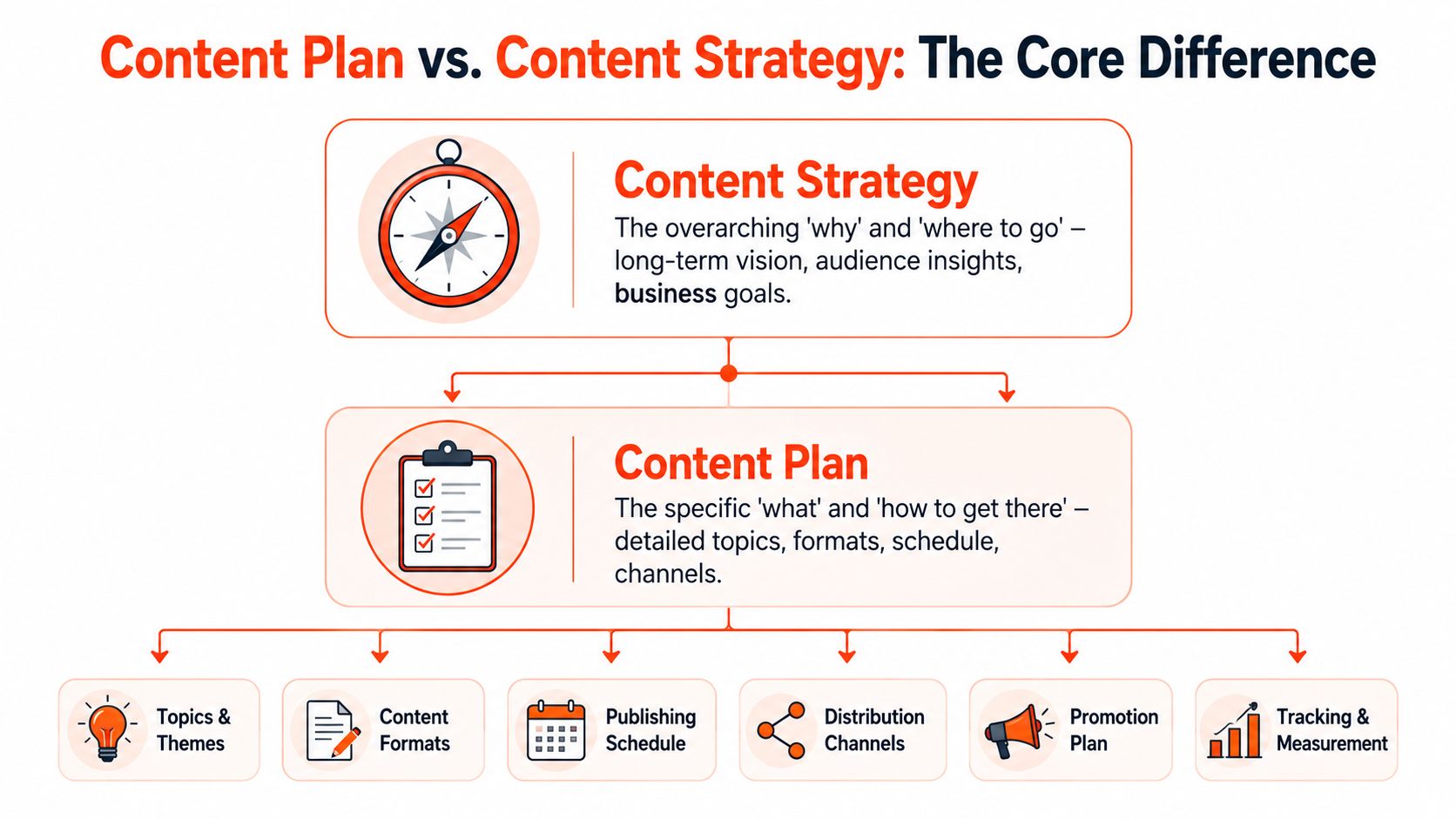
If you mix those up, your team stays tactical forever. You'll spend meetings debating blog titles and post frequency when the problem is that nobody agreed on the buyer, the message, or the commercial purpose.
Strategy answers different questions
Here's the cleanest distinction I use with new team leads.
| Layer | What it answers | Typical outputs |
|---|---|---|
| Content strategy | Why are we creating content, for whom, and around which core messages? | Audience definition, business goals, messaging pillars, journey map, measurement model |
| Content plan | What are we publishing, in which format, on which channel, and when? | Editorial calendar, briefs, assignments, production timeline, campaign checklist |
A strategy should survive a calendar change. If your Q3 webinar gets canceled or a blog deadline slips, your strategy shouldn't collapse. If it does, the team built a schedule, not a system.
Use the three Ps
To keep this practical, define strategy through three decisions.
Purpose
Purpose is the business reason the engine exists. Teams often get fuzzy on this point. “Build awareness” is rarely enough. Good purpose statements are specific enough to guide trade-offs.
Examples of strong purpose statements:
- Support category education: Useful when buyers don't yet understand the problem well.
- Help sales close cleaner: Useful when deals stall on objections, differentiation, or implementation fear.
- Own a strategic topic: Useful when the company needs authority around a narrow commercial theme.
People
This is not “mid-market companies in tech.” That isn't a usable audience definition. People means humans involved in the buying process, what each of them is trying to achieve, and what would make them trust your point of view.
You don't need a giant persona deck. You need enough clarity to decide what message belongs where.
Pillars
Pillars are the small set of themes your company can credibly own. They shouldn't be broad industry categories. They should sit close to buyer pain, product relevance, and the expertise your team can defend in public.
A weak pillar sounds like a website nav label. A strong pillar sounds like a position your sales team would argue for on a call.
What the plan does after strategy is clear
Once Purpose, People, and Pillars are set, planning gets easier. The team can now make tactical decisions with less debate:
- Topic selection: Does this idea reinforce one of our pillars?
- Format choice: Is the buyer best served by a case study, short video, article, or comparison page?
- Channel fit: Should this live on LinkedIn, in email, on the blog, or in a sales sequence?
- Cadence: What can we publish consistently without lowering quality?
The plan should execute the strategy, not compensate for the absence of one.
A lot of content operations pain comes from trying to solve strategic confusion with project management. More Asana tasks won't fix a weak message. More publishing discipline won't rescue content aimed at the wrong audience.
Defining Your Audience with B2B Buyer Personas
Generic personas fail in B2B because purchases rarely happen through one person acting alone. You aren't selling to “the marketer” or “the operations leader.” You're selling into a group of people with different risks, incentives, and internal politics.
I've seen teams build content for a fictional average reader and then wonder why none of it converts into useful sales conversations. The reason is simple. Buying committees don't act like a single person. Each stakeholder asks a different question and needs different proof.
A buying committee example
Take a common software purchase.
The day-to-day user wants the tool to remove friction. They care about workflow, usability, and whether adoption will be painful. The department head cares about team performance and whether the change will create operational drag. The executive sponsor cares about risk, budget logic, and whether this decision will hold up under scrutiny.
If your article only speaks to the practitioner, the executive won't see enough confidence. If your case study only speaks to budget logic, the user won't picture how the tool fits their work. That's why broad personas create broad content, and broad content rarely persuades anyone effectively.
Build personas around jobs and pressure
The best B2B personas I've used were less like ad targeting profiles and more like operating notes for content and sales. They answered practical questions.
Use a template like this:
- Role in the deal: User, recommender, approver, blocker, or champion.
- Primary job to get done: What are they trying to improve, fix, prevent, or accelerate?
- Personal KPI: What number, outcome, or internal expectation affects how they judge solutions?
- Internal pressure: What politics, legacy decisions, or cross-functional tensions are they navigating?
- Fear of getting it wrong: What would make this purchase feel risky to them?
- Reason to act now: What would make delay costly or embarrassing?
- Definition of a win: What makes them look smart to peers or leadership?
That last one matters more than often realized. B2B buyers don't just buy for the business. They also buy for career safety and internal credibility.
Content gets sharper when you stop asking, “What does this persona want to read?” and start asking, “What does this person need to believe to move confidently?”
A usable persona is tied to content decisions
Here's a simple way to test whether a persona is real enough to be useful.
Can your team answer these without guessing?
| Persona question | Why it matters for content |
|---|---|
| What problem are they trying to name internally? | Shapes awareness-stage topics |
| What objections will they raise during evaluation? | Shapes consideration content |
| What proof do they need before signing off? | Shapes decision-stage assets |
| What language do they trust? | Shapes tone, examples, and framing |
If the team can't answer those, the persona isn't ready.
What good persona work changes
Once the audience definition gets specific, content quality usually improves fast.
Writers stop producing generic thought leadership and start addressing live buying friction. Product marketers stop stuffing every asset with every feature. Sales enablement gets cleaner because each asset has a more obvious user.
You also get better distribution choices. Some stakeholders will consume a detailed article. Others will engage with a concise LinkedIn post, a short clip, or a comparison sheet passed over email. Persona work doesn't just shape message. It shapes package.
Good buyer personas don't live in slides. They show up in briefs, review comments, and editorial decisions every week.
Mapping Content to the B2B Buyer Journey
Most B2B teams overproduce top-of-funnel content because it feels easier to make. General educational posts are simpler than nuanced evaluation assets. But buyers don't need endless introductions to the problem. They need help progressing from confusion to conviction.
That's why a practical B2B content strategy maps content to distinct buying stages. Not because buyers move in a perfect line, but because different questions dominate at different moments.
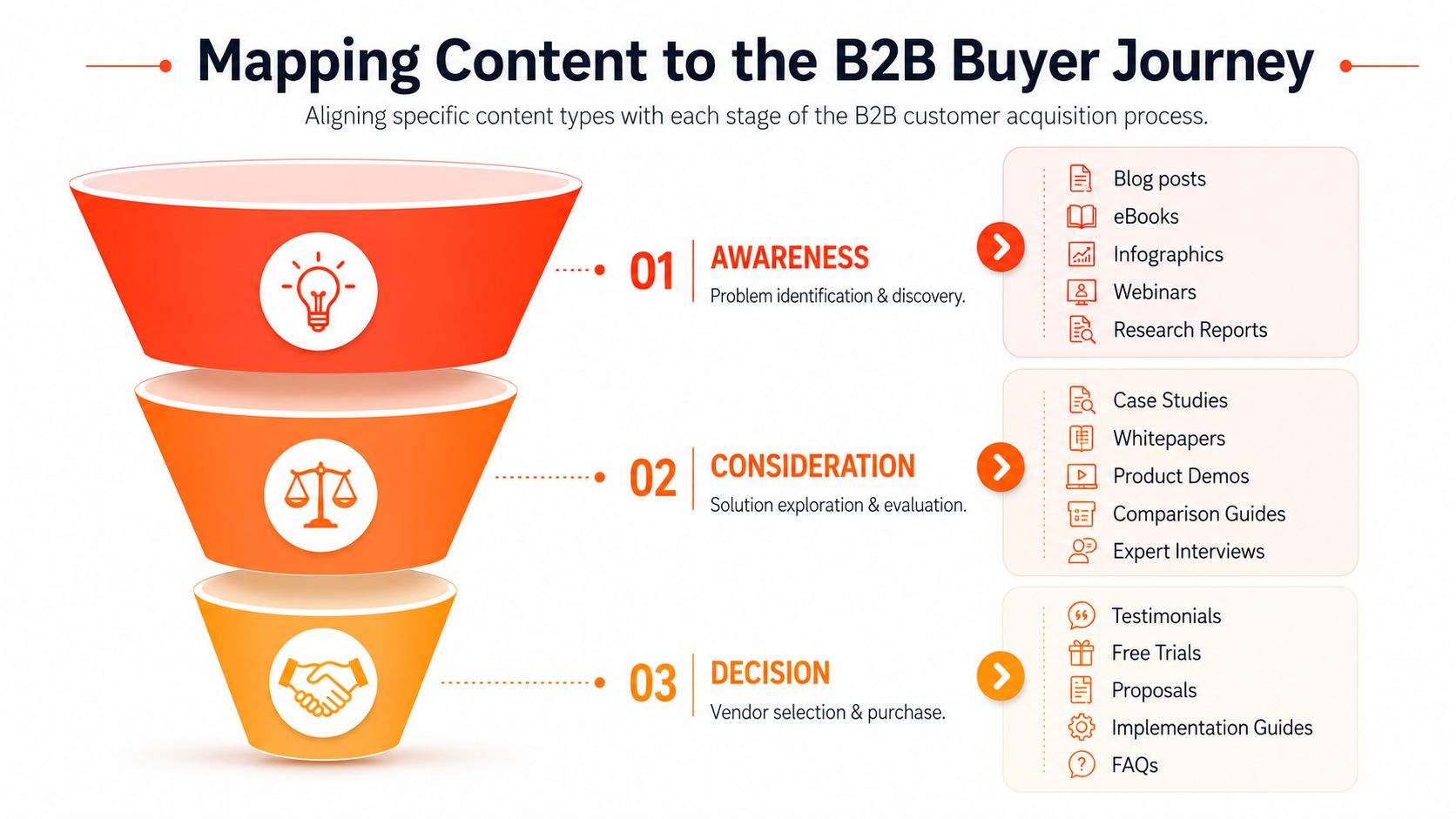
Awareness content should define the problem
At the awareness stage, the buyer usually isn't choosing vendors yet. They're trying to understand what's broken, what it costs them, and what a better approach might look like.
These formats work well for:
- Educational blog posts: Useful for naming the problem, clarifying trade-offs, and giving teams language they can use internally.
- Short-form video: Strong for grabbing attention on social and framing one idea fast.
- Research-backed explainers: Useful when the buyer needs a more structured understanding of the issue.
- Introductory webinars: Helpful when the topic needs more context than a post can give.
This stage is where many teams still underrate video. Short-form video was the highest ROI content format for B2B brands in 2025, generating direct sales of $8,900 for every $1,000 invested, according to Taboola's content marketing statistics roundup. The same source notes that short-form video, case studies, and interactive tools are among the top content formats now. That should change how teams allocate attention, especially if they still treat video as optional frosting on top of blog content.
Consideration content should reduce uncertainty
Once buyers understand the problem, they start comparing approaches. At this stage, shallow “ultimate guide” content stops helping.
Consideration-stage assets should make evaluation easier:
| Buyer need | Content that helps |
|---|---|
| Compare approaches | Comparison guides and expert interviews |
| See practical proof | Case studies and workflow breakdowns |
| Understand fit | Product demos and solution explainers |
| Build confidence internally | Whitepapers and detailed FAQs |
A lot of content engines stall here because they haven't built a habit of turning customer insight into evaluation content. Teams keep publishing educational pieces because they already know how. Meanwhile, sales keeps answering the same objections one call at a time.
Decision content should make the purchase easier to justify
Decision-stage content isn't about hype. It's about reducing friction for the final internal conversation.
The buyer needs material they can circulate, reference, and use to defend the choice. That usually includes:
- Implementation guides: Show what happens after the signature.
- Testimonials and proof assets: Give the buyer confidence that others have succeeded.
- FAQ pages: Handle practical concerns without forcing another meeting.
- Interactive tools: Help buyers test assumptions and make the case internally.
If an asset can't help a buyer explain the decision to someone else, it probably isn't strong decision-stage content.
The journey map should change your production mix
A common failure mode is publishing ten awareness assets for every one evaluation asset. That creates reach without progression.
A stronger operating model asks three questions before production begins:
- Which stage is under-supported right now?
- What question is blocking movement at that stage?
- Which format is the clearest answer to that question?
That logic usually leads to a more balanced content portfolio. The engine stops chasing volume and starts filling gaps. An awareness post can spark interest, but a case study or implementation guide often helps close hesitation.
The best journey maps don't just organize content. They expose where your revenue motion lacks support.
Building Your Tactical Content Calendar
A tactical calendar should behave like an execution layer, not a dumping ground for ideas. If your calendar is just a list of publish dates and tentative titles, it won't protect quality or create momentum.
The job of the calendar is to translate strategy into a repeatable production rhythm. That means every entry needs enough context for the team to make smart decisions before the draft stage gets messy.
Start with pillars, not random topics
Good calendars are built from content pillars. These are your recurring topic clusters. They keep the team focused on areas where the business wants authority and where the audience has ongoing questions.
Say your company sells into finance teams. A weak calendar might include scattered topics like “AI trends,” “workflow automation,” and “leadership advice.” A stronger one might organize around a pillar such as compliance operations, then break it into practical subtopics:
- Definition content: What breaks in current compliance workflows
- Evaluation content: What finance leaders should compare in a solution
- Operational content: How implementation changes team processes
- Proof content: Stories, examples, or objection handling tied to real use cases
That structure gives you coherence. It also makes internal SME interviews more productive because experts can see where their knowledge fits.
Put metadata in the calendar
A useful calendar row needs more than title and deadline. It should answer the questions a strategist, writer, designer, and distribution owner would all ask.
Here's a simple operating template:
| Field | Why it matters |
|---|---|
| Working title | Gives the team a clear production target |
| Audience persona | Prevents broad, diluted messaging |
| Buyer journey stage | Clarifies the asset's job |
| Content pillar | Keeps the topic tied to strategic themes |
| Primary keyword or search intent | Supports discoverability where relevant |
| Core CTA | Aligns the asset with a next step |
| Distribution channels | Forces promotion planning before publish day |
| SME source | Improves authority and specificity |
This is where operational discipline starts to matter. If you want assets to perform in search, the writing process needs SEO inputs early, not as an afterthought. Teams that need a practical refresher on structure, clarity, and optimization can use Surnex's guide to SEO content as a solid reference when building briefs.
Build in a publishing cadence you can actually sustain
The wrong cadence breaks more teams than the wrong ideas. Leaders often ask for a volume target before checking whether the team has enough expert input, editing capacity, or design support to sustain it.
A better approach is to define a source-asset rhythm. For example:
- One core asset: A deep article, webinar script, or interview-led piece
- One supporting asset: A case-study-style post, checklist, or FAQ
- Several derivative assets: Social posts, email snippets, clips, or carousels
That gives the team a system instead of a scramble.
For teams evaluating tooling for this process, it helps to review different approaches to content calendar software before locking themselves into a workflow that only solves scheduling and ignores briefing, repurposing, or distribution.
A good calendar makes trade-offs visible
When the calendar is built well, you can spot imbalance fast.
You can see whether all your content is aimed at one persona. You can catch when every asset sits at the awareness stage. You can notice when one pillar is overfed while another gets ignored. That's useful because content problems often look like quality problems when they're really allocation problems.
Editorial discipline starts before writing. It starts when the calendar forces every idea to earn its slot.
A tactical calendar shouldn't feel creative in the loose sense. It should feel dependable. The creativity belongs in the angle, the argument, the examples, and the packaging. The system itself should be boring enough that the team can run it without drama.
The Content Distribution and Repurposing Playbook
Most B2B teams spend too much energy getting an asset published and too little making sure people see it. That's why the content treadmill feels so punishing. You create something solid, publish it, promote it lightly for a day or two, then move on to the next asset as if the first one is already exhausted.
It usually isn't.
A better B2B content strategy treats creation as the starting point. Distribution and repurposing are where the asset earns its return. That matters even more now that 89% of B2B marketers have integrated AI into content creation workflows in 2025, according to the Increv B2B content marketing report. AI has already changed production expectations. Teams can create faster. The hard part is making sure speed doesn't turn into generic output.
Why repurposing often fails
The usual advice is too shallow. “Turn one blog into a thread, a video, and an email” sounds efficient, but it often creates repetitive, low-trust assets.
That problem gets sharper when teams rely too heavily on generic AI transformations. As noted in the DesignRush B2B content strategy guide, 60% of B2B buyers distrust AI-generated content that lacks human expertise. That's the constraint. Repurposing only works when each version carries distinct value, not just compressed wording.
Use the CODE model
I like a simple operating rule here. Create once, distribute everywhere, or CODE. The key is that “everywhere” doesn't mean copy-paste. It means re-express the same core insight in forms that match channel behavior.
Step one: Choose a strong source asset
Start with one substantial piece. That could be:
- An article: Best when you have a clear argument or educational concept.
- A webinar transcript: Good when the source includes real examples and spoken clarity.
- A customer interview: Useful when your strongest material is buried in conversation.
- A podcast script: Strong if it contains opinion, not just commentary.
Weak source material leads to weak repurposing. If the original asset is generic, the derivatives will be worse.
Step two: Extract the message spine
Before you repurpose anything, identify:
- The core argument
- Three to five sub-points
- One practical example
- One contrarian angle
- One buyer question the asset answers
This becomes the message spine. Every derivative format should pull from it.
Repurposing works when the idea stays consistent and the expression changes.
Step three: Match content form to channel behavior
One article can become many assets, but each one needs a different job.
| Derivative asset | Best use |
|---|---|
| LinkedIn carousel | Break down a framework or process visually |
| Short vertical video | Deliver one sharp point fast |
| Quote card | Highlight a contrarian opinion or practical rule |
| Email snippet | Drive traffic or reinforce one timely point |
| Sales follow-up asset | Reuse a section that answers a common objection |
If your team is building a multichannel workflow, it helps to study how a content distribution platform supports scheduling, formatting, and cross-channel consistency before trying to manage all of this manually in separate tools.
Add expert input at the derivative stage
This step is often overlooked.
They repurpose too directly. They summarize instead of enrich. A smarter workflow adds one fresh expert detail to each derivative asset. That could be a sentence from sales, a product nuance from customer success, or a tactical observation from the founder.
Examples:
- The carousel gets a practical checklist not included in the article.
- The short video opens with a sharper opinion than the source asset used.
- The quote card pairs a strong line with one sentence of context in the caption.
- The follow-up email includes an objection the sales team hears every week.
That keeps the output from feeling machine-processed.
Here's a useful example of how teams think about turning longer ideas into usable short-form assets:
Build a weekly distribution sequence
A single source asset can support a full week without feeling repetitive if the sequence is intentional.
Try a simple pattern:
- Publish the core asset on your owned channel.
- Lead with a sharp social angle that hooks attention rather than summarizing everything.
- Follow with a visual breakdown such as a carousel or graphic sequence.
- Release a short clip focused on one sub-point.
- Send an email that frames the asset through a buyer problem.
- Arm sales with a version they can drop into live conversations.
This keeps the topic active across formats and contexts. It also gives the team multiple chances to find the audience instead of betting everything on one launch moment.
What works and what doesn't
Repurposing works when the source is opinionated, grounded in expertise, and built around one clear message. It fails when teams try to stretch thin material across too many formats.
It also fails when distribution is treated like an afterthought. The team needs channel-specific ownership, light QA, and a repeatable publishing sequence. If nobody owns that layer, assets die young.
The practical goal isn't to produce everywhere for the sake of presence. It's to give a good idea multiple chances to reach the right buyer in the right format.
Measuring and Optimizing Your Content for ROI
The worst content dashboards are full of activity and empty of meaning. They show pageviews, reactions, impressions, and maybe time on page. Then leadership asks the obvious question: did any of this help revenue?
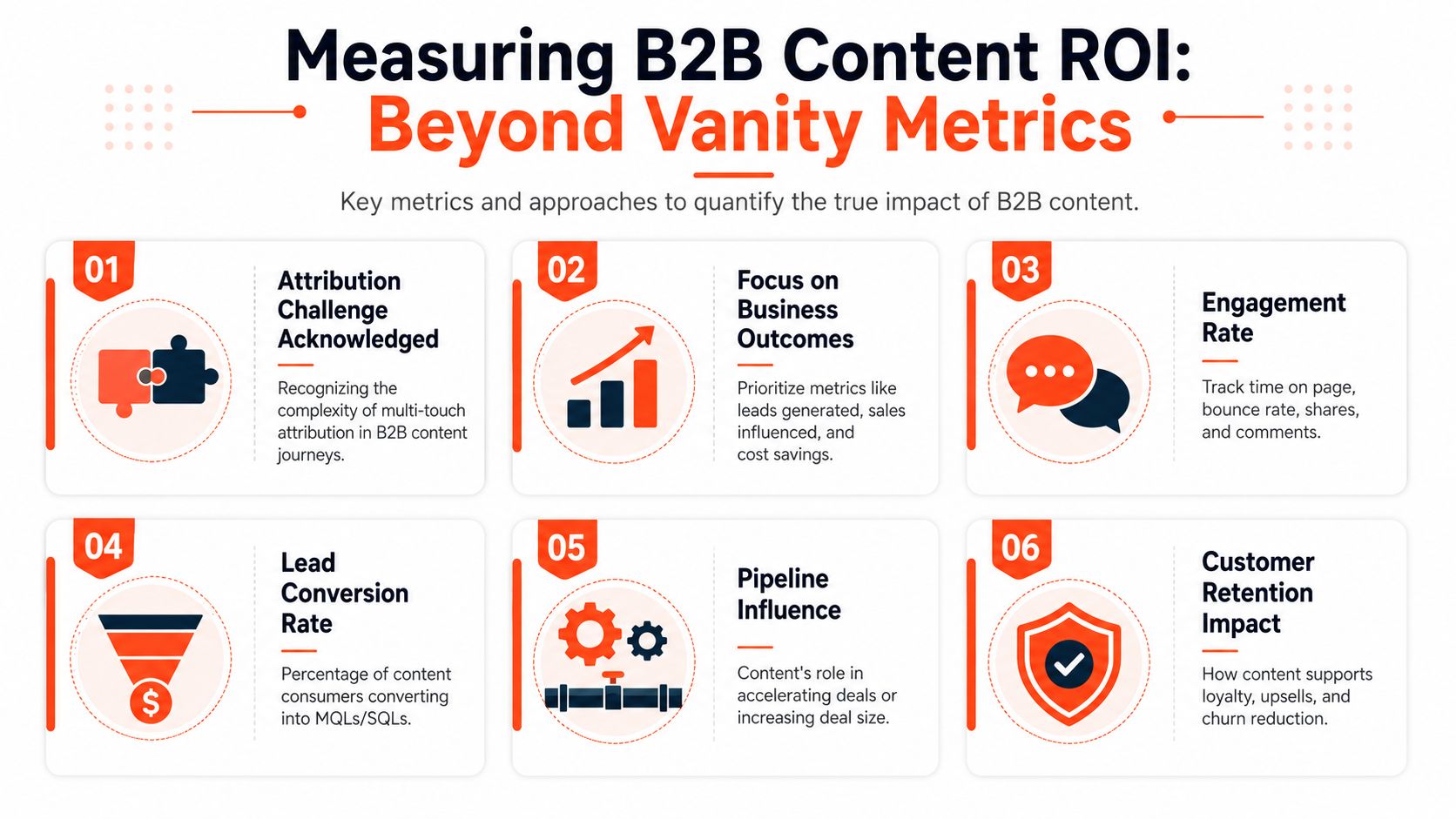
That frustration is legitimate. Attribution in B2B is messy, especially early in the journey. As CXL notes in its analysis of B2B content marketing challenges, one of the biggest gaps is the lack of practical frameworks for measuring content's value in early-stage deals, especially when teams rely on last-touch attribution that misses content's role in shaping belief and defining the problem.
Stop treating reach as proof
Reach matters. It just isn't enough.
A piece of content can attract attention from the wrong audience, answer the wrong question, or create interest that never turns into commercial movement. That's why smart teams pair engagement metrics with downstream signals.
Focus on a smaller set of business-tied questions:
- Lead quality: Are the right people converting, not just more people?
- Pipeline influence: Does this content appear in opportunities that move?
- Sales usefulness: Are reps using it in follow-up and objection handling?
- Journey progression: Does the content help buyers take a next step?
Build a practical measurement stack
You don't need a massive attribution setup to improve decision-making. You need a disciplined one.
Here's a workable stack for many organizations:
| Measurement layer | What to do |
|---|---|
| Campaign tracking | Use consistent UTM parameters on distribution links |
| Conversion capture | Add useful form fields such as “How did you hear about us?” |
| CRM notes | Ask sales to log which assets come up in real conversations |
| Content tagging | Label assets by persona, stage, and pillar so patterns are visible |
| Qualitative review | Gather comments from sales and customer success each month |
That last one is underrated. If three reps independently say a comparison guide helps unblock deals, that's not perfect attribution, but it is signal.
The goal isn't flawless attribution. The goal is better decisions than you could make last quarter.
Optimize for performance, not just production
Once measurement is in place, optimization gets more honest.
You can identify whether awareness content is attracting poor-fit traffic. You can see which decision-stage assets sales uses. You can also spot assets that rank or circulate well but don't support meaningful action.
Content refinement matters. Updating pages, tightening calls to action, improving search intent alignment, and revising weak sections often produces better results than publishing something new. Teams that want a practical framework for that process can use Keyword Kick for content optimization to think through how existing assets should be improved rather than endlessly replaced.
For teams trying to connect content performance across channels, it also helps to study how an omnichannel content strategy changes measurement logic. A buyer may first see a short clip, later read an article, then return through email or direct traffic. Looking at one touchpoint in isolation usually hides the complete picture.
What reporting should look like
A useful monthly review shouldn't ask, “What got the most traffic?”
It should ask:
- Which content influenced qualified conversations?
- Which buyer stages are still under-supported?
- Which formats are earning trust versus shallow engagement?
- Which assets deserve repromotion, revision, or retirement?
That's what turns reporting into management. Content ROI isn't proven by one dashboard widget. It's proven by a body of evidence that connects content to buyer movement, sales confidence, and commercial outcomes over time.
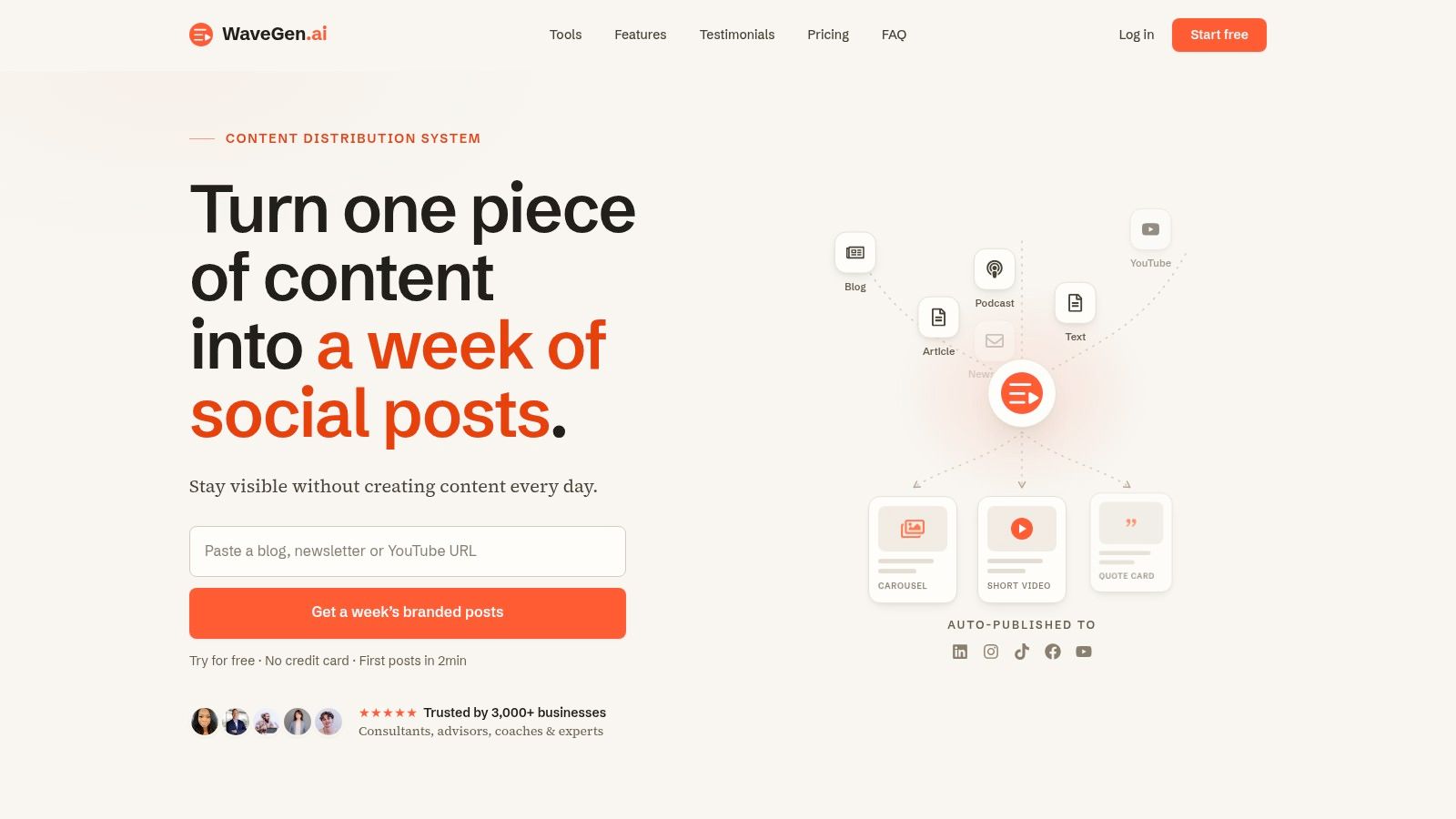
If you're building a B2B content engine and need a faster way to turn one strong article, script, or transcript into a steady stream of on-brand social assets, WaveGen.ai is built for that workflow. It helps teams repurpose source content into carousels, short videos, quote cards, and captions without losing brand consistency, which makes distribution easier to sustain when your calendar is already full.
b2b content strategy
content marketing
b2b marketing
content strategy framework
lead generation
Turn this kind of writing into a week of social content.
Paste a blog post, newsletter, or rough draft — WaveGen turns it into publish-ready carousels, captions, and slideshows for every channel.
No credit card · First posts in 2min