July 4, 2026
15 min read
Coach Personal Branding: A Realistic Framework for 2026
Build your coach personal branding with a step-by-step framework. Define your niche, craft your message, and create a content system that attracts clients.
Most advice on coach personal branding is backwards. It tells coaches to post more, polish a logo, pick a palette, and stay visible. That sounds productive, but it usually creates noise before clarity. A coach with fuzzy positioning who publishes every day only teaches the market to ignore them faster.
The better approach is slower and more commercial. Build a brand that can survive real work, real client conversations, and real repetition. That means choosing a narrow problem, expressing it in a way people can remember, creating one strong body of content, and distributing it with enough consistency that the market starts to associate your name with a specific result.
That patience matters because buyers don't make trust decisions in a vacuum. 77% of consumers are more likely to purchase from a company when its founder has a strong personal brand, and 82% are more likely to trust that company, according to the Edelman figures shared in this LinkedIn post summarizing the data. For coaches, that trust isn't a vanity bonus. It's the mechanism behind discovery calls, referrals, and premium pricing.
Table of Contents
- The Foundation of Your Coaching Brand
- Crafting Your Unforgettable Brand Identity
- Developing Your Cornerstone Content Engine
- Implementing a Sustainable Social Distribution System
- Tracking Metrics That Actually Drive Growth
- Playing the Long Game Your 3-Year Brand Roadmap
The Foundation of Your Coaching Brand
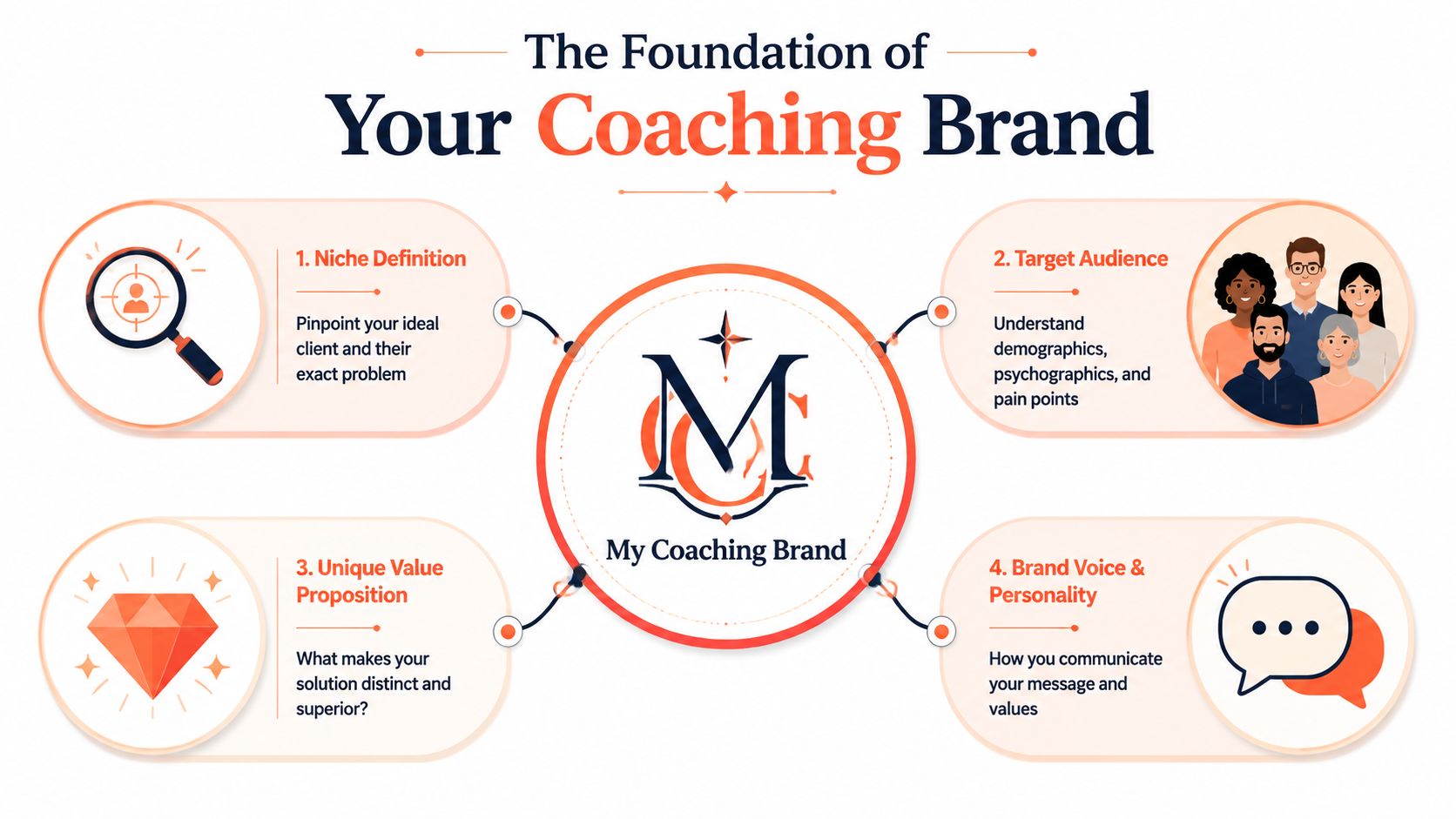
A coaching brand doesn't start with visuals. It starts with a clear commercial promise. If you can't say who you help, what problem you solve, and why your method fits that problem, your content will drift and your audience will stay vague.
That's why broad labels hurt coaches. "Life coach," "mindset coach," and "business coach" may describe a category, but they don't create preference. Buyers don't look for categories first. They look for someone who understands their exact situation.
Why generalist positioning fails
Specificity does two jobs at once. It makes your message easier to understand, and it makes your expertise easier to trust. In practical terms, a coach who helps consultants turn scattered expertise into a sellable offer will sound more credible than a coach who promises "transformation" to everyone.
Practical rule: If your niche description could fit thousands of unrelated coaches, it isn't a niche yet.
The market also pays for perceived authority, not effort alone. Pricing for personal branding coaching ranges widely, from $100 to over $3,000 per single session, and top-tier coaches with strong brand recognition command $1,000 to $3,000+ per session, while extensive packages often run $3,000 to $6,000+ over 8 to 12 weeks, according to MentorCruise's personal branding coach listings. That spread tells you something important. Positioning and recognition shape what the market will pay before a client experiences the full service.
A narrow niche doesn't limit growth. It creates the clarity that growth depends on.
Consider the four inputs that usually produce a durable position:
- Problem focus: Choose one painful, expensive, recurring problem.
- Audience fit: Define who feels that problem most urgently.
- Method bias: Name the way you solve it. Workshops, messaging sprints, accountability, systems, or diagnostic coaching.
- Proof pattern: Identify the situations where your approach works best.
If you want a practical example of how coaches tighten this commercially, BAMF's ultimate client acquisition playbook is useful because it pushes coaches toward clearer demand generation, not just prettier branding.
The positioning statement that sharpens everything
Most coaches need one sentence that acts like a filter. It should eliminate weak-fit inquiries and make content creation easier.
Use this structure:
| Element | Prompt |
|---|---|
| Audience | Who exactly do you coach? |
| Problem | What urgent issue are they trying to solve? |
| Outcome | What change are they buying? |
| Approach | Why does your process work for them? |
A simple version might sound like this in practice: you help independent consultants who get referrals but struggle to explain their value, using a positioning and content system that turns expertise into steady inbound interest.
That statement gives you boundaries. It tells you what stories to tell, what offers to build, and what to stop posting about.
Your ideal client profile should also go beyond age or job title. Include buying context. What are they embarrassed to admit? What have they already tried? What language do they use when describing the problem? Those details matter because coach personal branding isn't self-expression for its own sake. It's the discipline of becoming memorable for the right reason.
Crafting Your Unforgettable Brand Identity
Once the strategic core is clear, identity becomes simpler. You're no longer asking, "What looks good?" You're asking, "What expression matches the promise I'm making?"
A lot of coaches overbuild this part. They spend weeks on logos and ignore the repeated signals clients notice. Voice, tone, visual consistency, and language discipline matter more than complexity.
Choose a voice clients can recognize
Your brand voice should sound like the way you coach at your best. If your sessions are direct and analytical, don't write soft, vague captions. If you're warm and reflective in conversation, don't force a tough, aggressive online persona.
A simple voice chart is enough:
- Core tone: Analytical, compassionate, challenging, calm, energizing, or structured.
- What you always sound like: Clear, practical, grounded.
- What you never sound like: Hype-heavy, preachy, cryptic, overly corporate.
- Common phrases: Repeated language that supports your positioning.
- Content posture: Teacher, advisor, operator, mirror, or strategist.
Your audience doesn't need a louder coach. They need a coach whose communication feels stable enough to trust.
If you need a reference point for what this can look like in practice, Coachful has a useful piece on how to build your coaching brand through examples rather than abstract theory.
Build a simple visual system
Most coaches don't need a full rebrand. They need a usable kit. Pick a restrained color palette, one heading font, one body font, a photo style, and a logo treatment you can apply across LinkedIn banners, carousels, landing pages, and PDFs. That's enough to create familiarity.
A practical visual system usually includes:
Primary color and neutral support colors
Choose colors that match the emotional tone of your work. Executive coaching may call for clean restraint. Creative coaching may allow more energy.Typography rules
Use one font for headlines and one for body text. Consistency beats novelty.Image direction
Decide whether your visuals rely on studio portraits, documentary-style photos, illustrations, or text-first graphics.Layout standards
Set recurring choices for margins, headline style, and callout formatting so content feels related even when topics change.
If your current files are scattered, it helps to review what a brand kit should contain before you redesign anything.
The true test is operational. Can you hand your brand kit to a designer, assistant, or freelancer and get assets back that still sound and look like you? If not, the identity is still too loose.
Developing Your Cornerstone Content Engine
Most coaches burn out because they treat content like daily invention. They sit down every morning asking what to post, then stitch together disconnected thoughts. That creates output, but it rarely creates authority.
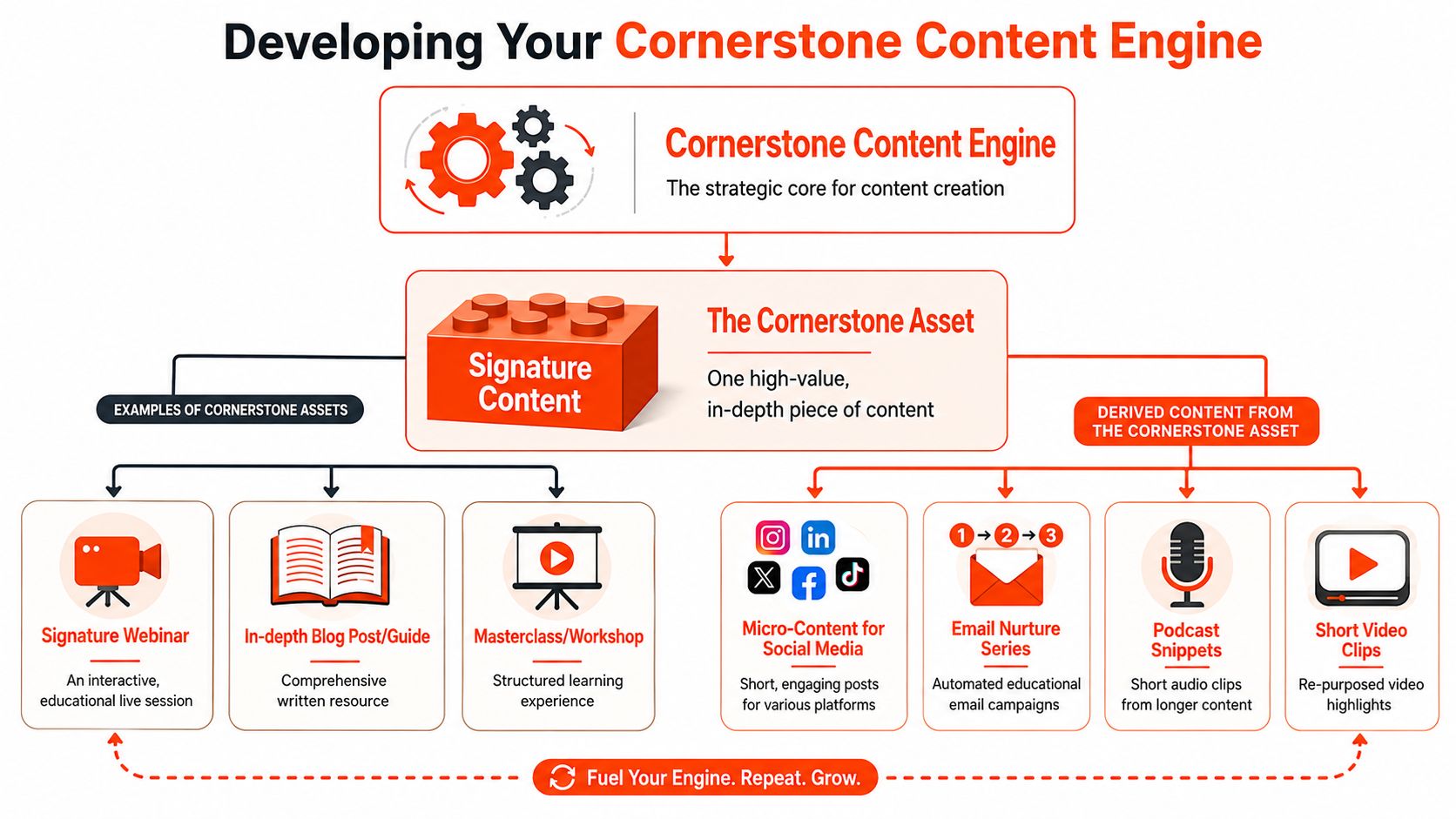
A stronger system starts with one substantial asset that carries your best thinking. This can be a signature webinar, a deep guide, a workshop, or a podcast episode built around a problem your ideal client urgently wants solved.
Start with one asset that can carry weight
Your cornerstone asset should do three things at once:
- Teach your point of view
- Demonstrate your method
- Create language you can reuse everywhere
That last part matters more than many coaches realize. Building a credible personal brand that audiences perceive as authoritative typically takes three years of consistent, multi-channel communication, and creating sound bites from cornerstone content helps position the coach across all messaging pieces, according to this YouTube analysis on long-term brand building for coaches.
That means your long-form content isn't only for immediate leads. It's raw material for identity repetition.
A useful test for a cornerstone topic is simple. Can you imagine talking about this same issue for years without sounding forced? If the answer is no, the topic may be timely but not foundational.
Turn strong ideas into reusable sound bites
Good sound bites aren't slogans. They're compact expressions of a bigger argument. They should be short enough to repeat, specific enough to remember, and connected tightly enough to your method that people start associating them with your name.
Examples of strong source material include:
| Cornerstone format | Best use |
|---|---|
| Signature webinar | Explaining a complete framework live |
| In-depth guide | Teaching a nuanced transformation in writing |
| Podcast episode | Exploring objections, stories, and philosophy |
| Workshop training | Showing process with interaction and examples |
From one cornerstone asset, you can derive many smaller pieces:
- Contrarian claims: Useful for text posts and hooks.
- Client language snippets: Good for emails and short videos.
- Framework steps: Ideal for carousels and educational threads.
- Objection handling: Strong material for FAQ posts and discovery call follow-up.
For coaches who need a practical process for breaking long-form ideas into smaller units, these actionable content repurposing tips are worth studying. The point isn't to flood channels. It's to let one well-developed idea appear in multiple formats without losing coherence.
If you publish thought leadership without a source asset, you'll eventually repeat yourself poorly. If you publish from a strong cornerstone, repetition becomes an advantage. For a deeper look at that discipline, this guide to thought leadership content is a useful companion.
Implementing a Sustainable Social Distribution System
A content engine only works if you can distribute it without turning your week into a production sprint. Most coaches don't fail because they lack ideas. They fail because the publishing process depends on energy, spare time, and last-minute motivation.
The fix is operational. Build a weekly system that starts with one source asset and turns it into platform-specific outputs.
Consistency matters because trust compounds through repeated exposure. Data cited by Milena Nguyen indicates that leaders who post 2 to 5 times per week see optimal engagement, and 82% of people are more likely to trust a company whose leaders are active on social media, as noted in this article on personal branding for coaches. Coaches don't need to be everywhere all day. They do need a cadence people can learn to expect.
A weekly operating rhythm that coaches can maintain
A sustainable distribution system usually has five steps:
Record or write one substantial piece
This becomes the week's source material.Pull out the strongest ideas
Look for claims, stories, objections, examples, and one-liners.Match ideas to platform behavior
LinkedIn often rewards clarity and argument. Instagram favors visual packaging. TikTok or Shorts usually need a sharper verbal hook.Batch edits and approvals
Don't redesign every post from scratch.Schedule and monitor replies
Distribution includes conversation, not just publishing.
A simple operating calendar might look like this:
| Day | Platform 1 (LinkedIn) | Platform 2 (Instagram) | Platform 3 (TikTok/Shorts) |
|---|---|---|---|
| Monday | Contrarian text post from cornerstone idea | Carousel summarizing key framework | Short clip with opening hook |
| Tuesday | Client objection post | Quote card with takeaway | Talking-head response to common mistake |
| Wednesday | Story post with lesson | Reel covering one step of method | Clip from workshop or webinar |
| Thursday | Educational post with practical checklist | Carousel on process breakdown | FAQ short answering one buyer concern |
| Friday | Reflection post tied to coaching philosophy | Behind-the-scenes brand insight | Recap clip with CTA to long-form asset |
Many coaches often waste effort. They copy the same post across channels and call it repurposing. That's cross-posting, not distribution.
Repurpose by format not by copy and paste
Each platform has its own consumption style. The same idea can travel well, but the packaging needs to change. A webinar transcript might become a concise LinkedIn post, a visual Instagram carousel, and a short vertical video script. The idea stays stable. The wrapper changes.
Working rule: Reuse the argument. Rebuild the format.
That distinction protects your energy. It also protects the brand. A stable message expressed in native formats feels coherent, not lazy.
If you want a clearer model for choosing where each asset belongs, this overview of a content distribution platform can help you think in systems instead of isolated posts.
Later in the workflow, video often becomes the most efficient format because one recording can feed several channels. This walkthrough shows the kind of process coaches should aim for when turning source material into a wider publishing stream.
The best social system is boring in the right way. You know what gets created, when it gets adapted, where it gets published, and how you respond. That predictability is what prevents burnout.
Tracking Metrics That Actually Drive Growth
A lot of coaches monitor the wrong scoreboard. They watch follower counts, impressions, and likes, then feel discouraged when those numbers don't produce clients. Visibility matters, but not every visible thing is commercially useful.
Brand measurement gets easier when you separate attention from movement. Attention tells you whether people are seeing your ideas. Movement tells you whether the right people are acting on them.
What to ignore
Follower count is the classic vanity trap. It can rise while inquiries stay flat. The same goes for low-intent engagement. A post can collect lightweight reactions from peers and still fail to attract buyers.
That doesn't mean awareness metrics are useless. It means they need context. If impressions go up while profile visits, replies, and discovery conversations stay still, your content may be entertaining the wrong audience or making the wrong promise.
The best-performing post isn't always the one that builds the business. Sometimes it's the one that filters for the right client.
Other weak signals include praise from non-buyers, shares without conversation, and saves on broad motivational content that never leads to action.
What to track instead
Use a simple dashboard with three buckets:
| Metric bucket | What to watch | Why it matters |
|---|---|---|
| Awareness | Reach, profile views, content views | Shows whether your message is entering the market |
| Engagement | Comments, direct messages, saves, meaningful replies | Shows whether the message resonates |
| Conversion | Discovery calls booked, qualified inquiries, proposal requests | Shows whether branding supports revenue activity |
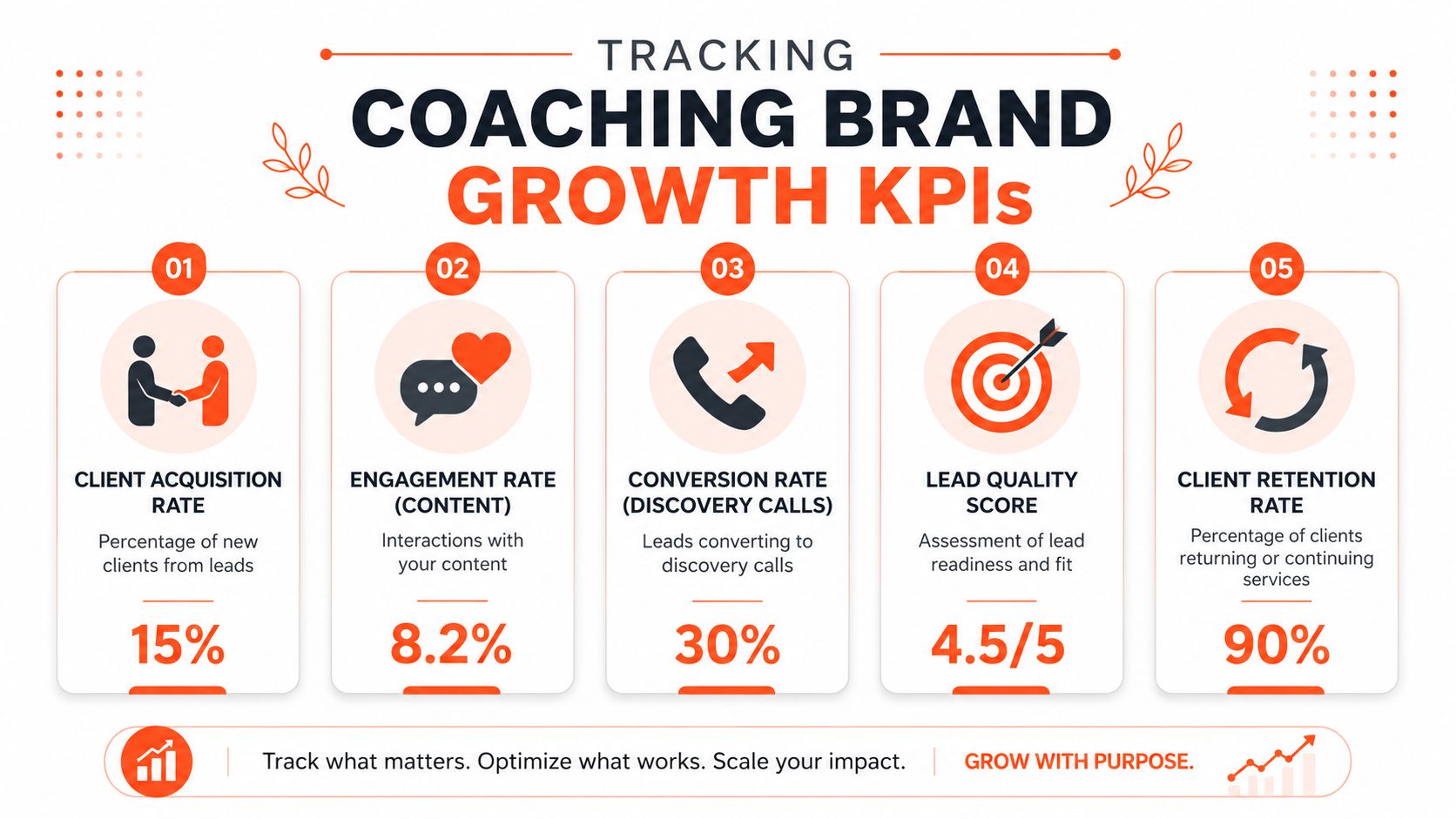
A coach should also review qualitative patterns every month:
- Which posts triggered serious buyer questions
- Which themes attracted weak-fit leads
- Which calls repeated the same language back to you
- Which content made referrals easier because contacts knew how to describe your work
That last one is often overlooked. Strong coach personal branding improves referral clarity. People know what to say when introducing you.
If you track only volume, you'll chase noise. If you track movement through the pipeline, you'll see what your brand is doing in the business.
Playing the Long Game Your 3-Year Brand Roadmap
The coaches who build strong brands rarely win fast. They win because they stay in the market long enough for buyers to remember them, trust them, and refer them with confidence.
That is why a three-year view matters.
Coach personal branding works like reputation built in public. A few good posts can create attention. Sustained visibility, consistent language, and repeated proof create demand. Coaches who expect branding to pay off in a month usually start over too often, change their message too quickly, or burn out trying to post everywhere at once.
A better approach is slower and more profitable. Build a system you can keep running.
Year 1 clarity and consistency
The first year is for narrowing the promise and proving you can show up consistently. Pick the client, problem, and outcome you want to be known for. Commit to a small set of content themes. Use one workable publishing rhythm instead of chasing every platform trend.
This stage feels quiet for many coaches. That is normal.
The goal is not reach for its own sake. The goal is message stability. By the end of year one, your audience should hear a clear throughline every time they encounter your work.
Year 2 authority and audience memory
The second year is where the system starts paying you back. Content gets easier to produce because you are no longer inventing from scratch. Your strongest ideas have already been tested. You know which stories start conversations, which teaching points attract the right leads, and which topics bring in the wrong ones.
Audience memory matters here. Referral partners can describe your work clearly. Past readers begin to recognize your phrasing. Prospects arrive on calls with more context, which shortens the trust-building process and improves fit.
This is also the year to protect your energy. Many coaches quit here because they confuse increased expectations with a need to produce more volume. Usually the better move is to repurpose better, distribute more consistently, and keep the core message stable.
Year 3 monetization and scale
By year three, the brand should do more of the pre-selling for you. Buyers understand what you do before the first conversation. Your body of work supports firmer pricing, stronger positioning, and cleaner client selection.
At this stage, growth comes from refinement. Improve your offer ladder. Strengthen your sales process. Use the content engine and distribution system you already built instead of rebuilding your brand every quarter.
That is the authentic long game. Not constant reinvention. Repeated proof, delivered through a system you can sustain for years.
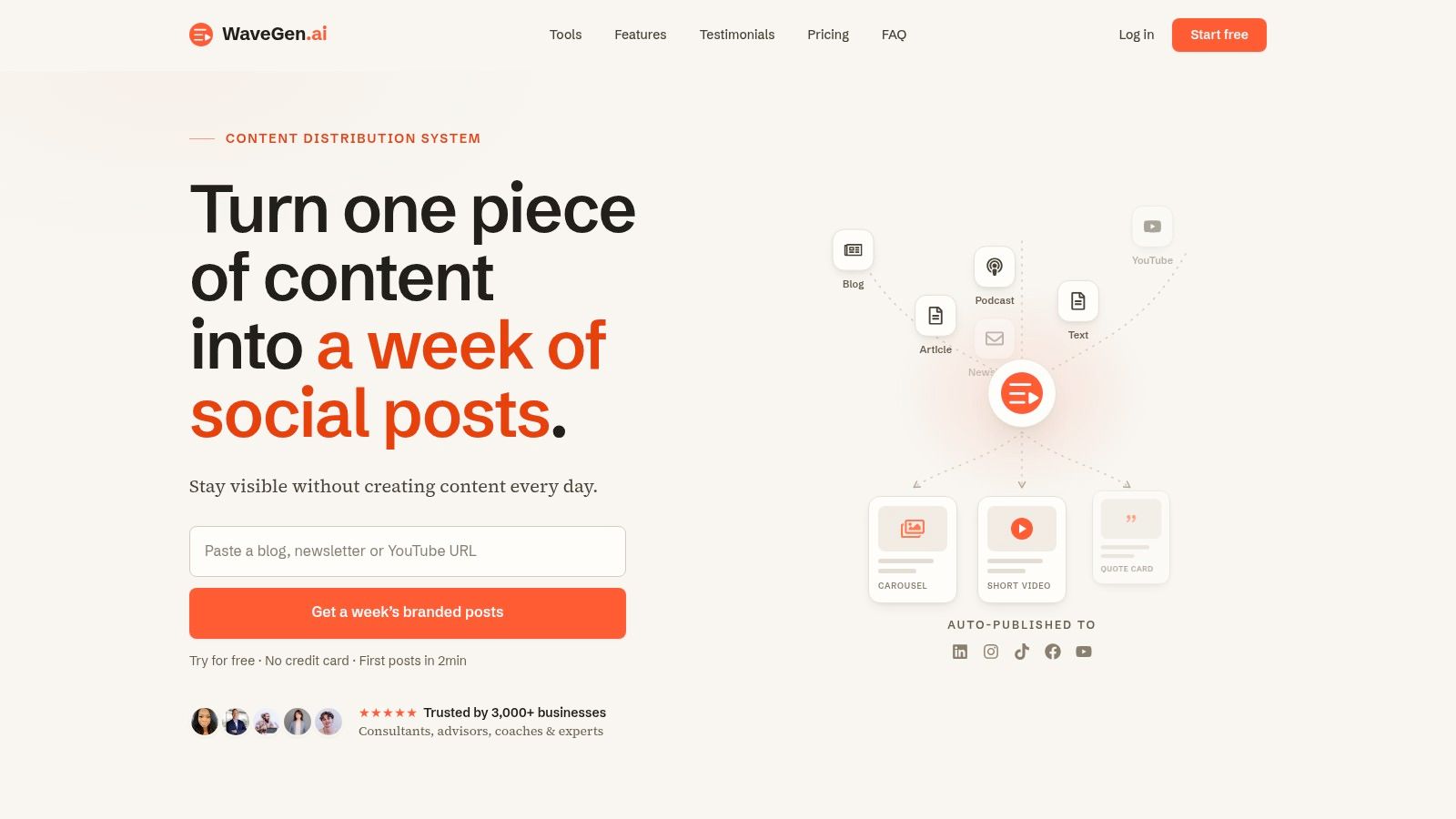
If you already have strong ideas but the distribution side keeps breaking down, WaveGen.ai can help you turn one article, transcript, newsletter, or script into a full week of on-brand social assets without rebuilding everything manually. It's a practical way to keep your publishing cadence steady while protecting the consistency that coach personal branding depends on.
coach personal branding
coaching business
personal brand for coaches
content repurposing
social media for coaches
Turn this kind of writing into a week of social content.
Paste a blog post, newsletter, or rough draft — WaveGen turns it into publish-ready carousels, captions, and slideshows for every channel.
No credit card · First posts in 2min