June 25, 2026
17 min read
Professional Services Marketing: 2026 Growth Guide
Master professional services marketing for your agency or consultancy. Learn key strategies for positioning, lead-gen, content & KPIs in 2026.
You're good at the work. Clients trust you once they meet you. Projects go well. Then the pipeline goes quiet.
That pattern shows up constantly in professional services. A consultant finishes a major engagement, gets buried in delivery, neglects visibility for a few months, and then realizes new opportunities have slowed to a trickle. Referrals still come in, but not predictably. Content gets published in bursts. Outreach happens when revenue feels tight. Marketing becomes reactive, not operational.
That's the problem with professional services marketing. It's rarely a lack of expertise. It's a lack of system.
The fix isn't becoming louder, more promotional, or more “salesy.” It's building a repeatable engine that turns expertise into trust, trust into conversations, and conversations into qualified client work. That matters in a market this large. The global professional services market reached nearly $6,070.96 billion in 2024 and had grown at a 4.85% compound annual growth rate in recent years, according to The Business Research Company's professional services market report.
Most firms don't need more random tactics. They need a structure that connects positioning, lead generation, content distribution, sales support, and measurement.
Table of Contents
- Introduction From Expert to Entrepreneur
- The Foundation Defining Your Market Position
- Attracting Clients Key Lead Generation Channels
- The Content Engine A System for Repurposing and Distribution
- The Sales Engine Connecting Marketing to The Client Lifecycle
- Measuring What Matters Revenue-Focused KPIs
- Your Actionable Marketing Playbooks
Introduction From Expert to Entrepreneur
A lot of firms start with reputation and stay there too long.
An advisor gets traction because early clients talk. A specialist agency grows because the founder's network opens doors. A coach wins business because a handful of strong results create momentum. At first, that works. Then delivery expands, the calendar fills, and marketing becomes whatever fits between client calls.
That's where the shift has to happen. You stop thinking like a solo expert who occasionally markets, and start thinking like a business owner who operationalizes credibility.
Expertise alone doesn't create pipeline
Professional buyers don't purchase a packaged product they can inspect in advance. They're hiring judgment, process, reliability, and fit. That means the sale usually starts long before the proposal. It starts when someone hears your name, reads your point of view, sees how you explain complex issues, or gets referred to you and checks whether your presence supports the recommendation.
When that visibility is inconsistent, demand becomes uneven. Good months hide the problem. Lean months expose it.
Professional services marketing works best when it demonstrates how you think before a buyer ever schedules a call.
The entrepreneur's shift
The firms that break out of feast-or-famine behavior usually make three operational changes:
- They define a narrow commercial focus. They stop describing themselves in broad capability terms and start speaking to a specific buyer with a specific problem.
- They publish from real expertise. Their marketing sounds like a practitioner, not a copywriter trying to sound impressive.
- They measure business outcomes. They don't confuse activity with traction.
That shift matters because growth in this category rewards firms that can translate expertise into repeatable demand. If you're still relying on referrals alone, you're building on a useful channel but a fragile system. A stronger model keeps referrals, then adds search visibility, authority content, direct outreach, and a sales process that makes follow-up easier.
The rest of this guide is built for that. Not brand theater. Not random posting. A working acquisition engine.
The Foundation Defining Your Market Position
Positioning decides whether your marketing feels relevant or forgettable.
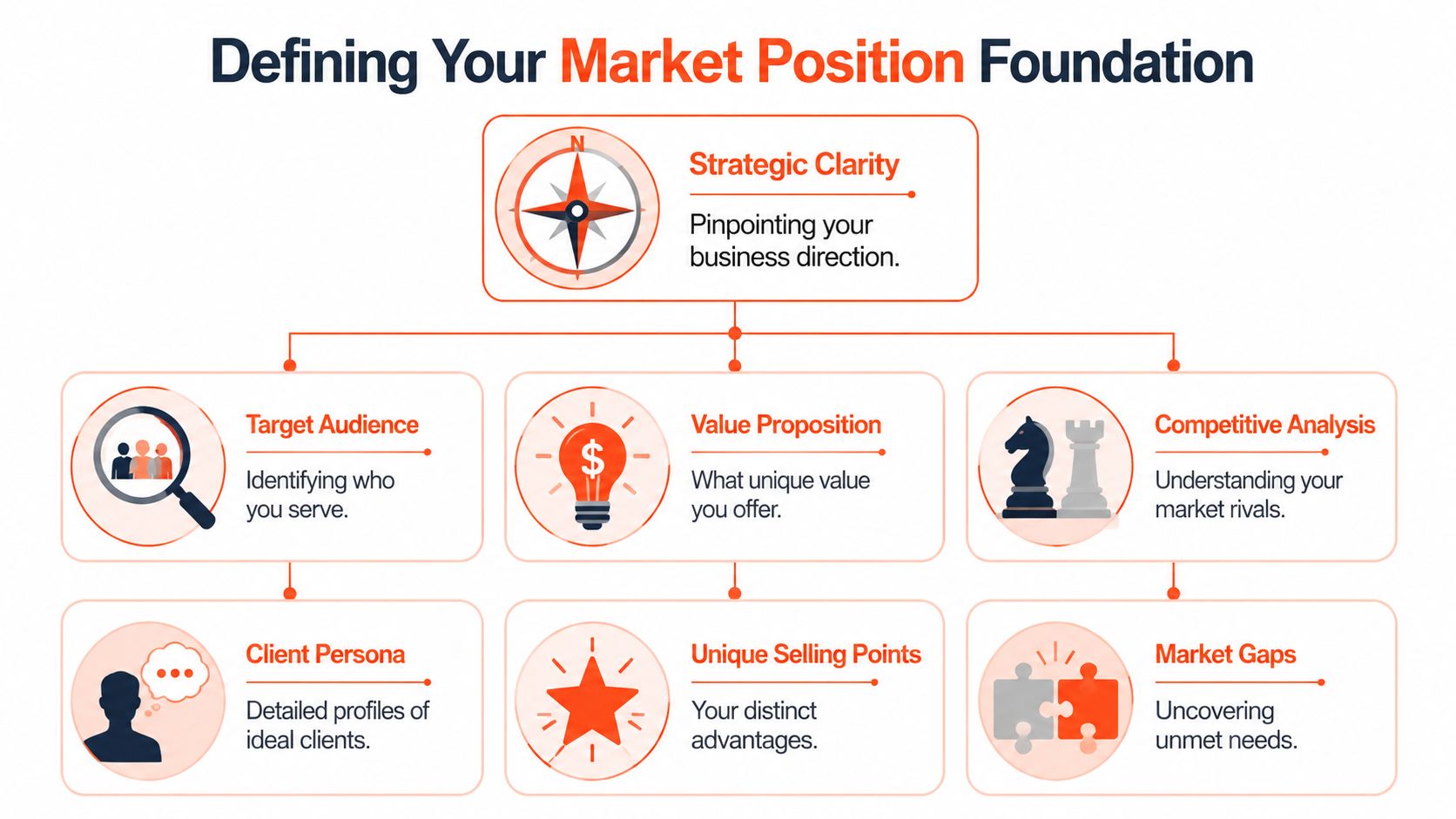
Most professional services firms think they have a lead generation problem when they have a positioning problem. They sound competent, experienced, and client-focused. Unfortunately, so does everyone else. Buyers don't respond to generic competence claims. They respond when they see a clear match between their problem and your expertise.
Why generalist messaging fails
If your homepage says you help businesses grow, improve operations, or realize potential, you've made the buyer do the hard work. They now have to guess whether you understand their situation.
That guess usually goes against you.
Professional services firms sell people and processes, so the messaging has to sound like the client experience. Content that uses candor and plain English builds trust more effectively because it mirrors how good advisors work, as noted in the Content Marketing Institute's guidance for professional services marketers.
Practical rule: If a prospect can swap your firm's name with a competitor's and the message still fits, the positioning is too broad.
A useful way to pressure-test your market stance is to review established strategy models like this guide to competitive advantage frameworks. It helps separate real differentiation from slogans.
A practical positioning framework
Strong positioning usually answers four questions.
| Question | What a strong answer looks like |
|---|---|
| Who is it for? | A clearly bounded client type, industry, role, or business stage |
| What problem do you solve? | A painful, expensive, urgent issue the buyer already recognizes |
| Why you? | A method, specialty, or perspective that changes the outcome |
| Why now? | A trigger that makes action timely |
Here's what that looks like in practice:
- Target buyer: Don't start with demographics. Start with commercial context. A fractional CFO for founder-led service firms has a different message than a finance advisor for multi-location healthcare groups.
- Problem framing: Name the operational pain, not a vague aspiration. Buyers react faster to risk, delays, missed revenue, compliance exposure, or stalled growth than to broad promises of transformation.
- Mechanism: Explain how you work. Your process is part of the product in professional services.
- Proof language: Use specifics in plain language. Skip inflated phrasing.
A lot of teams also benefit from codifying this into internal rules, especially once multiple people create content. A practical way to do that is to document voice, message hierarchy, visual consistency, and examples in a set of brand guidelines for content teams.
What to write down before you market anything
Before you publish, brief your own firm with these prompts:
- Best-fit clients: Which engagements produced strong outcomes, smooth collaboration, and healthy margins?
- Buying triggers: What usually happens right before someone hires you?
- Disqualifiers: Which prospects drain time, resist process, or push you into commodity pricing?
- Signature thinking: What do you believe that weaker competitors won't say clearly?
This work feels slower than posting on LinkedIn or launching a campaign. It's also the part that makes everything else cheaper, clearer, and easier to convert.
Attracting Clients Key Lead Generation Channels
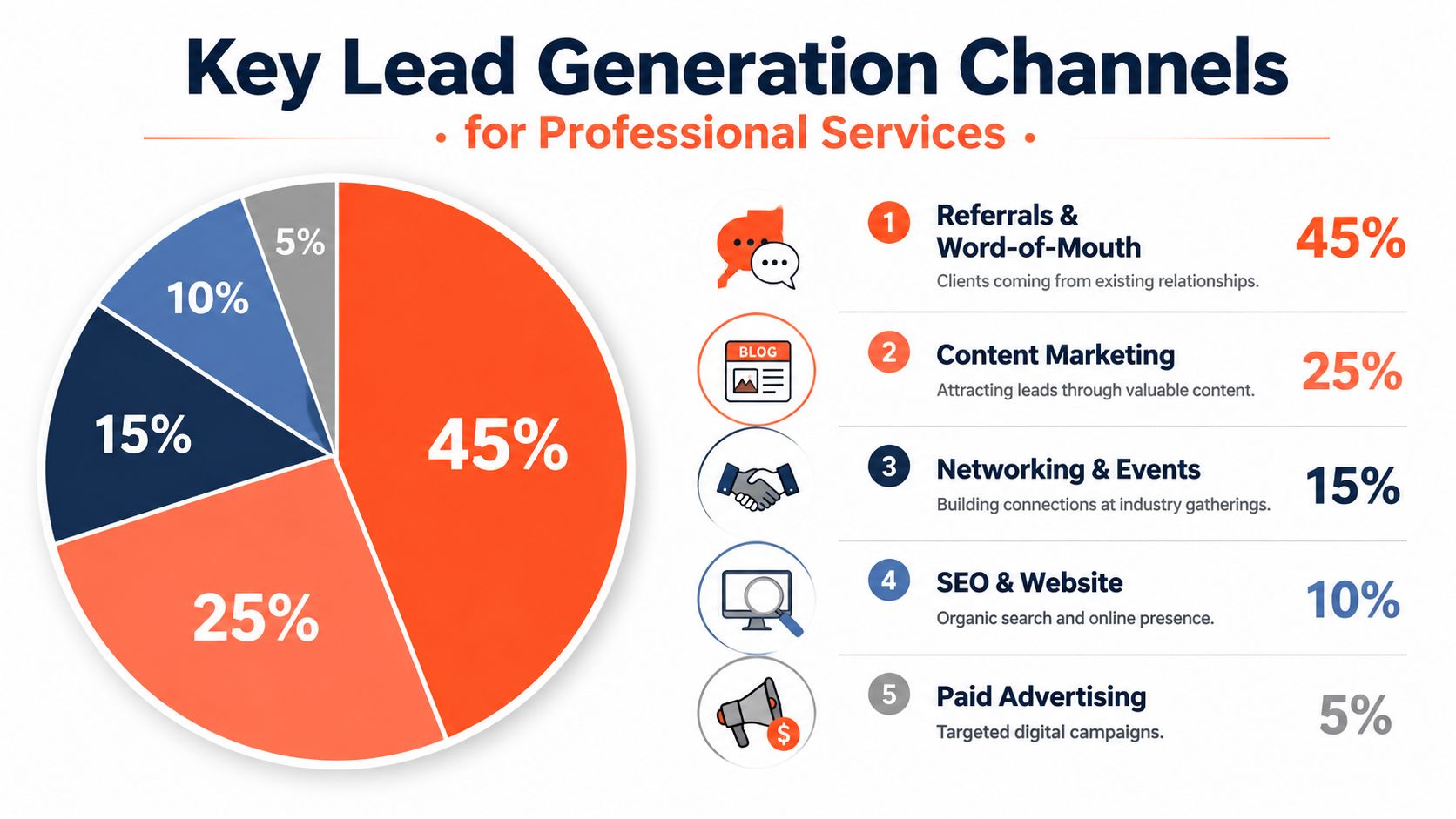
Once positioning is clear, channel decisions get simpler. You're no longer asking, “Where should we market?” You're asking, “Where do our buyers show intent, and which channels let us demonstrate expertise credibly?”
That distinction matters because professional services firms don't benefit equally from every acquisition tactic. Some channels generate attention but little trust. Others generate fewer leads but better conversations.
Where the strongest intent usually shows up
The channel mix that works best usually combines intent capture, authority building, and relationship-based outreach.
The most important quantitative signal here is conversion quality. In professional services, organic search converts at 12.3%, direct marketing channels average 16.8%, and email marketing averages 5.2%, according to Ruler Analytics' professional services marketing statistics. That lines up with what many firms see in practice. Search and direct outreach often attract buyers with clearer needs. Broad email campaigns often create activity without much movement.
How to balance channel mix
A useful way to think about channels is by job, not by trend.
| Channel | Best use | Common mistake |
|---|---|---|
| Organic search | Capture active demand | Publishing generic articles with no buyer intent |
| Direct outreach | Start targeted conversations | Sending templated messages to poorly matched prospects |
| Referrals | Convert trust faster | Treating referrals as automatic instead of managed |
| Build visible expertise | Posting shallow advice with no point of view | |
| Events and speaking | Compress trust | Attending without a follow-up system |
A few trade-offs matter.
- Organic search takes patience: It's slower to build, but it compounds because buyers often search when a problem becomes urgent. Good search content should answer decision-stage questions, not just educational ones.
- Direct outreach needs judgment: It works best when it's specific, researched, and tied to a visible trigger. High-volume outreach usually feels cheap in trust-sensitive categories.
- Referrals are strong but unstable: They close well when they happen, but they're not a system unless you track sources, stay in touch, and give people language for what you do.
- LinkedIn is a visibility layer: It rarely replaces deeper channels, but it can support all of them by making your expertise easier to inspect.
- Events can outperform their apparent scale: A workshop, panel, or niche roundtable often creates stronger conversations than a broad awareness campaign.
The best lead source is the one that matches buyer intent and your delivery model. Not the one that looks busiest in a dashboard.
If you're building social support around these channels, treat engagement as a distribution function, not a vanity exercise. Practical ideas like comment strategy, post formats, and response routines are covered in these social media engagement strategies for consistent visibility.
A realistic channel priority order
For most firms, this is a sensible order of operations:
- Refine offer and positioning first
- Build core website pages and search-driven content
- Create a focused direct outreach motion
- Strengthen referral follow-up
- Use LinkedIn to amplify thinking already proven elsewhere
That order keeps you from spending months on channels that broadcast weak positioning at scale.
The Content Engine A System for Repurposing and Distribution
Most firms don't have a content ideas problem. They have a production problem.
They know enough to publish. They've delivered workshops, client presentations, webinars, podcasts, memos, and strategy sessions full of usable insight. But turning that material into a steady stream of content takes time, design effort, editing discipline, and platform adaptation. That's where consistency usually breaks.
Start with one pillar asset
A better model is simple. Create one substantial asset, then split it into smaller pieces with distinct jobs.
That pillar asset could be:
- A webinar recording: Strong for extracting clips, objections, and practical takeaways.
- A podcast episode: Useful when your best thinking comes out in conversation. If you want examples of why audio works well upstream in B2B distribution, this piece on how podcasts transform B2B content is worth reviewing.
- A long-form article: Ideal when your service requires structured explanation.
- A client Q&A or workshop transcript: Often the richest source because it contains real language buyers use.
The gap isn't interest in repurposing. It's process. 73% of B2B marketers prioritize content repurposing, but only 12% of consulting firms have a formal framework to connect repurposed distribution to client acquisition costs, based on the verified data provided for this topic. That's why many firms stay busy making content while remaining unclear on commercial payoff.
Build a distribution workflow that survives busy weeks
The system has to be operational, not aspirational.
A practical weekly workflow looks like this:
Extract the thesis
Pull out one clear argument from the source material. Not “leadership matters.” Something sharper, such as why buyer hesitation often comes from unclear scope rather than price.Slice by format
Turn that thesis into multiple assets with different levels of depth:- Short post: One opinion or lesson
- Carousel: Step-by-step explanation
- Video clip: A concise spoken insight
- Quote graphic: One memorable line
- Email snippet: A trust-building takeaway with a link back to the main asset
Adapt by platform
LinkedIn rewards argument and clarity. Short-form video rewards immediacy. Email rewards relevance and timing. Don't paste the same copy everywhere.Add brand controls
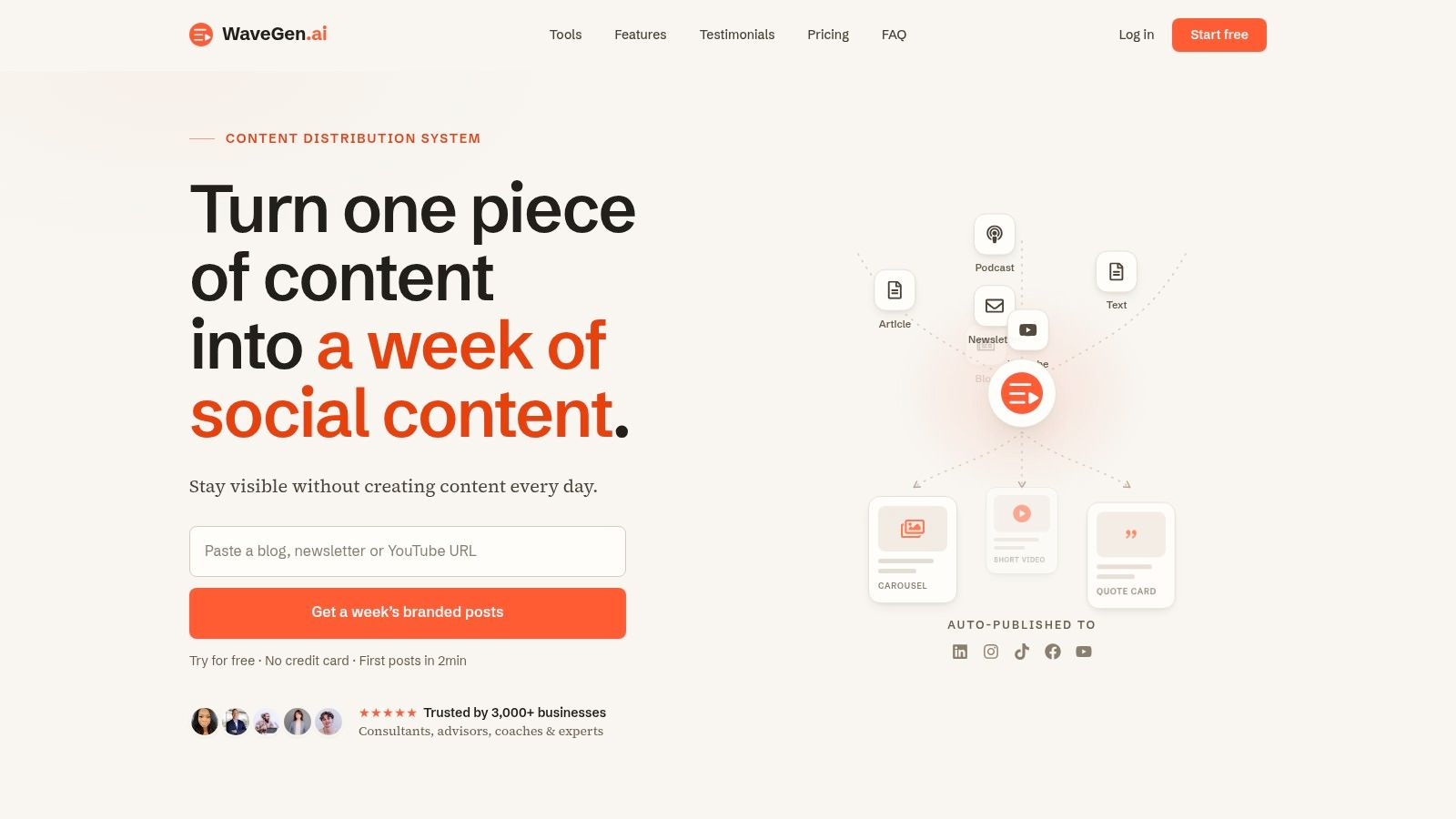
Voice drift ruins good repurposing. If three people write from different assumptions, your output starts to feel stitched together. Tools such as WaveGen.ai can help operationalize this by turning source content into platform-ready assets while applying preset brand kits, visual rules, and voice preferences from one place.
After you've built the workflow, support it with a format strategy. This resource on video content strategy for multi-channel distribution is useful when you're trying to turn one core message into assets that travel well.
A short demo helps make the workflow tangible:
What not to do
Content engines usually fail for familiar reasons:
- Too many fresh starts: Every post begins from a blank page.
- No source hierarchy: Teams create social content first instead of deriving it from stronger long-form thinking.
- No message discipline: The content sounds polished but disconnected from the actual service.
- No distribution cadence: Publishing depends on spare time, which means it disappears during delivery-heavy weeks.
Repurposing works when it preserves expertise, not when it dilutes it into generic motivational content.
The firms that sustain output don't create more ideas. They extract more value from ideas they've already earned.
The Sales Engine Connecting Marketing to The Client Lifecycle
Marketing gets attention. Sales turns attention into commitment. In professional services, those two functions are often handled by the same person, which is exactly why the handoff gets messy.
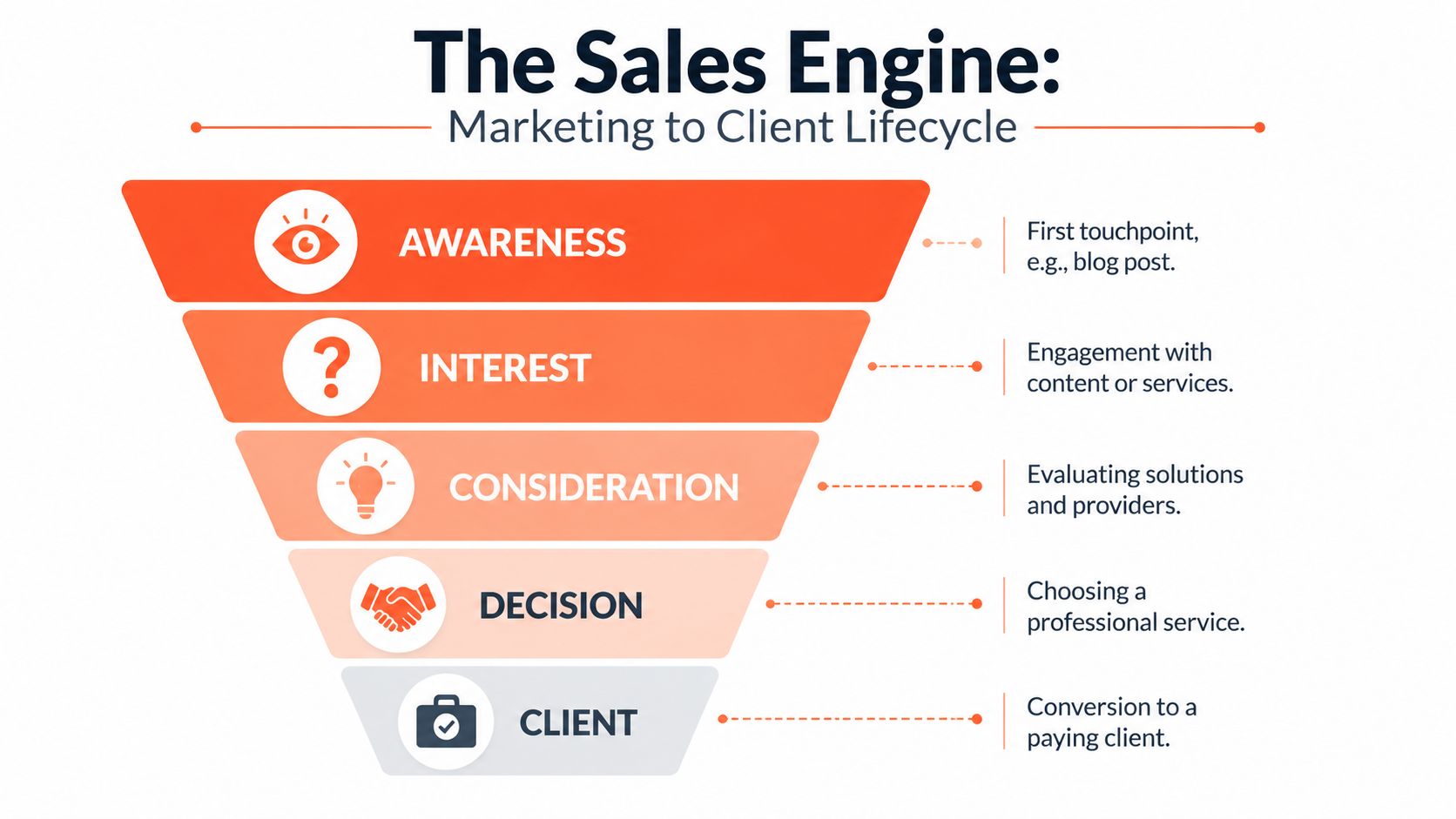
A prospect reads an article, follows you on LinkedIn, attends a webinar, and books a call. That sequence feels linear from your side. It doesn't feel linear from theirs. They're deciding whether you understand the problem, whether your process is credible, whether the chemistry is right, and whether the risk of choosing you feels acceptable.
What prospects need at each stage
Each stage of the lifecycle needs a different kind of proof.
| Stage | Prospect question | Best marketing support |
|---|---|---|
| Awareness | Do you understand this issue? | Strong point-of-view content |
| Interest | Are you relevant to my situation? | Niche-specific examples and clear service pages |
| Consideration | Can I trust your method? | Case studies, process explainers, FAQs |
| Decision | Is this worth the investment and risk? | Proposal support, scope clarity, objection handling |
| Client | Did I choose well? | Onboarding content and expectation setting |
Most firms overinvest in the first row and underinvest in the last three.
Sales assets that actually help close work
Buyers rarely need more slogans. They need confidence.
That confidence usually comes from a small set of practical assets:
- A sharp one-pager: Useful when a prospect needs to share your offer internally.
- A process brief: Helps buyers understand how the work will run, who does what, and what decisions they'll need to make.
- A case study with context: Not a victory lap. A decision aid.
- An objection library: Common concerns around timing, scope, resourcing, or internal alignment, answered clearly.
- A proposal that teaches: Good proposals don't just price the work. They clarify the path.
If a prospect reaches proposal stage but still seems uncertain, the missing piece is usually earlier trust-building, not late-stage persuasion.
Lead nurturing matters here, but it should feel like continued relevance, not pressure. If someone downloads a guide on a narrow issue, send them material related to that issue. If they attended an event about one service line, don't drop them into a broad generic sequence. Good nurturing feels like competent follow-up from someone who paid attention.
A clean sales engine also protects margins. When marketing has already educated the buyer, sales calls can focus on diagnosis, fit, and scope instead of basic credibility.
Measuring What Matters Revenue-Focused KPIs
A lot of professional services teams track what's easy to see. Website visits. Social impressions. Follower counts. Content output. Those numbers can be useful diagnostics, but they don't tell you whether marketing is improving the business.
The metrics that matter are the ones that connect visibility to revenue, cash flow, and operational quality.
The dashboard that matters
A practical measurement stack has two layers.
The first layer is commercial performance:
- Lead-to-client conversion rate: Are the opportunities entering your pipeline qualified?
- Sales cycle length: How long does it take to move from first meaningful contact to signed engagement?
- Client acquisition cost: What are you spending in time and money to win a new client?
- Average engagement value: Are you attracting the right size and type of work?
The second layer is operational finance. In professional services, weak cash discipline can erase the gains from solid marketing. The verified industry guidance here is straightforward: invoice reissue rate, billing cycle length, and days sales outstanding (DSO) are key metrics because they shape financial health and operating efficiency, as noted earlier in the referenced market analysis.
How to review results without getting lost in noise
A useful review process is monthly for channel performance and quarterly for business outcomes.
Use questions like these:
- Which channel generated the most sales conversations with credible fit?
- Which content topics repeatedly led to replies, referrals, or calls?
- Where are opportunities stalling?
If prospects reach proposal stage but hesitate, the issue may be scope clarity or stakeholder alignment rather than top-of-funnel volume. - What is marketing doing to cash flow?
If faster growth creates messy billing and delayed collection, the system isn't healthy yet.
For teams trying to tighten measurement discipline, this article on measuring digital marketing outcomes is a useful reference point for separating useful signals from reporting clutter.
A simple rule for KPI selection
If a metric can't change a decision, it doesn't belong on the main dashboard.
That means many vanity metrics should move to a secondary report. They're not useless. They're just not steering metrics. A managing partner doesn't need a weekly update on reach if the pipeline is full of poor-fit leads or if payment cycles are stretching.
Track metrics that help you reallocate budget, improve qualification, or speed up cash collection. Everything else is commentary.
The best marketing dashboard for a service firm is usually smaller than people expect, and more commercial than firms are used to.
Your Actionable Marketing Playbooks
Strategy only matters if it changes the weekly calendar. Most firms already know they should be more visible, more consistent, and more deliberate. The gap is execution under real constraints. Client work expands. Hiring gets delayed. Content sits in drafts. Good intentions disappear.
The way out is to use playbooks that are simple enough to run when things get busy.
The LinkedIn authority playbook
This works well for consultants, advisors, and founder-led firms whose expertise is a major buying factor.
- Pick one market point of view: Choose a topic where buyers regularly get bad advice or incomplete guidance.
- Create one post theme per week: Use recurring categories such as client mistakes, pattern recognition, operating lessons, or myth correction.
- Turn sales calls into prompts: Every objection, question, or hesitation can become content.
- Comment with intent: Don't just publish. Join conversations where your buyers and referral partners already spend time.
A good test is simple. After a month of posting, would a qualified prospect understand who you help, what you believe, and how you think? If not, the content is still too broad.
The pillar content to pipeline playbook
This playbook is better for firms with deeper expertise that needs more explanation before a buyer is ready to talk.
Start with one substantial monthly asset. A webinar, article, podcast, or workshop recap works well. Then turn it into a distribution packet:
- One long-form asset: The source of truth
- Several short posts: Each focused on one argument, mistake, or example
- One visual explainer: A carousel or document post
- One short video or audio clip: Useful for reach and familiarity
- One email follow-up: Sent to relevant contacts with a reason to care
The commercial discipline is to tag every inbound conversation by source. Not perfectly. Just consistently enough that you can tell which topics and formats attract serious buyers.
The referral follow-through playbook
Referrals are often treated as luck. They respond much better to structure.
Use a lightweight system:
List your best referrers
Former clients, complementary providers, peers, and collaborators.Define what they can refer
Don't assume they know. Give them a clear picture of trigger situations and ideal fit.Stay visible without asking constantly
Share relevant insights, useful content, and occasional updates on the kinds of problems you're solving.Close the loop
Thank them, update them appropriately, and make it easy to refer again.
This process sounds basic because it is. That's why it works. Most firms never operationalize it.
The standard to hold yourself to
A healthy professional services marketing system should do four things at once:
- Clarify who you serve
- Make expertise visible
- Support real sales conversations
- Tie activity back to revenue
If a tactic doesn't help one of those four, question it.
You do not need a louder marketing machine. You need a cleaner one. The firms that win consistently are usually not the ones doing everything. They're the ones repeating the right things with discipline.
If you already publish articles, newsletters, podcast scripts, webinar transcripts, or client education content, WaveGen.ai can help turn that source material into on-brand social assets for ongoing distribution. It's a practical fit for professional services teams that want a steadier presence without rebuilding every post from scratch.
professional services marketing
consulting marketing
agency marketing
lead generation
content repurposing
Turn this kind of writing into a week of social content.
Paste a blog post, newsletter, or rough draft — WaveGen turns it into publish-ready carousels, captions, and slideshows for every channel.
No credit card · First posts in 2min