June 15, 2026
15 min read
Financial Advisor Branding: Define Your Niche & Attract
Master financial advisor branding to define your niche, build compliant identity, and attract ideal clients. Get our step-by-step guide.

Most advice about financial advisor branding is shallow. It tells you to pick colors, refine your logo, and polish your headshot as if branding lives in a style guide.
That misses the core problem. Advisors don't operate in a free-form consumer category. They work in a regulated environment where claims, testimonials, comparisons, performance references, and even casual social posts can trigger review. A brand that looks good but can't survive compliance isn't a brand system. It's rework.
The practical standard is higher now anyway. In a 2025 advisor research discussion, 55% of advisors said their website was more important than their office for marketing, compared with 20% who chose the office, according to this 2025 advisor branding discussion on YouTube. Credibility has shifted online. Prospects often form an opinion from your website, search presence, and content before they ever speak with you.
That changes the job of branding. Financial advisor branding isn't decoration. It's the disciplined process of deciding who you serve, what you stand for, how you communicate it, and how to do all of that in a way your compliance team can approve.
Table of Contents
- Your Brand Is More Than a Logo It Is Your Reputation
- Define Your Unbeatable Brand Position
- Develop a Compliant Visual and Verbal Identity
- Build Your Content Engine to Prove Expertise
- Launch a Consistent Multi-Channel Presence
- Measure Brand Performance and Business Impact
- From Branding Plan to Business Growth
Your Brand Is More Than a Logo It Is Your Reputation
A logo helps with recognition. It doesn't create trust on its own.
Prospects judge your firm through a chain of small signals. They read the homepage headline. They look at your LinkedIn bio. They notice whether your proposal matches your website. They compare your tone in email with your tone in public posts. If those pieces feel disconnected, your brand feels weak even if the design is polished.
That's why reputation matters more than aesthetics in financial advisor branding. Your brand is the accumulated impression created by your message, your delivery, your cadence, and your consistency. In a crowded advisory market, generic positioning gets ignored fast. The firms that stand out usually aren't louder. They're clearer.
Practical rule: If a prospect removes your logo from a page and your message could belong to any other advisor, you don't have a brand position yet.
Compliance makes this stricter, not easier. Plenty of branding advice assumes you can make bold promises, use social proof freely, and write with loose, dramatic language. Advisors know that's not how things play out in practice. The useful question isn't "How can I sound bigger?" It's "How can I sound distinct, credible, and approvable at the same time?"
That usually requires a shift in mindset:
- Stop treating branding as a design project. Design supports the brand. It doesn't define it.
- Stop copying consumer marketing language. Phrases like "maximize wealth" or "achieve financial freedom" are so broad they say nothing.
- Stop relying on personality alone. Being likable helps, but a likable advisor with vague messaging still looks interchangeable.
- Start building an operating system. Positioning, message rules, visual standards, and approval workflows need to work together.
The firms that execute this well don't look flashy. They look coherent. That coherence lowers friction for prospects and for internal review. It also makes every future marketing asset easier to produce.
Define Your Unbeatable Brand Position
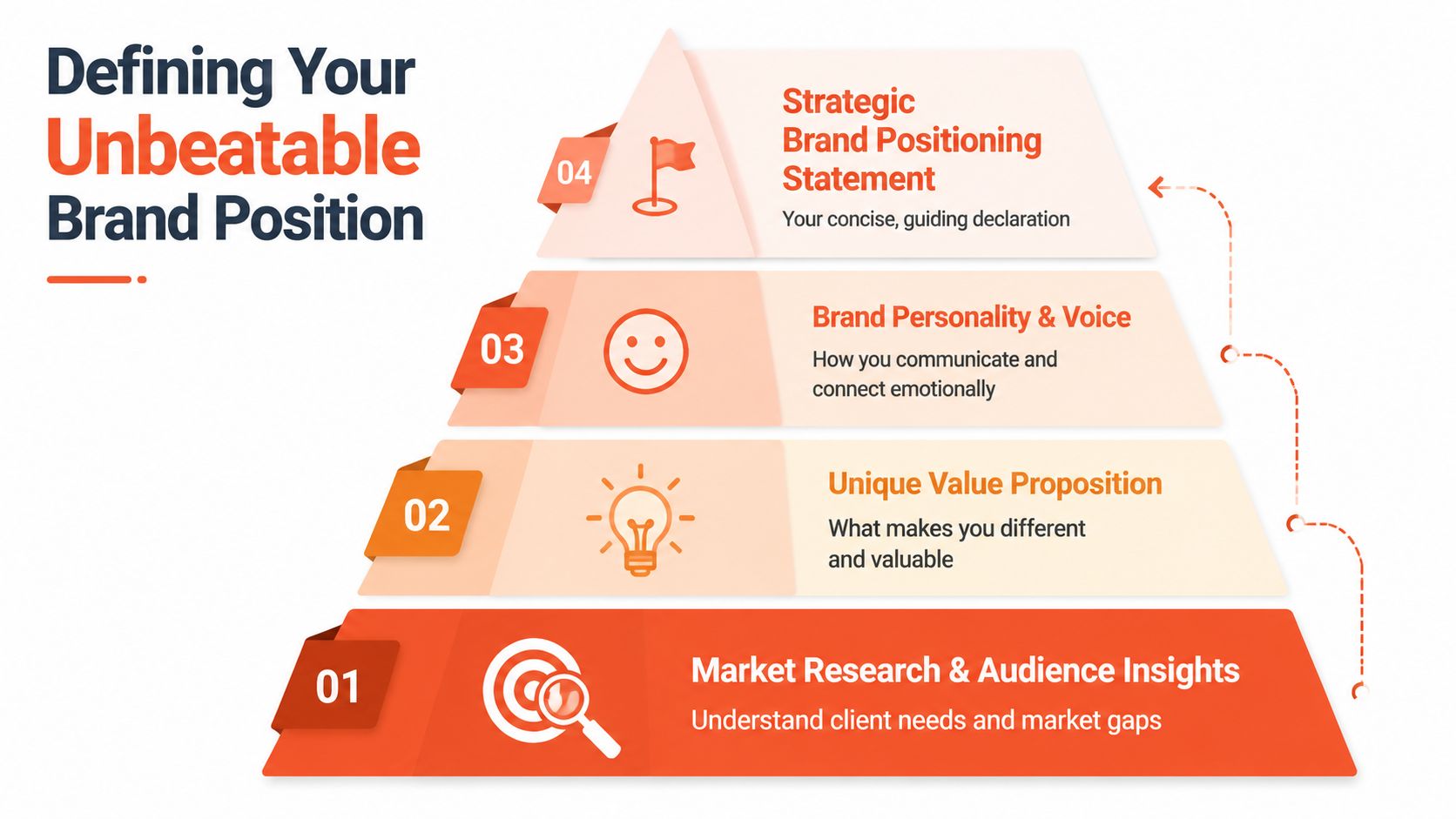
A brand position isn't a slogan. It's the strategic answer to one question: why should this specific type of client choose you instead of another advisor?
A practical methodology for financial advisor branding is to define a narrow audience, analyze client psychology, identify real competitors, and translate those differentiators into a messaging framework and visual identity, as outlined in this advisor brand positioning methodology from ProperExpression.
Narrow the audience until the message gets sharper
Most advisors define their audience too broadly. "Retirees." "Business owners." "High-net-worth families." Those labels are market categories, not positioning.
A useful audience definition includes context, pressure, and decision criteria. For example, a business owner preparing for a sale has different anxieties than a business owner optimizing annual tax decisions. A physician with irregular compensation has different planning concerns than an executive with concentrated stock. If your audience definition doesn't change your message, it isn't specific enough.
Use this filter:
- What financial situation creates urgency? Retirement transition, practice sale, sudden liquidity, inheritance planning, cross-border complexity.
- What emotional friction do they feel? Overwhelm, mistrust, fear of making an irreversible mistake, frustration with fragmented advice.
- How do they evaluate advisors? Responsiveness, planning depth, tax coordination, education style, family communication, simplicity.
- What language do they use? Not industry jargon. Their words in calls, emails, and discovery meetings.
The strongest positioning often comes from client psychology, not demographics. Age and asset level matter, but they rarely create memorable messaging on their own.
Study the competitors who actually take your prospects
Advisors waste time benchmarking against every firm in town. That's not strategy. You need to review the firms a prospect is realistically comparing against when deciding whether to book a call.
Build a short competitive sheet with columns like these:
| Category | What to review |
|---|---|
| Message | Homepage headline, bio language, offer framing |
| Proof style | Educational content, process clarity, specialization cues |
| Tone | Formal, conversational, technical, family-oriented |
| Friction | Hard-to-find contact info, vague process, generic copy |
| Compliance-safe differentiation | Areas where you can be clearer without making risky claims |
This exercise usually reveals a useful truth. Most advisors sound the same because most websites say some version of "personalized planning," "fiduciary advice," and "helping you reach your goals." Those phrases may be true, but they don't create separation.
The easiest way to sound different is to stop describing your service category and start describing the exact problem you solve.
Once you've identified the gap, write a positioning statement for internal use. Keep it plain. It should identify the audience, the problem, your approach, and why that approach fits them. This isn't ad copy. It's the source document that keeps your website, proposals, speaking topics, and social content aligned.
A strong position also makes compliance easier. Specific, process-based language is often safer than broad superiority claims. "We help physicians coordinate cash flow, equity compensation, and retirement planning" is clearer and more defensible than "We deliver unmatched financial guidance."
Develop a Compliant Visual and Verbal Identity
At this stage, many firms either become memorable or become generic. Once the positioning is set, you need to express it in ways that feel professional, distinct, and reviewable.
The underserved question in financial advisor branding is what survives compliance review and still differentiates the advisor, as emphasized in this advisor branding perspective from AssetMark. That's the right standard.
What compliance usually rejects
Most compliance friction comes from predictable mistakes, not complex strategy. Advisors try to sound persuasive and drift into risky language.
Common examples include:
- Implied guarantees: "Confidence in any market" or "retire without worry"
- Unqualified superlatives: "Best-in-class advice" or "the premier advisor for executives"
- Unclear testimonials or endorsements: especially when context and approval rules aren't handled properly
- Performance-adjacent storytelling: client anecdotes that imply outcomes without enough guardrails
- Overpersonalized social posts: content that sounds casual but makes regulated claims in shorthand
The answer isn't to flatten your message until it sounds sterile. The answer is to build language patterns that communicate value through process, philosophy, and specialization.
For example, instead of writing "We get clients better outcomes," write about how you plan, what you coordinate, what decisions you help simplify, and what type of client your process is built for. That language is more useful to prospects anyway.
Build a reusable identity system
A compliant identity should be modular. That means your team can reuse approved components rather than reinvent each post, page, and proposal from scratch.
Create a brand system with these parts:
- Visual standards: logo use, color palette, typography, image style, chart style, slide templates, headshot rules
- Message hierarchy: core firm statement, service summaries, niche-specific talking points, approved disclaimers
- Tone rules: plain English, level of formality, phrases to avoid, examples of acceptable educational framing
- Proof framework: what kinds of stories, insights, credentials, and process explanations are allowed
- Review workflow: who drafts, who checks, who approves, and what gets archived
If you haven't documented this yet, a practical place to start is with formal brand guidelines for content and design systems. The point isn't to create a thick PDF that nobody uses. The point is to reduce interpretation.
The following works in practice:
Use specificity instead of hype. A narrow audience, a clear planning philosophy, and repeatable phrasing do more for trust than dramatic wording ever will.
Advisors often think verbal identity means finding a clever tagline. It doesn't. It means creating a consistent way to explain who you help, how you work, and what clients can expect from the relationship. When that language is approved once and reused often, your brand gets stronger with every touchpoint.
Build Your Content Engine to Prove Expertise
Branding creates expectation. Content proves you can deliver on it.
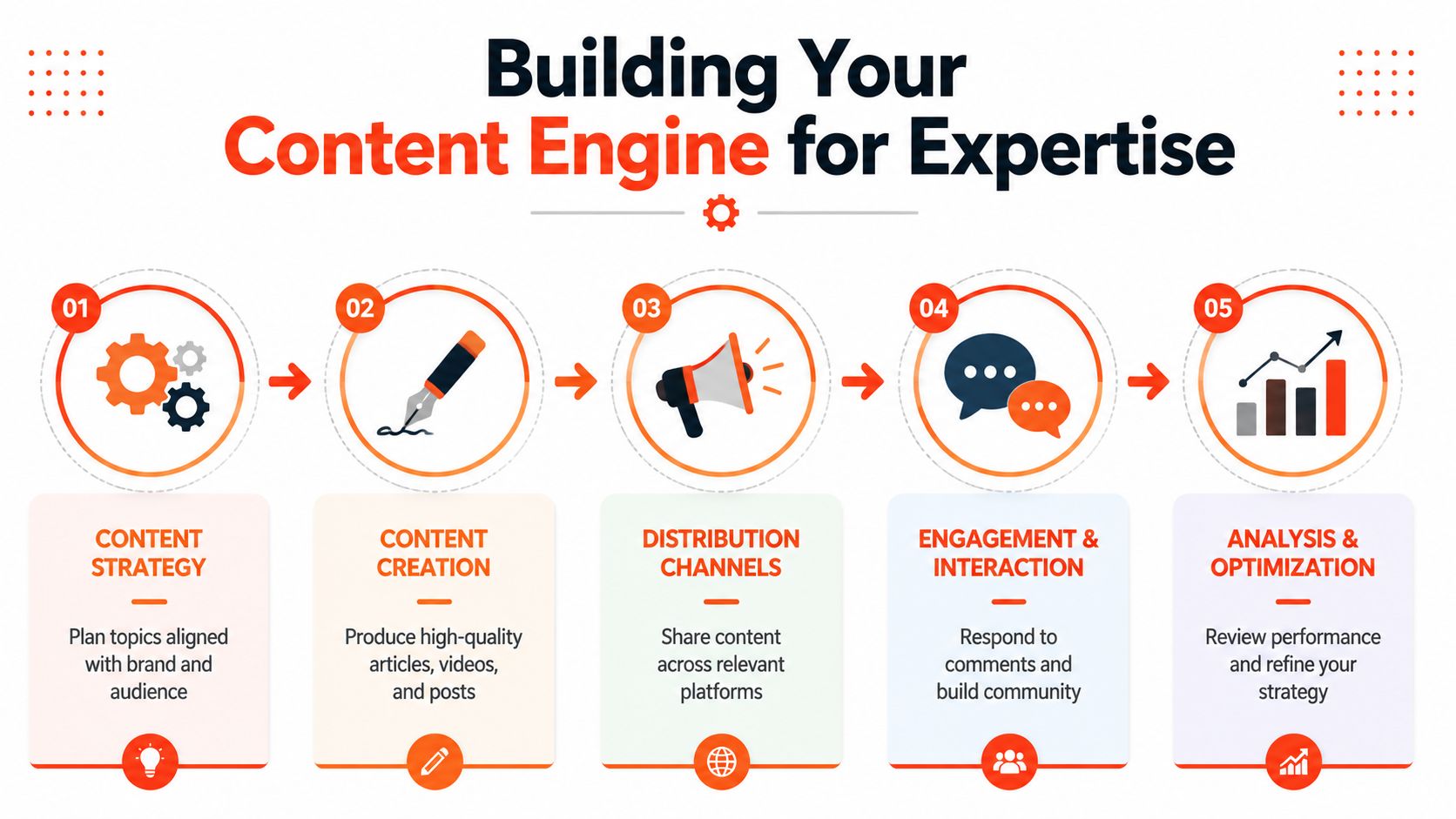
That matters because growth doesn't come from random posting. A 2026 marketing analysis reported that advisors with a defined marketing strategy onboard 50% more clients, while 31% of surveyed advisors planned to increase their marketing budgets, according to this 2026 financial advisor marketing analysis from Alden Investment Group. The lesson isn't "post more." It's "operate from a defined system."
A simple visual helps frame that system.
Start with one cornerstone asset
The most efficient content engine starts with a substantial piece of thinking. That could be a webinar, a detailed article, a market commentary, a retirement checklist, or a planning guide for your niche.
The key is depth. A weak source asset creates weak repurposed content. If the original piece doesn't contain a clear point of view, every derivative post will sound like a generic summary.
A strong cornerstone asset usually includes:
- One audience: not your entire market
- One core problem: such as liquidity-event planning or retirement income coordination
- One planning lens: your method, framework, or decision sequence
- Several extractable moments: clear lines, examples, objections, and FAQs that can stand alone
For advisors who want a reference workflow, an editorial calendar template for recurring content production helps tie these larger assets to weekly publishing without starting from zero each day.
This embedded example shows the kind of educational video format that can anchor broader content production:
Repurpose without sounding repetitive
Repurposing doesn't mean copying the same paragraph into five channels. It means extracting different angles from the same underlying expertise.
A single cornerstone piece can become:
- A short LinkedIn post focused on a common mistake
- A carousel that walks through a planning sequence
- A video clip answering one objection
- An email that reframes the issue in a timely context
- A quote card built around a single strong sentence
- A follow-up article expanding one subsection
What doesn't work is platform dumping. If you post the same caption, the same image, and the same framing everywhere, your presence feels automated in the wrong way. The message should stay consistent. The packaging should adapt.
A useful editorial standard is to organize content into three buckets:
| Bucket | Purpose |
|---|---|
| Insight | Teach how you think |
| Relevance | Connect expertise to current client concerns |
| Trust | Show process clarity and professional steadiness |
That mix keeps your brand from sounding either too academic or too promotional. More importantly, it gives compliance a clearer structure for review because the content categories are defined before anyone starts writing.
Launch a Consistent Multi-Channel Presence
A brand only compounds if prospects encounter the same firm, the same message, and the same level of polish across channels. If your website sounds specialized, your LinkedIn sounds generic, and your proposals look like they came from another company, trust drops.
Brand consistency requires keeping the same logo, color palette, typography, and messaging across websites, social media, proposals, and client communications, according to this financial advisor branding guidance from Alden Investment Group. That's not cosmetic. Recognition comes from repetition.
Audit every client-facing touchpoint
Most advisors think about branding in public channels only. That leaves a lot of leakage.
Review these assets in one pass:
- Website pages: homepage, about page, niche pages, contact page, advisor bios
- LinkedIn presence: headline, featured section, banner image, about summary, post style
- Email system: signature, newsletter template, calendar invites, follow-up messages
- Sales materials: proposals, one-pagers, slide decks, meeting agendas
- Client communication assets: review decks, checklists, onboarding documents, FAQs
When you audit them together, inconsistency becomes obvious. Maybe the homepage speaks to physicians, but the proposal language reverts to broad retirement planning. Maybe the website looks modern, but the slide deck still uses old fonts and stock visuals. Prospects notice these mismatches even if they can't articulate them.
Use tools to reduce manual inconsistency
Consistency usually breaks for operational reasons. Teams are busy. Different people make assets. Old templates stay in circulation. Social content gets built quickly and drifts off-brand.
Systems provide valuable support. Advisors looking for channel-specific ideas can review social media approaches for financial advisors. For production, some teams use Canva templates, shared Google Drive libraries, and approval checklists. Others use platforms that store a reusable brand kit and generate channel-ready assets from long-form content. WaveGen.ai is one example. It lets users set colors, fonts, logo, and voice once, then create on-brand social assets from a source article, newsletter, or transcript.
That kind of setup doesn't replace strategy. It reduces execution drift.
A consistent brand presence isn't built by reminding people to "stay on brand." It's built by making the branded option the easiest option.
The operational goal is simple. A prospect should move from your site to your email to your social profile to your presentation deck and feel the same firm in every place.
Measure Brand Performance and Business Impact
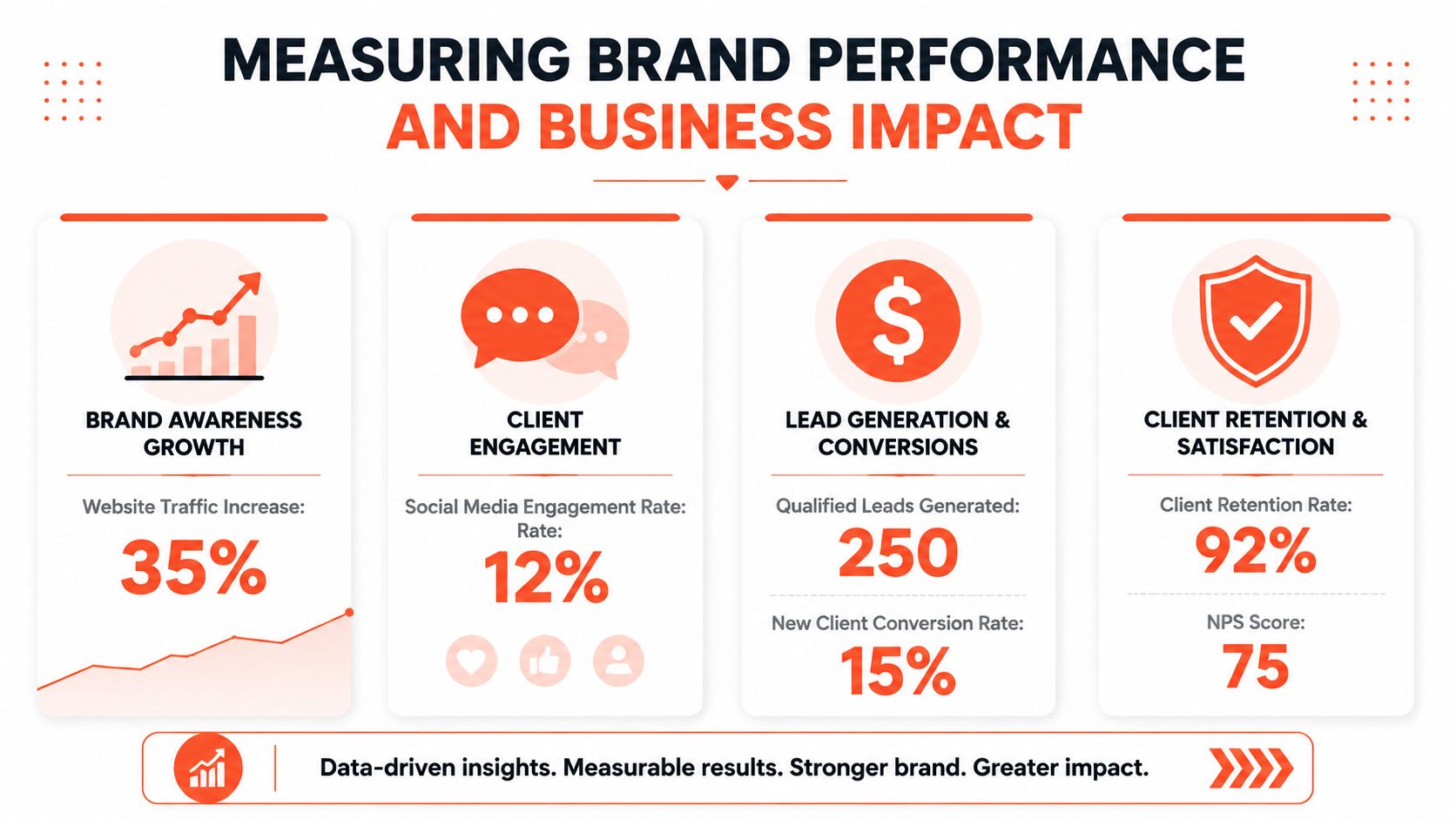
A financial advisor brand is working when it changes business outcomes you can see in CRM data, call notes, and close rates. If measurement starts and ends with impressions, likes, or follower growth, you are tracking activity, not brand performance.
Digital presence shapes trust before anyone books a call. As noted earlier, advisor research has already made that point. The practical question is whether your brand is making the first conversation easier, attracting better-fit prospects, and reducing friction in the sales process without creating compliance risk.
Track pre-meeting signals that indicate trust and fit
Start with the points where brand shows up before revenue does.
- Inquiry quality: Review form fills, email replies, and booked-call notes. Strong branding shows up when prospects reference your niche, your planning approach, or a specific piece of content.
- Page-level conversion intent: Measure which pages produce real contact actions. A niche service page that gets fewer visits but more qualified inquiries usually matters more than a broad page with higher traffic.
- Discovery call efficiency: Track whether first calls spend less time clarifying what you do and more time discussing the prospect's situation. That is often one of the clearest signs that your market position is landing.
- Right-audience engagement: Comments, shares, and saves only matter if they come from target clients, centers of influence, or referral partners. Broad engagement from the wrong audience can look good in a report and still produce weak pipeline.
Search behavior is useful here too. Branded search, niche-specific search queries, and repeat visits to educational content often signal that your positioning is sticking.
Build a dashboard your team will actually use
Keep the dashboard simple enough to survive compliance review, team turnover, and monthly reporting. A spreadsheet is fine. A basic reporting layer in your CRM is fine. What matters is consistent definitions.
Track four groups:
| Group | What to monitor |
|---|---|
| Visibility | Branded search interest, visits to key pages, profile views |
| Engagement | Time on cornerstone content, replies from target prospects, meaningful saves or shares |
| Pipeline quality | Inquiry relevance, discovery call fit, referral alignment |
| Revenue linkage | Opportunities influenced by content, closed clients tied to branded channels |
Review the numbers monthly, then examine the underlying evidence. Read inquiry notes. Listen to sales call recordings if your process allows it. Compare what prospects say they expected with how your brand presents the firm.
This is also where compliance constraints need to stay in view. Sometimes a brand underperforms because the message is weak. Sometimes the issue is that approved language is so generic that nothing distinctive survives review. Those are different problems. One calls for sharper positioning. The other calls for tighter collaboration between marketing, advisors, and compliance so approved claims, proof points, and phrasing still sound specific enough to matter.
If content output is steady but lead quality stays soft, revisit position and messaging. If positioning is clear but execution keeps drifting across channels, fix the workflow and templates. Useful brand measurement helps you find the bottleneck early and adjust something operational, not admire a dashboard no one trusts.
From Branding Plan to Business Growth
Financial advisor branding works when it's treated as a system. The sequence matters. Position clearly. Build a verbal and visual identity that compliance can live with. Turn that identity into a content engine. Distribute it consistently across every touchpoint. Measure whether it improves trust, fit, and pipeline quality.
Advisors often look for shortcuts. A homepage rewrite. A new logo. A burst of social activity. Those can help, but only if they sit on top of a clear position and a repeatable operating process.
The practical advantage of doing this well is simple. You become easier to understand, easier to trust, and easier to remember. In a regulated category, that's a serious competitive edge.
Start with the part most firms skip. Write down exactly who you serve, what problem you solve, and which claims, phrases, and proof points your compliance process will allow. Once that foundation is real, the rest of the brand gets easier to build and much easier to sustain.
If you're publishing articles, newsletters, podcast scripts, or video transcripts and need a practical way to turn them into a steady stream of on-brand social assets, WaveGen.ai can support that workflow. It converts one source asset into channel-specific content while preserving a configured brand kit, which helps advisors and marketing teams maintain consistency without rebuilding every post manually.
financial advisor branding
advisor marketing
brand strategy
client acquisition
wealth management branding
Turn this kind of writing into a week of social content.
Paste a blog post, newsletter, or rough draft — WaveGen turns it into publish-ready carousels, captions, and slideshows for every channel.
No credit card · First posts in 2min